
Deck Financing Options in Ontario: Loans, HELOC, and More
Compare deck financing options in Ontario: HELOCs, home equity loans, personal loans, and credit cards. Find the best way to pay for your deck project.
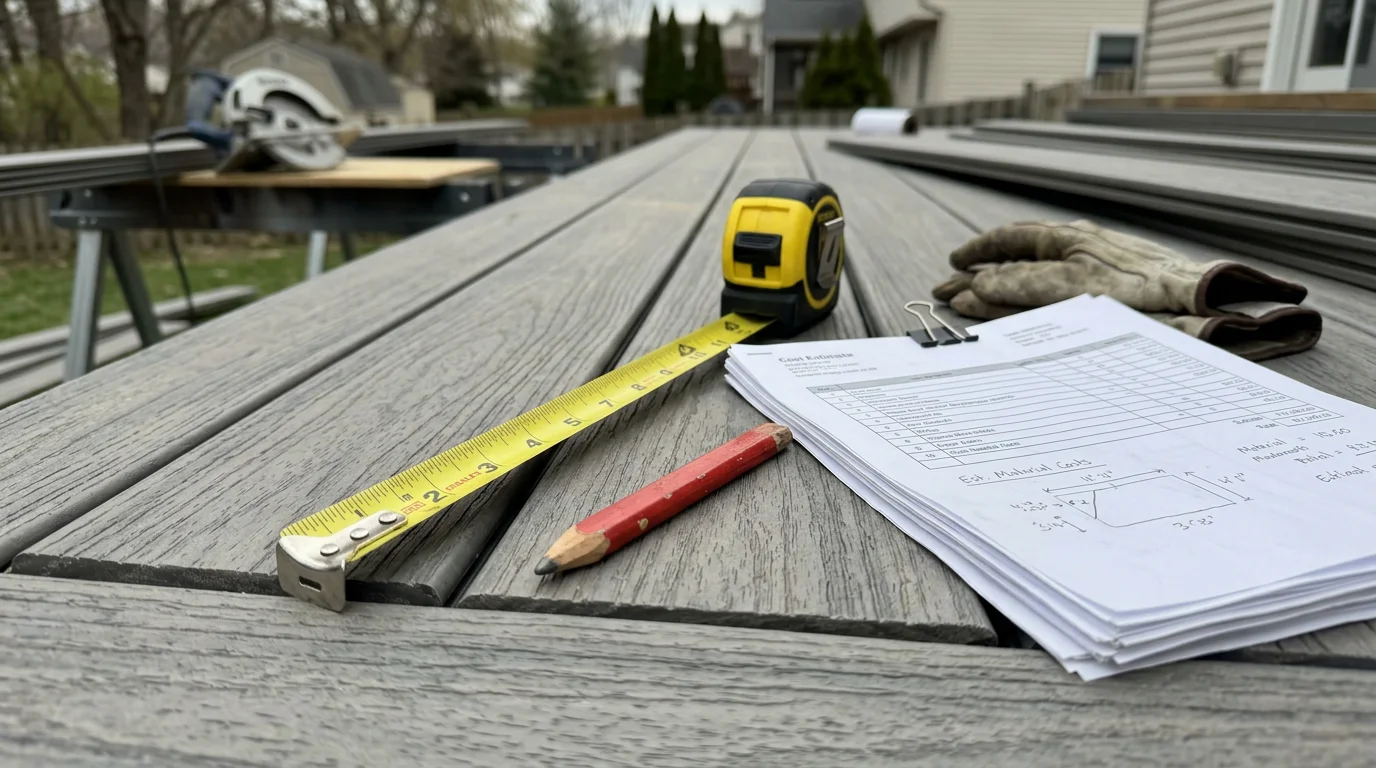
A 10x16 pressure-treated deck costs $7,200–$10,400 installed in Kitchener-Waterloo-Cambridge. A 12x20 composite deck runs $15,600–$22,800. Most homeowners don't have that cash sitting in a savings account.
You need financing. Here's how Ontario homeowners actually pay for deck projects, what each option costs, and which one makes sense for your situation.
Home Equity Line of Credit (HELOC)
A HELOC lets you borrow against the equity in your home. Most Canadian banks allow you to borrow up to 80% of your home's appraised value minus what you owe on your mortgage.
🏗️ Planning a deck project?
Get a free manual project review, or visualize your dream deck with AI before requesting quotes.
If your home is worth $700,000 and you owe $400,000, you can access up to $160,000 through a HELOC ($700,000 × 0.80 - $400,000).
HELOC Interest Rates (2026)
- Prime + 0.5% to Prime + 1% for most banks
- Prime rate in Canada: 6.95% (as of February 2026)
- Your rate: 7.45% to 7.95% variable
- Interest-only payments while you borrow
- Pay back the principal whenever you want
Example: Borrow $18,000 for a composite deck at 7.5% interest. Your monthly interest-only payment is $112.50. You can pay down the principal on your own schedule.
Why HELOCs Work for Deck Projects
You only pay interest on what you use. If your deck quote comes in at $15,000 but you budgeted $20,000, you only borrow $15,000.
You can draw funds as the project progresses. Pay the deposit (typically 10-30%), then draw more when the framing inspection passes, and the final amount at completion.
HELOCs have no set repayment term during the draw period (usually 10-20 years). You control how aggressively you pay it down.
HELOC Downsides
Variable rates mean your interest cost can jump if the Bank of Canada raises rates. Your 7.5% rate could become 8.5% or higher.
Setup costs run $300–$1,200 for appraisal, legal fees, and registration. Some banks waive these fees if you maintain a minimum balance or bundle other products.
You're putting your home as collateral. Miss payments and you risk foreclosure, though this is rare for homeowners with steady income.
Home Equity Loan (Second Mortgage)
A home equity loan gives you a lump sum with a fixed interest rate and fixed monthly payments over a set term (typically 5-15 years).
Home Equity Loan Rates (2026)
- 6.5% to 9.5% fixed for 5-10 year terms
- Higher than HELOC rates because they're fixed
- Monthly payments include principal + interest
- Predictable payment schedule
Example: Borrow $20,000 at 7.5% fixed for 7 years. Your monthly payment is $295. Total interest paid: $4,860.
When to Use a Home Equity Loan
You know your exact project cost from a signed contract and don't want rate uncertainty.
You want forced discipline with fixed payments. HELOCs let you pay interest-only indefinitely; home equity loans make you pay down principal every month.
You're doing a full deck replacement with a scope-creep risk. Lock in your budget with a fixed loan amount.
Home Equity Loan Downsides
You pay interest on the full amount from day one, even if your contractor hasn't completed the work.
Less flexibility than a HELOC. You can't re-borrow funds you've paid back without applying for a new loan.
Personal Loan or Line of Credit
Unsecured personal loans don't require home equity. You borrow based on income and credit score.
Personal Loan Rates (2026)
- 8% to 16% depending on credit
- Excellent credit (750+): 8–10%
- Good credit (650-749): 10–13%
- Fair credit (600-649): 13–16%
- Terms: 1–7 years typical
- Fixed monthly payments
Example: Borrow $15,000 at 11% for 5 years. Monthly payment: $326. Total interest: $4,560.
When Personal Loans Make Sense
You don't have sufficient home equity or you don't want to use your home as collateral.
You need money fast. Personal loans can fund in 1-3 business days. HELOCs take 2-4 weeks for appraisal and approval.
Your deck project is under $15,000. Most banks cap unsecured personal loans at $50,000, but the sweet spot for good rates is under $20,000.
Personal Loan Downsides
Higher interest rates than secured options. You're paying a premium for not using your home as collateral.
Shorter terms mean higher monthly payments. A $15,000 loan at 11% for 3 years costs $492/month.
Credit Cards and Promotional Financing
Some deck contractors accept credit cards. Some building material suppliers offer promotional financing on large purchases.
Credit Card Strategy
0% APR balance transfer cards give you 12-18 months interest-free if you transfer a balance from another card or make purchases during the promotional period.
Example: Put a $12,000 deck on a 0% APR card for 15 months. Pay $800/month and you're done before interest kicks in. Miss the deadline and you're paying 19.99% to 24.99% on the remaining balance.
Home Improvement Store Financing
Home Depot and Lowe's offer no-interest financing for 6-24 months on purchases over certain thresholds (often $299 or $999).
Buy your own materials (if you're DIYing or have a contractor who allows it) and finance them through the store. A $4,500 decking material order could qualify for 12 months no interest.
Read the fine print: "No interest if paid in full" promotions charge retroactive interest from the purchase date if you don't pay off the full balance before the term ends. That retroactive rate is often 28.99% to 31.99%.
Credit Card Downsides
High risk if you can't pay the balance before the promotional period ends. $15,000 at 28.99% retroactive interest costs you an extra $4,348.50 in year one.
Credit utilization impacts your credit score. Maxing out a $15,000 limit can drop your score 30-50 points temporarily.
Government and Utility Rebates
Ontario doesn't offer broad deck-specific financing, but some programs reduce your net project cost.
Energy Efficiency Rebates
If you're adding a pergola or covered deck with integrated insulation that reduces home energy loss, you might qualify for Canada Greener Homes Loan (up to $40,000 interest-free).
Realistically, this doesn't apply to most deck projects. You'd need to combine the deck with other qualifying renovations (insulation, windows, HVAC upgrades).
Municipal Property Tax Programs
Some Ontario municipalities offer Property Assessed Clean Energy (PACE) financing for exterior improvements that increase property value. Kitchener, Waterloo, and Cambridge don't currently offer PACE programs for decks, but check your municipality's website annually.
Contractor Financing
Some larger deck builders partner with third-party lenders to offer financing directly.
How Contractor Financing Works
You apply through the contractor. The lender (often Financeit, Fairstone, or LendCare in Canada) approves you based on credit score.
Rates: 7.99% to 19.99% depending on credit and term.
Terms: 6 months to 10 years.
Convenience: One-stop application. Contractor gets paid immediately; you make monthly payments to the lender.
Contractor Financing Downsides
Markup potential: The contractor may pad the quote to cover lender fees (typically 3-8% of the loan amount). You won't see this explicitly.
Worse rates than HELOCs: You're paying for convenience. A contractor-offered loan at 12.99% costs you more than a HELOC at 7.5%.
Limited shopping: You're locked into the contractor's lending partner. You can't shop around for better rates without switching contractors.
Cash Savings
Paying cash avoids interest entirely. A $16,000 deck costs you $16,000, not $16,000 + $3,500 in interest.
Delay and Save
If your deck isn't urgent, delay the project 6-12 months and save aggressively. Set up automatic transfers to a high-interest savings account (4.5% to 5.5% in 2026 from EQ Bank, Tangerine, or Wealthsimple).
Save $1,500/month for 12 months and you have $18,000 plus ~$450 in interest.
Off-Season Discounts
Build in fall or early spring when contractors offer 5-15% discounts to fill their schedules. A $16,000 summer deck quote might drop to $13,600 in November.
Combine savings with off-season pricing and you reduce both your principal and your opportunity cost.
Comparing Total Costs
Here's what a $18,000 deck costs with different financing options over 5 years:
| Option | Rate | Monthly Payment | Total Interest | Total Cost |
|-------------------------|----------|---------------------|--------------------|----------------|
| Cash | 0% | $0 | $0 | $18,000 |
| HELOC (interest-only) | 7.5% | $112.50 | $6,750* | $24,750 |
| HELOC (principal + int) | 7.5% | $360 | $3,600 | $21,600 |
| Home Equity Loan | 7.5% | $360 | $3,600 | $21,600 |
| Personal Loan | 11% | $391 | $5,460 | $23,460 |
| Credit Card (paid off) | 0% | $1,200 (15 months) | $0 | $18,000 |
| Credit Card (missed) | 28.99% | Varies | $7,800+ | $25,800+ |
*Assumes you only pay interest for 5 years and then pay off the principal in a lump sum.
Tax Deductibility (Spoiler: Not for Decks)
HELOC and home equity loan interest is not tax-deductible in Canada unless you use the funds to earn investment income (e.g., buying rental property or stocks).
You cannot deduct interest for a deck, even though it's a home improvement. The CRA doesn't allow deductions for personal-use renovations.
If you're financing a deck on a rental property, the interest is deductible as a rental expense. Keep records and consult an accountant.
Which Financing Option Should You Choose?
Best for most homeowners: HELOC if you have sufficient equity and a variable rate doesn't stress you out. Lowest interest cost and maximum flexibility.
Best for fixed-budget planners: Home equity loan if you want predictable payments and no rate-change anxiety.
Best for small projects (<$10,000): 0% credit card if you're disciplined, or a personal loan if you need 2-3 years to pay it back.
Best for speed: Personal loan if you need funding in under a week and don't have time for a HELOC appraisal.
Best overall: Pay cash if you can delay the project and save. Zero interest is unbeatable.
Before you commit to any financing option, get 3 written quotes using this quote request checklist. Know your true project cost before you borrow — our complete Ontario deck pricing guide breaks down what you should expect to pay. If one contractor quotes $12,000 for a deck in Waterloo and another quotes $18,000 for the same scope, you need to understand why before you finance anything.
🎨 Not sure which material to pick?
Upload a photo of your backyard and see exactly how Trex, TimberTech, or cedar would look — free and instant.
Common Questions
Can I use my RRSP to pay for a deck?
You can withdraw from your RRSP, but you'll pay income tax on the withdrawal at your marginal rate (30-50% for most Ontario homeowners). The Home Buyers' Plan allows tax-free RRSP withdrawals for home purchases, but not renovations. There's no RRSP program for deck financing. You're better off using a HELOC or savings.
Does deck financing affect my mortgage renewal?
If you have a HELOC or home equity loan, it increases your total debt load. When your mortgage comes up for renewal, your lender will assess your Gross Debt Service (GDS) and Total Debt Service (TDS) ratios. If your deck loan pushes your TDS above 44%, you may not qualify for the best renewal rates. Plan to pay down high-interest debt before renewal.
What credit score do I need for deck financing?
HELOC: 680+ for best rates; 620 minimum for approval at most banks. Home equity loan: 650+ preferred. Personal loan: 700+ for sub-10% rates; 600+ for approval with higher rates. Contractor financing: 600+ typically, but expect 15-19% rates below 650.
Should I finance the deck or pay cash and keep my emergency fund?
Keep 3-6 months of expenses in your emergency fund. If paying cash for a deck depletes that buffer, finance the deck instead. A HELOC at 7.5% is cheaper than paying 19.99% on a credit card when your furnace dies in January because you spent your emergency fund on composite decking.
Can I refinance my mortgage to pay for a deck?
Yes, if you're near renewal or willing to pay a prepayment penalty (typically 3 months interest or Interest Rate Differential, whichever is higher). Refinancing lets you borrow against your home equity at your mortgage rate (currently 4.5-6% for 5-year fixed in Ontario). This is cheaper than a HELOC, but you're extending your amortization period. A $20,000 deck rolled into a 25-year mortgage at 5% costs you $35,000 in total interest if you only make minimum payments. Refinance if you're already renewing; don't break your mortgage early just for a deck unless your penalty is under $2,000.
Upload a backyard photo and preview real decking materials with AI — free, instant, no sign-up.
Permits, costs, material comparisons, and questions to ask before requesting quotes — delivered to your inbox.