
Deck Permits in Chatham-Kent (2026)
Need a deck permit in Chatham-Kent? Learn requirements, fees, building codes, setback rules, and how to apply for your 2026 deck project in Ontario.
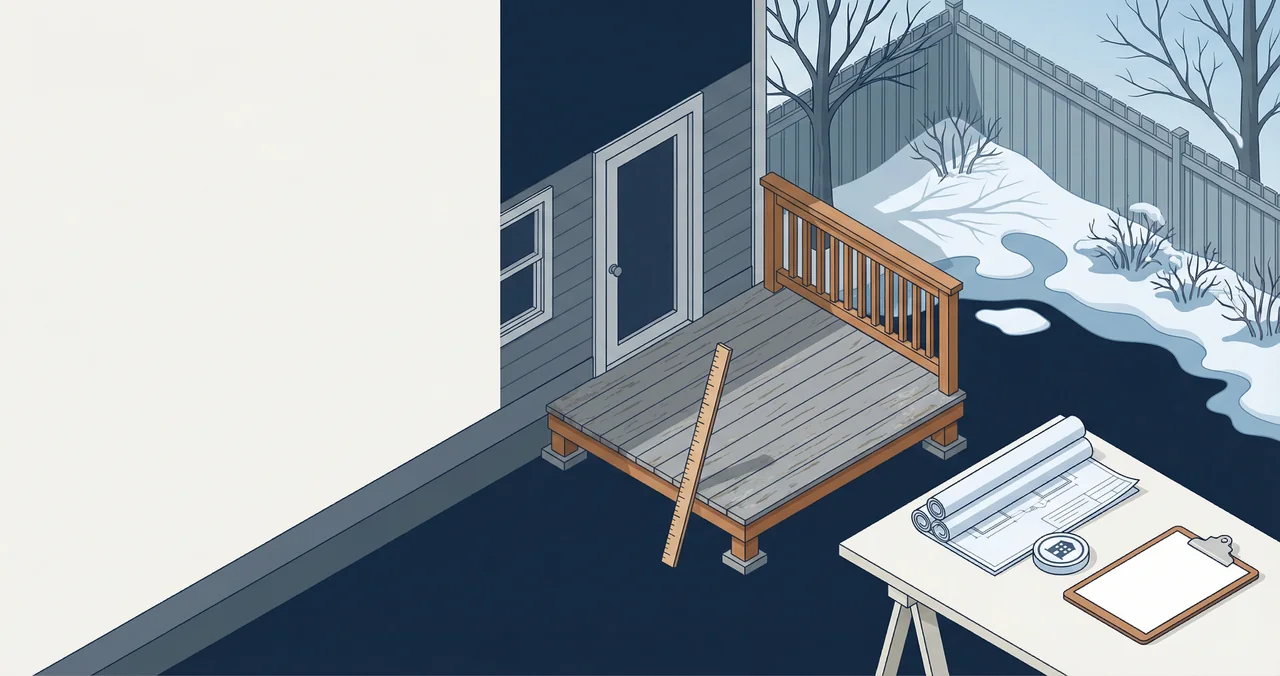
Planning a new deck in Chatham-Kent? Before you pick out decking boards or call a contractor, you need to answer one question first: do you need a building permit?
Looking for more regional information? Check out our Ontario Decking Hub.
The short answer for most homeowners — yes, you probably do. Chatham-Kent's Building Services Department requires permits for most deck projects, and skipping this step can cost you far more than the permit itself. Here's everything you need to know to get your project started right.
📋 Tool Alert: Permit Checker
Do you really need a permit? Check the exact rules for your city or township.
Check Permits →Do You Need a Deck Permit in Chatham-Kent?
In the Municipality of Chatham-Kent, a building permit is required for any deck that is more than 24 inches (0.6 metres) above finished grade or exceeds 100 square feet (approximately 10 square metres) in area. This applies to both attached and freestanding structures.
🏗️ Planning a deck project?
Get a free manual project review, or visualize your dream deck with AI before requesting quotes.
That means a small, ground-level platform might be exempt — but the moment you're building anything elevated, multi-level, or of any meaningful size, you need a permit.
Here's a quick breakdown:
| Scenario | Permit Required? |
|---|---|
| Ground-level deck under 100 sq ft, less than 24" above grade | Typically no |
| Deck over 24" above grade | Yes |
| Deck over 100 sq ft | Yes |
| Any deck attached to your house | Yes (affects structural connection) |
| Deck with a roof or covered structure | Yes |
| Replacing deck boards on existing framing (same footprint) | Usually no — confirm with Building Services |
Even if your project seems small, call Chatham-Kent's Building Services Department at (519) 360-1998 before you start. Zoning bylaws and property-specific conditions can change what's required. A five-minute phone call beats a stop-work order.
Attached vs. Freestanding Decks
An attached deck connects directly to your home's structure, which introduces additional engineering requirements. The ledger board connection must meet Ontario Building Code (OBC) standards to prevent pulling away from the house — a serious safety issue.
Freestanding decks sit on their own footings and don't connect to the house. Some homeowners assume freestanding means no permit. That's wrong. If it's over the height or size thresholds, you still need a permit regardless of whether it's attached or freestanding.
When a Permit Is Required
Beyond the basic thresholds, several specific situations trigger Chatham-Kent's permit requirements:
- Elevated decks — Anything more than 24 inches above grade at any point
- Large footprints — Decks exceeding 100 square feet
- Structural attachments — Decks bolted or lag-screwed to your home's rim joist
- Covered decks or pergolas — Adding a roof structure over your deck
- Hot tub installations — The added weight (often 3,000–4,000 lbs when full) requires engineered footings
- Multi-level or wraparound decks — Complex geometry means structural review
- Decks near property lines — Setback requirements may need variance approval
- Accessibility ramps — Ramps attached to decks still need permits, though some municipalities fast-track these
What About Replacing an Existing Deck?
If you're tearing down an old deck and building a new one in the same footprint, you still need a permit for the new construction. The original permit (if one existed) covered the old structure. Your new deck needs its own.
However, if you're simply replacing deck boards on existing, structurally sound framing — same size, same height — you may not need one. Confirm with Building Services before starting work.
Permit Fees & Processing Time
Chatham-Kent's building permit fees are based on the estimated construction value of your project. As of 2026, here's what to expect:
Residential Deck Permit Fees
| Project Value | Estimated Permit Fee |
|---|---|
| Under $10,000 | $100–$200 CAD |
| $10,000–$25,000 | $200–$400 CAD |
| $25,000–$50,000 | $400–$650 CAD |
| Over $50,000 | $650+ CAD (calculated per $1,000 of value) |
Fees are subject to change — check with the Municipality of Chatham-Kent for the current fee schedule. Most standard residential decks fall in the $200–$400 range.
Processing Time
Plan for 10 to 20 business days for permit review, though timelines vary by season. Applications submitted in March and April — right before building season — tend to see the longest wait times as contractors and homeowners rush to get approved before the May–October building window.
To avoid delays:
- Submit your application by February or early March to beat the spring rush
- Ensure all drawings and documents are complete — incomplete applications are the number one cause of delays
- Respond quickly to any requests for additional information from the plans examiner
Some straightforward deck projects may be reviewed faster. Complex builds with engineering requirements, variances, or proximity to easements will take longer.
Building Codes & Setback Rules
Chatham-Kent follows the Ontario Building Code (OBC), which sets minimum standards for structural safety, load capacity, railing heights, and more. Your deck plans must comply with both the OBC and Chatham-Kent's local zoning bylaws.
Key OBC Requirements for Decks
- Railing height: Minimum 36 inches (900 mm) for residential decks. If the walking surface is more than 1.8 metres above grade, the minimum increases to 42 inches (1,070 mm)
- Baluster spacing: Maximum 4 inches (100 mm) between balusters — a child's head must not fit through
- Stair requirements: Minimum width of 36 inches, with risers between 125 mm and 200 mm and uniform tread depths
- Live load: Decks must support a minimum 1.9 kPa (40 psf) live load
- Snow load: Chatham-Kent's ground snow load is significant. Your deck structure must be designed to handle the local snow load requirements — typically factored into joist sizing and beam spans
Setback Rules in Chatham-Kent
Setbacks determine how close your deck can be to property lines, and they vary by zone. Common requirements include:
- Rear yard setback: Typically 7.5 metres from the rear property line, though decks may encroach into this in some residential zones
- Side yard setback: Usually 1.2 metres minimum from the side property line
- Front yard: Decks are generally not permitted to encroach into front yard setbacks
Important: Setbacks in Chatham-Kent can vary depending on your specific zoning designation. Rural properties, waterfront lots, and lots in older urban areas of Chatham, Wallaceburg, Tilbury, or Ridgetown may have different requirements. Always verify your property's zoning before designing your deck.
If your dream deck doesn't fit within the setbacks, you can apply for a minor variance through Chatham-Kent's Committee of Adjustment — but this adds time, cost (typically $500–$1,000+ CAD), and uncertainty to your project.
Frost Line and Footing Requirements
This is where Chatham-Kent's climate makes things non-negotiable. Footings must extend below the frost line to prevent frost heave, which can shift and crack your deck's foundation.
In Chatham-Kent, the frost line depth is typically 48 inches (4 feet), though it can vary. Your footings — whether concrete piers, Sonotubes, or helical piles — must reach below this depth.
Cutting corners on footing depth is one of the most expensive mistakes you can make. Frost heave will lift improperly set footings, causing your deck to shift, crack, and eventually become unsafe. Chatham-Kent's freeze-thaw cycles are relentless — choosing materials that can withstand this climate is just as critical as getting the footings right.
How to Apply for a Deck Permit in Chatham-Kent
The application process is straightforward if you come prepared. Here's the step-by-step:
Step 1: Gather Your Documents
You'll need:
- Completed building permit application form (available from Chatham-Kent's Building Services or their website)
- Site plan showing your property boundaries, existing structures, the proposed deck location, and distances to all property lines
- Construction drawings including plan view (top-down), elevation views, and cross-sections showing:
- Deck dimensions and height above grade
- Joist sizes and spacing
- Beam sizes and post locations
- Footing type, size, and depth
- Railing details
- Ledger board connection (for attached decks)
- Stair layout
- Property survey (if available — especially important for properties near setback limits)
Step 2: Submit Your Application
Submit your application and drawings to:
Chatham-Kent Building Services 315 King Street West, Chatham, ON N7M 1E5
You can also inquire about submitting applications electronically. Call (519) 360-1998 for current submission options.
Step 3: Plan Review
A plans examiner will review your submission for OBC and zoning compliance. If revisions are needed, you'll be contacted. Respond promptly — delays in responding to revision requests push your approval further back.
Step 4: Receive Your Permit
Once approved, you'll receive your building permit. Post it visibly at the job site before construction begins. This isn't optional — inspectors need to see it.
Step 5: Schedule Inspections
Most deck projects require at least two inspections:
- Footing inspection — Before pouring concrete. The inspector verifies that holes are the correct depth (below frost line) and dimensions
- Final inspection — After the deck is complete. The inspector checks structural connections, railing compliance, and overall code conformance
Do not backfill footings or proceed past inspection milestones without inspector approval. If you pour concrete before the footing inspection, you may be required to dig it up.
Tips for a Smooth Application
If you're building your own deck, your drawings don't need to be architect-quality — but they must be clear, accurate, and to scale. Include all dimensions, materials, and structural details. Incomplete drawings are sent back, costing you weeks.
Working with a contractor? Most experienced deck builders in Chatham-Kent will handle the permit application as part of their service. Ask about this upfront — it's standard practice.
Use PaperPlan to visualize different decking materials on your own home before committing. Seeing how composite vs. pressure-treated looks against your siding can help you finalize plans before submitting drawings.
What Happens If You Build Without a Permit
Some homeowners gamble on skipping the permit. This is almost always a losing bet. Here's what's at stake:
Immediate Consequences
- Stop-work order: If a building inspector discovers unpermitted construction, they'll issue an order halting all work immediately
- Fines: Chatham-Kent can levy fines for building without a permit. Under the Ontario Building Code Act, fines can reach up to $50,000 for individuals and $100,000 for corporations
- Retroactive permit with penalties: You'll need to apply for a permit after the fact, often at double the standard fee, and you may need to expose hidden work (remove deck boards, dig up footings) for inspection
Long-Term Problems
- Insurance issues: If someone is injured on an unpermitted deck, your homeowner's insurance may deny the claim. That's a liability nightmare
- Selling your home: Home inspectors and real estate lawyers flag unpermitted structures. Buyers may demand you tear it down, obtain a retroactive permit, or reduce the sale price — sometimes by far more than the deck's value
- Neighbour complaints: Decks that violate setbacks or height restrictions draw complaints. The municipality must investigate, and you'll bear the cost of remediation
The permit fee for a typical deck is $200–$400 CAD. The cost of building without one? Potentially tens of thousands. The math is simple — don't risk it.
What About "Minor" Projects?
Even if your small project technically doesn't require a permit, getting one provides documented proof that your deck meets code. This protects you during resale and insurance claims. For a few hundred dollars, it's cheap insurance.
Budgeting for Your Chatham-Kent Deck Project
While this guide focuses on permits, understanding total project costs helps you plan realistically. Here's what deck installation typically costs in the Chatham-Kent area in 2026:
| Material | Installed Cost (CAD/sq ft) | Best For |
|---|---|---|
| Pressure-treated wood | $30–$55 | Budget-friendly builds |
| Cedar | $40–$65 | Natural look, moderate durability |
| Composite | $50–$85 | Low maintenance, long lifespan |
| Trex (brand-name composite) | $55–$90 | Premium composite with strong warranty |
| Ipe (hardwood) | $70–$120 | Maximum durability and aesthetics |
For a standard 12x16 deck (192 sq ft), you're looking at roughly $5,760–$10,560 CAD for pressure-treated or $9,600–$16,320 CAD for composite — including materials, labour, footings, and railing. For detailed breakdowns by size, check out our 12x16 deck cost guide for Ontario or 20x20 deck cost guide for larger builds.
Chatham-Kent-specific cost factors:
- Shorter building season (May–October) means contractor schedules fill up fast. Book by March to secure your preferred builder and avoid premium pricing
- Footing costs run higher than in milder climates because of the 48-inch frost line depth — more excavation, more concrete
- Composite and PVC materials are increasingly popular here because they handle freeze-thaw cycles far better than wood. Pressure-treated wood needs annual sealing against moisture and salt to survive Chatham-Kent winters without splitting or warping
🎨 Not sure which material to pick?
Upload a photo of your backyard and see exactly how Trex, TimberTech, or cedar would look — free and instant.
Frequently Asked Questions
How much does a deck permit cost in Chatham-Kent?
Most residential deck permits in Chatham-Kent cost between $200 and $400 CAD, depending on the estimated construction value of your project. Smaller projects under $10,000 may cost as little as $100–$200. Contact Chatham-Kent Building Services at (519) 360-1998 for the exact fee based on your project scope.
Can I build a deck without a permit in Chatham-Kent?
Only if your deck is under 24 inches above grade and under 100 square feet. Even then, you must still comply with zoning setbacks and other bylaws. For anything larger or higher, you need a building permit. Building without one when required can result in fines up to $50,000, stop-work orders, and serious complications when selling your home.
How long does it take to get a deck permit approved in Chatham-Kent?
Expect 10 to 20 business days for standard residential deck permits. Applications submitted during the spring rush (March–April) may take longer. The most common cause of delays is incomplete applications — double-check that your drawings include all required details before submitting.
Do I need a permit to replace my existing deck in Chatham-Kent?
If you're building a new deck structure — even in the same footprint as your old one — yes, you need a new permit. If you're only replacing deck boards on existing, structurally sound framing without changing the size or height, you may not need one. Confirm with Building Services before starting.
What is the frost line depth in Chatham-Kent for deck footings?
The frost line in Chatham-Kent is typically 48 inches (4 feet). All deck footings must extend below this depth to prevent frost heave. This is non-negotiable — footings that don't reach below the frost line will shift during Chatham-Kent's freeze-thaw cycles, compromising your entire deck structure. Learn more about choosing the right materials for Ontario's climate.
When is the best time to build a deck in Chatham-Kent?
The prime building window is May through October. However, the permit process should start much earlier. Submit your permit application in February or March so you're approved and ready to build when the weather cooperates. Given Chatham-Kent's short building season, timing your project correctly can save you both money and frustration.
📋 Planning a deck project?
Get a free manual project review from our team — no obligation, no spam.
Get Free Project Review →Upload a backyard photo and preview real decking materials with AI — free, instant, no sign-up.
Permits, costs, material comparisons, and questions to ask before requesting quotes — delivered to your inbox.