
Deck Cost in Burlington (2026)
What does a deck cost in Burlington, Ontario in 2026? Get real per-square-foot pricing for composite, wood, and Trex — plus local tips to save.
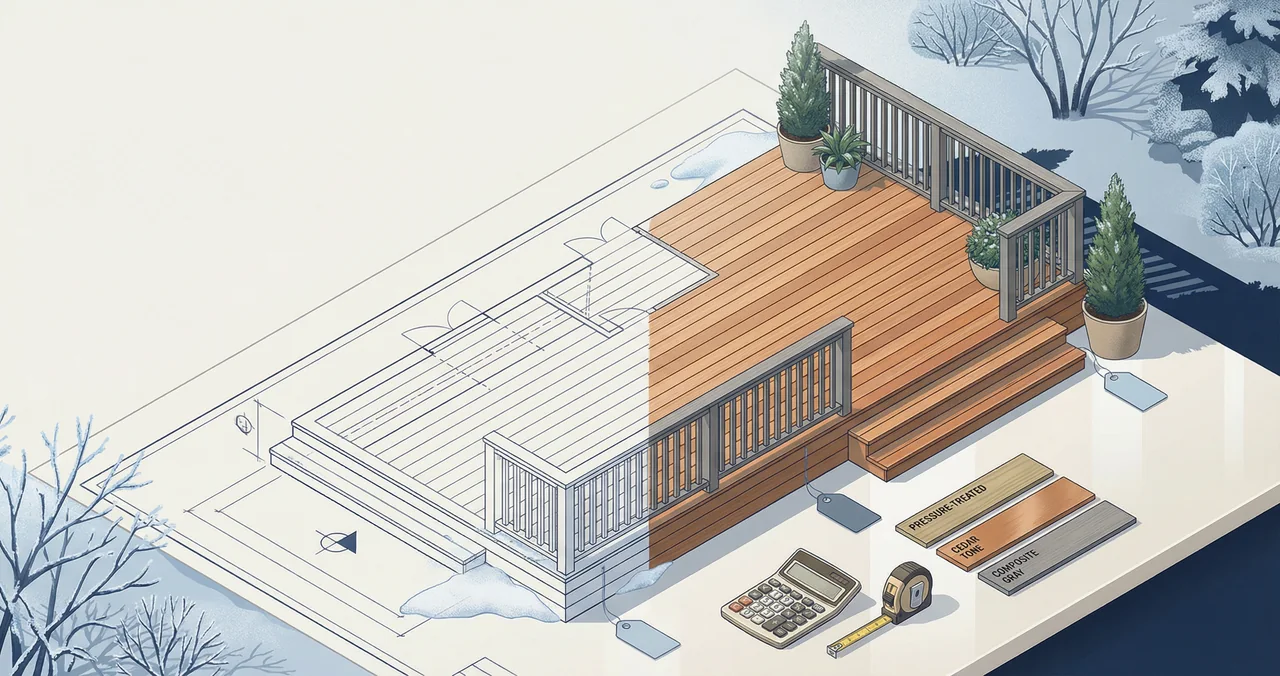
How Much Does a Deck Cost in Burlington Right Now?
You're looking at your backyard, picturing a new deck, and wondering what the damage will be. Fair question. In Burlington, Ontario, a standard deck runs between $30 and $90 per square foot installed, depending on the material you choose and how complex the build is.
🏗️ Planning a deck project?
Get a free manual project review, or visualize your dream deck with AI before requesting quotes.
Looking for more regional information? Check out our Ontario Decking Hub.
For a typical 12x16-foot deck (192 sq ft), that translates to roughly:
- Pressure-treated wood: $5,760–$10,560 CAD
- Cedar: $7,680–$12,480 CAD
- Composite: $9,600–$16,320 CAD
- Trex (premium composite): $10,560–$17,280 CAD
- Ipe (hardwood): $13,440–$23,040 CAD
These are 2026 installed prices — materials, labour, footings, and basic railing included. Your actual number depends on site conditions, design features, and when you book. More on all of that below.
🧮 Tool Alert: Deck Cost Calculator
Estimate your project costs in seconds based on local pricing bands for your area.
Calculate My Cost →For a broader look at deck pricing across different materials and regions, see our complete deck cost guide.
Average Deck Cost in Burlington by Material
Not all decking is created equal, especially in Burlington's climate. Here's what each material costs and how it handles our winters.
| Material | Installed Cost (per sq ft CAD) | Lifespan | Winter Performance |
|---|---|---|---|
| Pressure-treated | $30–$55 | 15–25 years | Needs annual sealing; prone to cracking from freeze-thaw |
| Cedar | $40–$65 | 20–30 years | Better moisture resistance than PT; still needs maintenance |
| Composite | $50–$85 | 25–50 years | Excellent; handles moisture and temperature swings well |
| Trex | $55–$90 | 25–50 years | Top-tier freeze-thaw resistance; backed by 25-year warranty |
| Ipe | $70–$120 | 40–75 years | Extremely durable; naturally resists rot and insects |
Pressure-treated lumber remains the most popular budget choice across Burlington. It does the job, but you'll be out there sealing it every spring — and Burlington's freeze-thaw cycles are relentless. Skip a year and you'll see cracking and splintering by the following winter.
Composite and PVC boards hold up best against the moisture, road salt, and temperature swings Burlington throws at them. Higher upfront cost, but virtually zero maintenance over decades. If you're comparing materials for our climate specifically, check out this guide to the best decking materials for Ontario's freeze-thaw cycles.
Cost Per Square Foot Breakdown
Here's where your money actually goes on a Burlington deck project:
Materials (40–50% of total cost)
- Decking boards: The biggest variable. Ranges from $8–$15/sq ft for pressure-treated to $35–$60/sq ft for Ipe (materials only)
- Framing lumber: Typically $5–$10/sq ft. Most Burlington builders use pressure-treated SPF for the substructure, though aluminum framing is gaining ground for longevity
- Hardware and fasteners: $2–$4/sq ft. Stainless steel or coated fasteners are non-negotiable here — regular steel corrodes fast with salt and moisture
- Railings: $30–$80 per linear foot installed, depending on material (aluminum, glass, cable, wood)
Labour (35–45% of total cost)
Burlington labour rates run $25–$50 per square foot, influenced by project complexity, the builder's experience, and timing. A simple rectangular platform deck on flat ground sits at the low end. Multi-level designs with built-in benches, pergolas, or curved edges push toward the top.
Permits and Extras (5–15% of total cost)
- Building permit: $200–$500+ depending on project scope
- Site prep and grading: $500–$2,000 if your yard needs levelling
- Footing excavation: Burlington's frost line sits at 36–60 inches deep, which means deeper holes and more concrete than you might expect
- Stairs, skirting, lighting: Each adds $500–$3,000+
Labour Costs in Burlington
Labour is where Burlington pricing diverges from national averages. A few reasons:
The building season is compressed. Realistically, outdoor construction runs May through October in Burlington. That's six months for contractors to complete a full year's worth of projects. Demand outstrips supply every single summer.
Book early. Most experienced Burlington deck builders start filling their spring schedules by March. If you wait until May to call around, you'll either pay a premium or push into late summer. Neither is ideal.
Expect to pay more for:
- Elevated decks requiring engineering and additional structural support
- Sloped lots common in areas near the Niagara Escarpment
- Second-storey decks or walkouts — these need beefier footings and often require engineered drawings
- Removal and disposal of an existing old deck
Average labour breakdown:
| Task | Cost Range (CAD) |
|---|---|
| Basic deck build (labour only) | $25–$40/sq ft |
| Complex/multi-level deck | $35–$50/sq ft |
| Old deck demolition & removal | $1,000–$3,500 |
| Footing installation (per footing) | $150–$400 |
| Permit drawings/engineering | $500–$2,000 |
What Affects Your Total Price
Beyond materials and labour, several Burlington-specific factors swing your final number.
Deck Size and Layout
Obvious but worth quantifying. A basic 12x16 deck runs $5,700–$17,300 depending on material. Jump to a 16x20 layout and you're looking at $9,600–$28,800. The per-square-foot rate drops slightly on larger decks since setup and mobilization costs get spread out — but the total climbs fast.
Height and Access
Ground-level decks on flat lots are the cheapest to build. Once your deck sits more than a couple of feet off the ground, you need taller posts, more bracing, stairs, and railings on all open sides. In Burlington, any deck over 24 inches above grade typically requires a building permit — contact Burlington's Building Department for your specific situation, as requirements can vary.
Footings in Burlington's Frost Zone
This catches homeowners off guard. Burlington's frost line means your footings need to reach 36 to 60 inches below grade. That's real excavation work — not the quick surface-mount approach you see in milder climates. Helical piles are an increasingly popular alternative here. They're faster to install and perform well in our soil conditions, though they add $200–$400 per footing versus traditional concrete sono tubes.
Lot Conditions
Burlington has everything from flat suburban yards in Alton Village to sloped ravine lots near Tyandaga and the Escarpment. A sloped lot can add $2,000–$8,000+ to your project in additional structural work, retaining, and access challenges.
Permits and Code Compliance
Don't skip the permit. In Burlington, building without one creates real problems when you sell — home inspectors flag unpermitted structures, and buyers use them as negotiation leverage. The permit process also ensures your deck meets Ontario Building Code requirements for structural loads, guard heights, and connections. If you're considering going the DIY route, read about the risks of building without a permit in Ontario first.
Extras That Add Up
- Built-in lighting: $500–$2,500 (worth it for evening use — check out the best deck lighting kits in Canada)
- Privacy screens or planters: $800–$3,000
- Built-in seating or storage: $1,000–$4,000
- Pergola or shade structure: $3,000–$12,000
- Hot tub reinforcement: $1,500–$4,000 for additional structural support
Composite vs Wood: Cost Comparison
This is the decision most Burlington homeowners wrestle with. Here's a clear-eyed comparison for a 14x20-foot deck (280 sq ft):
| Pressure-Treated | Cedar | Composite | |
|---|---|---|---|
| Installed cost | $8,400–$15,400 | $11,200–$18,200 | $14,000–$23,800 |
| Annual maintenance cost | $200–$500 (stain/seal) | $150–$400 (stain/seal) | $0–$50 (occasional cleaning) |
| 10-year total cost | $10,400–$20,400 | $12,700–$22,200 | $14,000–$24,300 |
| 20-year total cost | $14,400–$25,400+ (may need board replacements) | $14,200–$26,200 | $14,000–$24,800 |
The numbers tell the story. Composite costs more upfront but breaks even with wood around year 10–12. After that, it's pure savings — no staining, no sealing, no replacing cracked boards after a brutal January.
For Burlington specifically, composite and PVC have another advantage: they don't absorb moisture the way wood does. When water gets into wood grain and freezes overnight, it expands and cracks the fibres. That cycle repeats dozens of times each winter. Composite boards simply don't have this problem.
Use PaperPlan to visualize different decking materials on your own home before committing — it's a practical way to see how colours and textures will actually look against your siding and landscape.
That said, if your budget is firm and you're disciplined about annual maintenance, pressure-treated lumber remains a perfectly solid choice. Just factor in the ongoing time and cost of upkeep.
How to Save Money on Your Burlington Deck
Smart savings — not cheap shortcuts.
Time Your Build Right
Book in late fall or early winter for a spring build. Contractors are planning their schedules and may offer better rates to lock in work. Avoid calling in May or June when every homeowner in Burlington suddenly wants a deck — that's peak pricing.
The best time to build a deck in Ontario breaks this down month by month.
Keep the Design Simple
Every angle, curve, and level change adds labour. A rectangular deck with a single set of stairs is the most cost-effective layout. You can always add visual interest through railing style, board pattern (diagonal patterns use 10–15% more material), and furnishings.
Choose Your Splurges Carefully
Go composite on the decking surface where you'll feel the maintenance savings. Use pressure-treated lumber for the substructure where nobody sees it. Pick one premium feature — glass railing, built-in lighting, a pergola — rather than adding everything at once.
Get Multiple Quotes (But Compare Apples to Apples)
Get three to four quotes from Burlington-area builders. Make sure each quote specifies:
- Material brand and grade (not just "composite")
- Footing type and depth
- What's included (railing, stairs, permits, site cleanup)
- Timeline and payment schedule
- Warranty on labour
The lowest quote isn't always the best value. A builder who includes permit handling, deeper footings, and a two-year labour warranty at $5,000 more may save you money and headaches long-term.
Consider Phased Building
Build the main deck platform this year and add the pergola, lighting, or built-in seating next season. This spreads costs across two budgets and lets you live with the space before committing to extras.
Do What You Can Yourself
Demolishing an old deck, clearing the site, staining or sealing (for wood decks), and installing post-build accessories like planters and furniture are all tasks you can handle. Read up on whether building your own deck makes sense in Ontario before deciding how much DIY to take on.
🎨 Not sure which material to pick?
Upload a photo of your backyard and see exactly how Trex, TimberTech, or cedar would look — free and instant.
Frequently Asked Questions
How much does a 12x12 deck cost in Burlington?
A 12x12-foot deck (144 sq ft) in Burlington ranges from $4,320 to $12,960 CAD installed, depending on material. Pressure-treated sits at the low end ($4,320–$7,920), while composite runs $7,200–$12,240. Add $1,000–$3,000 for stairs and upgraded railing. These are 2026 estimates including labour, footings, and basic railing.
Do I need a permit to build a deck in Burlington, Ontario?
In most cases, yes. Burlington typically requires a building permit for decks over 24 inches above finished grade or over 100 square feet. Even if your deck falls below these thresholds, it's worth confirming with Burlington's Building Department — requirements can vary based on your property's zoning and setback rules. The permit process usually takes 2–4 weeks and costs $200–$500.
What is the best decking material for Burlington's climate?
Composite or PVC decking performs best in Burlington's harsh winters. The freeze-thaw cycles — where temperatures swing above and below zero repeatedly — are brutal on wood. Composite doesn't absorb water, so it won't crack or split the way wood does. If you prefer a natural wood look and don't mind annual maintenance, cedar holds up better than pressure-treated. For more detail, see our guide to the best composite decking brands in Ontario.
When is the best time to build a deck in Burlington?
The optimal building window is May through October, but your planning should start much earlier. Contact builders by February or March to get on their spring schedule. Burlington's compressed building season means the best contractors book up quickly. Fall builds (September–October) can sometimes offer better pricing as the rush slows down, and weather is typically still cooperative.
Is composite decking worth the extra cost in Burlington?
For most Burlington homeowners, yes. The math works out in composite's favour over a 10–15 year period once you factor in annual staining, sealing, and board replacement costs for wood. Beyond the financial comparison, there's the practical reality: spending every Victoria Day weekend sanding and staining your deck gets old fast. Composite gives you that time back. The upfront premium of $15–$30 per square foot over pressure-treated pays for itself in saved maintenance costs and preserved weekends.
📋 Planning a deck project?
Get a free manual project review from our team — no obligation, no spam.
Get Free Project Review →Upload a backyard photo and preview real decking materials with AI — free, instant, no sign-up.
Permits, costs, material comparisons, and questions to ask before requesting quotes — delivered to your inbox.