
Aluminum Deck Framing in Ontario: Pros, Cons, and Cost
Aluminum deck framing offers rot-proof durability for Ontario's freeze-thaw climate. Compare costs, code compliance, and real-world performance vs. wood.
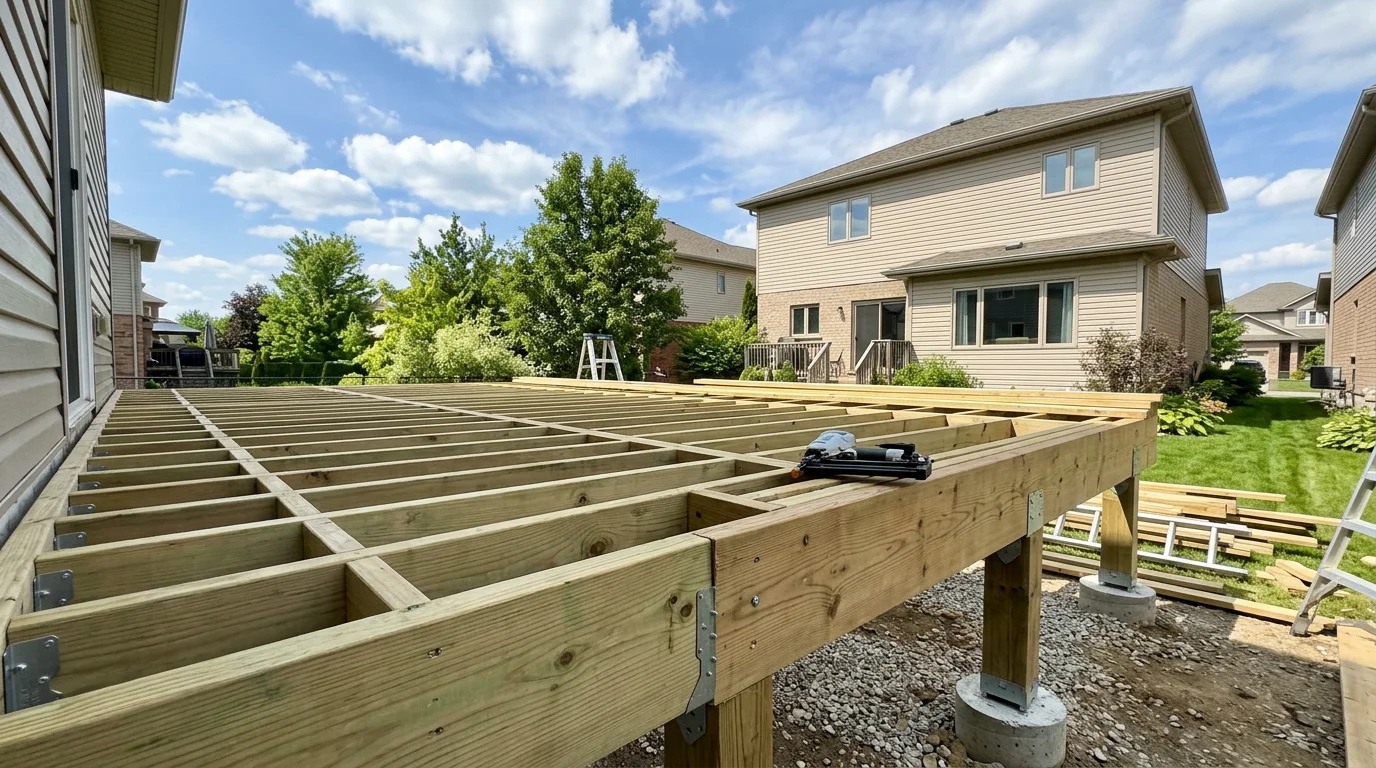
You're tired of replacing rotted joists and treating wood every few years. Aluminum deck framing promises a maintenance-free alternative—but does it make sense for Ontario's freeze-thaw cycles, and will it pass local building inspections?
Aluminum framing systems are gaining traction in Ontario for their zero-rot guarantee and lighter weight, but they cost $15-25/sqft more than pressure-treated lumber for framing alone. Here's what you need to know before committing to aluminum for your next deck project.
What Is Aluminum Deck Framing?
Aluminum deck framing replaces traditional wood joists, beams, and posts with extruded aluminum components. Most systems use marine-grade 6000-series aluminum alloy with powder-coated finishes to resist corrosion.
🏗️ Planning a deck project?
Get a free manual project review, or visualize your dream deck with AI before requesting quotes.
The framing accepts standard composite or wood decking on top using specialized fasteners or clips. You're not replacing the entire deck—just the structural skeleton underneath.
Common Aluminum Framing Systems in Canada
- AFCO Versadeck: Modular system with pre-cut joists and beams, sold through specialty dealers
- Fortress Evolution Steel: Steel alternative (not aluminum), available at some Ontario building supply stores
- Deckorators ALX: Aluminum railing manufacturer also offers framing components
- Custom fabrication: Local metal shops can fabricate aluminum framing to your specifications
Most Ontario homeowners encounter aluminum framing through composite deck manufacturers who bundle it as an upgrade option. Expect limited local availability—this isn't stocked at big-box stores yet.
Pros of Aluminum Deck Framing in Ontario
No Rot, No Insects, No Chemical Treatment
Wood framing—even pressure-treated lumber—deteriorates in Ontario's humid summers and freeze-thaw winters. Aluminum won't rot, warp, or attract carpenter ants.
You eliminate the maintenance cycle entirely. No joist tape, no annual inspections for soft spots, no surprise repairs when a beam fails after 15 years.
Lighter Weight, Lower Load on Footings
Aluminum weighs one-third as much as wood. A 12' aluminum joist weighs about 8 lbs versus 25+ lbs for a 2x10 pressure-treated board.
This matters for elevated decks or rooftop installations where weight transfer to the structure is a concern. You may also need fewer footings or smaller helical piles to support the deck—though deck footing options in Ontario still depend on soil conditions and live load calculations.
Spans Longer Distances
Aluminum I-beams can span 16-20 feet without mid-span support in some configurations, compared to 12-14 feet max for 2x10 wood joists at 16" on-center spacing.
Longer spans mean fewer posts interrupting your patio space below and cleaner sightlines. This is especially useful for hot tub installations where you want minimal obstruction.
Better Dimensional Stability
Wood expands and contracts with moisture changes. Aluminum's thermal expansion is predictable and uniform, so your deck frame won't twist or cup over time.
However, aluminum does expand with heat—about 0.13mm per meter per 10°C. You'll need proper fastening systems that allow for thermal movement, especially with composite decking that also expands.
Longer Lifespan
Properly installed aluminum framing can last 50+ years in Ontario's climate. Compare that to pressure-treated lumber at 15-25 years before major repairs are needed.
The upfront premium often pencils out if you plan to stay in your home long-term or want to add resale value without the "rotting deck" liability.
Cons of Aluminum Deck Framing in Ontario
Higher Upfront Cost
Aluminum framing adds $15-25/sqft to your project cost compared to pressure-treated wood framing.
For a 200 sqft deck, that's an extra $3,000-5,000 just for the substructure. When combined with composite decking at $65-95/sqft installed, you're looking at a premium-tier project.
Budget-conscious homeowners will struggle to justify this when pressure-treated decks cost $45-65/sqft installed with wood framing and surface boards. For a broader look at what decks cost in Ontario, our province-wide pricing guide covers all material tiers.
Limited Contractor Familiarity
Most Ontario deck guides builders have 20+ years of wood framing experience and zero aluminum installations under their belt.
You'll pay more for labor because installers need to learn the system, and you'll face longer timelines as they figure out connections and fastening details. Mistakes are costlier—you can't just cut a new joist from a 2x10 at the lumberyard.
Thermal Conductivity Issues
Aluminum conducts heat 200x faster than wood. In Ontario's summer sun, aluminum framing can reach 60-70°C (140-160°F) under dark composite decking.
This doesn't affect structural integrity, but it means:
- Decking boards get hotter faster (already an issue with composite materials in Ontario)
- Any direct contact with aluminum (e.g., sitting on a bench frame) can be uncomfortable
- Ice and snow melt slightly faster in winter—sounds good, but refreeze creates slip hazards
Code Compliance and Inspection Hurdles
The Ontario Building Code (OBC) doesn't explicitly address aluminum deck framing. Inspectors default to wood span tables and may require engineered drawings for aluminum systems—even for small residential decks.
You'll likely need:
- Manufacturer spec sheets showing load ratings
- Engineer's stamp for joist and beam sizing (adds $500-1,200)
- Custom framing inspection appointments because aluminum doesn't match standard wood checklists
In Kitchener, Waterloo, and Cambridge, some inspectors approve aluminum framing under the "alternative solution" provision (OBC 1.2.1.1), but others push back and demand additional documentation. Budget extra time for permit approval.
Fastening and Ledger Attachment Complexity
Connecting aluminum framing to wood ledger boards requires specialized fasteners and thermal break materials to prevent galvanic corrosion.
Ledger board attachment in Ontario is already the most critical safety detail on any deck. With aluminum, you're mixing materials with different expansion rates—improper connection can lead to loosening over time or corrosion at the interface.
You can't use standard lag bolts or structural screws. Expect to source stainless steel hardware and isolation washers, which aren't available at local suppliers.
Limited Availability and Long Lead Times
Aluminum framing isn't stocked in Ontario. You'll order from US suppliers or wait 6-12 weeks for Canadian distributors to ship.
This kills any flexibility in your project timeline. If the installer damages a joist during installation, you're waiting weeks for a replacement—versus driving to the lumberyard for a $15 pressure-treated board.
Aluminum Deck Framing Cost in Ontario (2026)
Here's a realistic cost breakdown for a 200 sqft elevated deck in the KWC area:
Wood Framing (Baseline)
| Component | Cost |
|-----------|------|
| Pressure-treated joists, beams, posts | $800-1,200 |
| Joist hangers, hardware, fasteners | $150-250 |
| Concrete footings (4x Sonotubes) | $400-600 |
| Labour (framing only) | $1,200-1,800 |
| Total Framing Cost | $2,550-3,850 |
Aluminum Framing (Premium Option)
| Component | Cost |
|-----------|------|
| Aluminum joists, beams, posts | $3,500-5,000 |
| Specialized fasteners and brackets | $400-700 |
| Helical piles (lighter load) | $600-1,200 |
| Labour (framing only, with learning curve) | $2,000-3,000 |
| Engineer's stamp for plans | $500-1,200 |
| Total Framing Cost | $7,000-11,100 |
Price difference: $4,450-7,250 more for aluminum on a 200 sqft deck, or roughly $22-36/sqft premium.
For larger decks (300-400 sqft), the per-sqft premium drops slightly to $18-28/sqft due to economies of scale on engineering and setup.
Does the Cost Make Sense Long-Term?
Let's assume a wood deck needs joist replacement after 20 years at $3,000-4,500 (adjusted for inflation). Aluminum framing lasts 50+ years with zero maintenance.
If you stay in your home for 30+ years, aluminum saves money. If you're planning to sell within 10-15 years, wood makes more financial sense—buyers won't pay extra for invisible framing upgrades.
Aluminum vs. Steel vs. Wood: Side-by-Side Comparison
| Feature | Aluminum | Galvanized Steel | Pressure-Treated Wood |
|---------|----------|------------------|----------------------|
| Cost (framing only) | $35-55/sqft | $28-42/sqft | $13-20/sqft |
| Lifespan | 50+ years | 30-40 years | 15-25 years |
| Weight | Lightest | Medium | Heaviest |
| Rot resistance | Excellent | Excellent | Requires maintenance |
| Ontario code acceptance | Requires engineer | Easier approval | Standard |
| Contractor availability | Very limited | Limited | Universal |
| Thermal expansion | High | Medium | Low |
| Span capacity | Excellent | Excellent | Good |
Bottom line: Aluminum wins on durability and weight. Wood wins on cost and simplicity. Steel splits the difference but still faces code and availability challenges.
Ontario Building Code Considerations
Span Tables and Load Ratings
OBC Section 9.4.4 provides prescriptive joist span tables—for wood only. Aluminum framing falls under Part 4 (engineered design), meaning you need:
1. Manufacturer's engineering data showing live load (50 lbs/sqft) and dead load compliance
2. Connection details for all beam-to-post and joist-to-beam interfaces
3. Lateral load resistance calculations (wind and seismic, even though Ontario's seismic zone is low)
Most aluminum suppliers provide span charts, but your municipality may require a Professional Engineer's stamp to validate those charts for your specific project.
Attachment to Existing Structure
If attaching aluminum framing to a wood-framed house, you'll need:
- Isolation barriers to prevent galvanic corrosion between dissimilar metals
- Through-bolts or structural screws rated for the load transfer—standard ledger board practices still apply, but fastener sizing changes because aluminum doesn't provide the same bearing surface as wood
Ledger flashing and water damage prevention is just as critical with aluminum framing.
Footing and Foundation Requirements
Aluminum's lighter weight doesn't exempt you from Ontario's 48-inch frost depth requirement for footings. You still need:
- Sonotubes extending to 1.2m below grade, or
- Helical piles installed to refusal depth
The advantage: you may get away with fewer footings due to aluminum's superior span capacity, reducing excavation costs.
Installation Challenges in Ontario Climate
Freeze-Thaw and Fastener Integrity
Aluminum expands and contracts more than wood. In Ontario, temperature swings from -25°C to +35°C mean your deck frame moves 3-4mm per 10-foot span.
Fasteners must allow for this movement. Most aluminum systems use:
- Floating clips for decking attachment
- Slotted holes in connection brackets
- Isolation washers to prevent binding
If you rigidly fasten everything (like you would with wood), you'll get stress cracks at joints within 2-3 years.
Ice and Snow Load
Ontario requires decks to handle 45 lbs/sqft snow load (or higher in some areas). Aluminum framing easily meets this, but you need to verify:
- Joist spacing matches the load rating (16" OC is typical)
- Beam spans don't exceed manufacturer's snow load limits
- Post-to-beam connections are rated for uplift forces (rare but possible in wind-exposed locations)
Aluminum's strength-to-weight ratio actually makes it better for snow load than wood of equivalent dimensions.
Water Drainage and Corrosion
Marine-grade aluminum resists corrosion, but galvanic corrosion happens when aluminum contacts dissimilar metals (steel fasteners, galvanized joist hangers).
Use stainless steel hardware exclusively—no zinc-coated screws or hot-dipped galvanized brackets. This adds another $200-400 to hardware costs.
Ensure proper drainage under the deck to prevent standing water, which accelerates oxidation even on aluminum.
Should You Choose Aluminum Framing for Your Ontario Deck?
You're a Good Candidate If:
- You're building a high-end deck with composite or PVC decking and want the substructure to last just as long
- Your deck is elevated or rooftop-mounted where weight reduction matters
- You plan to stay in your home 20+ years and want zero maintenance
- You can afford the upfront premium and value long-term durability over cost savings
Stick with Wood Framing If:
- Budget is your top priority—wood framing costs half as much
- Your builder isn't experienced with aluminum and you don't want to pay for their learning curve
- You need the deck finished quickly—wood is available today, aluminum takes weeks
- Your municipality's inspector is conservative—some KWC inspectors push back on non-standard materials
For most Ontario homeowners, pressure-treated wood framing with proper maintenance delivers 20-25 years of service at a fraction of the cost. Add joist tape for moisture protection and you'll extend that lifespan even further.
Aluminum makes sense for premium builds where lifecycle cost and zero maintenance justify the upfront investment—but it's still a niche choice in Ontario's deck market.
Common Questions
Can I use aluminum framing with wood decking?
Yes. Aluminum framing accepts any decking material—pressure-treated, cedar, or composite. You'll need stainless steel screws or hidden fasteners rated for aluminum-to-wood attachment. The framing doesn't care what's on top, but composite decking pairs better with aluminum's long lifespan so both components age at the same rate.
Does aluminum framing require a permit in Kitchener, Waterloo, or Cambridge?
Yes. Aluminum framing doesn't change permit requirements—you still need approval for any deck over 24 inches high or attached to your house in Kitchener, Waterloo, and Cambridge. Expect additional scrutiny during permit application because inspectors will request engineered drawings and manufacturer load ratings. Budget an extra 2-3 weeks for permit approval compared to standard wood framing.
Can I DIY aluminum deck framing?
Technically yes, but it's much harder than wood. Aluminum requires specialized cutting tools (chop saw with carbide blade, not a standard circular saw), precise measurements (no margin for error like wood), and specific fastener torque specs. Most DIY builders who attempt aluminum framing end up hiring a structural engineer to verify their work, negating any labor cost savings. If you've never built a deck before, start with wood.
How long does aluminum framing last compared to pressure-treated wood?
Aluminum framing lasts 50+ years with zero maintenance in Ontario's climate. Pressure-treated wood joists last 15-25 years depending on ground contact, moisture exposure, and ventilation under the deck. The tradeoff: aluminum costs 2-3x more upfront, so you're paying for longevity. If you replace wood framing once after 20 years, total lifecycle cost is similar—aluminum wins if you avoid that second replacement.
Will aluminum framing increase my home's resale value?
Minimal impact. Most buyers don't inspect deck framing—they see the surface decking and railing. Aluminum adds value only if marketed as a low-maintenance, premium feature during listing, and even then, you won't recover the full cost premium. Composite decking on wood framing delivers better ROI for resale because buyers see the upgrade immediately. Aluminum makes sense if you're building for your own long-term use, not for flipping the house.
🎨 Not sure which material to pick?
Upload a photo of your backyard and see exactly how Trex, TimberTech, or cedar would look — free and instant.
Related guides (to pick the right structure + surface)
Local deck pages (Kitchener-Waterloo-Cambridge):
Materials (surface):
Permits + design constraints:
Get quotes: /#quote-form
Looking for local pros? Check out Affordable Deck Builders in Nanaimo: Budget-Friendly Options for 2026.
Looking for local pros? Check out Trex Deck Builders in Seattle: Certified Installers & Pricing.
Looking for local pros? Check out Affordable Deck Builders in Welland: Budget-Friendly Options for 2026.
Upload a backyard photo and preview real decking materials with AI — free, instant, no sign-up.
Permits, costs, material comparisons, and questions to ask before requesting quotes — delivered to your inbox.