
Deck Cost in McKinney (2026)
What does a deck cost in McKinney in 2026? See real pricing by material, labor rates, and smart ways to save on your McKinney deck project.
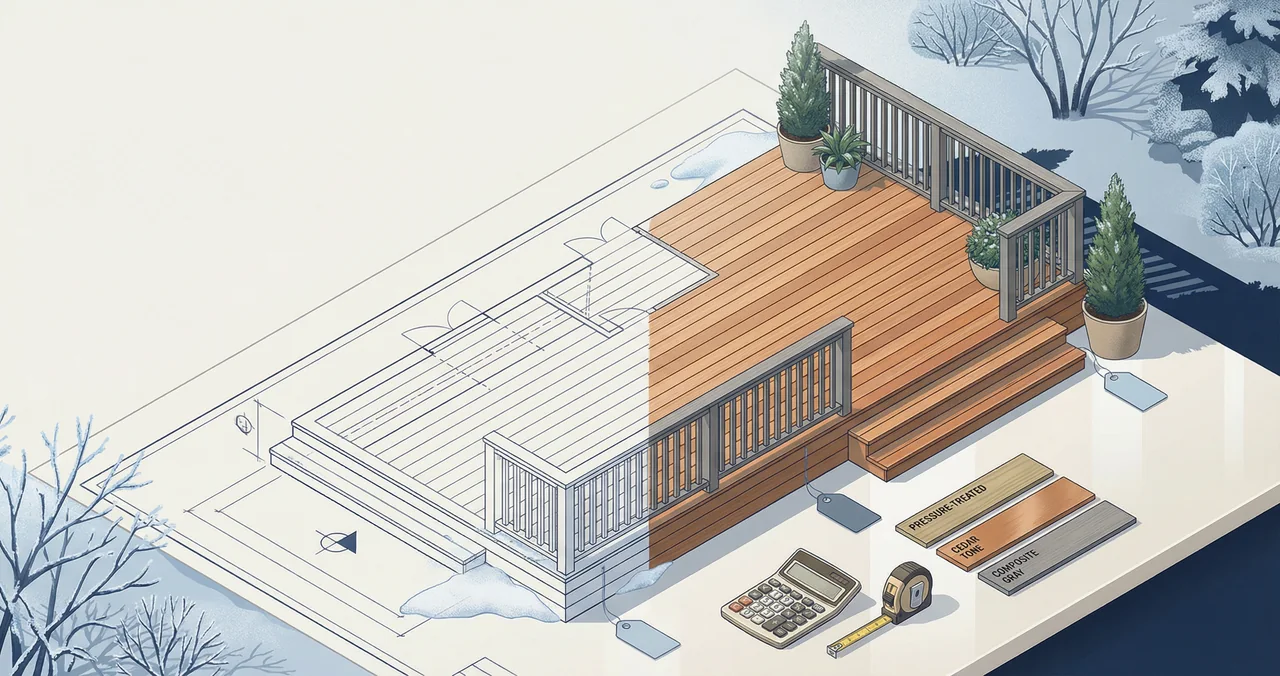
Deck Cost in McKinney: What Homeowners Are Paying in 2026
You want a deck. You want to know what it's going to cost — not a national average, but what McKinney homeowners are actually paying right now. Fair enough.
🏗️ Planning a deck project?
Get a free manual project review, or visualize your dream deck with AI before requesting quotes.
🧮 Tool Alert: Deck Cost Calculator
Estimate your project costs in seconds based on local pricing bands for your area.
Calculate My Cost →Looking for more regional information? Check out our Texas State Decking Hub.
A standard 300 sq ft deck in McKinney runs between $7,500 and $22,500 installed, depending on material. Pressure-treated pine sits at the low end. Composite and exotic hardwoods push toward the top. But material is only part of the equation — your lot, your design, and McKinney's permitting requirements all factor in.
Here's a detailed breakdown so you can budget with confidence.
<!-- slot:after-intro -->
For a broader look at deck pricing across different materials and regions, see our complete deck cost guide for Texas. Timing your build right can also save thousands — check our guide on the best time to build a deck.
Average Deck Cost in McKinney by Material
Material choice drives the biggest chunk of your total cost. Here's what McKinney contractors are quoting in 2026 for a fully installed deck:
| Material | Installed Cost per Sq Ft | 300 Sq Ft Deck | 500 Sq Ft Deck |
|---|---|---|---|
| Pressure-Treated Wood | $25–$45 | $7,500–$13,500 | $12,500–$22,500 |
| Cedar | $35–$55 | $10,500–$16,500 | $17,500–$27,500 |
| Composite | $45–$75 | $13,500–$22,500 | $22,500–$37,500 |
| Trex (brand-name composite) | $50–$80 | $15,000–$24,000 | $25,000–$40,000 |
| Ipe (Brazilian Hardwood) | $60–$100 | $18,000–$30,000 | $30,000–$50,000 |
Pressure-treated pine dominates in McKinney for budget-conscious builds. It handles the job, but the Texas sun and humidity mean you'll need to seal it every 1–2 years or watch it warp and gray. Composite decking costs more upfront but eliminates most of that maintenance — a serious consideration when McKinney summers regularly push past 100°F.
If you're comparing specific deck sizes, the cost breakdown for a 12x16 deck gives you a useful reference point for a mid-size project.
Cost Per Square Foot Breakdown
Installed prices include materials, labor, and basic hardware. But it helps to understand where the money goes:
- Materials only: $8–$40/sq ft depending on decking type
- Labor: $10–$25/sq ft for standard builds
- Hardware, fasteners, and concrete: $3–$8/sq ft
- Permits and inspections: $200–$600 (flat fee, not per sq ft)
Why Per-Square-Foot Pricing Can Be Misleading
A 150 sq ft deck doesn't cost half of a 300 sq ft deck. Fixed costs — permits, mobilization, ledger board attachment, footings — stay roughly the same regardless of size. The per-square-foot price tends to drop as the deck gets larger.
For a small deck under 200 sq ft, expect to pay toward the higher end of the per-square-foot range. For decks above 400 sq ft, you'll often land closer to the lower end.
Labor Costs in McKinney
McKinney sits in Collin County, one of the fastest-growing areas in Texas. That growth means plenty of contractors — but also plenty of demand.
Typical labor rates for McKinney deck builders in 2026:
- Basic ground-level deck: $10–$18/sq ft
- Elevated deck (over 30"): $15–$25/sq ft
- Multi-level or complex design: $20–$30/sq ft
- Demolition/removal of old deck: $3–$8/sq ft
Labor costs here run slightly below Dallas proper but above smaller Texas metros. Subdivisions in Stonebridge Ranch, Tucker Hill, and Trinity Falls often require HOA architectural review before a contractor can even start — factor in 2–4 weeks for that process on top of permitting.
When to Build for the Best Labor Rates
McKinney's climate gives you a long building season, which works in your favor. October through April is ideal — you dodge the worst of the summer heat (which slows crews down and inflates timelines), and contractors have more availability.
Summer builds aren't impossible, but expect higher labor costs and longer completion times. Crews working in 105°F heat take more breaks and work shorter days. That's just reality.
<!-- slot:mid-content -->
What Affects Your Total Price
Two McKinney homeowners with the same square footage can get quotes $10,000 apart. Here's why:
Deck Height and Foundation
A ground-level deck on a flat lot needs simple concrete pier footings — maybe 6–8 piers at $50–$150 each. An elevated deck on a sloped lot in a neighborhood like Adriatica or along Honey Creek might need engineered footings, taller posts, and lateral bracing, easily adding $2,000–$5,000.
McKinney's frost line sits at 6–12 inches, relatively shallow compared to northern states. Your footings don't need to go deep, which keeps foundation costs reasonable.
Permits and Code Requirements
In McKinney, deck permits are typically required for structures over 200 sq ft or 30 inches above grade. Contact McKinney's Building/Development Services department before you start — they'll confirm requirements for your specific project.
Permit fees generally run $200–$600 and include plan review plus one or two inspections. Skipping the permit is a bad idea. It can derail a home sale later and void your homeowner's insurance coverage for deck-related incidents. If you're curious about what happens when you build without a permit, the consequences are worth understanding.
Design Complexity
Every feature adds cost:
- Built-in benches: $500–$1,500
- Pergola or shade structure: $2,000–$8,000
- Stairs (per flight): $500–$2,000
- Built-in lighting: $500–$3,000
- Deck skirting: $5–$15/linear ft
- Cable or glass railing: $50–$120/linear ft (vs. $20–$50 for standard wood)
A straight rectangular deck with standard wood railing is the most affordable configuration. Curves, angles, multi-levels, and premium railing systems all push the budget up — sometimes significantly.
Climate-Specific Costs in McKinney
McKinney's weather demands specific material choices:
- UV protection: Intense Texas sun fades and degrades unprotected wood fast. Budget for UV-resistant stain ($1–$3/sq ft) every 1–2 years for wood decks, or choose composite with built-in UV inhibitors.
- Mold and mildew resistance: Humidity promotes fungal growth. Pressure-treated wood resists rot but can still develop surface mold. Composite handles this better.
- Termite prevention: Subterranean termites are active throughout Collin County. Pressure-treated lumber is chemically resistant, but ensure your contractor uses ground-contact rated PT for any wood within 6 inches of soil.
- Fastener quality: Use stainless steel or coated screws rated for treated lumber. Standard fasteners corrode quickly in McKinney's humid conditions.
Use PaperPlan to visualize different decking materials on your own home before committing — seeing how composite versus cedar actually looks against your siding saves a lot of second-guessing.
Composite vs Wood: Cost Comparison
This is the decision most McKinney homeowners wrestle with. Here's a head-to-head comparison over 10 years for a 350 sq ft deck:
| Factor | Pressure-Treated Wood | Composite |
|---|---|---|
| Installed cost | $8,750–$15,750 | $15,750–$26,250 |
| Annual maintenance | $200–$500 (seal/stain) | $0–$100 (cleaning) |
| 10-year maintenance total | $2,000–$5,000 | $0–$1,000 |
| 10-year total cost | $10,750–$20,750 | $15,750–$27,250 |
| Expected lifespan | 10–15 years | 25–30+ years |
| Warranty | None typical | 25–50 years |
The gap narrows fast. After 8–10 years, many wood decks in McKinney need partial or full board replacement due to sun damage, moisture cycling, and termite pressure. Composite rarely does.
For McKinney's specific climate, composite is the better long-term investment if your budget allows it. The combination of extreme UV, humidity, and termites punishes wood harder here than in milder climates. If you want to compare the best composite brands on the market, that guide covers the major players and their warranty differences.
When Wood Still Makes Sense
- You're building a deck to sell the house within 2–3 years — no point paying the composite premium
- Your budget is firm at under $12,000 for a full-size deck
- You genuinely enjoy the look of natural cedar and don't mind the upkeep
- You're building a temporary or seasonal structure (pool deck, hot tub platform)
How to Save Money on Your McKinney Deck
Time Your Build Right
Fall and winter (October through February) is your leverage window. Contractors are less booked. You can often negotiate 5–15% off labor simply by scheduling during the slower season. January and February in McKinney are mild enough for outdoor construction — average highs still reach the 50s and 60s.
Simplify the Design
Every angle, curve, and level change adds labor hours. A rectangular deck with straight stairs can cost 20–30% less than a comparable multi-level design with custom features. If budget matters more than complexity, keep it simple.
Get Multiple Quotes
Get at least three quotes from licensed McKinney contractors. Don't just compare total price — compare what's included: permit handling, footing depth, joist spacing (16" on center is standard, 12" is premium), fastener type, and warranty terms.
Choose Materials Strategically
- Use pressure-treated pine for the substructure (framing, joists, beams) and composite for the decking surface and railing. This hybrid approach saves 15–25% versus all-composite construction.
- Skip exotic hardwoods unless aesthetics are non-negotiable. Ipe is beautiful but costs 2–3x more than quality composite with similar longevity.
- Buy decking materials during off-season sales (late fall) if you're handling materials purchasing yourself.
DIY What You Can
Even if you hire a contractor for the structural work, you can save by handling:
- Staining/sealing (wood decks): saves $2–$5/sq ft
- Demolition of old deck: saves $500–$2,000
- Landscaping around the deck: saves on landscaper markup
- Simple skirting installation: saves $300–$800
Just don't DIY the structural framing, footings, or ledger board attachment. Those are where safety and code compliance matter most. Understanding whether you can build your own deck helps you draw that line in the right place.
Consider Phased Construction
Build the main deck platform now. Add the pergola, lighting, and built-in seating next year. Spreading costs across two seasons makes a premium build achievable without financing.
<!-- slot:before-faq -->
🎨 Not sure which material to pick?
Upload a photo of your backyard and see exactly how Trex, TimberTech, or cedar would look — free and instant.
Frequently Asked Questions
How much does a 12x12 deck cost in McKinney?
A 12x12 (144 sq ft) deck in McKinney costs approximately $3,600–$6,480 in pressure-treated wood or $6,480–$10,800 in composite, fully installed. Because this falls under the 200 sq ft permit threshold, you may not need a permit — but confirm with McKinney Building Services, especially if the deck is elevated.
Do I need a permit to build a deck in McKinney, Texas?
Yes, in most cases. McKinney typically requires permits for decks over 200 sq ft or 30 inches above grade. The permit process involves submitting a site plan and construction drawings to the Building/Development Services department. Budget $200–$600 and 2–4 weeks for approval. Your contractor should handle this, but verify.
What is the cheapest decking material that holds up in McKinney's climate?
Pressure-treated pine is the most affordable at $25–$45/sq ft installed. It handles moisture and termites reasonably well thanks to chemical treatment, but McKinney's intense UV will degrade the surface within 2–3 years without regular sealing. If "cheapest over 10 years" is your question, composite often wins due to near-zero maintenance. Check out the best low-maintenance decking options for a deeper dive.
How long does it take to build a deck in McKinney?
A straightforward ground-level deck takes 3–7 days of active construction. An elevated or multi-level deck takes 1–3 weeks. Add 2–4 weeks for permitting and 2–4 weeks for HOA review if applicable. Total timeline from first call to finished deck: 6–10 weeks is typical.
Is composite decking worth the extra cost in Texas?
For most McKinney homeowners, yes. Texas heat, UV, humidity, and termite pressure create a punishing environment for natural wood. Composite handles all four without ongoing maintenance. The detailed comparison of railing systems also shows how composite railings outperform wood in harsh climates. Over a 15–20 year ownership period, composite typically costs less than wood when you factor in staining, sealing, repairs, and eventual replacement.
<!-- slot:end -->
📋 Planning a deck project?
Get a free manual project review from our team — no obligation, no spam.
Get Free Project Review →Upload a backyard photo and preview real decking materials with AI — free, instant, no sign-up.
Permits, costs, material comparisons, and questions to ask before requesting quotes — delivered to your inbox.