
How to Finance a Deck in Ontario: HELOC vs Personal Loan vs Contractor Financing (2026)
Compare every way to finance a deck in Ontario in 2026. HELOC rates from 6.45%, personal loans, contractor financing, and monthly payment breakdowns for $15K-$40K decks.
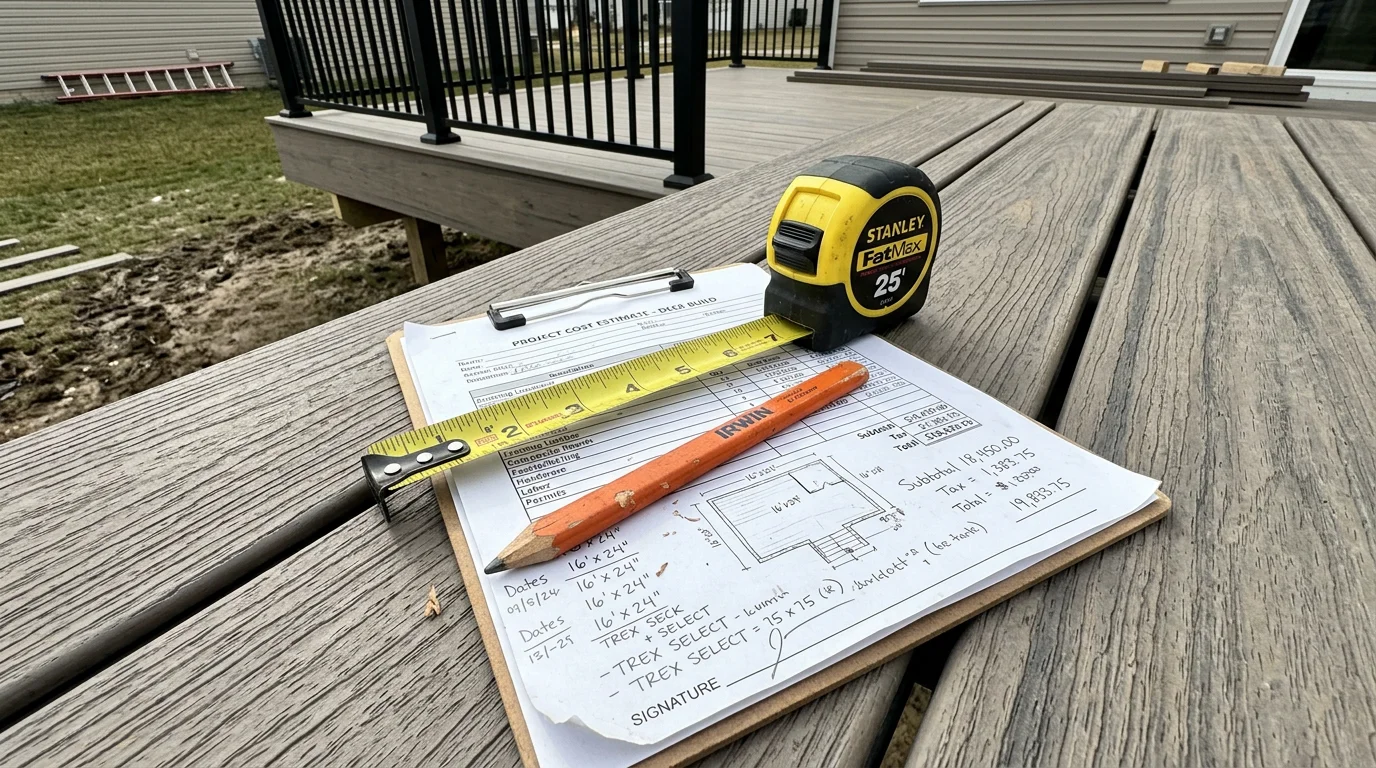
You want a deck. You know what it costs — somewhere between $15,000 and $40,000 for a professionally built deck in Ontario. But you don't have that sitting in your chequing account, and you're not alone. (Not sure what yours will cost? Use our complete Ontario deck cost guide for accurate estimates.)
Most Ontario homeowners finance their deck projects. The question isn't whether to finance — it's which option costs you the least and fits your situation.
Here's every financing option available to Ontario homeowners in 2026, with real monthly payment examples, true costs, and the honest pros and cons of each.
Your Financing Options at a Glance
| Option | Rate Range (2026) | Best For | Approval Difficulty |
🏗️ Planning a deck project?
Get a free manual project review, or visualize your dream deck with AI before requesting quotes.
|--------|-------------------|----------|-------------------|
| HELOC | 6.45-7.95% | Homeowners with equity | Moderate |
| Home Equity Loan | 6.50-8.50% | Fixed payment preference | Moderate |
| Personal Loan | 7.99-15.99% | No home equity / renters | Easy-Moderate |
| Contractor Financing | 0-14.99% | Convenience, promos | Easy |
| Credit Card | 19.99-29.99% | Small purchases only | Easy |
| Line of Credit (unsecured) | 8.99-12.99% | Flexibility | Moderate |
Option 1: HELOC (Home Equity Line of Credit)
The best option for most Ontario homeowners with equity.
A HELOC lets you borrow against the equity in your home at rates significantly lower than personal loans or credit cards. In February 2026, Ontario HELOC rates range from 6.45% to 7.95% at major banks and credit unions.
How It Works
- You get approved for a credit limit based on your home equity (typically up to 65% of home value minus mortgage balance)
- Draw funds as needed — you only pay interest on what you use
- Variable rate tied to prime (currently prime + 0.50% to prime + 1.50%)
- Interest-only payments during the draw period
- Revolving — repay and reborrow as needed
Monthly Payment Examples (Interest Only)
At 7.00% HELOC rate:
- $15,000 deck: $87.50/month (interest only)
- $25,000 deck: $145.83/month (interest only)
- $40,000 deck: $233.33/month (interest only)
If you make principal payments (recommended), at $500/month on a $25,000 balance:
- Paid off in approximately 4.5 years
- Total interest paid: ~$3,800
Pros
- Lowest rates available (secured by your home)
- Flexible draw schedule — pay your contractor in stages
- Interest-only minimum payments keep monthly costs low
- Interest may be tax-deductible if used for home improvement (consult your accountant)
- No prepayment penalties
Cons
- Your home is collateral — defaulting risks foreclosure
- Variable rate means payments can increase if Bank of Canada raises rates
- Requires sufficient home equity (need at least 20-35% equity)
- Application process takes 2-4 weeks (appraisal may be required)
- Annual fees at some lenders ($50-150/year)
Best Banks for HELOCs in Ontario (2026)
- TD Canada Trust: Prime + 0.50% (strong online tools)
- Tangerine: Competitive rates, no annual fee
- Desjardins: Often lowest posted rates
- Local credit unions (Meridian, DUCA): May offer prime + 0.00% for qualified borrowers
Option 2: Home Equity Loan (Fixed-Rate Second Mortgage)
Best for homeowners who want predictable payments.
Unlike a HELOC, a home equity loan gives you a lump sum at a fixed interest rate with fixed monthly payments. Think of it as a second mortgage specifically for your deck project.
Monthly Payment Examples (Fixed Rate, 5-Year Term)
At 7.50% fixed rate:
- $15,000 deck: $300/month → Total paid: $18,020 (interest: $3,020)
- $25,000 deck: $501/month → Total paid: $30,033 (interest: $5,033)
- $40,000 deck: $801/month → Total paid: $48,053 (interest: $8,053)
Pros
- Fixed rate = predictable payments
- Lump sum simplifies contractor payment
- Lower rates than personal loans
- Structured repayment (forces discipline)
Cons
- Higher rates than HELOC (typically 0.50-1.00% more)
- Less flexible — you borrow a fixed amount
- Same equity requirements as HELOC
- May have setup fees ($500-1,500)
Option 3: Personal Loan (Unsecured)
Best for homeowners without sufficient equity or renters.
Personal loans don't require your home as collateral, but you'll pay higher interest rates as a result. Ontario rates in 2026 range from 7.99% to 15.99% depending on your credit score and lender.
Monthly Payment Examples (5-Year Term)
At 10.99% (mid-range rate for good credit):
- $15,000 deck: $326/month → Total paid: $19,550 (interest: $4,550)
- $25,000 deck: $543/month → Total paid: $32,583 (interest: $7,583)
- $40,000 deck: $869/month → Total paid: $52,133 (interest: $12,133)
Who Gets the Best Rates?
- Credit score 750+: 7.99-9.99%
- Credit score 680-749: 9.99-12.99%
- Credit score 600-679: 12.99-15.99%
- Credit score below 600: May not qualify, or rates above 15.99%
Best Personal Loan Lenders in Ontario (2026)
- Tangerine: 7.99-12.49% (existing clients get best rates)
- TD: 8.49-12.99%
- Meridian Credit Union: Competitive rates for members
- Borrowell / Loans Canada: Comparison platforms to find your best rate
Pros
- No home equity required
- Faster approval (often 1-5 business days)
- Fixed rate and fixed payments
- No risk to your home
- Available to renters
Cons
- Higher rates than secured options
- Maximum amounts may cap at $35,000-$50,000
- Monthly payments are higher
- Reduces your borrowing capacity for other needs
Option 4: Contractor Financing
Best for convenience and promotional 0% offers.
Many Ontario deck guides builders offer financing through partnerships with lenders like Financeit, PayBright (Affirm), or their own in-house programs.
How It Works
- Apply at the contractor's office or online (soft credit check, then hard pull if proceeding)
- Approval typically takes minutes to hours
- Funds go directly to the contractor
- Repay in fixed monthly instalments
Typical Terms (2026)
- Promotional 0% financing: 6-18 months (if paid in full by end of promo period)
- Standard rates: 8.99-14.99% for 3-10 year terms
- Deferred interest: Some programs charge 0% but backdate all interest if you don't pay off within the promo window — read the fine print carefully
Monthly Payment Examples
At 9.99% over 5 years through Financeit:
- $15,000 deck: $318/month → Total paid: $19,100
- $25,000 deck: $531/month → Total paid: $31,833
- $40,000 deck: $849/month → Total paid: $50,933
Pros
- Convenient — arranged through your contractor
- Fast approval
- 0% promotional offers can save thousands if you pay on time
- One less thing to arrange separately
Cons
- Rates often higher than bank options (you're paying for convenience)
- Deferred interest traps — miss the payoff window and you owe all backdated interest
- Limited to that specific contractor (can't shop around with pre-approved funds)
- May include origination fees (2-5% of loan amount)
⚠️ Watch Out for Deferred Interest
Some "0% for 18 months" offers are actually deferred interest — meaning if you don't pay the full balance by month 18, you owe interest on the entire original amount retroactively. On a $25,000 deck at 14.99%, that's a surprise bill of $5,600+.
Always ask: "Is this true 0% or deferred interest?" Get it in writing.
Option 5: Credit Card
Only for small deck expenses or if you can pay off within 30 days.
At 19.99-29.99% interest, using a credit card to finance a full deck build is almost never a good idea. However, credit cards can make sense for:
- Material purchases to earn rewards points (pay off immediately)
- Small remaining balances after using another financing method
- Deposit payments while waiting for loan approval
Never carry a deck-sized balance on a credit card. A $25,000 balance at 21.99% costs over $5,000 in interest per year.
Option 6: Unsecured Line of Credit
A flexible middle ground.
An unsecured line of credit offers rates between personal loans and HELOCs (typically 8.99-12.99% in 2026) without requiring home equity as collateral.
Pros
- More flexible than a term loan
- Only pay interest on what you draw
- No home collateral required
- Good for staged payments to contractors
Cons
- Higher rates than HELOC
- Variable rates
- Requires good credit (700+) for best rates
- Credit limits may be lower than needed
Which Financing Option Should You Choose?
Decision Framework
You have 20%+ home equity → HELOC
- Lowest rates, most flexibility
- Use this unless you have a specific reason not to
You have home equity but want fixed payments → Home Equity Loan
- Slightly higher rate but payment certainty
- Good if rising rates worry you
You don't have home equity (or prefer not to use it) → Personal Loan
- Higher rates but no home risk
- Compare at least 3 lenders
Your contractor offers true 0% financing → Take It
- But only if it's TRUE 0%, not deferred interest
- And only if you can pay it off within the promotional period
You need less than $5,000 → Unsecured Line of Credit
- For smaller projects or topping up other financing
How to Get Approved: Tips for Ontario Homeowners
Before You Apply
1. Check your credit score (free at Borrowell or Credit Karma Canada). Aim for 680+ for decent rates, 750+ for the best rates.
2. Pay down credit card balances to reduce your credit utilization ratio below 30%
3. Gather documents: Recent pay stubs, T4s, Notice of Assessment, mortgage statement, property tax bill
4. Calculate your debt service ratios: Lenders want total debt payments below 40-44% of gross income (GDS/TDS ratios)
Boost Your Approval Odds
- Apply with your primary bank first — they have your history and may offer relationship pricing
- Consider a co-applicant if your income alone doesn't qualify
- Time your application: Apply after a raise, bonus, or paying off a car loan
- Don't apply to multiple lenders simultaneously — each hard credit check drops your score slightly. Use soft-check pre-qualification tools first.
Red Flags That Signal Trouble
If you find yourself in any of these situations, reconsider whether now is the right time:
- Monthly deck payment + mortgage + other debt exceeds 44% of gross income
- You'd be using credit card financing with no payoff plan
- The deck project keeps growing beyond your original budget
- You're financing because of lifestyle pressure rather than genuine need
A deck should improve your life, not create financial stress. If the numbers don't work comfortably, consider a smaller deck, more affordable materials, or waiting until your financial position improves.
Real-World Financing Scenarios
Scenario 1: The $15,000 Pressure-Treated Deck
*Sarah and Mike in Kitchener, household income $95,000, home value $650,000, mortgage balance $380,000*
- Available equity: ~$42,500 (65% of $650K - $380K)
- Best option: HELOC at 6.95%
- Monthly cost: ~$87/month interest-only, or ~$350/month to pay off in 4 years
- Total interest (4-year payoff): ~$2,100
Scenario 2: The $25,000 Composite Deck
*David in Waterloo, income $75,000, home value $550,000, mortgage $420,000*
- Available equity: ~$17,500 (limited)
- Best option: Personal loan at 10.49% over 5 years
- Monthly cost: ~$537/month
- Total interest: ~$7,220
Scenario 3: The $40,000 Multi-Level Deck
*The Chen family in Cambridge, household income $140,000, home value $850,000, mortgage $350,000*
- Available equity: ~$202,500 (ample)
- Best option: HELOC at 6.45%
- Monthly cost: ~$215/month interest-only, or ~$800/month to pay off in 5 years
- Total interest (5-year payoff): ~$7,100
🎨 Not sure which material to pick?
Upload a photo of your backyard and see exactly how Trex, TimberTech, or cedar would look — free and instant.
FAQ
Can I finance a deck with bad credit in Ontario?
Yes, but your options are limited and rates will be higher. Contractor financing through programs like Financeit may approve credit scores as low as 600. Some alternative lenders offer personal loans for lower credit scores at 14-19.99%. Avoid payday loans or high-interest private lenders for a home improvement project.
Is it better to save up or finance a deck?
If you can save the full amount within 6-12 months, saving avoids all interest costs. But if saving would take 2-3 years, financing at a reasonable rate (under 8%) often makes more sense — you get to enjoy the deck sooner, and material/labour costs increase 3-5% annually.
How much should I put down on a financed deck?
There's no required down payment for most deck financing options. However, putting down 20-30% reduces your loan amount and monthly payments significantly. Some contractor financing programs work better with a deposit.
Can I deduct deck financing interest on my taxes?
Generally, no. Home improvement loan interest is not tax-deductible in Canada for a primary residence. However, if the deck is on a rental property, the interest may be deductible as a rental expense. Consult a Canadian tax professional for your specific situation.
What credit score do I need to finance a deck?
For the best rates: 750+. For approval at reasonable rates: 680+. For basic approval: 600+. Below 600, options become limited and expensive. If your score is below 680, spend 3-6 months improving it before applying — the interest savings will likely exceed any material cost increase.
Should I get pre-approved before getting deck quotes?
Yes. Knowing your budget before meeting contractors prevents scope creep and gives you negotiating confidence. A HELOC or personal loan pre-approval typically lasts 60-120 days and doesn't commit you to borrowing.
Is 0% contractor financing really free?
Sometimes yes, sometimes no. True 0% financing means the contractor is absorbing the financing cost (they pay the lender's fee, typically 3-8% of the project cost). This is genuinely free money for you. Deferred interest 0% financing is NOT free — it's a trap if you don't pay in full by the deadline. Always ask which type it is and get confirmation in writing.
Related Articles
- Deck Financing Options in Ontario: Loans, HELOC, and More
- Deck Labour Cost in Ontario: What Builders Charge Per Hour (2026)
- Deck Repair Near Me in Ontario: How to Find the Right Contractor
- 20x20 Deck Cost in Ontario: Full Budget Breakdown
You may also find Deck Demolition Cost in Ontario: Removal, Hauling, Dump Fees helpful.
Upload a backyard photo and preview real decking materials with AI — free, instant, no sign-up.
Permits, costs, material comparisons, and questions to ask before requesting quotes — delivered to your inbox.