
Deck Permits in Niagara Falls (2026)
Find out if you need a deck permit in Niagara Falls, Ontario. Learn 2026 fees, building code requirements, setback rules, and how to apply step by step.
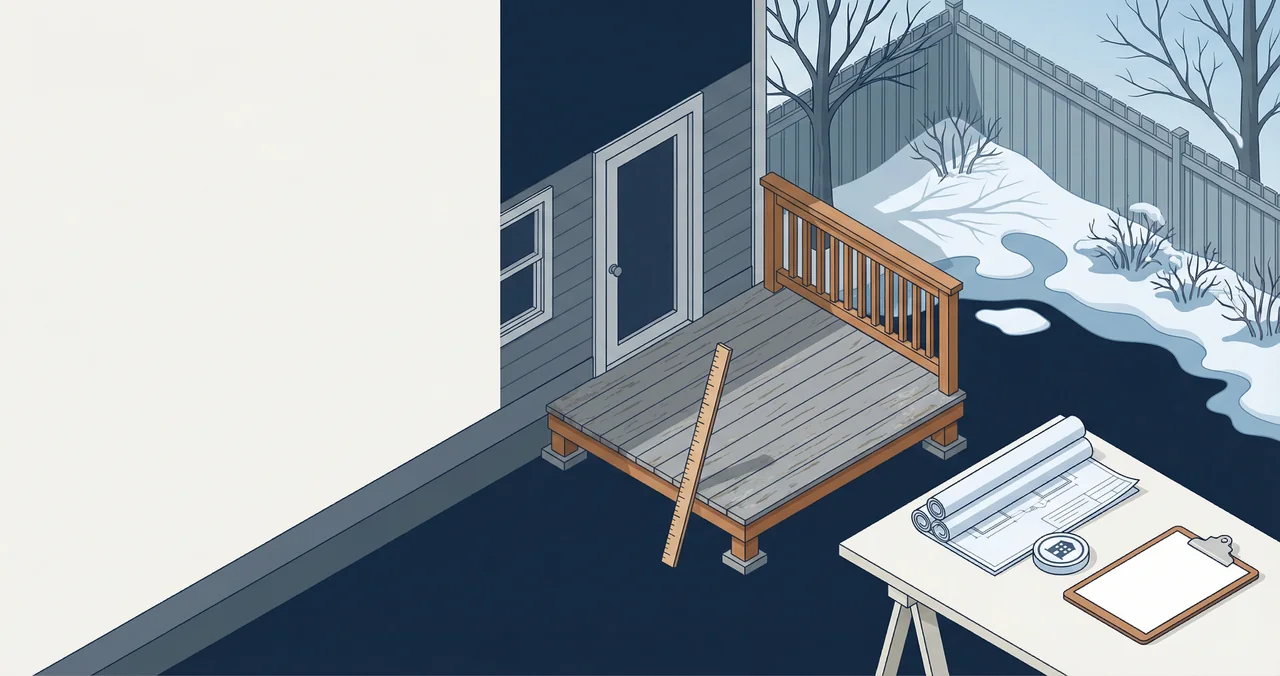
Planning a new deck in Niagara Falls, Ontario? Before you pick out decking boards or call a contractor, you need to answer one question first: do you need a building permit?
Looking for more regional information? Check out our Ontario Decking Hub.
Skip this step and you risk fines, forced removal, or serious headaches when you eventually sell your home. Here's everything Niagara Falls homeowners need to know about deck permits in 2026 — requirements, costs, timelines, and the exact steps to apply.
📋 Tool Alert: Permit Checker
Do you really need a permit? Check the exact rules for your city or township.
Check Permits →Do You Need a Deck Permit in Niagara Falls?
In most cases, yes. The City of Niagara Falls requires a building permit for decks that meet any of the following criteria:
🏗️ Planning a deck project?
Get a free manual project review, or visualize your dream deck with AI before requesting quotes.
- The deck surface is more than 24 inches (0.6 m) above finished grade
- The deck area exceeds 100 square feet (9.3 m²)
- The deck is attached to your house (structural connection to the building)
If your deck is both under 24 inches above grade and under 100 square feet and freestanding, you may not need a permit. But "may" is doing heavy lifting in that sentence. Municipal interpretations vary, and the City of Niagara Falls Building Services department can give you a definitive answer for your specific property.
Bottom line: If you're building anything beyond a small ground-level platform, budget for a permit. It's not optional — it's required under the Ontario Building Code (OBC).
For a deeper look at how attached and freestanding decks are treated differently, see our guide on attached vs. freestanding deck permits in Ontario.
When a Permit Is Required
Let's break this down further, because the 24-inch / 100 sq ft rule isn't the only trigger.
You Definitely Need a Permit If:
- Your deck is more than 24 inches above grade at any point — not just the average height
- The deck exceeds 100 sq ft in total area (that's roughly a 10×10 space — smaller than most useful decks)
- You're attaching the deck to your home's structure using a ledger board
- The deck includes a roof, pergola, or covered structure
- You're adding electrical or plumbing (hot tub hookups, outdoor kitchen gas lines, built-in lighting circuits)
- Stairs or railings are involved — railings are required on any deck surface 24 inches or more above grade under OBC
You Might Not Need a Permit If:
- The deck is freestanding, under 24 inches above grade, and under 100 sq ft
- You're building a ground-level floating deck with no structural attachment to the house
Even in these cases, setback and lot coverage rules still apply. You can build without a permit and still violate zoning bylaws — which creates its own set of problems.
Niagara Falls Climate Factor
Niagara Falls sits right in one of Ontario's harshest freeze-thaw zones. The city experiences heavy snowfall, ice storms, and temperature swings that can cycle above and below freezing dozens of times each winter. This matters for permits because the building inspector will verify your footings extend below the frost line — typically 48 to 60 inches deep in the Niagara Region.
Shallow footings that pass inspection in July can heave and crack by February. The permit process exists partly to prevent exactly this kind of failure. For more on choosing materials that withstand these conditions, check out the best decking materials for Ontario's freeze-thaw climate.
Permit Fees & Processing Time
How Much Does a Deck Permit Cost in Niagara Falls?
Deck permit fees in Niagara Falls are calculated based on the estimated construction value of your project. As of 2026, here's what to expect:
| Project Value | Approximate Permit Fee |
|---|---|
| Under $10,000 CAD | $150–$250 |
| $10,000–$25,000 CAD | $250–$500 |
| $25,000–$50,000 CAD | $500–$800 |
| Over $50,000 CAD | $800+ (scaled by value) |
These are approximate ranges. The City of Niagara Falls Building Services will calculate your exact fee when you submit your application. Fees may also include plan review charges and inspection fees.
To give you a sense of total project costs, here's what deck installation typically runs in the Niagara Falls area in 2026:
| Decking Material | Installed Cost (CAD/sq ft) |
|---|---|
| Pressure-treated wood | $30–$55 |
| Cedar | $40–$65 |
| Composite | $50–$85 |
| Trex (brand-name composite) | $55–$90 |
| Ipe (tropical hardwood) | $70–$120 |
For a standard 12×16 deck (192 sq ft), you're looking at roughly $5,760–$10,560 CAD for pressure-treated or $9,600–$16,320 CAD for composite, installed. Want a detailed cost breakdown? See our 12×16 deck cost guide for Ontario.
How Long Does Permit Approval Take?
Plan on 2 to 4 weeks for a standard residential deck permit in Niagara Falls. More complex projects — multi-level decks, structures near property lines, or anything requiring a variance — can take 6 to 8 weeks or longer.
Timing matters in Niagara Falls. The building season runs roughly May through October, and contractor schedules fill up fast. If you want to be building by May, submit your permit application by March at the latest. Waiting until April often means you won't break ground until midsummer.
Building Codes & Setback Rules
Ontario Building Code Requirements for Decks
Every deck in Niagara Falls must comply with the Ontario Building Code (OBC). Key requirements include:
Structural:
- Footings must extend below the frost line — minimum 48 inches deep in the Niagara Region, though 60 inches is common for added safety
- Beam and joist sizing must match OBC span tables based on lumber species, grade, and spacing
- Ledger board connections (for attached decks) require proper flashing, lag bolts or through-bolts, and must connect to the home's rim joist — never just to siding
Railings and Guards:
- Required on any deck surface 24 inches or more above grade
- Minimum railing height: 36 inches (42 inches recommended, and required in some situations under OBC for decks over 5.5 ft above grade)
- Baluster spacing: maximum 4 inches (a 4-inch sphere cannot pass through)
- Railings must withstand specific load requirements — no wobbly DIY railings
Stairs:
- Maximum riser height: 7.87 inches (200 mm)
- Minimum tread depth: 9.84 inches (250 mm)
- Consistent riser height throughout the staircase — variation of more than 3/8 inch between any two risers is a code violation
- Handrail required on at least one side for stairs with 3 or more risers
For an overview of railing systems that meet code, see the best deck railing systems in Canada.
Setback Rules in Niagara Falls
Setback requirements vary depending on your zoning designation, but typical residential setbacks in Niagara Falls include:
- Rear yard setback: 7.5 metres (approximately 25 feet) from the rear property line for the main structure; decks may project up to 1.5–2 metres into this setback depending on zoning
- Side yard setback: 1.2 metres (approximately 4 feet) minimum
- Lot coverage limits: Your deck counts toward your property's total lot coverage, which is typically capped at 35–45% in residential zones
Important: These are general guidelines. Your specific property may have different requirements based on its zoning classification, any easements, or proximity to environmental features like the Niagara River escarpment or Welland River corridor. The City's Planning & Development department can confirm your property's exact setback requirements.
If your property has easements, read our guide on building near an easement in Ontario before you submit plans.
Snow Load and Structural Considerations
This is where Niagara Falls deck building gets serious. The region sees significant snow accumulation, and the OBC specifies minimum snow load requirements for your area. Your deck must be engineered to handle:
- Ground snow loads specific to the Niagara Region (typically 1.5 to 2.0 kPa)
- Additional weight from ice buildup on railings and overhead structures
- Wind loads, especially for elevated decks or those with pergolas
If you're building a covered deck or pergola, snow load requirements increase substantially. Your designer or contractor should reference the OBC climatic data tables for Niagara Falls specifically.
How to Apply for a Deck Permit in Niagara Falls
Step 1: Gather Your Documents
Before contacting the Building Department, prepare:
- Site plan showing your property boundaries, existing structures, and the proposed deck location with dimensions and setback distances
- Construction drawings including plan view (top-down), elevation views, and cross-section details
- Structural details: footing size and depth, beam and joist sizes, post spacing, ledger board connection method
- Material specifications for decking, framing, and hardware
- Proof of property ownership or authorization from the property owner
- A completed building permit application form (available on the City of Niagara Falls website or at Building Services)
Use PaperPlan to visualize different decking materials on your own home before committing — it can help you finalize material choices before you draft your permit drawings.
Step 2: Submit Your Application
You can submit your deck permit application to:
City of Niagara Falls — Building Services
- In person: City Hall, 4310 Queen Street, Niagara Falls, ON
- Online: Check the City of Niagara Falls website for electronic submission options (availability varies)
Bring two copies of all drawings when submitting in person. Pay the application fee at the time of submission.
Step 3: Plan Review
Building Services reviews your plans for OBC compliance. This is where most delays happen. Common issues that trigger revision requests:
- Insufficient footing depth (remember — 48 to 60 inches minimum in this region)
- Missing or inadequate lateral bracing details
- Railing designs that don't meet code
- Setback violations
- Missing flashing details at ledger board connections
If revisions are needed, you'll receive written feedback. Address every comment and resubmit. Each revision cycle can add 1 to 2 weeks to your timeline.
Step 4: Permit Issuance and Inspections
Once approved, you'll receive your building permit. Post it visibly at the job site — this is a legal requirement.
Typical inspection stages for a deck project:
- Footing inspection — before pouring concrete (inspector verifies depth and size)
- Framing inspection — after framing is complete but before decking is installed
- Final inspection — completed deck with railings, stairs, and all finishes
Do not proceed to the next construction stage until the previous inspection passes. Building without inspections — even with a valid permit — can result in the work being rejected and potentially torn out.
Step 5: Final Approval
After the final inspection passes, the Building Department closes your permit file. Keep your permit documentation — you'll need it if you sell your home or refinance.
What Happens If You Build Without a Permit
Some homeowners think they can skip the permit and nobody will notice. Here's what actually happens:
Immediate Consequences
- Stop-work orders: If a building inspector spots unpermitted construction, they can issue an immediate stop-work order
- Fines: The City of Niagara Falls can issue fines under the Ontario Building Code Act — penalties can reach $25,000 for individuals and $50,000 for corporations per offence
- Forced removal: In worst-case scenarios, you may be ordered to demolish the deck entirely
Long-Term Problems
- Insurance issues: If someone is injured on an unpermitted deck, your homeowner's insurance may deny the claim. This is a massive liability
- Selling your home: Home inspections flag unpermitted structures. Buyers' lawyers will request proof of permits. No permit means renegotiation, price reductions, or deals falling through entirely
- Retroactive permits: You can apply for a permit after the fact, but the Building Department may require you to expose footings and framing for inspection — which means partially demolishing your finished deck
We've written a detailed breakdown of the risks of building a deck without a permit in Ontario. Read it before you decide to skip the process.
The Real Cost of Skipping a Permit
A deck permit in Niagara Falls costs roughly $150–$500 for most residential projects. Compare that to:
- $25,000 in potential fines
- $5,000–$15,000 to demolish and rebuild
- $10,000–$30,000 knocked off your home's sale price
The permit is the cheapest part of your entire project. Don't skip it.
🎨 Not sure which material to pick?
Upload a photo of your backyard and see exactly how Trex, TimberTech, or cedar would look — free and instant.
Frequently Asked Questions
How much does a deck permit cost in Niagara Falls, Ontario?
Most residential deck permits in Niagara Falls cost between $150 and $500 CAD, depending on the estimated construction value of your project. Larger or more complex decks with higher construction values will incur higher fees. Contact the City of Niagara Falls Building Services at City Hall (4310 Queen Street) for an exact quote based on your project scope.
Can I build a small deck without a permit in Niagara Falls?
Possibly. If your deck is freestanding (not attached to your house), under 24 inches above finished grade, and under 100 square feet, you may not need a building permit. However, zoning setback and lot coverage rules still apply regardless of permit requirements. Always confirm with Building Services before starting construction — a quick phone call can save you thousands in potential problems. For more on what you can and can't do yourself, see our guide on building your own deck in Ontario.
How long does it take to get a deck permit approved in Niagara Falls?
Standard residential deck permits typically take 2 to 4 weeks for approval. If your plans require revisions, each revision cycle adds another 1 to 2 weeks. Complex projects near property lines or requiring variances can take 6 to 8 weeks or more. Submit your application by March if you want to start building in May — the Niagara Falls building season is short and contractor availability drops fast.
What inspections are required for a deck in Niagara Falls?
You'll typically need three inspections: a footing inspection (before pouring concrete), a framing inspection (after structural work is done but before decking boards go on), and a final inspection (completed deck with railings and stairs). Each inspection must pass before you move to the next phase. Your permit will outline the specific inspections required for your project.
Do I need a permit to replace an existing deck in Niagara Falls?
Generally, yes. If you're replacing an existing deck — even if it's the same size and in the same location — you typically need a new building permit. The new construction must meet current Ontario Building Code standards, which may have changed since the original deck was built. This is especially true for footing depth requirements and railing specifications. If you're simply resurfacing (replacing decking boards only, no structural changes), a permit may not be required, but confirm with Building Services to be certain.
📋 Planning a deck project?
Get a free manual project review from our team — no obligation, no spam.
Get Free Project Review →Upload a backyard photo and preview real decking materials with AI — free, instant, no sign-up.
Permits, costs, material comparisons, and questions to ask before requesting quotes — delivered to your inbox.