
Deck Permits in Ottawa (2026)
Need a deck permit in Ottawa? Learn requirements, fees, processing times, setback rules, and how to apply. Updated for 2026 with local building codes.
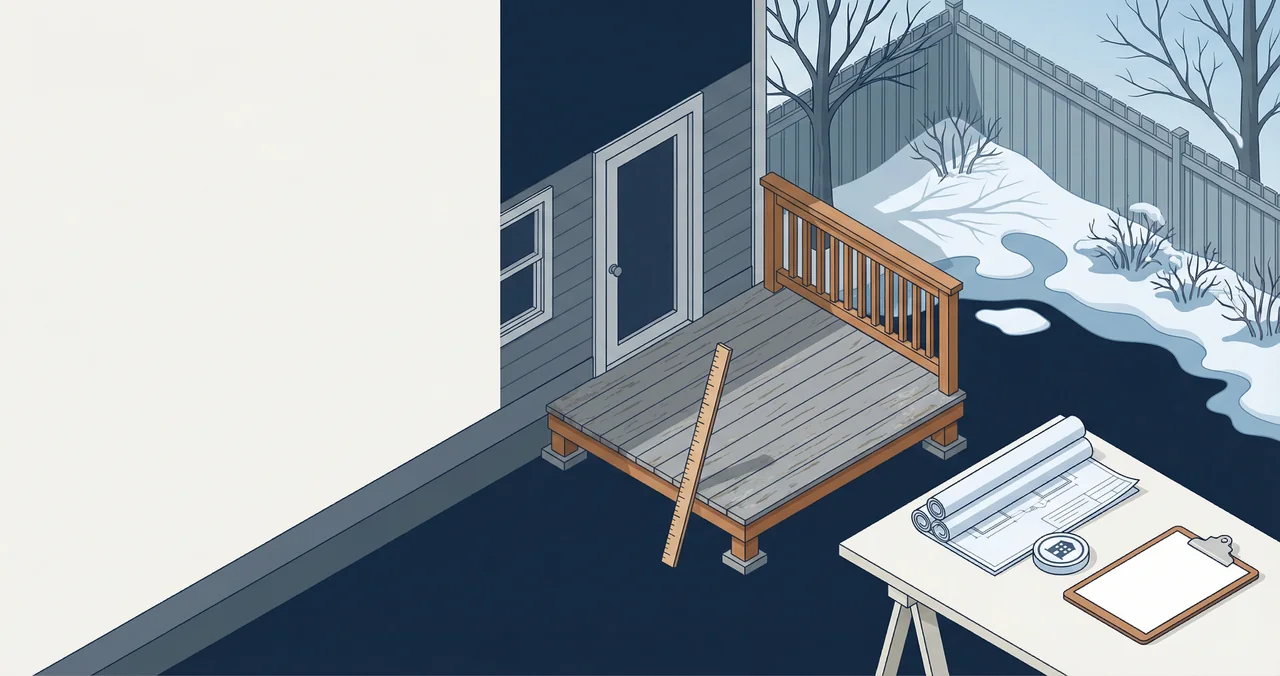
Do You Need a Deck Permit in Ottawa?
If your deck will be more than 24 inches (600 mm) above finished grade or larger than 100 square feet (10 m²), the City of Ottawa requires a building permit before you start construction. That covers the vast majority of backyard deck projects.
🏗️ Planning a deck project?
Get a free manual project review, or visualize your dream deck with AI before requesting quotes.
Looking for more regional information? Check out our Ontario Decking Hub.
Even a modest 12x12 deck attached to your home almost certainly needs one. Freestanding ground-level platforms under 24 inches might be exempt — but "might" is doing a lot of heavy lifting in that sentence. The rules depend on your specific lot, zoning, and whether the deck is attached to the house.
Bottom line: Call Ottawa's Building Code Services at 311 or check the City of Ottawa's building permit portal before you order a single board. A 10-minute phone call can save you thousands in fines and rework.
📋 Tool Alert: Permit Checker
Do you really need a permit? Check the exact rules for your city or township.
Check Permits →When a Permit Is Required
Ottawa follows the Ontario Building Code (OBC), and the city's zoning by-law (By-law 2008-250) adds local requirements on top. Here's when you need a permit — and when you don't.
You Need a Permit If:
- Your deck is more than 24 inches (600 mm) above adjacent finished grade at any point
- The deck exceeds 100 sq ft (10 m²) in area
- The deck is attached to your home (structural connection to the building)
- You're adding a roof, pergola, or enclosed structure over the deck
- The project involves electrical, plumbing, or gas lines (outdoor kitchen, hot tub hookup)
- You're building within the required setback zones from property lines
You Likely Don't Need a Permit If:
- The deck is freestanding (not attached to the house), under 100 sq ft, and under 24 inches above grade
- You're building a simple ground-level patio on grade using pavers or flagstone (no structure)
A common mistake Ottawa homeowners make: assuming a small attached deck is exempt. If it's bolted to your house, it needs a permit regardless of size in most cases. The structural connection to your home's ledger board is the key trigger.
For a deeper look at how attached and freestanding decks are treated differently under Ontario rules, see attached vs. freestanding deck permits in Ontario.
Permit Fees & Processing Time
What You'll Pay
Ottawa's building permit fees for residential decks are based on project value. As of 2026:
| Project Detail | Estimated Fee |
|---|---|
| Permit application fee | $100–$200 CAD (base fee) |
| Per $1,000 of construction value | $10.95–$13.50 CAD |
| Typical deck permit total | $150–$500 CAD |
| Zoning review (if required) | $75–$150 CAD |
For a standard 12x16 pressure-treated deck costing around $6,000–$10,000 CAD to build, expect a permit fee in the $200–$350 range. A larger composite deck valued at $20,000+ could push the fee closer to $400–$500.
Fees are set by the city and updated periodically. Confirm exact numbers on Ottawa's building permit fee schedule or by calling 311.
How Long Does It Take?
- Simple deck projects: 10–20 business days for residential review
- Complex projects (multi-level decks, structures near setback limits, heritage overlays): 4–8 weeks
- Incomplete applications: Add weeks. Missing drawings or site plans are the #1 cause of delays.
Pro tip for Ottawa's short building season: Submit your permit application in February or March. Approval by April means your contractor can start in May when the ground thaws. Wait until May to apply and you might not break ground until July — with contractor schedules already packed. For more on timing your project, check out the best time to build a deck in Ontario.
Building Codes & Setback Rules in Ottawa
Ontario Building Code Requirements
Ottawa decks must meet OBC structural standards. The key requirements:
- Footings must extend below the frost line — in Ottawa, that's 48 inches (4 feet) minimum, though some areas require up to 60 inches. Ottawa's freeze-thaw cycles are brutal, and shallow footings will heave.
- Guard rails are mandatory on any deck surface more than 24 inches above grade — minimum 42 inches high with openings no larger than 4 inches (to prevent children from passing through)
- Structural connections: Ledger boards must be lag-bolted to the house framing with proper flashing. Nails alone don't meet code.
- Load requirements: Decks must support a minimum live load of 40 psf (1.9 kPa) plus dead load. Snow load in Ottawa adds to this — your engineer or designer should account for snow loads of 1.5–2.4 kPa depending on roof exposure.
- Stair requirements: Minimum 36-inch width, consistent riser height (max 7.87 inches / 200 mm), minimum tread depth of 9.75 inches (248 mm), and a graspable handrail on at least one side.
Setback Rules (Zoning By-law 2008-250)
Setbacks determine how close your deck can be to property lines. In Ottawa's residential zones:
| Zone Type | Rear Yard Setback | Interior Side Yard | Exterior Side Yard |
|---|---|---|---|
| R1 (single detached) | 7.5 m typical | 1.2–1.8 m | 4.5 m |
| R2/R3 (semi/row) | 7.5 m typical | 1.2 m | 4.5 m |
Deck projections: Uncovered decks can often project into the required rear yard setback by up to 1.5 metres, but this varies by zone. Covered decks or decks with privacy walls may not qualify for this projection.
Important for Ottawa neighbourhoods: Older areas like The Glebe, Westboro, and Old Ottawa South may fall under heritage overlay zones with additional restrictions. Properties in these areas often require a Heritage Permit on top of the building permit, adding 2–4 weeks to the process.
If your lot backs onto an easement or right-of-way, your buildable area shrinks further. See building near an easement in Ontario for details on how that affects deck placement.
Ottawa-Specific Climate Considerations
Ottawa's climate punishes poorly built decks. Code compliance isn't just paperwork — it's protection against:
- Frost heave: Footings that don't reach 48"+ will shift. Sonotube piers poured below the frost line are standard practice here.
- Snow load: A 200 sq ft deck can hold 3,000+ pounds of snow in a heavy winter. Your structure needs to handle it.
- Freeze-thaw cycling: Ottawa sees 30+ freeze-thaw cycles per year. This cracks concrete, warps wood, and loosens fasteners. Composite and PVC decking handles this far better than untreated wood.
- Ice dam potential: Where a deck attaches to the house, improper flashing leads to ice dams and water infiltration into your walls.
Choosing the right materials matters as much as the structure itself. For a breakdown of what holds up best in this climate, read best decking materials for Ontario's freeze-thaw cycles.
How to Apply for a Deck Permit in Ottawa
Step 1: Gather Your Documents
Ottawa requires these for a residential deck permit application:
- Completed application form (available on the City of Ottawa website or at Client Service Centres)
- Site plan showing your property boundaries, the house footprint, the proposed deck location, and distances to all property lines (drawn to scale)
- Construction drawings including plan view, cross-section, elevation views, footing details, and connection details
- Structural specifications — beam sizes, joist spacing, post sizes, footing dimensions, and hardware
- Proof of property ownership or authorization from the owner
For straightforward decks, many Ottawa contractors prepare the drawings as part of their quote. For larger or multi-level decks, you may need a structural engineer to stamp the drawings ($500–$1,500 CAD).
Use PaperPlan to visualize different decking materials on your own home before committing — it helps when planning your layout and choosing between composite, cedar, or pressure-treated options before finalizing drawings.
Step 2: Submit Your Application
You have two options:
- Online: Through the City of Ottawa's e-permitting portal. Upload your documents, pay fees by credit card, and track status online. This is the faster route.
- In person: At a Client Service Centre (Ben Franklin Place at 101 Centrepointe Drive is the main location for building permits).
Step 3: Wait for Review
The city reviews your plans against the OBC and zoning by-law. They may come back with:
- Approval as submitted — you're good to build
- Conditional approval — minor changes needed
- Request for more information — usually missing dimensions or unclear footing details
Step 4: Build and Inspect
Once approved:
- Post your permit visibly on the job site (required by law)
- Call for inspections at the stages specified on your permit — typically footing/foundation inspection (before pouring concrete) and final inspection (completed deck)
- Don't cover footings before the footing inspection. Inspectors need to see the depth and rebar placement.
Failed inspections mean rework. Common reasons: footings not deep enough, guard rail height off, missing joist hangers, or ledger board improperly attached.
What Happens If You Build Without a Permit
Skipping the permit is tempting. The fees seem high, the timeline feels slow, and your neighbour built their deck without one — so why bother?
Here's why:
- Fines up to $25,000 for individuals under the Ontario Building Code Act, and up to $50,000 for corporations
- Stop-work orders — an inspector can halt your project mid-build
- Forced removal — the city can order you to tear down a non-compliant deck at your expense
- Insurance problems — your homeowner's insurance may deny claims for injuries on an unpermitted deck
- Sale complications — home inspectors flag unpermitted structures. Buyers negotiate down or walk away. You may be required to retroactively permit and bring the deck to current code before closing, which often costs more than doing it right the first time.
A retroactive permit (called an "after-the-fact" permit) in Ottawa typically costs 1.5–2x the normal permit fee, and you still need to prove the deck meets code — which may mean opening up the structure for inspection.
For the full picture on risks, see building a deck without a permit in Ontario.
🎨 Not sure which material to pick?
Upload a photo of your backyard and see exactly how Trex, TimberTech, or cedar would look — free and instant.
Frequently Asked Questions
How much does a deck permit cost in Ottawa?
Most Ottawa homeowners pay between $200 and $500 CAD for a residential deck permit. The exact amount depends on your project's construction value. The city charges a base application fee plus a per-$1,000 rate. A standard 12x16 pressure-treated deck runs about $250–$350 in permit fees. Confirm current rates through Ottawa's 311 service.
How long does it take to get a deck permit approved in Ottawa?
Plan for 10–20 business days for a straightforward deck. Complex projects involving setback variances, heritage overlays, or multi-level designs can take 4–8 weeks. Incomplete applications are the biggest delay — double-check that your site plan includes all required dimensions and your drawings show footing depths before submitting.
Can I build a small deck without a permit in Ottawa?
Possibly. A freestanding deck under 100 sq ft and under 24 inches above grade may be exempt from a building permit. However, it still must comply with zoning setbacks and the Ontario Building Code. "Exempt from a permit" does not mean "exempt from the rules." When in doubt, confirm with Ottawa Building Code Services — it's a free phone call that could save you a major headache.
Do I need a permit for a ground-level deck or floating deck in Ottawa?
If the deck is freestanding (not attached to your house), under 24 inches above finished grade, and under 100 sq ft, you generally don't need a building permit. But ground-level decks still need proper drainage and should use rot-resistant materials. Ottawa's clay-heavy soil retains moisture, so ground contact without proper airflow leads to rapid wood decay. Consider composite or pressure-treated lumber rated for ground contact. For help choosing materials, check out low-maintenance decking options for Canada.
What inspections are required for a deck permit in Ottawa?
Ottawa typically requires two inspections: a footing inspection before you pour concrete or backfill (the inspector checks depth, diameter, and rebar placement), and a final inspection of the completed deck. Some projects may require additional inspections for framing or electrical work. You're responsible for scheduling each inspection through the city — don't proceed to the next stage until you pass. Failed inspections require corrections and a re-inspection, which can add days or weeks to your build timeline.
What's the cost to actually build a deck in Ottawa?
Beyond the permit, here's what the deck itself typically costs in 2026:
| Material | Installed Cost (CAD/sq ft) |
|---|---|
| Pressure-treated wood | $30–$55 |
| Cedar | $40–$65 |
| Composite | $50–$85 |
| Trex (brand-name composite) | $55–$90 |
| Ipe (tropical hardwood) | $70–$120 |
For a detailed breakdown based on popular sizes, see 12x16 deck costs in Ontario or 16x20 deck costs in Ontario.
📋 Planning a deck project?
Get a free manual project review from our team — no obligation, no spam.
Get Free Project Review →Upload a backyard photo and preview real decking materials with AI — free, instant, no sign-up.
Permits, costs, material comparisons, and questions to ask before requesting quotes — delivered to your inbox.