
Deck Permits in St. Catharines (2026)
Need a deck permit in St. Catharines? Learn when permits are required, current fees, building codes, setback rules, and how to apply step by step in 2026.
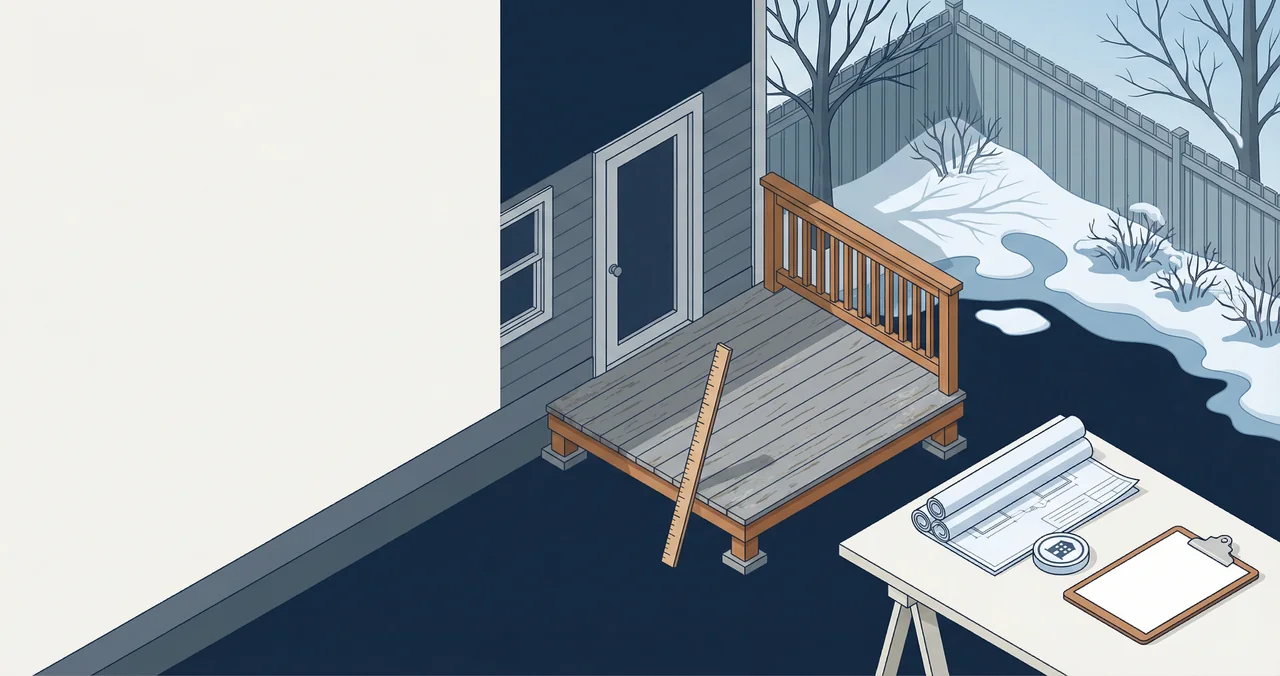
Planning a new deck in St. Catharines? Before you pick out materials or call a contractor, you need to answer one question first: do you need a building permit?
Looking for more regional information? Check out our Ontario Decking Hub.
The short answer for most homeowners — yes, you probably do. St. Catharines follows the Ontario Building Code (OBC), and the city's Building Services Division enforces permit requirements for most deck projects. Skip this step and you're looking at fines, forced removal, or serious headaches when you sell your home.
Here's everything you need to know to get your permit sorted before the 2026 building season kicks off.
📋 Tool Alert: Permit Checker
Do you really need a permit? Check the exact rules for your city or township.
Check Permits →Do You Need a Deck Permit in St. Catharines?
In St. Catharines, a building permit is required for any deck that is more than 24 inches (0.6 m) above finished grade or exceeds 100 square feet (approximately 10 m²) in area. This applies whether the deck is attached to your house or freestanding.
🏗️ Planning a deck project?
Get a free manual project review, or visualize your dream deck with AI before requesting quotes.
That 24-inch threshold catches most homeowners off guard. If your backyard slopes even slightly — common in areas like Glendale, Grantham, or along the Twelve Mile Creek corridor — you can easily exceed that height on the low side of your lot without realizing it.
You likely need a permit if your deck:
- Is higher than 24 inches above grade at any point
- Is larger than 100 sq ft
- Is attached to your home's structure
- Includes a roof, pergola, or overhead covering
- Has stairs with more than two risers
- Is being built over a basement walkout
You may be exempt if your deck is:
- 24 inches or less above finished grade at all points AND under 100 sq ft
- A ground-level platform sitting directly on grade (no footings)
- Not attached to the house
Even if you think you're exempt, call St. Catharines Building Services at (905) 688-5601 ext. 1511 to confirm. It takes five minutes and could save you thousands. The rules around attached vs. freestanding decks affect permit requirements differently, and staff can clarify your specific situation.
When a Permit Is Required
Let's break this down by the types of deck projects St. Catharines homeowners typically tackle:
Standard Backyard Deck (12x16 to 20x20)
If you're building a typical backyard deck — say a 12x16 or 16x20 — you need a permit. No exceptions. These decks exceed both the size and height thresholds in almost every case.
A 12x16 deck in Ontario runs 192 sq ft, nearly double the 100 sq ft exemption limit. Even a modest 10x12 deck at 120 sq ft requires a permit.
Raised or Multi-Level Decks
Any raised deck in St. Catharines needs a permit. Full stop. The city pays close attention to these because of snow load requirements and the structural demands of Ontario winters. A deck that's 4 or 5 feet above grade carries significant safety implications — railings, beam spans, and footing depth all need to meet code.
Deck Replacements and Major Repairs
Replacing your deck boards? If you're keeping the existing structure (joists, beams, footings) and not changing the footprint, you typically don't need a permit. But if you're replacing the substructure, expanding the deck, or changing the height, you're back in permit territory.
Covered Decks, Screened Porches, and Pergolas
Adding a roof structure over your deck always requires a permit. This includes screened-in porches, pergola covers, and shade structures. These affect wind load and snow load calculations — a real concern in St. Catharines where snow loads can reach 1.5 kPa or higher per the OBC.
Permit Fees & Processing Time
St. Catharines calculates building permit fees based on the construction value of the project. As of 2026, expect the following:
| Project Type | Estimated Fee Range (CAD) |
|---|---|
| Standard deck (under $10,000 value) | $150 – $300 |
| Mid-size deck ($10,000 – $25,000 value) | $300 – $500 |
| Large or complex deck ($25,000+) | $500 – $800+ |
The minimum permit fee is typically around $150 CAD. Fees are calculated as a percentage of construction value (roughly $10–$12 per $1,000 of construction value), but contact Building Services for the current fee schedule.
Processing Timeline
- Standard deck permits: 10 to 20 business days for review
- Complex projects (multi-level, roofed structures): 3 to 6 weeks
- Revisions or resubmissions: Add another 5 to 10 business days
Pro tip: Submit your application by late February or early March. St. Catharines contractors start booking up fast once spring hits, and a delayed permit means a delayed build. If you're hoping to start construction in May — the beginning of the best building window in Ontario — you need that permit in hand well before.
Building Codes & Setback Rules
St. Catharines follows the Ontario Building Code (OBC 2024), supplemented by the city's own zoning bylaw. Here's what matters for your deck project.
Setback Requirements
Setbacks determine how close your deck can be to your property lines. In most residential zones in St. Catharines:
- Rear yard setback: Typically 7.5 m (24.6 ft) from the rear lot line to the main building, but decks may project into this setback by up to 1.5 m (5 ft) in some zones
- Interior side yard: Usually 1.2 m (4 ft) minimum, though this varies by zone
- Exterior side yard (corner lots): 4.5 m (14.8 ft) is common
- Lot coverage: Your deck counts toward total lot coverage, which is typically capped at 35–40% in residential zones
These numbers vary by zoning designation. Properties in older neighbourhoods like Merritton, Facer, or downtown may have different setbacks than newer subdivisions in the north end. Always verify your specific zoning designation — you can look this up on the City of St. Catharines zoning map or call Planning Services.
Structural Code Requirements
The OBC mandates specific structural standards. For St. Catharines decks:
- Frost line depth: Footings must extend to a minimum of 48 inches (1.2 m) below grade — this is critical in the Niagara Region where freeze-thaw cycles are relentless
- Railing height: Minimum 36 inches (900 mm) for decks up to 5.9 ft (1.8 m) above grade; 42 inches (1,070 mm) for anything higher
- Baluster spacing: Maximum 4 inches (100 mm) between balusters — a child's head must not be able to pass through
- Joist sizing and spacing: Depends on span and species; typically 2x8 or 2x10 pressure-treated lumber at 16-inch centres
- Beam sizing: Based on span tables in the OBC; your designer or contractor handles this
- Snow load: Designed for minimum 1.5 kPa ground snow load in the Niagara Region
- Guard requirements: Required on any deck surface more than 24 inches above grade
Climate-Specific Considerations
St. Catharines sits in a unique climate pocket. The Niagara Region gets lake-effect moisture from both Lake Ontario and Lake Erie, which means:
- Heavy freeze-thaw cycling — footings that aren't deep enough will heave, cracking your deck structure over time
- High moisture exposure — pressure-treated wood needs annual sealing to hold up; without it, expect splitting and greying within 2–3 seasons
- Snow and ice loads — your deck structure needs to handle sustained snow weight through January and February
- Salt exposure — if you use de-icing products on your deck stairs, composite and PVC materials hold up far better than wood
For materials that handle these conditions best, check out this breakdown of the best decking materials for Ontario's freeze-thaw climate.
How to Apply for a Deck Permit in St. Catharines
The application process is straightforward, but incomplete submissions are the number one cause of delays. Here's how to get it right the first time.
Step 1: Gather Your Documents
You'll need:
- Completed building permit application form (available from the City of St. Catharines website or in person at City Hall)
- Site plan / lot survey showing your property lines, existing structures, and the proposed deck location with dimensions and setbacks
- Construction drawings including:
- Plan view (bird's eye) with dimensions
- Cross-section/elevation drawings showing height above grade
- Footing details (depth, diameter, type)
- Framing plan (joist spacing, beam locations, post spacing)
- Railing details
- Ledger board attachment details (if attached to the house)
- Specifications for materials (decking, framing lumber, hardware)
Use PaperPlan to visualize different decking materials on your own home before committing — it helps you finalize your design before spending money on professional drawings.
Step 2: Submit Your Application
You can submit in two ways:
- In person at St. Catharines City Hall, 50 Church Street, Building Services counter
- Online through the City's building permit portal (check the city website for current digital submission options)
Pay the permit fee at the time of submission. Keep your receipt — you'll need your permit number to schedule inspections later.
Step 3: Wait for Review
The Plans Examiner reviews your submission against the OBC and local zoning. If everything checks out, you'll receive your approved permit. If there are issues, you'll get a list of required corrections.
Common reasons for rejection:
- Missing setback dimensions on the site plan
- Footing depth not meeting the 48-inch frost line requirement
- Inadequate ledger board connection details
- Railing height or baluster spacing not meeting code
- Exceeding lot coverage limits
Step 4: Build and Schedule Inspections
Once your permit is approved, you can start construction. St. Catharines typically requires two inspections:
- Footing inspection — before pouring concrete or backfilling around sonotubes
- Final inspection — after the deck is fully complete, including railings, stairs, and any electrical work
Do not backfill footings before the footing inspection. The inspector needs to verify depth and diameter. This is a common mistake that forces homeowners to dig everything up again.
Your permit is valid for 12 months from the date of issuance. If your project stalls, you can request an extension — but don't let it lapse, or you'll need to reapply and pay again.
What Happens If You Build Without a Permit
Tempted to skip the permit process? Here's what you're risking in St. Catharines — and it's not just a slap on the wrist.
Fines and Penalties
Under the Ontario Building Code Act, building without a required permit can result in fines of up to $50,000 for an individual and up to $100,000 for a corporation. St. Catharines bylaw enforcement doesn't hand out maximum fines for a backyard deck, but penalties of $500 to $5,000 are realistic, especially for repeat offenders or structures that pose safety risks.
Stop Work Orders and Forced Removal
The city can issue a stop work order at any point during construction. In worst-case scenarios — say your unpermitted deck encroaches on a setback or doesn't meet structural code — you may be ordered to tear it down entirely at your own expense.
Problems When Selling Your Home
This is where most homeowners get burned. When you sell your home, the buyer's lawyer will check for open permits and compare the property's structures against what's on file. An unpermitted deck can:
- Delay or kill a sale — buyers' lenders may refuse to finance a property with unpermitted structures
- Reduce your sale price — buyers will negotiate down to cover the cost of bringing the deck up to code
- Void your insurance — if someone is injured on an unpermitted deck, your liability insurance may not cover you
For a deeper look at the risks, read about building a deck without a permit in Ontario.
What If You Already Built Without a Permit?
Contact Building Services proactively. You can apply for a permit retroactively, but expect:
- Double the standard permit fee (a common penalty for after-the-fact permits)
- A full inspection, which may require opening up parts of the structure
- Possible remediation work if the deck doesn't meet code
It's cheaper and less painful to get the permit upfront. Every time.
🎨 Not sure which material to pick?
Upload a photo of your backyard and see exactly how Trex, TimberTech, or cedar would look — free and instant.
Frequently Asked Questions
How much does a deck permit cost in St. Catharines?
Permit fees start at approximately $150 CAD and scale based on your project's construction value. A typical backyard deck permit runs $200 to $500 CAD. The fee is calculated as roughly $10–$12 per $1,000 of construction value. Contact Building Services at (905) 688-5601 ext. 1511 for an exact quote based on your project scope.
Can I build a small deck without a permit in St. Catharines?
Possibly. If your deck is 24 inches or less above finished grade at all points and under 100 square feet, you may be exempt from the building permit requirement. However, your deck must still comply with zoning bylaws (setbacks, lot coverage) and the Ontario Building Code. Even small decks near property lines or easements can create issues — always check the rules around building near easements before starting.
How deep do deck footings need to be in St. Catharines?
Deck footings in St. Catharines must extend to a minimum of 48 inches (1.2 m) below grade to get below the frost line. This is non-negotiable in the Niagara Region. Footings that are too shallow will heave during freeze-thaw cycles, causing your deck to shift, crack, and eventually become unsafe. Most contractors in the area use sonotubes with poured concrete extending to the full 48-inch depth.
How long does it take to get a deck permit in St. Catharines?
Plan for 10 to 20 business days for a standard deck permit review. Complex projects with roofed structures or multi-level designs can take 3 to 6 weeks. If your application requires revisions, add another 5 to 10 business days. Submit by late February or March if you want to start building in May — the shorter Ontario building season means timing matters.
Do I need a permit to replace my existing deck in St. Catharines?
It depends on the scope of work. Replacing deck boards only (keeping the existing substructure intact) generally doesn't require a permit. But if you're replacing joists, beams, or footings — or changing the deck's size, height, or footprint — you'll need a new building permit. When in doubt, a quick call to Building Services will clarify whether your replacement project qualifies as maintenance or new construction. If you're considering whether to build the deck yourself, keep in mind that permit requirements apply equally to DIY and contractor-built decks.
📋 Planning a deck project?
Get a free manual project review from our team — no obligation, no spam.
Get Free Project Review →Upload a backyard photo and preview real decking materials with AI — free, instant, no sign-up.
Permits, costs, material comparisons, and questions to ask before requesting quotes — delivered to your inbox.