
Deck Permits in Sudbury (2026)
Need a deck permit in Sudbury? Learn requirements, fees, setback rules, and how to apply. Avoid fines and delays — everything Sudbury homeowners need for 2026.
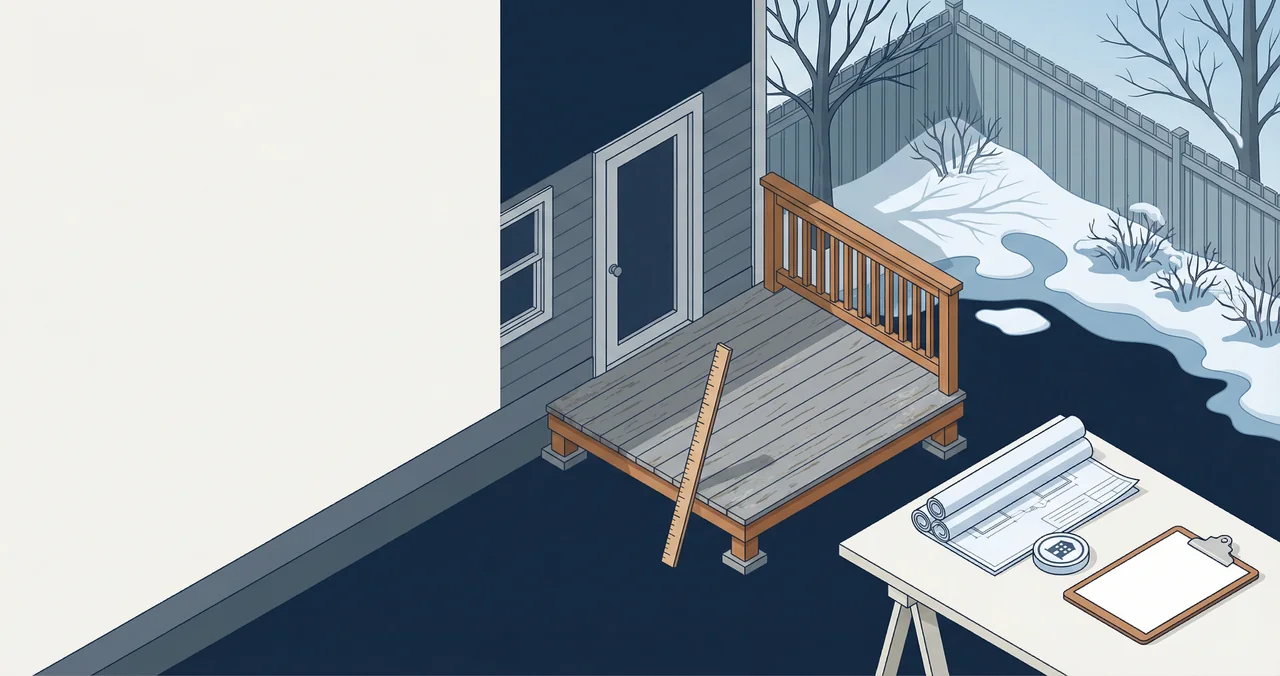
Planning a new deck in Greater Sudbury? Before you pick out materials or call a contractor, you need to figure out one thing first: do you need a building permit?
Looking for more regional information? Check out our Ontario Decking Hub.
The short answer for most Sudbury homeowners — yes, you probably do. The City of Greater Sudbury requires permits for most deck projects, and skipping this step can cost you far more than the permit itself. Fines, forced removal, and complications when you sell your home are all real risks.
Here's exactly what you need to know to get your deck permitted, built to code, and ready for Sudbury's punishing winters.
📋 Tool Alert: Permit Checker
Do you really need a permit? Check the exact rules for your city or township.
Check Permits →Do You Need a Deck Permit in Sudbury?
In Greater Sudbury, a building permit is required for any deck that is more than 24 inches (0.6 m) above finished grade or exceeds 100 square feet in area. This threshold catches the vast majority of backyard deck projects.
🏗️ Planning a deck project?
Get a free manual project review, or visualize your dream deck with AI before requesting quotes.
You do not need a permit if your deck meets all of these conditions:
- Less than 24 inches above grade at any point
- 100 square feet or smaller (roughly 10×10 feet)
- Not attached to the house (freestanding)
- Not covering an exit or means of egress
That small ground-level platform next to your garden? Probably fine without a permit. The raised deck off your kitchen with stairs? You need a permit.
Important: Even if your deck falls under the permit-exempt threshold, it still must comply with the Ontario Building Code (OBC) and local zoning bylaws. "No permit required" doesn't mean "no rules apply."
If you're unsure whether your specific project needs a permit, contact the City of Greater Sudbury Building Services Division at 311 or visit their office at Tom Davies Square. A five-minute phone call can save you months of headaches.
When a Permit Is Required
Let's break this down further, because certain deck features trigger permit requirements regardless of size:
Projects That Always Need a Permit
- Raised decks more than 24 inches above grade
- Attached decks connected to the house structure (these affect your home's structural integrity)
- Decks with roofs or overhead structures — pergolas, gazebos, or shade structures attached to a deck
- Decks with electrical or plumbing — hot tub installations, built-in lighting circuits, outdoor kitchens
- Multi-level decks with stairs and landings
- Decks over walkout basements or above a lower living space
Projects That May Be Exempt
- Small, freestanding ground-level platforms under 100 sq ft and under 24 inches high
- Replacement of decking boards on an existing permitted structure (same footprint, no structural changes)
- Minor repairs that don't alter the structure
When it comes to attached vs. freestanding decks, the permit requirements differ significantly. Freestanding decks under the size and height thresholds can sometimes avoid the permit process, but attached decks almost always require one because they involve fastening to your home's structure.
Permit Fees & Processing Time
How Much Does a Deck Permit Cost in Sudbury?
Permit fees in Greater Sudbury are based on the estimated construction value of your project. As of 2026, expect the following:
| Project Value | Approximate Permit Fee |
|---|---|
| Under $5,000 | $100–$150 |
| $5,000–$15,000 | $150–$300 |
| $15,000–$50,000 | $300–$600 |
| Over $50,000 | $600+ (scaled) |
These are approximate ranges. The city calculates fees based on a rate per $1,000 of construction value, plus a base application fee. For a typical 12×16 pressure-treated deck running $5,760–$10,560 installed, you're looking at a permit fee in the $150–$300 range. For a larger composite build — say a 16×20 deck — the permit fee could reach $300–$500.
Relative to total project cost, the permit fee is a rounding error. Don't let a few hundred dollars tempt you into skipping it.
Processing Time
Standard permit applications in Greater Sudbury typically take 10 to 20 business days to process. During peak building season (May through August), expect the longer end of that range.
Tips to speed things up:
- Submit a complete application — missing documents are the number one cause of delays
- Include detailed drawings with dimensions, materials, and footing specifications
- Apply in late winter or early spring (February–March) before the rush
- Consider hiring a designer or contractor who regularly submits to Sudbury's Building Services
Since Sudbury's effective building season runs roughly May through October, getting your permit squared away by March or April gives you the best shot at starting on time. Contractor schedules fill up fast when the season is this short — booking by March is not just smart, it's essential.
Building Codes & Setback Rules
Ontario Building Code Requirements
Your Sudbury deck must comply with the Ontario Building Code (OBC), which sets minimum standards for:
- Structural loads: Decks must support a minimum live load of 1.9 kPa (40 psf) plus dead loads. In Sudbury, snow load is a critical factor — the design snow load for Greater Sudbury is approximately 2.4 kPa (50 psf), which your structure and footings must accommodate.
- Railing height: Guard rails are required on any deck surface more than 24 inches above grade. Minimum height is 36 inches for residential decks up to 1.8 m above grade, and 42 inches for anything higher.
- Baluster spacing: Maximum 4 inches between balusters (a 4-inch sphere cannot pass through). No horizontal rails that children can climb.
- Stair requirements: Minimum 36-inch width, consistent rise and run, with handrails on at least one side. Rise between 125 mm and 200 mm, run between 210 mm and 355 mm.
- Ledger board connections: If attached to the house, the ledger must be properly flashed and bolted (not nailed) to the rim joist or structural framing.
Frost Line and Footing Depth
This is where Sudbury's climate makes a real difference. Frost line depth in the Greater Sudbury area ranges from 48 to 60 inches — among the deepest in Ontario. Your deck footings must extend below the frost line to prevent frost heave, which can shift and crack your entire structure.
Options for footings in Sudbury include:
- Concrete sono tubes sunk to a minimum of 4 feet deep (5 feet recommended for most Sudbury locations)
- Helical screw piles — increasingly popular because they can be installed year-round and aren't affected by freeze-thaw
- Concrete piers poured in place
Cutting corners on footing depth is the single most common — and most expensive — mistake in Northern Ontario deck building. A deck that shifts 2 inches in its first winter isn't just annoying; it's a structural failure.
For a deeper look at how freeze-thaw cycles impact your material choices, check out the best decking materials for Ontario's freeze-thaw climate.
Setback Rules
Greater Sudbury's zoning bylaws establish minimum setbacks that determine how close your deck can be to property lines:
- Rear yard setback: Typically 7.5 metres (varies by zone)
- Interior side yard setback: Typically 1.2 to 1.8 metres
- Exterior side yard (corner lots): Typically 4.5 metres
- Lot coverage maximums: Your deck counts toward total lot coverage — most residential zones cap this at 35–45%
These numbers vary by zoning designation (R1, R2, R3, etc.). Your specific property's zoning determines which rules apply. You can check your zoning designation through the City of Greater Sudbury's online mapping tool or by calling 311.
Pro tip: If your lot is tight and setbacks are a concern, a freestanding deck sometimes offers more flexibility in placement. But always verify with Building Services before assuming.
Sudbury-Specific Climate Considerations
Building code compliance isn't just paperwork — in Sudbury, it's the difference between a deck that lasts 25 years and one that fails in 5. Key factors:
- Snow load: Sudbury gets an average of 260+ cm of snow per year. Your deck structure, joists, and beams must handle the weight of accumulated snow, especially if it's a covered or semi-enclosed design.
- Freeze-thaw cycles: Sudbury experiences dozens of freeze-thaw cycles per season. Water gets into wood grain, freezes, expands, and splits the fibers. Composite and PVC decking hold up significantly better than wood in these conditions. If you go with pressure-treated lumber, budget for annual sealing to fight moisture and road salt damage.
- Ice dam potential: Where a deck meets the house, improper flashing can trap ice and cause water infiltration into your home. Proper ledger board flashing is non-negotiable.
Use PaperPlan to visualize different decking materials on your own home before committing — it's especially helpful when you're weighing the long-term durability tradeoffs between wood and composite in a harsh climate like Sudbury's.
How to Apply for a Deck Permit in Sudbury
Step-by-Step Process
1. Gather your documents. You'll need:
- A completed building permit application form (available from Greater Sudbury's Building Services or their website)
- A site plan showing your property boundaries, existing structures, the proposed deck location, and distances to all property lines
- Construction drawings including plan view, elevation views, cross-sections, and footing details
- Specifications for materials, fasteners, and finishes
- Proof of property ownership or authorization from the owner
2. Check your zoning. Before submitting, confirm your project complies with local zoning bylaws. You can do a preliminary zoning review through the city's planning department. This catches setback or lot coverage issues before they delay your permit.
3. Submit your application. Applications can be submitted at:
- In person: Building Services, Tom Davies Square, 200 Brady Street, Sudbury, ON P3A 5P3
- Online: Check the City of Greater Sudbury's website for electronic submission options (availability may vary)
4. Pay the fee. Fees are due at submission.
5. Wait for review. Building Services reviews your application for OBC and zoning compliance. If they need changes, they'll contact you with deficiency notes. Respond promptly — incomplete responses add weeks.
6. Receive your permit. Once approved, you'll get your building permit. Post it visibly at the construction site — this is a legal requirement.
7. Schedule inspections. Your permit will specify required inspections, typically:
- Footing inspection — before pouring concrete (inspector checks depth and diameter)
- Framing inspection — after the structure is built but before decking is installed
- Final inspection — completed deck with railings, stairs, and all safety features
Don't cover up work before it's inspected. Pouring concrete over uninspected footings means you might have to dig them up.
Can You DIY a Permitted Deck?
Yes. Ontario allows homeowners to build their own decks on their own property. You don't need to be a licensed contractor. However, you're still responsible for meeting all code requirements and passing inspections. The building inspector doesn't grade on a curve because you're a homeowner — the standards are identical.
If you're not confident in your ability to produce code-compliant drawings, consider hiring a designer or draftsperson to prepare the permit documents while you handle the construction.
What Happens If You Build Without a Permit
This is where things get expensive. The risks of building a deck without a permit in Ontario are serious:
Fines
Greater Sudbury can issue fines for unpermitted construction. Under the Ontario Building Code Act, penalties can reach $25,000 for individuals and $50,000 for corporations per offence. In practice, fines for residential deck violations are typically lower, but they're still significant — and the fine doesn't include the cost of fixing the problem.
Stop Work Orders
The city can issue a stop work order the moment they discover unpermitted construction. All work halts until you retroactively obtain a permit — which means going through the full application process while your half-built deck sits in the rain.
Retroactive Permits (and Demolition)
You can apply for a permit after the fact, but the process is harder:
- You may need to expose completed work for inspection (tear up decking to show joists, excavate around footings)
- If the work doesn't meet code, you'll need to modify or rebuild those components
- In worst cases, the city can order complete demolition of the unpermitted structure
Impact on Home Sales
When you sell your home, the buyer's lawyer will check permit records. An unpermitted deck can:
- Kill a sale entirely
- Require you to obtain a retroactive permit before closing
- Reduce your home's appraised value
- Create title insurance complications
Neighbour Complaints
An unpermitted deck that's too close to the property line or too tall is a prime target for neighbour complaints. Once a complaint is filed, the city is obligated to investigate. What might have been a $200 permit becomes a $5,000+ problem.
Bottom line: The permit costs a few hundred dollars. Skipping it can cost tens of thousands. The math isn't complicated.
🎨 Not sure which material to pick?
Upload a photo of your backyard and see exactly how Trex, TimberTech, or cedar would look — free and instant.
Frequently Asked Questions
How much does a deck permit cost in Sudbury?
Most residential deck permits in Greater Sudbury cost between $100 and $600 CAD, depending on the estimated construction value of your project. A typical backyard deck in the $8,000–$25,000 range will have a permit fee of roughly $150–$500. Fees are calculated on a per-$1,000-of-value basis plus a base application fee. Contact Building Services at 311 for an exact quote based on your project scope.
How long does it take to get a deck permit in Sudbury?
Plan for 10 to 20 business days from submission of a complete application. During peak season (May–August), processing times trend toward the longer end. Submitting a thorough, complete application — with all drawings, site plans, and specifications — is the best way to avoid delays. Apply by March or early April if you want to start building in May.
Can I build a deck without a permit in Sudbury?
You can build a small deck without a permit only if it meets all exemption criteria: under 24 inches above grade, under 100 square feet, freestanding (not attached to the house), and not obstructing any exit. If your deck exceeds any of these thresholds, a permit is required. Building without one when required exposes you to fines up to $25,000, stop work orders, and forced removal.
How deep do deck footings need to be in Sudbury?
Deck footings in Greater Sudbury must extend below the frost line, which is 48 to 60 inches deep depending on your specific location. Most contractors in the Sudbury area dig to a minimum of 5 feet to provide a safety margin. Inadequate footing depth leads to frost heave — your deck literally lifts and shifts as the ground freezes and thaws. This is the most critical structural element for any deck in Northern Ontario.
What's the best time to apply for a deck permit in Sudbury?
February or March. The building season in Sudbury is short — roughly May through October — and both permit reviewers and contractors are swamped once spring hits. Applying early gives you the best chance of having your permit in hand by the time the ground thaws. Pair this with choosing the right time to build and you'll set yourself up for a smooth project.
📋 Planning a deck project?
Get a free manual project review from our team — no obligation, no spam.
Get Free Project Review →Upload a backyard photo and preview real decking materials with AI — free, instant, no sign-up.
Permits, costs, material comparisons, and questions to ask before requesting quotes — delivered to your inbox.