
Ipe Deck Cost in Ontario: Is Hardwood Decking Worth It?
Ipe deck cost in Ontario ranges $95-150/sqft installed. Compare pricing, lifespan vs composite/cedar, and see if this premium hardwood is worth the investment.
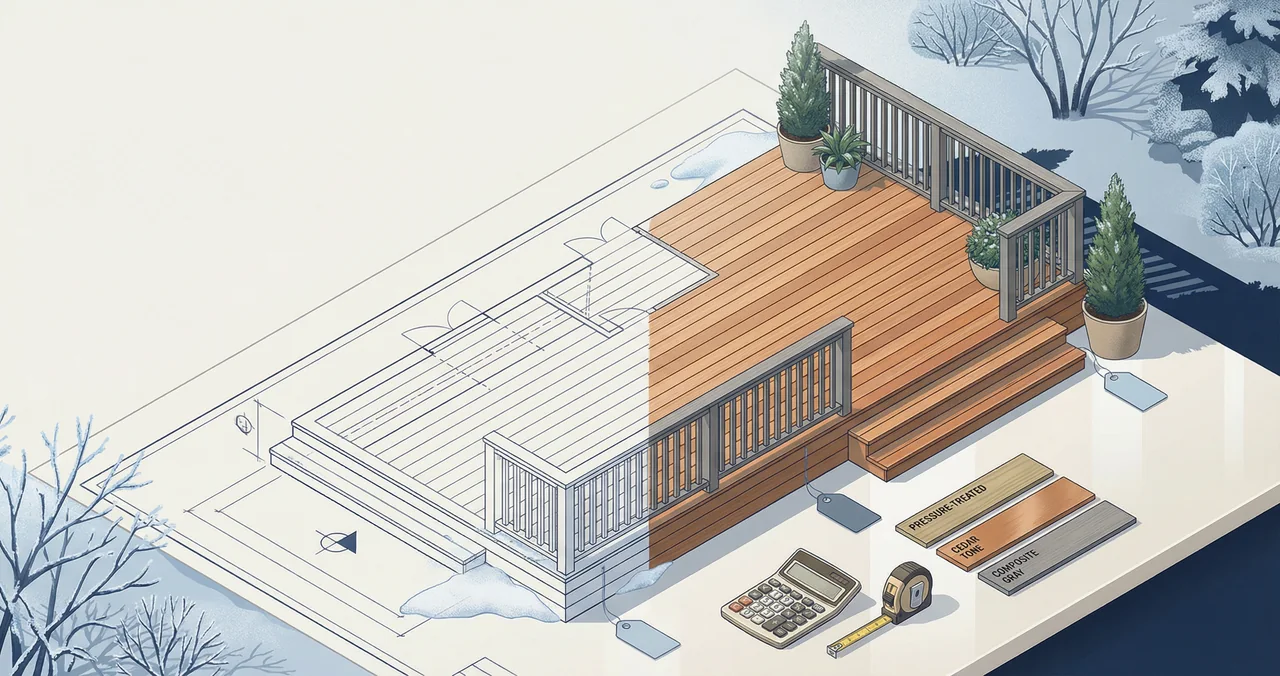
You're considering ipe for your deck, but the price quotes you're getting are significantly higher than other materials. Here's what you actually pay for ipe decking in Ontario in 2026, and whether the premium is justified for your project.
What Does Ipe Decking Cost in Ontario?
Expect to pay $95-150 per square foot installed for an ipe deck in the Kitchener-Waterloo-Cambridge area. That's roughly double the cost of composite and more than triple pressure-treated pricing.
🏗️ Planning a deck project?
Get a free manual project review, or visualize your dream deck with AI before requesting quotes.
Material costs alone:
- Ipe decking boards: $10-18/sqft (5/4x6 standard boards)
- Ipe railings: $80-160/linear foot installed
- Ipe stair treads: $45-75 each
- Hidden fasteners (required): $1.50-3/sqft
- Specialized drill bits/blades: $150-300 (contractor cost passed through)
Labour runs significantly higher than other deck materials. Ipe is extremely dense (more than twice as heavy as oak) and requires pre-drilling every fastener hole. Expect labour at $45-65/sqft versus $25-45/sqft for composite or pressure-treated installations.
For a 300 sqft deck, you're looking at:
- Low-end (simple design, no railings): $28,500
- Mid-range (standard railings, basic stairs): $36,000
- High-end (ipe railings, multi-level, custom details): $45,000+
Compare that to composite deck costs in Waterloo at $19,500-28,500 for the same footprint, or see complete deck pricing for Ontario homeowners for a full material comparison.
Why Is Ipe So Expensive?
Sourcing and transportation. Ipe grows primarily in Central and South American rainforests. It's harvested selectively (not plantation-grown like cedar), shipped internationally, and subject to import duties. Supply chain disruptions in 2024-2025 pushed prices up 15-20% from previous years.
Density and workability. Ipe has a Janka hardness rating of 3,680 lbf — more than three times harder than pressure-treated pine (690 lbf). This wears down saw blades rapidly, requires carbide-tipped bits for every pre-drill, and slows installation significantly.
Specialized installation requirements. You can't use standard deck screws. Ipe requires stainless steel fasteners or hidden clip systems designed for hardwoods. Many contractors won't work with it due to the equipment wear and slower pace.
Limited local availability. Most KWC lumberyards don't stock ipe. Special orders mean longer lead times (4-8 weeks typical) and minimum order quantities that increase waste factors on smaller projects.
Ipe vs Other Decking Materials: Real Cost Comparison
| Material | Installed Cost/sqft | Expected Lifespan | Maintenance | 25-Year Total Cost (300 sqft deck) |
|----------|---------------------|-------------------|-------------|-------------------------------------|
| Ipe | $95-150 | 40-50+ years | Oil every 2-3 years (optional) | $31,500-45,000 |
| Premium Composite | $75-95 | 25-30 years | Wash annually | $25,500-28,500 |
| Cedar | $55-80 | 15-20 years | Stain every 2-3 years | $19,500 + $8,000 maintenance |
| Pressure-Treated | $45-65 | 10-15 years | Stain every 2-3 years | $16,500 + rebuild at year 12-15 |
When you factor in lifespan and replacement costs, ipe becomes more competitive. A pressure-treated deck will need complete replacement at least once (likely twice) within the lifespan of a single ipe deck.
But there's a catch: That math only works if you stay in your home long enough to realize the longevity benefit. If you're planning to sell within 10-15 years, you won't recoup the premium through increased home value.
Performance in Ontario's Climate
Ipe handles freeze-thaw cycles exceptionally well — better than any alternative including composite.
Winter performance:
- No moisture absorption (0.1% water uptake vs 2-4% for composites)
- Zero cracking or splitting from freeze-thaw
- Doesn't become slippery when wet/frozen like composite can
- No salt damage concerns
Summer durability:
- Minimal expansion/contraction (board spacing requirements: 1/8" gaps)
- Stays cool underfoot (doesn't heat up like composite or PVC)
- Naturally rot and insect-resistant (Class A durability rating)
- UV-stable (won't fade significantly even without maintenance)
Weathering appearance: Untreated ipe naturally weathers to a silver-gray patina over 12-18 months. This doesn't affect structural integrity at all. If you prefer the original rich brown color, plan on applying hardwood oil every 2-3 years at approximately $300-600 per treatment for a 300 sqft deck (DIY) or $800-1,200 professionally.
Hidden Costs and Installation Challenges
Framing requirements. Ipe is heavy. A 300 sqft ipe deck weighs roughly 9,000-10,000 lbs (versus 4,500 lbs for pressure-treated). This often requires closer joist spacing (12" on center instead of 16") and may necessitate upgrading beam sizes or adding support posts. Budget an extra $800-1,500 for beefier framing.
Fastener costs add up quickly. Hidden fastener clips run $1.50-3/sqft in materials alone. For a 300 sqft deck, that's $450-900 just in clips. Stainless steel screws (if face-screwing) cost approximately $120-180 per box, and you'll need 3-4 boxes for a typical deck.
Specialized tools. Contractors will pass through costs for carbide saw blades ($40-80 each, wearing out every 200-300 linear feet of cuts) and carbide drill bits. Factor $200-400 into your quote for consumables.
Longer installation timeline. Pre-drilling every fastener hole doubles installation time compared to pressure-treated. A deck that takes 3 days with PT lumber takes 5-6 days with ipe. More days on-site means higher labour costs.
Permit costs remain the same. Whether you're building with ipe or pressure-treated, expect deck permit fees in KWC of $150-400 depending on your municipality. The same Ontario Building Code requirements apply regardless of decking material.
When Ipe Makes Sense (and When It Doesn't)
Ipe is worth it if:
- You're building your forever home and plan to stay 20+ years
- You want the absolute lowest long-term maintenance commitment
- You live on a waterfront property where durability justifies premium cost
- You're building a pool deck where heat resistance and slip performance matter
- You value authentic wood aesthetics over composite alternatives
- Budget allows without compromising structural components (don't cheap out on framing to afford ipe boards)
Skip ipe if:
- You're selling within 10 years (you won't recoup the premium)
- Your budget is under $30,000 for a 300 sqft deck (consider premium composite instead)
- You can't find a contractor experienced with hardwood installation in your area
- You want railings included (ipe railings push total costs significantly higher)
- You prefer consistent color over natural weathering and won't maintain oiling schedule
For most KWC homeowners, premium composite decking offers the best balance of durability, low maintenance, and cost. You get 25-30 year lifespan at 60-70% the cost of ipe, with zero maintenance beyond annual washing.
Ipe Deck Resale Value
Appraisers don't typically add significant value premiums for ipe over quality composite. Both are viewed as "premium decking" and add roughly $8,000-15,000 to home value for a well-built 300 sqft deck in KWC markets.
Where ipe can provide an edge: High-end waterfront properties or luxury homes where buyers expect premium materials throughout. In standard subdivisions, most buyers can't distinguish ipe from composite at a showing.
ROI expectations:
- Ipe deck: 40-55% return on investment at sale
- Composite deck: 50-65% return on investment at sale
- Pressure-treated: 60-75% return on investment at sale
Pressure-treated actually offers better ROI because the lower upfront cost means a smaller investment to recoup. But remember — ROI isn't the only consideration if you're enjoying the deck for 15+ years before selling.
Finding an Ipe-Experienced Contractor in KWC
Not all deck builders work with ipe regularly. Ask potential contractors:
- How many ipe decks have you installed in the past two years?
- What fastening system do you recommend and why?
- Do you have carbide-tipped equipment or will tool costs be added to my quote?
- What's your approach to end-grain sealing (cut ends)?
- Can you provide references from recent ipe projects?
Expect to pay 10-15% more for a contractor with extensive hardwood experience versus a generalist who primarily builds PT or composite decks. The expertise is worth it — improper installation voids any performance advantages ipe offers.
Get detailed quotes using our deck quote checklist to ensure you're comparing apples-to-apples pricing between contractors.
🎨 Not sure which material to pick?
Upload a photo of your backyard and see exactly how Trex, TimberTech, or cedar would look — free and instant.
Common Questions
How long does an ipe deck last in Ontario?
An ipe deck lasts 40-50+ years in Ontario's climate with minimal maintenance. Even without oiling treatments, the structural integrity remains sound for decades. With periodic oiling (every 2-3 years) to maintain color, ipe decks regularly exceed 50 years. This is significantly longer than composite (25-30 years), cedar (15-20 years), or pressure-treated (10-15 years).
Can you install ipe decking yourself to save money?
Yes, but it's challenging. Ipe requires pre-drilling every fastener hole with sharp carbide bits, uses specialized hidden fasteners, and is extremely heavy to maneuver. DIY installation can save $12,000-18,000 on a 300 sqft deck, but plan on the project taking 3-4x longer than pressure-treated and budget $400-600 for proper tools (carbide saw blades, drill bits, miter saw). Most DIYers underestimate the difficulty and end up hiring pros mid-project.
Does ipe decking need to be sealed or stained?
No. Ipe naturally resists rot, insects, and moisture without any chemical treatment. It will weather to a silver-gray patina over 12-18 months if left untreated, but this doesn't compromise durability. If you want to maintain the original rich brown color, apply penetrating hardwood oil every 2-3 years. Never use film-forming stains or sealers — they'll peel and trap moisture.
What's the difference between ipe and cheaper tropical hardwoods?
Ipe (Tabebuia spp.) has a Class A durability rating and 40-50+ year lifespan. Cheaper alternatives like cambara, garapa, or cumaru offer some similar properties but typically last 20-30 years and may have more color variation or defects. Ipe is denser (specific gravity 0.90-1.00 vs 0.65-0.80 for alternatives), more rot-resistant, and more dimensionally stable. If budget is tight, premium composite often outperforms cheaper tropical hardwoods.
Can you use ipe for deck framing or just decking boards?
Ipe works exceptionally well for structural framing and lasts far longer than pressure-treated joists and beams. However, the cost is prohibitive for most projects — using ipe for framing can double your total deck cost. Most builders use pressure-treated or steel framing with ipe surface boards. The exception: waterfront or ground-contact applications where you want 50+ year framing lifespan to match the decking.
Upload a backyard photo and preview real decking materials with AI — free, instant, no sign-up.
Permits, costs, material comparisons, and questions to ask before requesting quotes — delivered to your inbox.