
Concrete Patio Cost in Ontario: Poured, Stamped, and Pavers
Concrete patio costs in Ontario range from $12-40/sqft installed. Compare poured, stamped, and paver options with 2026 pricing and climate considerations.
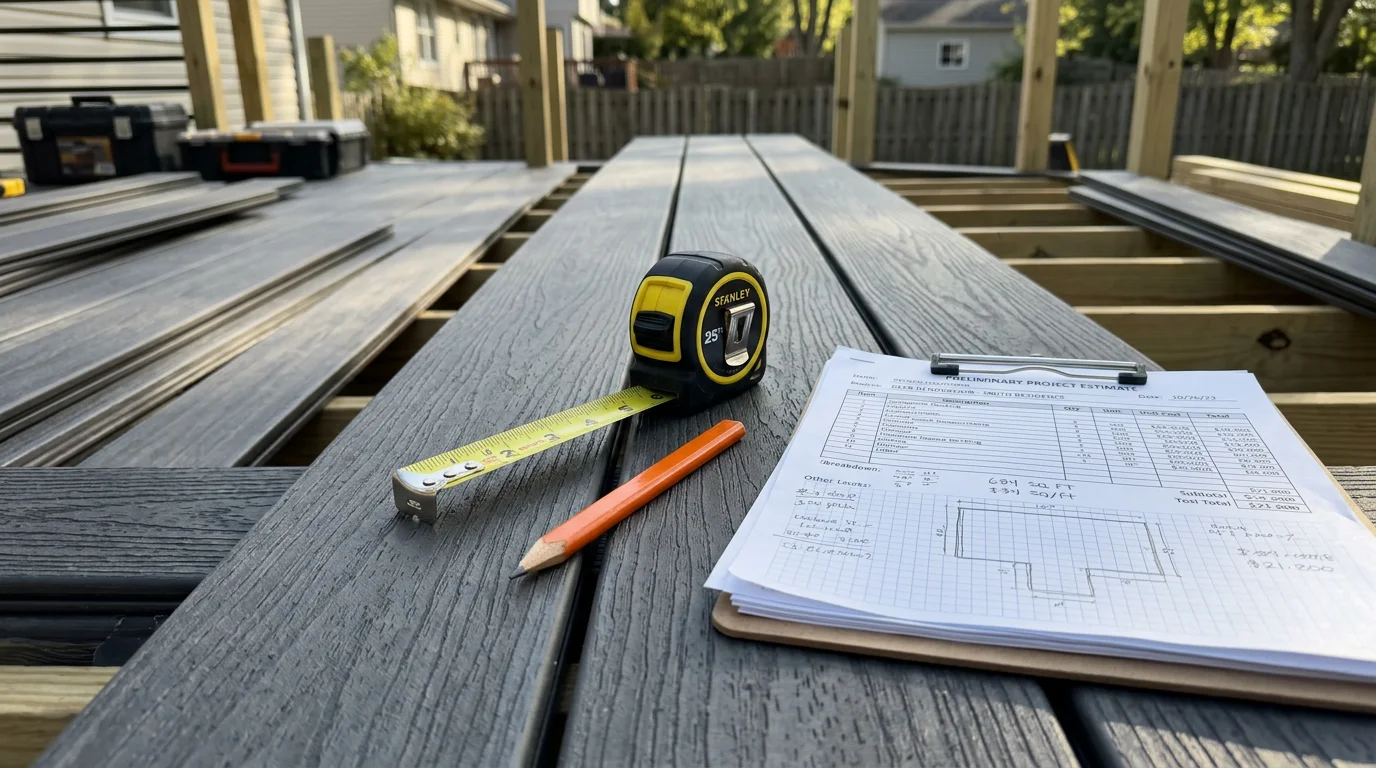
You're planning a concrete patio and need to know what it'll actually cost in Ontario. The answer depends on which type you choose: basic poured concrete runs $12-18 per square foot installed, stamped concrete costs $15-30 per square foot, and concrete pavers range from $20-40 per square foot.
Here's what drives those numbers and how to decide which option makes sense for your property.
Poured Concrete Patio Cost
Basic poured concrete is the most affordable option. For a 12x16 foot patio (192 square feet), expect to pay $2,300-3,500 installed.
🏗️ Planning a deck project?
Get a free manual project review, or visualize your dream deck with AI before requesting quotes.
What's Included in Poured Concrete Pricing
- Excavation and grading: Removing sod, leveling the base
- Granular base: 4-6 inches of compacted gravel for drainage
- Concrete pour: 4-inch slab, typically 3000 PSI minimum
- Finishing: Broom finish for slip resistance (standard in Ontario)
- Control joints: Saw cuts to control cracking
Poured Concrete Upgrade Options
Want more than a plain gray slab? Here are common upgrades:
- Acid staining: +$2-4/sqft for color variation
- Exposed aggregate: +$3-6/sqft for textured finish
- Integral color: +$1-2/sqft for uniform color throughout
- Smooth trowel finish: No extra cost, but less slip-resistant
- Border details: +$8-15 per linear foot for decorative edges
Ontario climate consideration: Basic broom-finished concrete holds up well through freeze-thaw cycles if properly installed with adequate drainage. The rough texture also provides traction when wet or icy.
Stamped Concrete Patio Cost
Stamped concrete mimics stone, brick, or wood patterns. Expect $15-30 per square foot installed, with most KWC projects landing around $20-25 per square foot.
That same 192 square foot patio would cost $2,900-5,750 in stamped concrete.
What Affects Stamped Concrete Pricing
| Factor | Cost Impact |
|--------|-------------|
| Single pattern, one color | Base price ($15-20/sqft) |
| Multiple patterns or colors | +$3-6/sqft |
| Complex borders/inlays | +$5-10/sqft |
| Sealer (required) | Included, needs reapplication every 2-3 years |
| Hand-detailing | +$2-4/sqft for enhanced texture |
Stamped Concrete Durability in Ontario
Stamped concrete requires more maintenance than plain concrete:
- Resealing: Every 2-3 years (costs $1.50-3/sqft per application)
- Salt damage: De-icing salts can damage the surface sealer and color
- Color fading: UV exposure fades color over 5-10 years without sealer
- Crack visibility: Cracks are more obvious on patterned surfaces
The sealer protects against moisture penetration—critical in Ontario where freeze-thaw cycles can cause spalling (surface flaking). Budget $300-600 every 2-3 years for resealing a 200 sqft patio.
Concrete Paver Patio Cost
Concrete pavers offer the highest upfront cost but the easiest repairs. Expect $20-40 per square foot installed, with most projects around $25-30 per square foot.
A 192 square foot patio runs $3,850-7,700 in concrete pavers.
Paver Cost Breakdown
Materials (40-50% of total cost):
- Standard concrete pavers: $3-6/sqft
- Premium/textured pavers: $6-10/sqft
- Polymeric sand: $0.50-1/sqft
- Geotextile fabric: $0.30-0.50/sqft
- Granular base materials: $1-2/sqft
Labor (50-60% of total cost):
- Excavation: $2-4/sqft
- Base preparation: $3-5/sqft
- Paver installation: $4-7/sqft
- Cutting and edge restraints: $1-2/sqft
Why Pavers Cost More
The installation takes longer than poured concrete:
1. Precision base work: Base must be perfectly level and compacted
2. Individual placement: Each paver is set by hand
3. Cutting requirements: Edge pieces need custom cuts
4. Polymeric sand: Swept between joints, requires careful application
But you get major benefits: individual pavers can be lifted and replaced if damaged, and the surface is immediately usable (no curing time).
Poured vs. Stamped vs. Pavers: Direct Comparison
| Feature | Poured | Stamped | Pavers |
|---------|--------|---------|--------|
| Cost (installed) | $12-18/sqft | $15-30/sqft | $20-40/sqft |
| Installation time | 2-3 days + 7-day cure | 2-4 days + 7-day cure | 3-5 days, immediate use |
| Crack likelihood | Moderate (inevitable) | Moderate (more visible) | Very low (joints absorb movement) |
| Repair difficulty | Hard (patching shows) | Hard (matching pattern/color) | Easy (swap individual pavers) |
| Maintenance | Low (reseal optional) | High (reseal every 2-3 yrs) | Medium (re-sand joints every 3-5 yrs) |
| Salt/freeze damage | Good resistance | Moderate (sealer dependent) | Excellent (joints allow drainage) |
| Lifespan | 20-30+ years | 15-25 years (needs resealing) | 25-40+ years |
Ontario-specific winner: Pavers perform best in freeze-thaw cycles because the joints between units allow water to drain and prevent heaving. Poured concrete is the budget choice if you accept that cracks will eventually appear.
Hidden Costs and Site Conditions
Ontario soil and climate add costs you might not expect:
Clay Soil Issues (Common in KWC)
Heavy clay soil requires extra base depth to prevent settling:
- Standard gravel base: 4-6 inches
- Clay soil base: 6-10 inches (adds $2-4/sqft)
Clay expands when wet and shrinks when dry. A thicker base prevents the patio from shifting.
Drainage and Grading
Your patio needs to slope away from your house at 2% grade (1/4 inch per foot):
- Flat lot: No extra cost
- Sloped lot (grade work required): +$500-1,500
- French drain installation: +$1,200-2,500 if drainage is poor
Poor drainage causes water to pool under the slab, leading to frost heaving in winter. If your property has standing water issues, factor in drainage solutions. See deck drainage under-deck water management for related grading principles.
Existing Structure Removal
Replacing an old patio or deck:
- Concrete patio demolition: $3-6/sqft
- Asphalt removal: $2-4/sqft
- Deck removal: $5-12/sqft depending on height
Demolition and disposal add $600-1,800 for a typical 200 sqft area. Compare costs with deck demolition disposal KWC.
Access and Site Challenges
- Limited access (no vehicle access to backyard): +10-20% labor cost
- Concrete pump required (truck can't reach site): +$800-1,200
- Tree root removal: +$300-800 per tree
- Underground utilities (requiring hand digging): +$500-1,500
Do You Need a Permit for a Concrete Patio in Ontario?
Usually no—but there are exceptions.
When Permits Are NOT Required
- Ground-level patio (not raised more than 24 inches)
- No roof or permanent structure overhead
- Not attached to the house foundation
Most concrete patios in KWC fall into this category.
When Permits ARE Required
You need a permit if your patio includes:
- Covered structure (pergola with solid roof, screened enclosure)
- Raised patio/platform more than 24 inches above grade
- Structural connection to the house foundation
- Electrical work (if adding lighting or outlets)
If you're adding a covered pergola over your patio, check pergola covered deck permit Kitchener-Waterloo for permit requirements.
Property line setbacks: Even without a permit, patios must meet setback requirements—typically 2-3 feet from property lines in KWC. Check deck setback rules Kitchener-Waterloo-Cambridge for your municipality's rules.
How to Save Money on Your Concrete Patio
DIY the Excavation
Contractors charge $2-4 per square foot for excavation. If you can remove sod and dig out 8-10 inches of soil yourself, you'll save $400-800 on a 200 sqft patio.
You'll still need the pro for base compaction and concrete work.
Choose Off-Season Installation
Spring and early summer are peak season. Book for late summer or fall (August-October) for potential 10-15% discounts.
Concrete needs above-freezing temperatures to cure properly, so avoid late October through April in Ontario. See best time to build a deck in Ontario for seasonal considerations that also apply to concrete work.
Stick with Standard Finishes
Upgrades add up fast:
- Skip stamping/patterns: Save $3-10/sqft
- Use standard broom finish instead of exposed aggregate: Save $3-6/sqft
- Choose gray concrete instead of integral color: Save $1-2/sqft
A basic poured concrete patio with broom finish performs just as well structurally—you're only giving up aesthetics.
Compare Against Other Patio Options
Concrete isn't your only choice:
- Patio vs deck: Wood decks cost $25-45/sqft installed; composite decks run $35-60/sqft. See deck cost Waterloo 2026 for complete deck pricing.
- Interlock pavers: Similar price to concrete pavers ($20-40/sqft) but come in more colors and shapes
- Natural stone: Premium option at $30-60/sqft installed
If you have an elevated yard or want to avoid grading issues, a low deck vs elevated deck might be a better solution than extensive site prep for a patio.
What to Ask Concrete Contractors
Get at least three quotes and ask these questions:
1. What PSI concrete are you using? (Should be 3000 PSI minimum for Ontario climate)
2. How thick is the slab? (4 inches is standard; 5-6 inches for heavy use)
3. What's your base preparation process? (Should include compacted gravel, proper slope)
4. Do you use wire mesh or rebar? (Reinforcement reduces cracking)
5. What's your warranty? (1 year minimum; some offer 2-5 years on workmanship)
6. How do you handle drainage? (Should describe grading away from house)
7. When will you saw control joints? (Should be cut within 24 hours of pour)
8. Is demolition/disposal included? (If replacing existing patio)
See deck quote checklist Kitchener-Waterloo for more contractor vetting questions that apply to concrete work too.
Concrete Patio Maintenance in Ontario
Year One
- 30 days: No de-icing salts (wait until fully cured)
- 60 days: Apply concrete sealer if desired (optional for poured, required for stamped)
Ongoing Maintenance
Spring:
- Inspect for cracks or heaving
- Clean with pressure washer (1500-2000 PSI max)
- Reseal if water no longer beads on surface
Fall:
- Clear leaves and debris (staining risk)
- Check drainage—standing water causes freeze damage
Winter:
- Use sand or calcium-based de-icers (avoid rock salt for first 2 years)
- Shovel promptly to prevent ice bonding to surface
Repair Costs
- Crack filling: $2-5 per linear foot
- Slab leveling (mudjacking): $500-1,200 per area
- Surface resurfacing: $3-8/sqft (thin overlay to restore appearance)
- Full replacement: Same as new installation cost
Small cracks (hairline) are cosmetic. Cracks wider than 1/4 inch or heaving/settling issues need professional repair.
🎨 Not sure which material to pick?
Upload a photo of your backyard and see exactly how Trex, TimberTech, or cedar would look — free and instant.
Common Questions
How long does a concrete patio last in Ontario?
20-30+ years for properly installed poured or stamped concrete. Concrete pavers can last 25-40 years because individual units can be replaced. Lifespan depends on base preparation, drainage, and winter maintenance—Ontario's freeze-thaw cycles are hard on concrete that wasn't installed correctly.
Can I pour a concrete patio myself?
Excavation and base prep: Yes. You can save $400-800 by digging and preparing the site yourself. Concrete pour and finishing: Not recommended. You need a crew to place and finish concrete within 2-3 hours before it sets. Poor finishing leads to drainage problems and premature failure. Most DIYers hire pros for the pour but do their own prep work.
What's better for Ontario winters: concrete or pavers?
Pavers perform better in freeze-thaw cycles. The joints between pavers allow water to drain and prevent heaving. Poured concrete will eventually crack (it's a question of when, not if), though cracks can be managed with proper control joints. If winter durability is your top priority, spend the extra $8-20/sqft for pavers.
How thick should a concrete patio be in Ontario?
4 inches minimum for foot traffic and patio furniture. Go with 5-6 inches if you're placing heavy objects like hot tubs, outdoor kitchens, or if vehicles will occasionally drive over it. The base is equally important: you need 6-10 inches of compacted gravel (more if you have clay soil) to prevent settling.
Do I need to seal a concrete patio?
Optional for plain poured concrete; required for stamped concrete. Sealing protects against moisture penetration, salt damage, and staining, but unsealed concrete still performs structurally. In Ontario, sealing is worth it if you use de-icing salts in winter or want to prevent staining from leaves and dirt. Expect to reseal every 2-3 years at $1.50-3/sqft.
Upload a backyard photo and preview real decking materials with AI — free, instant, no sign-up.
Permits, costs, material comparisons, and questions to ask before requesting quotes — delivered to your inbox.