
Deck Cost in Minneapolis (2026)
What does a deck cost in Minneapolis in 2026? Get real pricing per square foot by material, labor rates, and tips to save — built for Minnesota's climate.
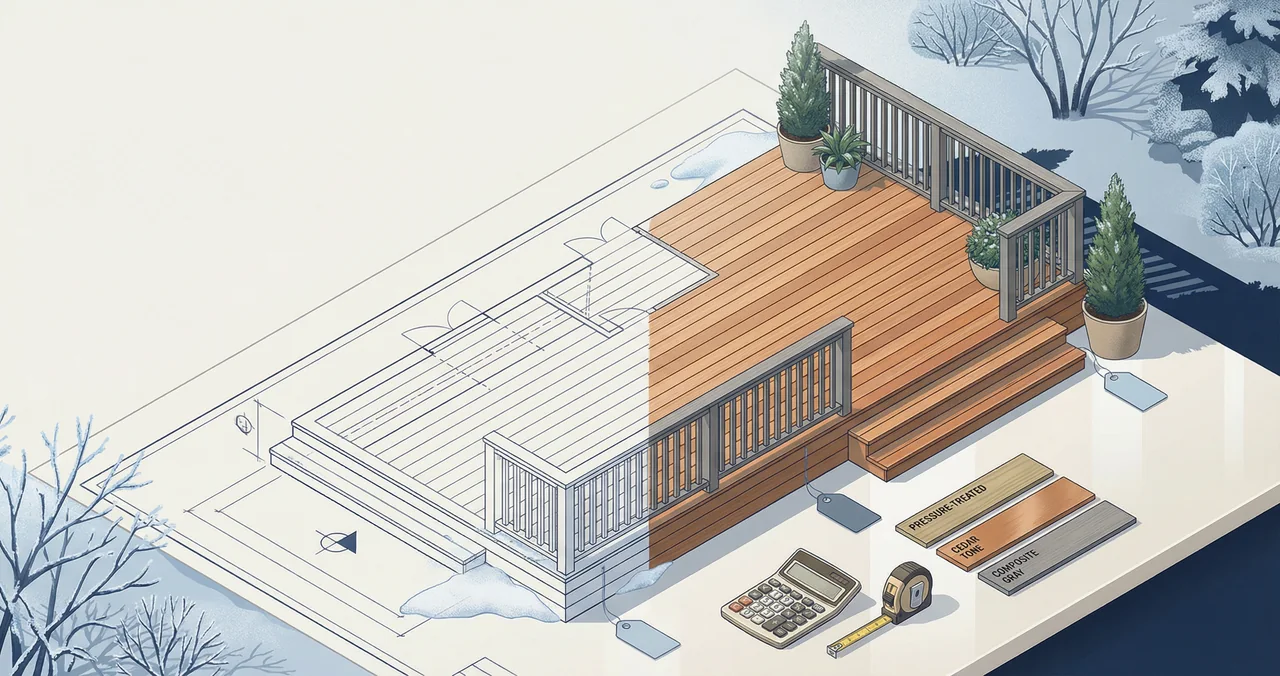
You're looking at your backyard in Uptown, Linden Hills, or maybe out near Maple Grove, and you want a number. What's a deck actually going to cost you in Minneapolis in 2026?
🧮 Tool Alert: Deck Cost Calculator
Estimate your project costs in seconds based on local pricing bands for your area.
Calculate My Cost →The short answer: most Minneapolis homeowners pay between $8,000 and $30,000 for a standard deck, with the final number depending heavily on material choice, deck size, and how deep your footings need to go. That frost line requirement alone — 42 to 60 inches in the Twin Cities metro — adds real cost compared to warmer climates.
Here's what you need to know before you start calling contractors.
<!-- slot:after-intro -->
For a broader look at deck pricing across different materials and regions, see our deck cost guide.
Average Deck Cost in Minneapolis by Material
Material is the single biggest factor in your total price. Here's what Minneapolis homeowners are paying in 2026, fully installed:
🏗️ Planning a deck project?
Get a free manual project review, or visualize your dream deck with AI before requesting quotes.
| Material | Installed Cost per Sq Ft | 12×16 Deck (192 sq ft) | 16×20 Deck (320 sq ft) |
|---|---|---|---|
| Pressure-Treated Wood | $25–$45 | $4,800–$8,640 | $8,000–$14,400 |
| Cedar | $35–$55 | $6,720–$10,560 | $11,200–$17,600 |
| Composite (mid-range) | $45–$75 | $8,640–$14,400 | $14,400–$24,000 |
| Trex (premium lines) | $50–$80 | $9,600–$15,360 | $16,000–$25,600 |
| Ipe (hardwood) | $60–$100 | $11,520–$19,200 | $19,200–$32,000 |
These ranges include materials, labor, standard railings, and basic stairs. They don't include permits, complex multi-level designs, or built-in features like benches or planters.
Pressure-treated lumber remains the most popular choice in Minneapolis for budget-conscious homeowners. It handles the job, but Minnesota's freeze-thaw cycles and road salt tracked onto boards mean you'll need to seal or stain it every year to prevent cracking and rot.
Composite and PVC decking dominate the mid-to-high end of the Minneapolis market for good reason. They hold up dramatically better against moisture, ice, and UV without annual maintenance. The upfront premium pays for itself within 5–7 years when you factor in staining costs and time.
Cost Per Square Foot Breakdown
That installed price per square foot bundles a lot together. Here's roughly how it breaks down for a mid-range composite deck in Minneapolis:
- Decking materials: $15–$30/sq ft
- Framing lumber and hardware: $5–$10/sq ft
- Footings and foundation: $5–$12/sq ft (higher here than national average due to frost depth)
- Labor: $15–$25/sq ft
- Railings: $3–$8/sq ft (averaged across deck area)
- Permits and engineering: $1–$3/sq ft
Footings are where Minneapolis costs diverge from national averages. The city requires footings below the frost line, which ranges from 42 inches in the metro core to 60 inches in outer suburbs. That means more concrete, more digging, and more labor than a deck in Dallas or Atlanta. Expect to add $1,500–$4,000 just for proper footing installation on a standard-sized deck.
Helical piles are gaining popularity with Minneapolis contractors as an alternative to poured concrete footings. They're faster to install and perform well in Minnesota's clay-heavy soils, though they typically cost 10–20% more than traditional sono tubes.
Labor Costs in Minneapolis
Labor makes up roughly 35–45% of your total deck cost in the Twin Cities area. In 2026, expect to pay:
- General deck labor: $15–$25 per square foot
- Experienced crew (composite/Trex specialists): $20–$30 per square foot
- Demolition and removal of old deck: $3–$8 per square foot
Minneapolis labor rates run 10–15% above the national average for deck building. Two factors drive this:
The compressed building season. Realistically, deck construction happens between May and October in Minneapolis. That's six months of buildable weather crammed with demand. Contractors who are good stay booked solid.
Skilled trade demand. The Twin Cities construction market competes for labor across residential, commercial, and infrastructure projects. That competition keeps rates firm.
When to Book Your Contractor
This is critical: contact contractors by March if you want your deck built before summer. By April, the best crews in Minneapolis are already booked into July or August. If you wait until May to start calling, you may not get your deck built until fall — or you'll pay rush pricing.
Getting quotes in January or February, when contractors have time to actually sit down and plan, often gets you better pricing and more attention to your project's details.
What Affects Your Total Price
Beyond material and labor, these factors can swing your Minneapolis deck cost by thousands:
Deck Size and Shape
A simple rectangle is the most cost-effective shape. Every angle, curve, or multi-level transition adds cutting waste and labor time. L-shaped and multi-level decks typically cost 15–25% more per square foot than a basic rectangular build.
Height and Access
A ground-level deck on a flat lot is straightforward. A second-story walkout deck overlooking a hill — common in neighborhoods like Tangletown, Kenwood, and along the chain of lakes — requires taller posts, more robust structural engineering, and potentially longer construction timelines. Elevated decks (8+ feet) can add $3,000–$8,000 to the project.
Railings and Stairs
Standard wood railings come included in most quotes. Upgrading changes the math:
- Composite railings: Add $30–$60 per linear foot
- Aluminum or cable railings: Add $50–$100+ per linear foot
- Glass panel railings: Add $80–$150+ per linear foot
Each set of stairs adds $500–$2,000 depending on the run length and material.
Permits and Inspections
In Minneapolis, deck permits are required for structures over 200 square feet or 30 inches above grade. The permit process through Minneapolis's Development Services department typically costs $150–$500 depending on project scope, and you'll need to show footing depths that meet Minnesota's frost line requirements.
Don't skip the permit. Unpermitted decks create real problems when you sell your home — inspectors flag them, and you'll either tear it down or retroactively permit it at a premium. For more on the risks involved, see this breakdown on building a deck without a permit.
Site Conditions
Rocky soil, steep grades, poor drainage, or the need to remove an existing structure all add cost. Minneapolis sits on a mix of clay, sand, and glacial till depending on your neighborhood. Clay-heavy soil (common in South Minneapolis and many first-ring suburbs) can require larger footings to prevent settling.
<!-- slot:mid-content -->
Composite vs Wood: Cost Comparison
This is the decision most Minneapolis homeowners wrestle with. Here's an honest look at the numbers over time:
| Factor | Pressure-Treated Wood | Mid-Range Composite |
|---|---|---|
| Installed cost (320 sq ft) | $8,000–$14,400 | $14,400–$24,000 |
| Annual maintenance cost | $200–$500 (stain/seal) | $0–$50 (occasional cleaning) |
| Maintenance over 15 years | $3,000–$7,500 | $0–$750 |
| Expected lifespan | 10–15 years | 25–30+ years |
| 15-year total cost | $11,000–$21,900 | $14,400–$24,750 |
The 15-year total cost is remarkably close. And composite pulls ahead if you factor in the time value of spending weekends staining instead of actually using your deck.
For Minneapolis specifically, composite has another advantage: it handles freeze-thaw cycles without the cracking, splintering, and cupping that plague wood decks after a few Minnesota winters. Pressure-treated boards that don't get sealed before the first freeze often show damage by spring.
Cedar splits the difference on aesthetics and price. It's naturally rot-resistant and gorgeous, but it still needs annual sealing in Minnesota's climate to maintain its color and structural integrity. Left untreated, cedar grays within a season and can start to check and split within two to three years.
If you're debating materials, explore how the best composite brands compare and what makes low-maintenance decking worth the investment. Use PaperPlan to visualize different decking materials on your own home before committing — it's a practical way to see how colors and textures look against your siding and landscaping.
What About Trex Specifically?
Trex is the most-requested composite brand in the Minneapolis market. Their pricing tiers:
- Trex Enhance (entry): $50–$60/sq ft installed
- Trex Select (mid): $55–$70/sq ft installed
- Trex Transcend (premium): $65–$80/sq ft installed
The performance difference between Trex tiers is mostly about color options and cap thickness. All three handle Minneapolis winters well. If budget matters more than having the exact right shade of "Spiced Rum," the Enhance line is a solid choice.
How to Save Money on Your Minneapolis Deck
Real ways to reduce your deck cost without compromising quality:
Time Your Build Strategically
Late September through October is the sweet spot. Contractors are finishing their summer backlogs and may offer better pricing to keep crews working before winter shutdown. You're building in cooler but still workable weather, and material suppliers sometimes run end-of-season promotions.
Early spring (late April/May) is another window — some contractors offer early-season pricing to lock in work before the summer rush.
Choose Your Size Carefully
Before assuming you need a 20×20 deck, think about how you'll actually use the space. A well-designed 12×16 deck (192 sq ft) fits a dining table for six, a grill station, and a couple of lounge chairs comfortably. Going from 192 to 320 square feet adds $4,000–$10,000 depending on material.
Mix Materials
A smart strategy: use composite for the deck surface (where you need durability and low maintenance) and pressure-treated lumber for the substructure (where it's hidden and protected from direct weather exposure). Most Minneapolis contractors already build this way — it's the standard approach, not a shortcut.
Keep the Design Simple
Every bump-out, angle cut, and level change adds cost. A rectangular deck with one set of stairs is the most budget-friendly configuration. If you want visual interest, achieve it through railing choices and lighting rather than complex geometry.
Get Multiple Quotes — But Be Smart About It
Three to five quotes gives you a reliable pricing range. But don't automatically pick the cheapest. In Minneapolis, a lowball bid often means the contractor is cutting corners on footing depth, using thinner joists, or planning to subcontract labor at the last minute. Ask every contractor:
- What footing method and depth will you use?
- Are permits and inspections included?
- What's the warranty on labor?
- Can I see a recent Minneapolis project you've completed?
Handle Demo Yourself
If you're replacing an old deck, doing the demolition yourself can save $500–$2,500. Rent a dumpster, grab a reciprocating saw, and set aside a weekend. Just make sure you're not removing anything structural that ties into your house — get the contractor's guidance first.
Minneapolis-Specific Considerations
Snow Load and Structural Requirements
Minnesota building code requires decks to handle a ground snow load of 42 pounds per square foot in the Minneapolis metro. This means heavier joists, closer joist spacing, or both compared to decks built in milder climates. Your contractor should be sizing framing members to handle this — if their quote seems unusually cheap, ask about their snow load calculations.
Frost Heave Protection
Inadequate footing depth is the number one reason decks fail in Minneapolis. When footings don't extend below the frost line, the ground freezing and thawing literally pushes your deck up and drops it back down each cycle. Over a few years, this causes:
- Pulled ledger board connections
- Cracked concrete pads
- Uneven deck surfaces
- Railing failures
Non-negotiable: every footing must go below 42 inches minimum in the city of Minneapolis. Outer suburbs may require 48–60 inches. This isn't where you save money. For more on how freeze-thaw cycles affect material choices, see this guide on the best decking materials for freeze-thaw climates.
Drainage and Ice
Water management matters more here than in most markets. Your deck design should ensure:
- Proper board gapping (3/16" minimum for composite) to allow snowmelt drainage
- Slight slope away from the house (1/4" per foot minimum) to prevent water pooling at the ledger
- Adequate ground clearance beneath the deck for airflow and drainage
- Flashing at the ledger board to prevent ice dam formation where the deck meets your home
If you're building over a walkout basement or patio, an under-deck ceiling system can protect the space below from rain and snowmelt.
<!-- slot:before-faq -->
🎨 Not sure which material to pick?
Upload a photo of your backyard and see exactly how Trex, TimberTech, or cedar would look — free and instant.
Frequently Asked Questions
How much does a 12×16 deck cost in Minneapolis?
A 12×16 deck (192 sq ft) in Minneapolis runs $4,800–$8,640 for pressure-treated wood and $8,640–$14,400 for composite, fully installed. Add $1,500–$3,000 if you need stairs, upgraded railings, or complex footing work due to soil conditions. These prices reflect 2026 Twin Cities labor rates and include standard permitting.
Do I need a permit to build a deck in Minneapolis?
Yes, in most cases. Minneapolis requires a building permit for decks over 200 square feet or higher than 30 inches above grade. You'll submit plans showing footing locations, depths, framing details, and ledger attachment methods to the city's Development Services department. Most reputable contractors handle the permit process as part of their scope of work. Budget $150–$500 for permit fees.
What is the best decking material for Minnesota winters?
Composite and PVC decking perform best in Minnesota's climate. They resist moisture absorption, don't crack from freeze-thaw cycles, and won't splinter after years of ice and snow exposure. Pressure-treated wood works if you're diligent about annual sealing, but most Minneapolis homeowners who've lived through a few winters end up preferring the lower maintenance of composite. Check out this comparison of top composite brands for specific product recommendations.
When is the best time to build a deck in Minneapolis?
The optimal building window is May through October, with the sweet spot being June through September for reliable weather. However, the best time to *start the process* is January through March — that's when you should be getting quotes, finalizing designs, and booking your contractor. Waiting until May to begin shopping means you'll likely be building in September at the earliest, if you can get on a schedule at all. For a deeper look at seasonal timing, see best time to build a deck.
Is it cheaper to build a deck yourself in Minneapolis?
DIY can save you 35–45% on labor costs, bringing a pressure-treated deck down to roughly $15–$25 per square foot for materials alone. But in Minneapolis, the footing work is the critical piece — getting those sono tubes or helical piles to the proper frost line depth in clay soil is genuinely difficult without equipment and experience. Many homeowners find a middle ground: hire a contractor for the substructure and footings, then install the decking boards themselves. That DIY approach can save $2,000–$5,000 on a mid-sized deck while ensuring the structural work meets code.
<!-- slot:end -->
📋 Planning a deck project?
Get a free manual project review from our team — no obligation, no spam.
Get Free Project Review →Upload a backyard photo and preview real decking materials with AI — free, instant, no sign-up.
Permits, costs, material comparisons, and questions to ask before requesting quotes — delivered to your inbox.