
Deck Cost in Cincinnati (2026)
What does a deck cost in Cincinnati in 2026? Get real pricing by material, labor rates, and money-saving tips for Cincinnati homeowners building this year.
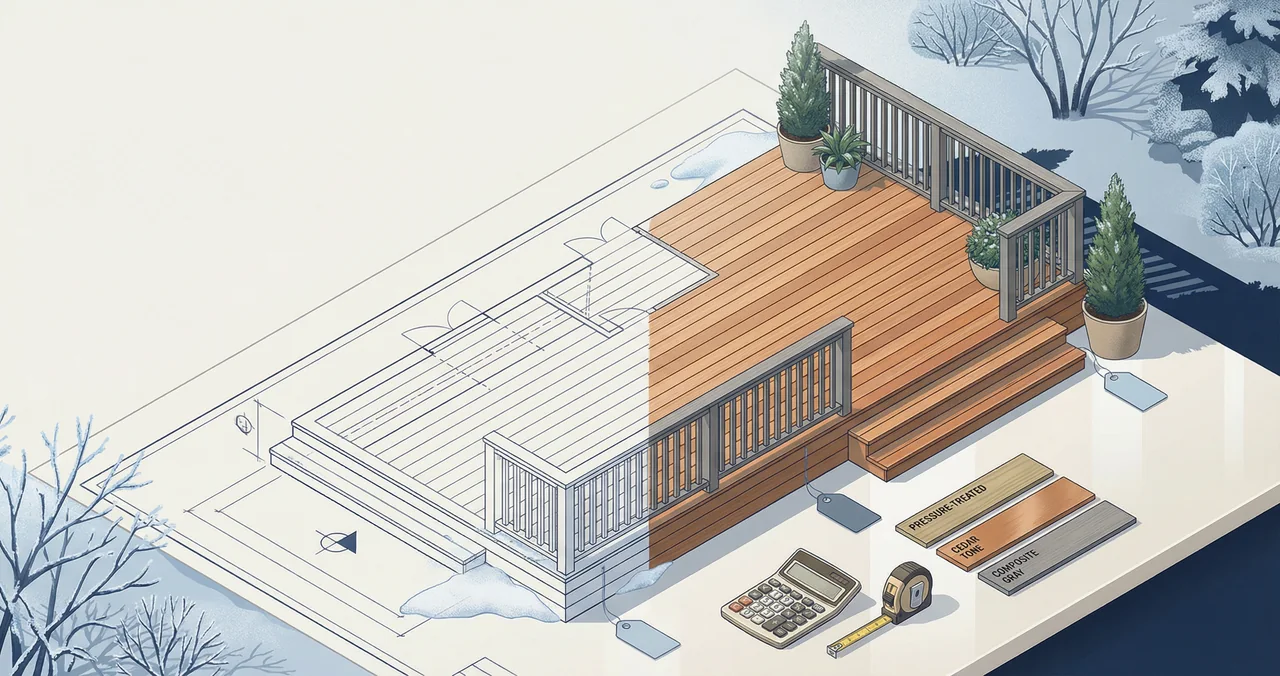
Deck Cost in Cincinnati: What Homeowners Are Paying in 2026
A new deck in Cincinnati runs $8,000 to $30,000+ for most homeowners, with the final number depending heavily on material choice, deck size, and how complex the build gets. That's a wide range — and the difference between the low and high end often comes down to decisions you haven't made yet.
🏗️ Planning a deck project?
Get a free manual project review, or visualize your dream deck with AI before requesting quotes.
🧮 Tool Alert: Deck Cost Calculator
Estimate your project costs in seconds based on local pricing bands for your area.
Calculate My Cost →Looking for more regional information? Check out our Ohio State Decking Hub.
Cincinnati's climate plays a bigger role in those decisions than you might expect. Freeze-thaw cycles, heavy snow loads, and the salt and moisture that come with Ohio winters all shorten the lifespan of cheaper materials and drive up long-term maintenance costs. Understanding what you're actually paying for — and where you can cut without regret — is how you build a deck that holds up for decades in this city.
<!-- slot:after-intro -->
For a broader look at deck pricing across different materials and regions, see our complete deck cost guide for Ohio. Timing your build right can also save thousands — check our guide on the best time to build a deck.
Average Deck Cost in Cincinnati by Material
Material is the single biggest variable in your deck budget. Here's what Cincinnati homeowners are paying in 2026 for a fully installed deck, including labor, materials, and standard railing:
| Material | Installed Cost (per sq ft) | 300 sq ft Deck | 400 sq ft Deck |
|---|---|---|---|
| Pressure-treated wood | $25–$45 | $7,500–$13,500 | $10,000–$18,000 |
| Cedar | $35–$55 | $10,500–$16,500 | $14,000–$22,000 |
| Composite | $45–$75 | $13,500–$22,500 | $18,000–$30,000 |
| Trex (mid-to-premium) | $50–$80 | $15,000–$24,000 | $20,000–$32,000 |
| Ipe (hardwood) | $60–$100 | $18,000–$30,000 | $24,000–$40,000 |
A few notes on these numbers. Pressure-treated lumber is the entry point, and it performs fine in Cincinnati — if you commit to annual sealing and staining. Skip that maintenance and you'll see warping, cracking, and grey discoloration within two to three seasons. Cedar offers better natural rot resistance but still demands regular upkeep in Ohio's wet-freeze climate.
Composite and PVC decking hold up best against Cincinnati winters. The upfront cost stings, but you're trading annual maintenance weekends for a 25-year warranty and boards that won't split when the temperature swings 40 degrees in a week.
Cost Per Square Foot Breakdown
The per-square-foot price you'll see quoted includes several components. Here's roughly how that breaks down for a mid-range composite deck in Cincinnati:
- Decking boards: $15–$30/sq ft
- Substructure (joists, beams, ledger board): $5–$10/sq ft
- Footings and foundation: $3–$8/sq ft
- Railing and stairs: $3–$10/sq ft
- Hardware and fasteners: $1–$3/sq ft
- Labor: $15–$25/sq ft
Those footing costs deserve attention. Cincinnati's frost line sits between 36 and 60 inches deep, depending on your specific location in the region. That means footings need to be dug well below grade to prevent frost heave — a requirement that adds real cost compared to building in milder climates. Contractors who know the area will factor this in automatically. If a quote seems suspiciously low, ask about footing depth.
For smaller deck projects, the per-square-foot cost runs higher because fixed costs (permits, equipment, mobilization) get spread across fewer square feet. A 150 sq ft deck might cost $50–$85/sq ft installed, while a 400 sq ft deck drops to $35–$65/sq ft for the same material.
Labor Costs in Cincinnati
Labor typically accounts for 40% to 60% of your total deck cost in Cincinnati. Expect to pay $15–$30 per square foot for installation, with that range reflecting:
- Basic rectangular deck on flat ground: $15–$20/sq ft labor
- Multi-level or curved deck: $22–$28/sq ft labor
- Elevated deck (8+ feet) with complex framing: $25–$35/sq ft labor
Cincinnati's building season runs roughly May through October. That compressed window means contractor schedules fill up fast. The builders with the best reputations are typically booked solid by April. If you're planning a summer build, reach out to contractors by March to lock in your spot and avoid rush-season surcharges.
Labor rates in Cincinnati track slightly below major metros like Columbus or Cleveland, but the gap has narrowed in recent years. Skilled deck builders are in high demand, and quality matters more than ever when you're dealing with deep footings and snow-load engineering.
Should You DIY to Save on Labor?
A straightforward ground-level pressure-treated deck is within reach for experienced DIYers. You'll save $4,000–$10,000 on labor for a typical build. But be realistic about what Cincinnati's code requires:
- Footings to frost depth (36–60 inches) — this means renting an auger or hiring that portion out
- Snow load calculations for the substructure
- Permits for anything over 200 sq ft or 30 inches above grade
- Inspections at footing and framing stages
The substructure and footings are where mistakes get expensive. Some homeowners handle the decking surface themselves and hire out the structural work — a solid middle ground that can save 20–30% on total labor.
<!-- slot:mid-content -->
What Affects Your Total Price
Beyond material and size, several factors can push your Cincinnati deck cost up or down:
Deck Height and Access
A deck attached at a walkout basement level costs significantly less than one perched 8–12 feet up on a hillside — common in neighborhoods like Mt. Adams, Price Hill, and the East Side bluffs overlooking the river. Elevated decks require more lumber for posts and bracing, engineered beam connections, and sometimes crane access. Budget an extra $5,000–$15,000 for significant elevation.
Site Conditions
- Sloped lots add $2,000–$8,000 depending on severity
- Limited access (tight side yards, no truck access) can add $1,000–$3,000 in labor
- Tree root removal or regrading runs $500–$2,500
- Old deck demolition and disposal adds $1,000–$3,000
Railings and Stairs
Standard wood railing comes included in most quotes at the base price. Upgrading to aluminum, cable, or glass railing adds $30–$80 per linear foot. A full staircase with landing can add $1,500–$4,000 depending on height and material. For railing options that handle Cincinnati winters well, composite and aluminum systems outperform wood significantly.
Built-In Features
These are the line items that separate a basic deck from an outdoor living space:
- Built-in benches: $500–$2,000
- Pergola or shade structure: $3,000–$10,000
- Outdoor kitchen rough-in: $2,000–$5,000
- Under-deck drainage system: $1,500–$4,000
- Deck lighting: $500–$3,000
If you're considering lighting options for your deck, factor that into the build phase — running wiring is far cheaper before the boards go down.
Permits and Code
In Cincinnati, deck permits are typically required for structures over 200 sq ft or 30 inches above grade. Contact Cincinnati's Building/Development Services department before breaking ground. Permit fees generally run $150–$500 depending on project scope. Your contractor should handle the application, but verify this upfront — building without a permit carries real risks including fines and forced removal.
Composite vs Wood: Cost Comparison
This is the decision most Cincinnati homeowners wrestle with. Here's a head-to-head over 20 years for a 320 sq ft deck:
| Factor | Pressure-Treated Wood | Mid-Range Composite |
|---|---|---|
| Initial build cost | $9,600–$14,400 | $16,000–$24,000 |
| Annual maintenance | $200–$500 (stain/seal) | $0–$50 (occasional cleaning) |
| Maintenance over 20 years | $4,000–$10,000 | $0–$1,000 |
| Board replacement (est.) | $1,000–$3,000 | $0–$500 |
| 20-year total cost | $14,600–$27,400 | $16,000–$25,500 |
| Expected lifespan | 15–20 years | 25–30+ years |
The math often favors composite over the long run, especially in Cincinnati. Here's why:
Freeze-thaw cycles wreck wood. Water penetrates the grain, freezes, expands, and splits the fibers. This happens dozens of times each winter. Pressure-treated lumber handles it better than untreated wood, but only when properly sealed. Miss a season of maintenance and deterioration accelerates fast.
Road salt and de-icing compounds get tracked onto decks all winter. Salt is corrosive to wood fibers and stain finishes. Composite boards shrug it off.
Snow load and standing moisture are constant from November through March. Wood decks that don't drain well develop mold and rot at the joist connections — often invisible until structural damage has already occurred.
If budget is tight and you're choosing wood, cedar outperforms pressure-treated in Cincinnati's climate thanks to its natural oils and rot resistance. But it still needs annual sealing. For a deeper look at materials built for harsh winters, this guide on freeze-thaw performance covers the science behind material durability.
Use PaperPlan to visualize different decking materials on your own home before committing — seeing composite vs wood side by side on your actual house makes the decision much easier.
How to Save Money on Your Cincinnati Deck
Smart savings come from timing, material choices, and knowing where quality matters most (and where it doesn't).
Book in the Off-Season
Contractors are hungriest for work in late fall and early spring. Signing a contract in November or February — even for a May build — often gets you 5–15% off compared to calling in June when every builder in Hamilton County is slammed.
Choose Materials Strategically
You don't need premium everything. A common approach among experienced Cincinnati builders:
- Composite or Trex for the deck surface (what you see and touch)
- Pressure-treated lumber for the substructure (hidden, structural, and perfectly suited to the task)
- Standard aluminum railing instead of custom cable or glass
This combo saves $3,000–$7,000 on a mid-size deck versus going all-premium.
Right-Size Your Deck
A 12x16 deck (192 sq ft) handles a dining table and grill comfortably. Jumping to 16x20 (320 sq ft) adds outdoor lounge space but increases cost by $5,000–$10,000. Be honest about how you'll actually use the space. If you're considering a larger footprint, understanding the costs at various sizes helps set realistic expectations.
Get Multiple Quotes
Three quotes minimum. Five is better. In Cincinnati's competitive market, pricing varies significantly between contractors — we've seen 30%+ differences for identical specs. Make sure each quote covers the same scope: footings, framing, decking, railing, stairs, permit, and cleanup.
Skip the Built-Ins (For Now)
Benches, planters, and pergolas can all be added later. Building them during initial construction saves some labor, but deferring them spreads your costs and lets you live with the deck before deciding what you actually want.
Consider Phased Building
Build the deck now, add the under-deck ceiling or drainage system next year. Add lighting the year after. Phased building lets you spread costs across multiple budgets without compromising on the structural foundation.
<!-- slot:before-faq -->
🎨 Not sure which material to pick?
Upload a photo of your backyard and see exactly how Trex, TimberTech, or cedar would look — free and instant.
Frequently Asked Questions
How much does a 12x16 deck cost in Cincinnati?
A 12x16 deck (192 sq ft) in Cincinnati runs $4,800–$8,600 in pressure-treated wood and $8,600–$14,400 in composite, fully installed. Add $1,500–$3,500 if you need stairs, upgraded railing, or significant footing work due to slope. These are 2026 prices including labor, materials, and standard railing.
Do I need a permit to build a deck in Cincinnati?
Yes, in most cases. Cincinnati requires permits for decks over 200 sq ft or 30 inches above grade. Even smaller decks may need a permit depending on your specific situation — attached decks, for instance, involve ledger board connections to your house that must meet code. Contact Cincinnati's Building/Development Services department for your specific requirements. Budget $150–$500 for permit fees.
What is the best decking material for Cincinnati's climate?
Composite and PVC decking perform best in Cincinnati's freeze-thaw climate. They resist moisture absorption, won't split from ice expansion, and handle road salt without degrading. If you prefer natural wood, cedar offers better weather resistance than pressure-treated lumber but still needs annual sealing and staining to survive Ohio winters. Pressure-treated wood works fine on a budget if you commit to yearly maintenance.
When is the best time to build a deck in Cincinnati?
The prime building window is May through October, but the best time to *start the process* is January through March. Getting quotes and signing contracts in late winter locks in your preferred contractor and timeline before the spring rush. Cincinnati's top deck builders book up fast — waiting until May often means a late-summer or fall start. Off-season booking can also save you 5–15% on labor costs.
How long does a deck last in Cincinnati?
Lifespan depends entirely on material and maintenance. Pressure-treated wood lasts 15–20 years with consistent annual sealing — closer to 10 years without it. Cedar lasts 15–25 years with proper care. Composite decking typically lasts 25–30+ years with virtually no maintenance beyond occasional cleaning. Given Cincinnati's harsh winters, low-maintenance composite options deliver the best long-term value for most homeowners.
<!-- slot:end -->
📋 Planning a deck project?
Get a free manual project review from our team — no obligation, no spam.
Get Free Project Review →Upload a backyard photo and preview real decking materials with AI — free, instant, no sign-up.
Permits, costs, material comparisons, and questions to ask before requesting quotes — delivered to your inbox.