
Hidden Deck Costs in Ontario: 10 Surprises That Add $2,000-$8,000+
Ontario deck quotes miss these 10 hidden costs that add $2,000-$8,000+ to your project. Permits, soil issues, railing upgrades, disposal fees — budget for them all.
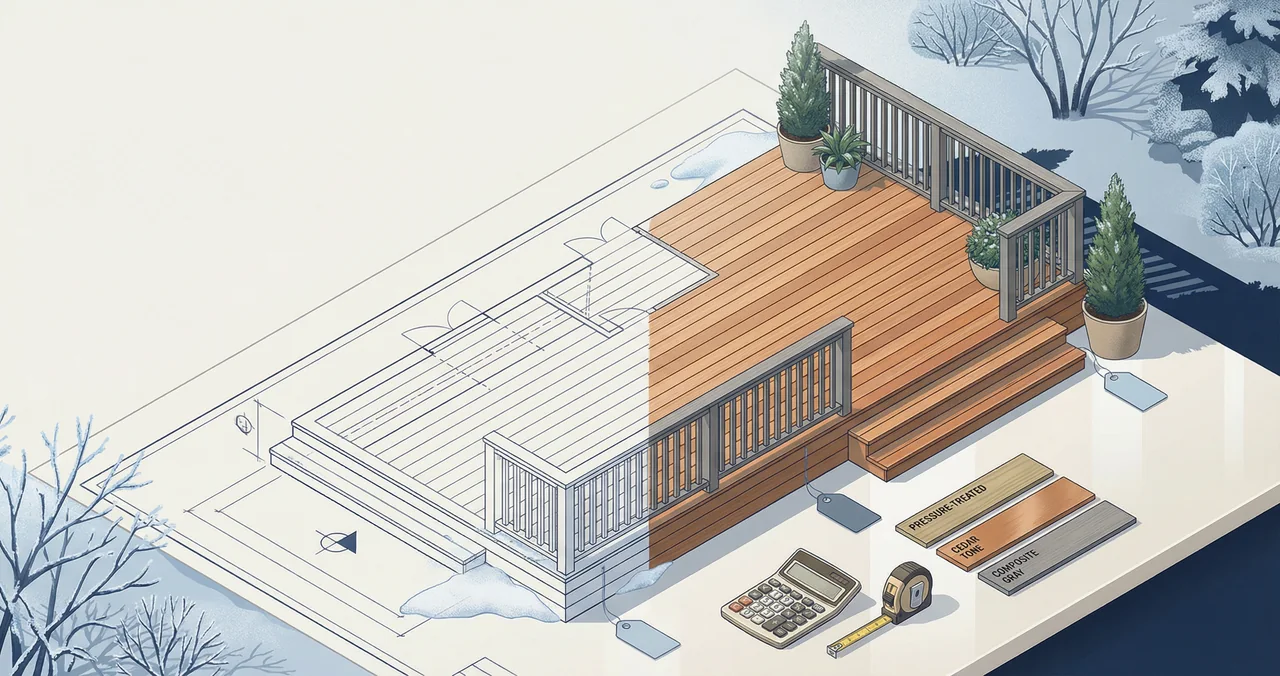
You've collected three deck quotes. They're all around $15,000 for a 200-square-foot pressure-treated deck. You pick the middle one, sign the contract, and two weeks later you're writing cheques for things that weren't in the original number.
Sound familiar? Most Ontario homeowners discover hidden deck costs halfway through construction. Here's what quotes routinely miss—and what you should budget for before breaking ground. Start with our complete Ontario deck cost guide for baseline pricing, then add these extras.
1. Permit Fees and Plan Revisions
Your quote says $250 for permit application. What it doesn't mention:
🏗️ Planning a deck project?
Get a free manual project review, or visualize your dream deck with AI before requesting quotes.
- Plan amendments: If the inspector rejects your drawings for missing guardrail details or incorrect footing placement, you'll pay your designer $150-$400 to revise and resubmit
- Resubmission fees: Some KWC municipalities charge $75-$150 for second submissions
- Engineer's stamp: If your deck is elevated, cantilevers, or supports a hot tub, you may need structural drawings stamped by a P.Eng. Cost: $800-$1,500
What to ask: "Does your quote include all permit fees, plan revisions, and any required engineering stamps?" Get it in writing with a cap on revision costs.
Learn the full permit process: Kitchener Deck Permit Application: Step-by-Step (2026)
2. Site Access and Material Delivery
Standard quotes assume a truck can back into your driveway and workers can carry lumber through a standard side gate. Reality check:
- Crane or lift rental: If your backyard has no ground-level access, expect $600-$1,200 for a crane to lift material over your house
- Hand-bombing material: Tight access means manual carrying. Builders charge $300-$800 in extra labour
- Delivery surcharges: Some suppliers add $150-$300 for rural KWC addresses (Breslau, New Hamburg, Elmira)
- Street parking permits: Downtown Kitchener or Uptown Waterloo builds may require $50-$100/day parking permits for the work truck
What to ask: "Have you accounted for site access in your quote? Will material delivery cost extra?" Walk your property with the builder during the initial site visit and point out access constraints.
3. Soil and Footing Surprises
Your quote assumes normal soil conditions. Ontario clay and bedrock have other ideas:
- Bedrock hits: If you hit bedrock at 30 inches instead of digging to the required 48-inch frost line, you'll need to switch to helical piles. Cost difference: $150-$300 per footing (6-8 footings = $1,200-$2,400 extra)
- High water table: Soggy soil requires longer piles or concrete bell footings. Add $500-$1,500
- Existing utilities: Hit a buried gas line and you'll pay for emergency utility locates, repair, and construction delays. Always call Ontario One Call (811) before digging—it's free, and it's the law
What to ask: "What happens if we hit bedrock or water during excavation? Is that cost included?" A good builder includes a bedrock contingency or clearly states it's extra.
See your footing options: Deck Footing Options Ontario: Sonotube, Helical Piles, Pros & Cons
4. Demolition and Disposal
Replacing an old deck? Your quote might cover teardown but not disposal:
- Dump fees: Disposing of pressure-treated lumber costs $100-$200/tonne at KWC landfills. A 12x16 deck generates 1-2 tonnes of waste
- Concrete removal: Old footings add another $150-$400 in disposal costs
- Bin rental: If the builder doesn't include haul-away, you're renting a bin for $350-$600
What to ask: "Does your quote include full demolition, haul-away, and dump fees? Or is disposal separate?" Budget an extra $500-$1,000 if it's not explicitly included.
Full breakdown: Deck Demolition & Disposal KWC: Cost & Dump Fees
5. Stairs and Landings
You mentioned you need stairs. The quote includes "deck stairs"—but does it include:
- Concrete landing pad: Ontario Building Code requires a 3x3-foot landing at the base of stairs. Cost: $300-$600 poured and finished
- Extra stringers: Stairs wider than 36 inches need a third center stringer. Add $150-$250
- Handrails: Code-compliant handrails on both sides of stairs cost $200-$400 installed
A basic stair assembly runs $800-$1,500 installed. If your quote just says "stairs included," clarify what that covers.
What to ask: "Does the stair price include the concrete landing, handrails, and all code-required components?"
Ontario stair codes explained: Deck Stairs Code Ontario: Rise, Run, Handrail (Kitchener)
6. Railings and Guardrails
Many quotes price basic pressure-treated railings at $40-$60/linear foot. But if you want composite, aluminum, or glass:
- Composite railing systems: $80-$120/linear foot installed
- Aluminum picket railings: $90-$140/linear foot
- Tempered glass panels: $150-$250/linear foot
A 12x16 deck requires roughly 44 linear feet of railing. Upgrading from wood to composite adds $1,760-$2,640 to your total.
What to ask: "What railing material is included in the base quote? What's the cost to upgrade?" Get a per-linear-foot price for each option.
Compare your options: Deck Railing Cost Ontario (Kitchener-Waterloo)
7. Ledger Board Flashing and Membranes
The ledger board bolts your deck to your house. Protecting it from water intrusion isn't optional—but it's often underspecified in quotes:
- Self-adhered flashing membrane: Required by OBC to prevent rot. Quality membranes cost $3-$5/linear foot in material alone
- Drip cap flashing: Metal flashing over the ledger adds $8-$12/linear foot installed
- Joist tape: Protects the tops of all joists and beams from moisture. Material cost: $50-$150 for a typical deck
These details add $300-$800 to a build but prevent thousands in future rot repairs.
What to ask: "Does your quote include ledger flashing, drip cap, and joist tape? Which brands do you use?" Cheap builders skip this. Good ones specify it.
Why it matters: Deck Ledger Flashing Ontario: Water Damage Prevention
8. Finish and Maintenance
Your quote covers the structure. What about protecting it?
Pressure-Treated Decks
- Initial stain/seal: Most builders don't include this. Professional staining costs $2-$4/sqft ($400-$800 for a 200-sqft deck)
- Wait time: You should wait 3-6 months after installation before staining to let the wood dry. That means a summer of unprotected boards—or paying for a return visit
Composite Decks
- Installation waste: Composite cuts generate 5-10% waste. Some quotes assume zero waste, then charge you for extra boards mid-project. Clarify upfront
What to ask: "Is staining or sealing included? When will it be done?" For composite, ask: "How much material waste is included in your estimate?"
9. Structural Upgrades You Didn't Know You Needed
Once construction starts, your builder might discover:
- Rotted rim joist: If your house's rim joist is compromised, ledger attachment isn't safe. Replacing a section costs $500-$1,200
- Undersized beams: Spanning more than 8 feet between posts? You might need doubled-up 2x10s instead of single 2x8s. Add $300-$600 in lumber
- Lateral bracing: Elevated decks over 6 feet need diagonal bracing for lateral stability. Cost: $200-$400 in material and labour
What to ask: "What happens if you discover structural issues with my house or deck during construction? Are those repairs included or extra?"
10. Finishing Touches and Change Orders
You signed off on the plan. Then you see the deck taking shape and decide:
- You want an electrical outlet: Adding a weatherproof GFCI outlet costs $300-$600 (permits, electrician, inspection)
- You want deck lighting: Low-voltage LED strips or post cap lights run $600-$1,500 installed
- You want skirting or privacy screens: Lattice skirting costs $15-$25/linear foot; composite privacy screens cost $40-$80/linear foot
Change orders mid-project cost 20-30% more than if you'd included them upfront. Builders charge premium rates for unplanned work.
What to ask: "What's your change order policy? What's the markup on mid-project additions?" Budget $1,000-$2,000 as a change order cushion if you're even slightly indecisive.
How to Avoid Cost Surprises
1. Get itemized quotes: Demand line-item breakdowns showing materials, labour, permits, and disposal separately. Reject any quote that says "full deck build: $15,000" with no detail
2. Ask about exclusions: "What's *not* included in this quote?" Force the builder to list assumptions (site access, normal soil, basic railings, no demo, no staining)
3. Include contingencies: Budget 10-15% above the quoted price for unforeseen issues. On a $15,000 deck, that's $1,500-$2,250 in reserve
4. Use a detailed contract: Your contract should list every inclusion, specify all material brands, and include a clear change order process with markup rates
What to include in your contract: Deck Builder Contract KWC: What to Include (Warranty, Payment)
🎨 Not sure which material to pick?
Upload a photo of your backyard and see exactly how Trex, TimberTech, or cedar would look — free and instant.
Common Questions
What's a reasonable contingency budget for a deck build in Ontario?
Budget 10-15% above the quoted price for typical projects, and 15-20% if you're replacing an old deck, building on a sloped lot, or using helical piles instead of concrete footings. For a $20,000 deck, keep $2,000-$4,000 in reserve.
Should I accept a quote that doesn't itemize costs?
No. Lump-sum quotes hide assumptions and make it impossible to comparison-shop. Insist on line-item pricing that breaks out framing, decking, railings, labour, permits, and disposal. Any builder who refuses is hiding something.
How much do hidden costs typically add to a deck project?
On average, Ontario homeowners spend $2,000-$5,000 more than the original quote due to permits, soil conditions, demolition, finishing, and change orders. Complex projects (elevated decks, difficult access, bedrock) can see $5,000-$8,000 in extras.
Can I negotiate who pays for unforeseen costs like bedrock?
Yes. Many contracts split unforeseen costs 50/50 or cap the builder's exposure at $1,000-$2,000 beyond the quote. Negotiate this *before* signing. Get it in writing.
What's the best way to compare quotes if they all use different line items?
Create a spreadsheet. List every component (footings, framing, decking, railings, stairs, permits, demo, finish) in rows. Fill in what each quote covers, then add rows for what's *missing*. Calculate the true apples-to-apples total. The cheapest quote often becomes the most expensive once you account for exclusions.
Upload a backyard photo and preview real decking materials with AI — free, instant, no sign-up.
Permits, costs, material comparisons, and questions to ask before requesting quotes — delivered to your inbox.