
How Much Value Does a Deck Add to a Home in Ontario?
A well-built deck adds 60-90% of its cost to home value in Ontario. Learn ROI by deck type, regional factors, and what buyers actually want in 2026.
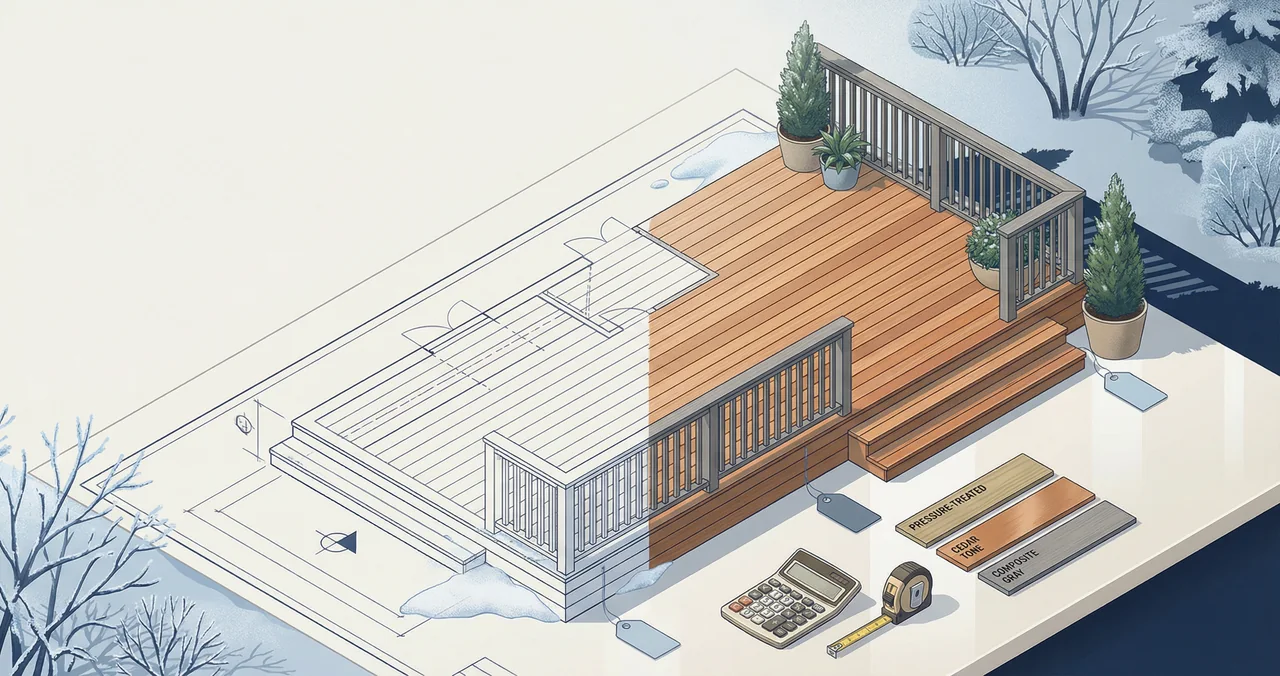
You're thinking about building a deck, but you want to know if it's actually worth it. Will you recoup the cost when you sell? How much value does a deck really add to an Ontario home?
Here's the practical answer: A professionally-built deck typically returns 60-90% of its construction cost in added home value. That means a $15,000 deck could add $9,000-13,500 to your home's sale price. The exact return depends on your deck material, size, condition, and local market.
What Determines Deck ROI in Ontario?
Not all decks add the same value. Several factors affect how much buyers will pay for your outdoor space.
🏗️ Planning a deck project?
Get a free manual project review, or visualize your dream deck with AI before requesting quotes.
Deck Material and Condition
Composite decking delivers the highest ROI in Ontario's resale market. Buyers see it as low-maintenance and durable through freeze-thaw cycles. A well-maintained composite deck can return 75-90% of its cost.
Pressure-treated wood decks return about 60-75% if they're in excellent condition. However, buyers often deduct $3,000-8,000 from offers if the deck shows rot, loose boards, or needs restaining within 1-2 years.
Cedar decks fall in the middle at 65-80% ROI, appealing to buyers who value natural wood but worry about maintenance.
A brand-new deck built within 2-3 years of selling adds maximum value. Decks older than 10 years add significantly less unless they've been meticulously maintained. For more on material choices, see our guide on composite vs. wood decking in Ontario.
Size and Usability
Bigger isn't always better. A 200-250 square foot deck (roughly 12×16 to 12×20) offers the best value-per-square-foot because it's large enough for furniture and entertaining but doesn't dominate the yard.
Oversized decks (400+ square feet) often return lower percentages because they reduce usable lawn space that families with kids or dogs want. Small decks under 100 square feet feel like an afterthought and don't add much value.
Multi-level decks can boost value by 5-10% over single-level designs, but only if they serve a clear purpose (connecting to a walkout basement, creating distinct entertaining zones, or accommodating a slope).
Quality of Construction
Buyers—or their home inspectors—will notice substandard work. Decks built without permits, improper ledger board attachment, or shallow footings raise red flags and can actually reduce your home's value or delay sales.
A properly permitted deck with Ontario Building Code-compliant footing depth, railing height, and ledger flashing signals quality and protects buyers from future repair costs.
Regional Market Conditions
KWC's competitive housing market favors outdoor living spaces. Homes with decks in Waterloo's Beechwood or Kitchener's Forest Heights neighborhoods often sell 5-7 days faster than comparable homes without decks.
In rural areas like New Hamburg or Elmira, decks are expected rather than value-adds—but a missing or damaged deck hurts your sale price more than a new one helps.
Deck ROI by Material (2026 KWC Market)
Here's what you can expect based on current construction costs and resale values:
| Deck Type | Installed Cost (200 sqft) | Estimated Value Added | ROI Percentage |
|-----------|---------------------------|------------------------|----------------|
| Pressure-Treated | $9,000-13,000 | $6,000-9,500 | 60-75% |
| Composite (Trex, Fiberon) | $13,000-19,000 | $10,500-16,000 | 75-90% |
| Cedar | $11,000-16,000 | $7,500-12,500 | 65-80% |
| PVC/High-End Composite | $16,000-22,000 | $11,500-17,000 | 70-85% |
These figures assume professional installation, proper permits, and sale within 5 years of construction. For detailed pricing breakdowns, check our Kitchener, Waterloo, and Cambridge deck cost guides.
Features That Increase Deck Value
Not all deck features deliver equal returns. Focus on these high-impact additions:
Built-In Seating and Planters
Built-in benches with storage underneath add functionality without cluttering the deck. Buyers appreciate the finished look and extra storage for cushions or yard tools. Cost: $800-2,000 | Value added: $600-1,500 (75-85% ROI).
Quality Railing Systems
Aluminum or composite railings with glass or cable inserts look modern and require zero maintenance. They're a selling point for buyers tired of sanding and painting wood balusters. Expect to pay $60-120 per linear foot installed. See our deck railing cost guide for details.
Low-Voltage LED Lighting
Post cap lights, riser lights, and under-rail lighting extend usability into evening hours and create ambiance. Professionally installed systems cost $800-2,500 but add perceived value beyond their cost—buyers see them as a luxury upgrade.
Pergolas and Partial Shade
A cedar or aluminum pergola over part of your deck adds architectural interest and defines entertaining zones. In Ontario's sunny summers, shade is a practical selling point. Budget $2,500-8,000 depending on size and materials. Note: covered structures may require separate permits in KWC.
Hot Tub Structural Support
If you plan to include a hot tub, ensuring your deck is structurally rated for the load adds value for buyers who already own a hot tub or want the option. This requires engineered plans and heavier framing—an upfront cost but a clear selling point.
Features That Don't Add Value
Skip these unless you'll personally enjoy them for years:
- Ornate railing designs that look dated or require specialized replacement parts
- Built-in planters that restrict furniture placement or create drainage issues
- Exotic hardwoods (ipe, tigerwood) that intimidate buyers with unknown maintenance requirements
- Overly customized shapes (octagons, curves) that reduce furniture layout options
When NOT to Build a Deck for Resale Value
Sometimes a deck won't boost your sale price enough to justify the cost:
You're Selling Within 12 Months
You likely won't recoup enough value to break even. Buyers may prefer to build their own deck to their specifications. Focus on quick-win curb appeal projects instead.
Your Home Is Already at the Top of Market Range
If you own one of the priciest homes in your neighborhood, a new deck won't push your value higher—you're already capped by comparable sales. Save the investment.
Your Yard Is Unusually Small or Oddly Shaped
A deck that consumes 60%+ of your yard will turn off buyers with kids or dogs. If you lack space for both a deck and usable lawn, consider a smaller patio instead.
Major Repairs Are Needed First
Fix foundation cracks, roof leaks, or failing HVAC systems before building a deck. Buyers mentally subtract deferred maintenance costs from their offers, negating any value a deck adds.
Maintenance Impact on Resale Value
A poorly maintained deck actively hurts your home value. Here's what buyers scrutinize:
Wood decks: Buyers (and inspectors) look for splintering boards, loose railings, faded or peeling stain, soft spots indicating rot, and rust-stained fasteners. Addressing these issues costs $1,500-5,000 right before listing—or buyers will deduct more from their offers. Follow a regular pressure-treated maintenance schedule.
Composite decks: While marketed as maintenance-free, composite boards still need annual cleaning to prevent mold and mildew buildup. Surface scratches and fading (common on older composite products) reduce perceived value. Learn proper composite deck maintenance for Ontario conditions.
Winter damage: Salt damage, ice scraper gouges, and snow load deflection are common in Ontario. Buyers will notice warped boards or sagging joists caused by improper snow removal.
Appraisal vs. Market Perception
There's a gap between what appraisers recognize and what buyers emotionally value:
Appraisers use comparables and replacement cost calculations. They typically add $5,000-12,000 for a deck regardless of your $15,000-20,000 investment. This matters for refinancing or equity loans but less so for sale price.
Buyers make emotional decisions. A beautiful deck can tip the scales between your home and a comparable listing, even if the appraised value difference is modest. In competitive markets, decks help homes sell faster at asking price rather than sitting and requiring reductions.
Realtors often advise that a deck's real value is in time-to-sale reduction (5-10 days faster on average) and negotiating leverage—buyers are less likely to lowball on homes that feel move-in ready.
How to Maximize Your Deck Investment
If you're building now but selling in 3-10 years, follow these guidelines:
1. Choose composite or high-quality pressure-treated lumber that ages well
2. Stay neutral: grays, browns, and natural wood tones appeal broadly; avoid bold deck board colors that may look dated in 5 years
3. Pull permits: buyers' lawyers and home inspectors ask about permits—unpermitted work can derail sales or reduce offers by $5,000-15,000
4. Hire licensed contractors: DIY deck sales are harder to close because buyers worry about structural integrity
5. Keep receipts and warranties: a file with building permits, contractor invoices, material warranties, and inspection records reassures buyers
6. Plan for standard furniture layouts: 12×16 or 14×16 decks accommodate typical patio sets comfortably
For a properly scoped project, review our deck quote checklist before hiring contractors.
Beyond ROI: Quality of Life Value
Not every home improvement should be judged purely on resale value. If you'll enjoy your deck for 5-15 years, calculate the cost-per-year:
- $15,000 deck ÷ 10 years = $1,500/year for a private outdoor space (see our guide to deck costs in Ontario for current pricing)
- Add in the meals, gatherings, morning coffees, and summer evenings you'll enjoy
- Factor in not having to leave home for restaurant patios
Many homeowners find decks deliver more quality-of-life value than higher-ROI renovations like bathroom updates. Just be realistic: you're building for yourself first, resale value second.
🎨 Not sure which material to pick?
Upload a photo of your backyard and see exactly how Trex, TimberTech, or cedar would look — free and instant.
Common Questions
Does a deck add more value than a patio?
Decks typically add more value in Ontario because they create elevated outdoor space, work better with split-level or raised-foundation homes common in KWC, and integrate with doorways from living rooms or kitchens. Patios work well for ground-level walkouts but require proper base preparation and drainage—poor patio construction shows frost heave damage within 2-3 Ontario winters. Decks generally return 5-10% higher ROI than patios of similar size.
Will I recoup the full cost of my deck when I sell?
Unlikely. Most decks return 60-90% of construction cost in added home value. You're paying for years of personal use, not a break-even investment. The exception: if you're selling a home that's the only one without a deck in a neighborhood where they're standard, you may recoup 90-100% because you're bringing your home up to expected baseline features.
Does a second-story deck add more value than ground-level?
Second-story decks cost more to build (due to taller posts, larger beams, and stair construction) but don't necessarily add proportionally more value unless they unlock a view or connect to main-level living spaces. Buyers with young children or mobility concerns sometimes see tall decks as a drawback. Ground-level decks typically offer better ROI percentages because of lower construction costs.
How much value does a deck add if it needs repairs?
A deck requiring obvious repairs—loose boards, wobbly railings, peeling stain—often adds zero value or negative value because buyers factor in $3,000-8,000 for deck rebuilding or resurfacing. If inspection reveals structural issues (rotted ledger board, shallow footings, missing flashing), buyers may request $8,000-15,000 in credits or walk away entirely. Fix problems before listing or be prepared for reduced offers.
Should I build a deck if I'm planning to sell in 2-3 years?
Maybe. If your home lacks outdoor space and comparable listings all have decks, building one prevents your home from sitting on market. In that case, you're reaching baseline expectations, not adding bonus value. If decks are optional in your neighborhood and you're selling soon, invest in lower-cost curb appeal projects instead—landscaping, fresh paint, new front door—that deliver faster emotional impact for less money.
Upload a backyard photo and preview real decking materials with AI — free, instant, no sign-up.
Permits, costs, material comparisons, and questions to ask before requesting quotes — delivered to your inbox.