
Backyard Renovation Timeline in Ontario: Planning to Completion
Realistic backyard renovation timeline for Ontario homeowners. From permits to final inspection, here's how long deck, fence, and patio projects actually take.
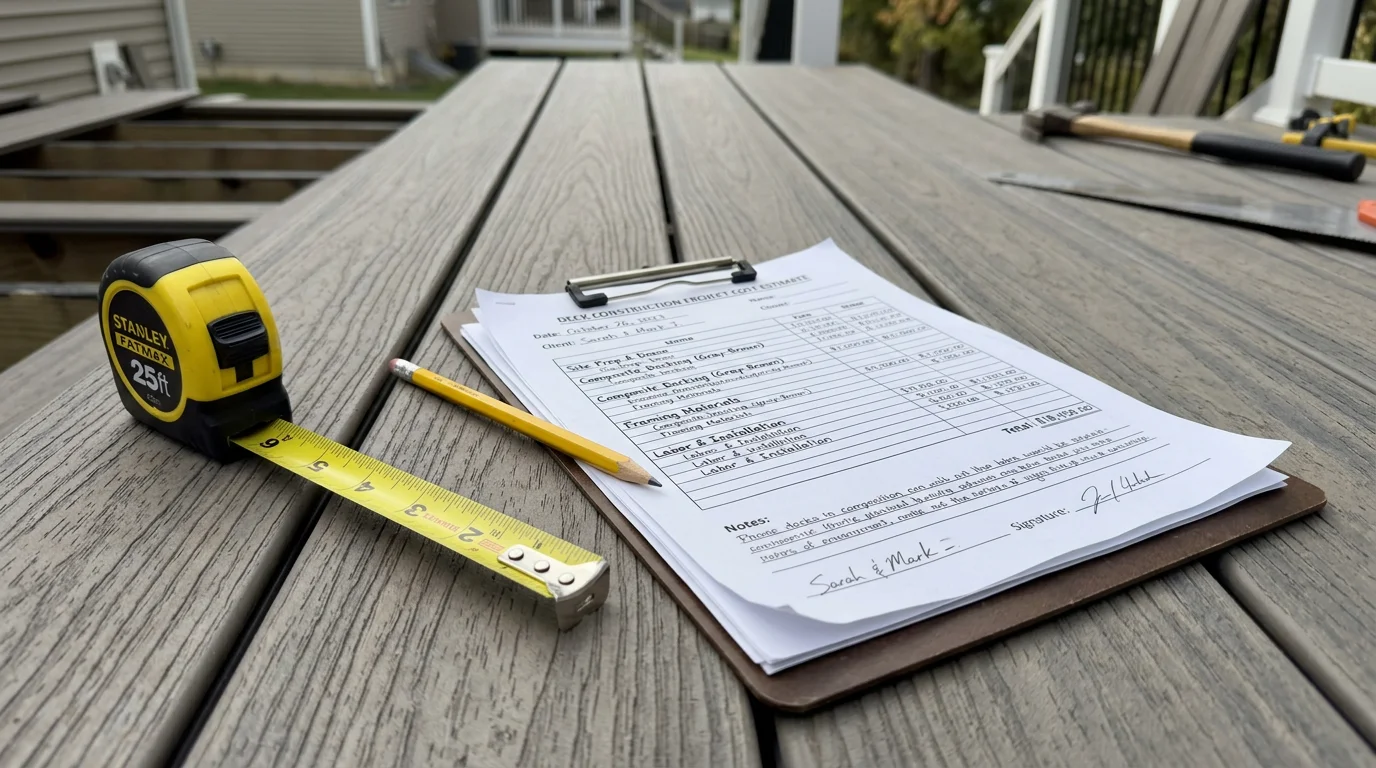
Planning a backyard renovation in Ontario means understanding realistic timelines. Here's exactly how long each phase takes, from your first sketch to final inspection.
Pre-Construction Phase: 2-6 Weeks
Before a single shovel hits the ground, you need design decisions, permits, and contractor scheduling.
🏗️ Planning a deck project?
Get a free manual project review, or visualize your dream deck with AI before requesting quotes.
Design and Planning (1-2 weeks)
If you're working with a deck builder, expect 3-7 days for them to visit your property, take measurements, and prepare a detailed quote. Complex projects with multiple elements—deck, fence, pergola, patio—can push this to 10-14 days.
Need drawings for your permit application? Factor in another 5-7 days if your builder provides them, or 2-3 weeks if you hire a designer separately. Detailed permit drawing requirements vary by municipality but always include site plans, framing layouts, and elevation views.
Permit Application and Approval (2-4 weeks)
Kitchener: Typically 10-15 business days for deck permits under 300 sq ft. Larger or more complex projects can take 3-4 weeks.
Waterloo: Average 15-20 business days. Waterloo's permit process requires detailed structural plans for decks over 24 inches high.
Cambridge: Plan for 3-4 weeks. Cambridge applications often take longer due to thorough zoning reviews.
Fence permits are faster—usually 5-10 business days—because they're structurally simpler. Combined deck-and-fence projects get processed together, so use the longer deck timeline.
Permit fees in 2026: $150-$300 for decks, $50-$150 for fences, depending on project size and municipality.
Material Ordering and Delivery (1-3 weeks)
Once permits are approved and you've signed a contract, your builder orders materials.
Pressure-treated lumber: Usually available within 3-5 days from local suppliers.
Composite decking: Stock colors ship in 5-10 days. Custom or premium lines (Trex Transcend, TimberTech Azek) can take 2-3 weeks, especially during peak season (May-July).
Fence materials: Cedar and PT pine are typically in stock. Vinyl and aluminum may require 7-14 days for manufacturing and delivery.
Helical piles or engineered footings: If your project requires helical piles, add 1-2 weeks for engineering stamps and specialized equipment scheduling.
Construction Phase: 1-6 Weeks
This is where your backyard transforms. Timeline depends heavily on project scope and weather.
Site Preparation (1-3 days)
Locating utilities: Before any digging, your contractor calls Ontario One Call (811). Utility companies mark lines within 3-5 business days. Never skip this—hitting a gas line means massive delays and fines.
Demolition: Removing an old deck takes 4-8 hours for a typical 12x16 ft structure. Disposal adds another half day unless your contractor hauls it away immediately. Demolition costs run $500-$1,500 including dump fees. For a full breakdown of what a new deck costs to replace it, see our Ontario deck cost guide.
Grading and leveling: Minor adjustments take a few hours. If you need significant regrading for drainage, budget 1-2 days.
Deck Construction (3-10 days)
Small deck (100-200 sq ft): 3-5 days with a two-person crew.
Medium deck (200-400 sq ft): 5-8 days, especially if you're adding stairs, multiple levels, or custom railings.
Large or complex deck (400+ sq ft): 8-14 days. Factor in extra time for hot tub reinforcement, built-in benches, or intricate railing designs.
Typical sequence:
- Day 1-2: Footings and posts. In Ontario, footings must go 4 feet deep below grade to reach below the frost line.
- Day 3-4: Framing (beams, joists, ledger board). Ledger attachment is critical—improper flashing causes 80% of deck failures.
- Day 5-7: Decking installation. Composite requires precise board spacing to accommodate thermal expansion.
- Day 8-10: Railings, stairs, and finishing details.
Fence Construction (2-5 days)
Standard privacy fence (100-150 linear feet): 2-3 days with a two-person crew.
Larger or complex projects (200+ ft, multiple gates, varying terrain): 4-5 days.
Fence installation is faster than decks because there's less structural complexity. Crews dig post holes (typically 36 inches deep in Ontario clay), set posts in concrete, and install panels or boards.
Wood fencing: PT pine costs $30-50/ft installed, cedar runs $40-60/ft. Installation is quickest—panels go up fast.
Vinyl fencing: $45-70/ft installed. Slightly slower because panels must be carefully leveled and snapped into posts.
Aluminum fencing: $50-80/ft installed. Similar timeline to vinyl but requires more precise measurements.
Multi-Element Projects (3-6 weeks)
Combining deck, fence, patio, and landscaping stretches timelines significantly.
Deck + fence: 2-3 weeks. Builders usually complete the deck first, then move to fencing. This sequencing prevents fence panels from blocking equipment access.
Deck + patio: 3-4 weeks. If you're adding an interlock or poured concrete patio, expect 5-7 days for excavation, base prep, and installation, plus 3-5 days curing time for concrete.
Full backyard renovation (deck, fence, patio, pergola): 4-6 weeks. Weather delays are almost guaranteed on projects this long, especially during Ontario's unpredictable spring and fall seasons.
Inspection Phase: 1-3 Days
Once construction wraps, your municipality schedules inspections.
Framing Inspection
Required before decking goes on. Inspectors check footing depth, joist spans, ledger attachment, and structural connections. What inspectors look for includes proper hardware, correct spacing, and code-compliant framing.
Scheduling: Call as soon as framing is complete. Inspections typically happen within 2-3 business days.
Failed inspection: If something's wrong, your builder fixes it and reschedules. This adds 3-7 days depending on the issue and inspector availability.
Looking for local pros? Check out Deck & Porch Builders in Rochester: Options, Costs & Top Contractors.
Looking for local pros? Check out Custom Deck Builders in Surrey: Design & Build Your Dream Deck in 2026.
Final Inspection
Covers completed railings, stairs, and overall safety. Railing height requirements in Ontario mandate 42 inches for decks over 24 inches high, with 4-inch maximum gaps between balusters.
Most projects pass final inspection on the first try if framing passed earlier. Budget 1-2 days for scheduling.
Seasonal Considerations for Ontario Projects
Ontario weather dramatically affects renovation timelines.
Spring (April-May)
Pros: Contractors are available and motivated after winter. Ground thaws early-to-mid April in KWC.
Cons: Spring rain delays are common—expect 3-5 weather days that halt work. Muddy conditions slow equipment access and footing installation.
Best for: Getting on the schedule early. Spring is ideal for starting projects you want done by June.
Summer (June-August)
Pros: Consistent weather, long days, minimal delays.
Cons: Peak season means 2-4 week wait times just to get on a builder's schedule. Material costs spike 10-15% due to demand.
Best for: Fast construction once you're scheduled. Projects move quickly in dry, warm conditions.
Fall (September-October)
Pros: Contractor availability opens up after summer rush. Prices may drop slightly.
Cons: Shorter days reduce productive hours. Late October brings frost risk, which complicates footing pours.
Best for: Experienced builders who can work efficiently before weather turns.
Winter (November-March)
Reality check: Most builders shut down December-March. Frozen ground makes footing installation impossible without expensive ground thawing equipment.
Exception: Indoor planning, permit applications, and material ordering happen year-round. Use winter to finalize designs so you're first in line for spring construction.
Common Delays and How to Avoid Them
Weather Delays (3-7 days average)
Rain stops most work. Concrete needs 24-48 hours of dry weather to cure. High winds halt fence panel installation.
Solution: Add 1 week of buffer to any timeline between April-October. Projects starting in June-July face fewer weather delays.
Permit Delays (1-3 weeks)
Incomplete applications, zoning issues, or missing engineering stamps can double permit timelines.
Solution: Use a permit drawing checklist to ensure nothing's missing. Work with builders who know local requirements—they'll get it right the first time.
Material Shortages (1-4 weeks)
Specialty composite colors, custom vinyl fencing, and imported materials face supply chain delays.
Solution: Order materials immediately after permit approval. Choose in-stock options when possible. Composite decking made in Canada ships faster than imported brands.
Contractor Scheduling (1-4 weeks)
Good builders book up fast, especially May-July.
Solution: Contact builders in February-March for summer projects. Get on the schedule early, even if permits aren't approved yet.
Failed Inspections (3-7 days)
Code violations, improper footings, or missing structural elements require rework.
Solution: Hire experienced builders who rarely fail inspections. Check references and ask about their inspection pass rate.
Realistic Timeline Examples
Scenario 1: Simple Deck Replacement
- Project: 12x14 ft ground-level PT deck, Kitchener
- Planning and permits: 3 weeks
- Construction: 4 days
- Inspection: 2 days
- Total: 4-5 weeks from first call to final inspection
Scenario 2: Elevated Composite Deck
- Project: 16x20 ft composite deck with stairs and glass railings, Waterloo
- Planning and permits: 4 weeks
- Material delivery: 2 weeks (custom composite color)
- Construction: 8 days
- Inspections: 3 days (framing + final)
- Total: 8-9 weeks
Scenario 3: Deck and Fence Package
- Project: 14x18 ft deck + 120 ft cedar privacy fence, Cambridge
- Planning and permits: 5 weeks (combined application)
- Construction: 12 days (deck first, then fence)
- Inspections: 3 days
- Total: 10-11 weeks
Scenario 4: Full Backyard Renovation
- Project: 20x24 ft multi-level composite deck, 200 ft vinyl fence, 12x16 ft patio, pergola over deck section
- Planning and permits: 6 weeks
- Material delivery: 3 weeks (staggered)
- Construction: 4-5 weeks
- Inspections: 4 days (multiple inspections)
- Total: 14-16 weeks
How to Speed Up Your Timeline
1. Start planning in winter. Design, permits, and material selection happen before construction season.
2. Choose stock materials. Readily available lumber, standard composite colors, and in-stock fencing ship within days.
3. Use builders who handle permits. They know exactly what municipalities require and rarely face rejections.
4. Be flexible on start dates. Contractors can often fit you in sooner if you're not locked to specific dates.
5. Pre-approve material substitutions. If your first-choice composite is backordered, have a backup approved so work doesn't stall.
6. Schedule inspections proactively. Call the building department the moment each phase is ready—don't wait for your builder to do it.
Budget for Timeline Buffers
Never plan a major event (wedding, party, family gathering) around the exact projected completion date.
Conservative buffer: Add 2-3 weeks to any contractor's timeline estimate. This accounts for weather, minor permit delays, and material delivery variations.
Safe buffer: Add 4-6 weeks for complex multi-element projects. This is especially important for spring and fall projects when weather is unpredictable.
Projects starting June-July with experienced builders often finish on time or early. Projects starting April-May or August-October face higher delay risk.
🎨 Not sure which material to pick?
Upload a photo of your backyard and see exactly how Trex, TimberTech, or cedar would look — free and instant.
Common Questions
How long does a typical deck take to build in Ontario?
A standard 200-300 sq ft deck takes 5-8 construction days with a two-person crew, assuming no weather delays. Simple ground-level decks can be done in 3-4 days, while elevated decks with complex railings and stairs take 8-12 days. Add 3-4 weeks for permits and planning before construction starts.
Can you build a deck and fence at the same time in Ontario?
Yes, but most builders complete the deck first to maintain equipment access, then install fencing. This sequencing adds 2-3 days compared to deck-only projects. Total construction time for both is typically 10-14 days. Permits can be applied for simultaneously, though deck permits take longer to process.
What time of year do backyard renovations happen fastest in Ontario?
June through August offers the fastest construction timelines due to consistent weather and long daylight hours. However, contractor wait times are longest—expect 2-4 weeks just to get on the schedule. May and September offer good weather with better availability, though you'll need to budget for 3-5 potential weather delay days.
How much does rushing a project cost?
Expedited permits (if available) add $100-$300 to application fees, and rush delivery on materials can increase costs by 10-20%. More significantly, accepting a contractor's "squeeze you in" timeline often means paying premium rates—typically 15-25% more than standard pricing. Unless you have a firm deadline, standard timelines deliver better value.
Do I need to be home during construction?
Not constantly, but expect to be available for key decision points: initial walkthrough, framing inspection day, and final walkthrough. Most builders prefer daily check-ins around mid-afternoon when the day's progress is visible. You don't need to supervise minute-by-minute, but being reachable by phone or text prevents delays when questions arise.
Upload a backyard photo and preview real decking materials with AI — free, instant, no sign-up.
Permits, costs, material comparisons, and questions to ask before requesting quotes — delivered to your inbox.