
Deck Guardrail Code in Ontario: Height, Spacing, Load Requirements
Ontario deck guardrail code requires 42-inch height, 4-inch max spacing, and 200 lb load capacity. Complete OBC requirements for KWC homeowners.
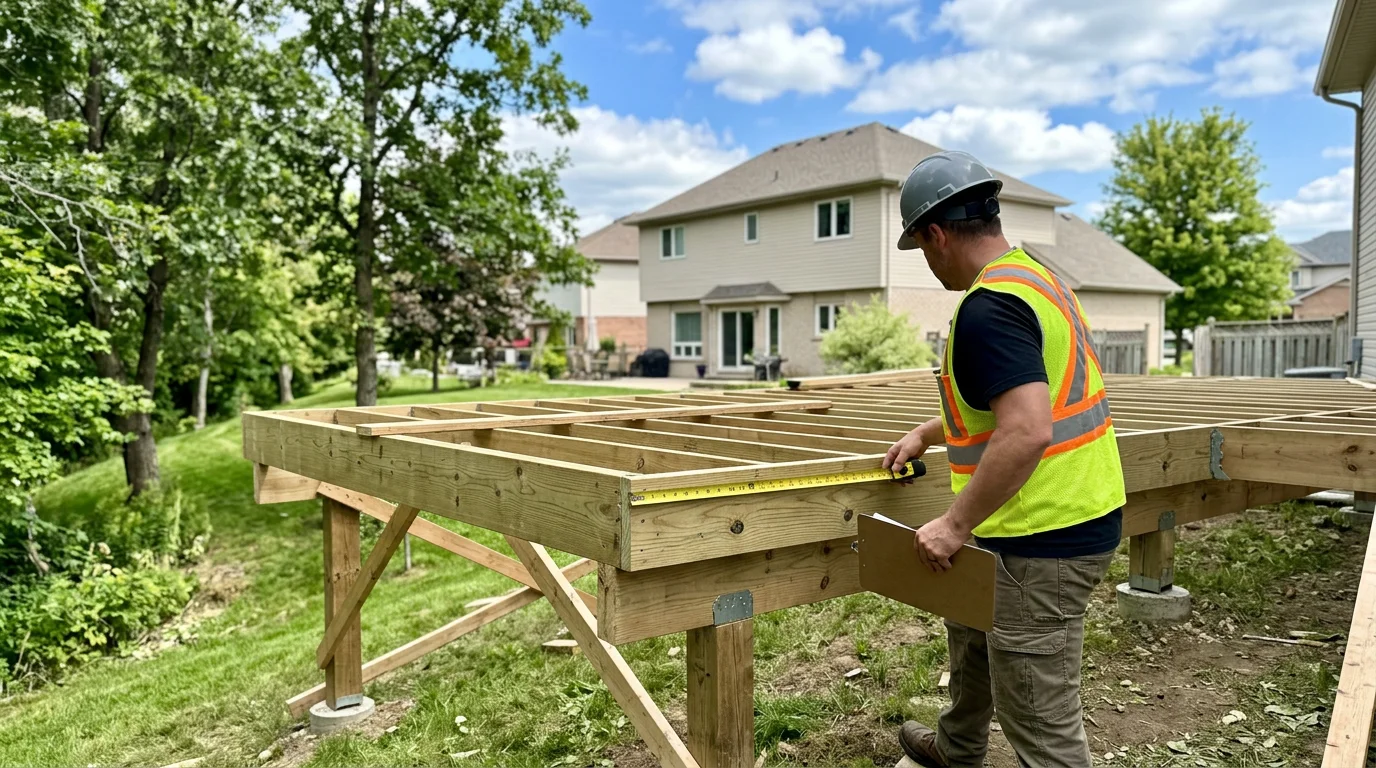
Your deck guardrails must meet Ontario Building Code (OBC) requirements or your inspector will fail your permit. The rules are specific: 42 inches minimum height, 4-inch maximum openings, and 200-pound concentrated load capacity. These aren't suggestions—they're structural safety requirements that apply to every elevated deck in Kitchener-Waterloo-Cambridge.
When You Need Guardrails in Ontario
The OBC is clear: any walking surface elevated more than 24 inches (600 mm) above the ground requires guardrails. This threshold catches most decks.
🏗️ Planning a deck project?
Get a free manual project review, or visualize your dream deck with AI before requesting quotes.
Your deck needs guardrails if:
- The deck surface is 24+ inches above grade
- You have stairs with more than 3 risers
- Your deck attaches to a second-story doorway
- The deck overhangs a slope or hillside
Ground-level decks under 24 inches don't need guardrails, but they're the exception. Most raised decks in KWC fall into permit territory and require full code-compliant railings. If you're unsure whether your deck crosses the 24-inch threshold, measure from the lowest adjacent grade to the deck surface—not from where the ground happens to be highest.
OBC Guardrail Height Requirements
Minimum guardrail height: 42 inches (1,070 mm) measured vertically from the deck surface to the top of the guardrail.
This measurement is non-negotiable. Inspectors measure from the walking surface (deck boards) straight up to the top rail. If your railing measures 41.5 inches, it fails.
Common Height Mistakes
- Measuring from the joist instead of the deck surface: Adds 1.5 inches and creates a false pass
- Sloped top rails that dip below 42 inches: The lowest point must still hit 42 inches
- Built-in benches used as guardrails: The bench back must reach 42 inches from the deck surface, not from the bench seat
Some builders install 43-44 inch railings to create a buffer. The extra inch or two costs nothing in materials but eliminates measurement disputes during inspection.
Stair handrails follow different rules—they require 34-38 inches measured vertically from the stair nosing. Don't confuse stair handrail height with deck guardrail height.
Guardrail Opening and Spacing Rules
Maximum opening size: 4 inches (100 mm) in any direction. This applies to:
- Horizontal spacing between balusters
- Vertical gaps under the bottom rail
- Triangular openings at stair angles
- Decorative pattern openings
The 4-inch rule prevents small children from slipping through or getting their heads stuck. Inspectors carry a 4-inch diameter sphere to test every opening—if it passes through anywhere, your railing fails.
Baluster Spacing Calculation
For vertical balusters, you need to account for baluster width when calculating spacing:
Number of balusters needed = (Rail length - Post widths) / (Baluster width + Spacing)
Example for a 10-foot section between 4x4 posts:
- Rail length: 120 inches
- Post width: 3.5 inches each = 7 inches total
- Available space: 113 inches
- Baluster width: 1.5 inches (2x2)
- Maximum spacing: 4 inches
- Balusters needed: 113 / 5.5 = 21 balusters
Most builders use 3.5-inch on-center spacing to stay safely under the 4-inch maximum even with measurement variation.
Bottom Rail Gap
The space under your bottom rail counts as an opening. If you run a bottom rail 6 inches above the deck surface, that 6-inch gap fails code.
Common solutions:
- Bottom rail directly on deck surface: Zero gap, but traps debris
- 2-inch gap with skirting boards: Clean look, easy to sweep
- Continuous balusters touching deck surface: Extra material but eliminates gap concerns
Cable and glass railings need special attention—see below for specific requirements.
Structural Load Requirements
Ontario guardrails must withstand:
- 200 lb (0.9 kN) concentrated load applied horizontally at the top rail in any direction
- 50 lb per linear foot (0.73 kN/m) uniform load applied horizontally at the top rail
These loads simulate someone leaning heavily against the railing or a crowd pushing during a gathering.
What This Means for Materials
Pressure-treated wood (most common):
- 4x4 posts every 6 feet maximum for wood balusters
- 4x4 posts every 4-5 feet for horizontal cable
- Posts must attach with through-bolts or structural screws—not nails
Composite railing systems:
- Follow manufacturer's specifications for post spacing
- Most require posts every 6 feet with engineered brackets
- Mixing composite rails with wood posts often voids warranties
Aluminum and vinyl systems:
- Engineered for 6-8 foot post spacing
- Must include manufacturer's engineer stamp for permit approval
- Surface-mount systems need structural backing underneath
Cable railing:
- Requires posts every 3-4 feet due to horizontal load deflection
- Cable must be stainless steel, minimum 1/8-inch diameter
- Maximum deflection under load: 4 inches (often the limiting factor)
Post Attachment Methods
Your posts must handle significant lateral force. Acceptable methods:
Through-bolted to rim joist:
- Minimum 2x 1/2-inch galvanized bolts per post
- Bolts must penetrate through post, rim joist, and band board
- Most reliable method for wood-framed decks
Structural post brackets:
- Simpson Strong-Tie or equivalent engineered brackets
- Must use specified fasteners (usually structural screws)
- Surface-mount brackets need blocking underneath
Notched posts over rim joist:
- Post notch sits over joist, through-bolted
- Reduces effective post height—adjust accordingly
- Common for thick posts (6x6)
Surface screws alone don't meet code. Inspectors look for through-bolts or engineered bracket systems with proper fasteners.
Cable Railing Code Compliance
Cable railings are popular for clean sightlines but require careful execution to meet OBC requirements.
Cable Spacing
- Maximum 4-inch spacing between cables (measured at widest point)
- Cables must run horizontally—vertical or diagonal cables don't meet code
- Typical spacing: 3-3.5 inches on-center for safety margin
Cable deflects under pressure. A cable that measures 3.5 inches apart when slack might spread to 4.5 inches when someone pushes on it. Inspectors test this.
Cable Tensioning Requirements
- Cables must be tensioned to 300 lbs to limit deflection
- Use mechanical tensioners with built-in indicators, not turnbuckles alone
- Maximum deflection under 50 lb load: 4 inches from original position
Under-tensioned cable railings fail inspection because they deflect beyond safe limits. Plan to retension cables annually—temperature changes cause expansion and contraction.
Post Spacing for Cable
Cable creates horizontal load on posts. Standard 6-foot post spacing used for vertical balusters won't work.
Cable railing requirements:
- 4x4 posts maximum 3-4 feet apart for residential decks
- 6x6 posts at 5-6 feet for heavier applications
- End posts need extra bracing or larger size—they take all the tension load
Many homeowners underestimate the engineering required for cable railings. If your inspector sees 6-foot post spacing on a cable system, expect a correction notice. For detailed railing costs including cable systems, see deck railing cost in Ontario.
Glass Panel Railing Requirements
Tempered safety glass is required—laminated or annealed glass doesn't meet code for guardrail applications.
Glass panel specifications:
- Minimum 1/4-inch thick tempered glass
- Must meet CAN/CGSB-12.1-M90 safety glazing standard
- Panels require engineer's stamp for permit approval
- Maximum panel size depends on wind load calculations
Glass Panel Framing
The OBC doesn't allow frameless glass panels as primary guardrails—the glass must sit in a structural frame system. The frame itself must meet the 42-inch height and 200 lb load requirements.
Common compliant systems:
- Aluminum channel frame (top and bottom)
- Shoe rail with posts every 4-6 feet
- Manufacturer-engineered glass railing systems with provided engineering
Glass adds significant weight. Your deck framing may need reinforcement to handle the load—bring this up during your deck framing inspection.
Graspable Handrail Requirements
The OBC distinguishes between guardrails (protective barrier) and handrails (graspable rail for stability). Stairs require both.
When You Need a Graspable Handrail
- All stairs with 3+ risers require at least one handrail
- Stairs wider than 44 inches need handrails on both sides
- Decks don't need graspable handrails—only stairs do
Graspable Handrail Specifications
- Height: 34-38 inches measured vertically from stair nosing
- Diameter: 1-1/4 to 2 inches (must fit in an adult hand)
- Continuous length from top to bottom of stairs
- Must extend 12 inches horizontally beyond top and bottom risers
- 1.5-inch clearance from wall or mounting surface (finger space)
Standard 2x6 top rails aren't graspable—they're too wide. You need either:
- A separate rounded handrail mounted inside the top rail
- A routed or milled graspable profile on the top rail itself
- A metal pipe handrail (1.25-1.5 inch diameter)
Inspectors physically test this—they'll wrap their hand around it. If they can't grip it comfortably, it fails.
Post Spacing and Structural Span
Post spacing determines your railing's ability to handle lateral loads. The OBC doesn't specify exact spacing—it requires that the assembly meet the 200 lb load requirement.
Maximum Post Spacing by Material
Wood balusters with wood top/bottom rails:
- 6 feet maximum for 4x4 posts with 2x4 rails
- 8 feet possible with 2x6 top rail and engineered design
Horizontal cable:
- 3-4 feet maximum for 4x4 posts
- 5 feet maximum for 6x6 posts
Composite and vinyl systems:
- Follow manufacturer specifications exactly
- Typically 6 feet for sleeved wood posts
- Aluminum posts may allow 8 feet
Glass panels:
- 4-6 feet depending on panel size and engineer's design
Corner posts experience loads from two directions. Consider:
- Using 6x6 posts at corners even if using 4x4 elsewhere
- Through-bolting corner posts with extra fasteners
- Installing diagonal bracing underneath if the inspector questions stability
Wider post spacing saves money on posts but requires heavier top rails and stronger connections. Most builders stick with 6 feet on-center for wood railings—it's the sweet spot between cost and code compliance.
Inspection Points for Guardrails
KWC inspectors specifically check:
Height verification:
- Measured at multiple points (decks settle unevenly)
- Measured from deck surface, not joists
- No point along the rail dips below 42 inches
Opening test:
- 4-inch sphere test at all openings
- Horizontal baluster spacing
- Vertical gap under bottom rail
- Triangular openings at stairs
Structural load test (sometimes):
- Inspector may push forcefully on top rail
- Looking for movement at post connections
- Checking for loose fasteners or undersized hardware
Connection inspection:
- Through-bolts visible and properly installed
- Structural brackets with correct fasteners
- No split wood around fasteners
- Lag screws not used where through-bolts required
Material verification:
- Pressure-treated or naturally durable wood species
- Manufacturer specs for prefab systems
- Proper fasteners (stainless or hot-dipped galvanized)
If your railing fails inspection, you'll need to correct the issue before receiving occupancy approval. Common corrections take 1-3 days depending on the problem. For permit timelines, see how long deck permits take in KWC.
Built-In Seating and Guardrails
Built-in benches don't replace guardrails unless the bench back reaches 42 inches from the deck surface.
If you want bench seating on your deck:
Option 1: Bench with code-compliant back:
- Bench seat at 18 inches (typical)
- Bench back extends another 24 inches upward
- Total height from deck: 42 inches
- Back must meet 4-inch spacing rules
Option 2: Bench inside the guardrail:
- Standard 42-inch guardrail at deck perimeter
- Bench positioned 12-18 inches inboard from guardrail
- No height restrictions on bench itself
Option 3: Low bench outside the guardrail (not common):
- 42-inch guardrail at deck edge
- Low bench (under 24 inches) on the exterior side
- Only works if ground level is within 24 inches—otherwise the bench area needs its own guardrail
Most builders avoid combining benches and guardrails. The bench back height looks awkward at 42 inches, and adjusting it later is expensive.
Special Conditions and Variations
Hot Tub Surrounds
Hot tubs on elevated decks create unusual guardrail situations:
- Guardrail required around the elevated platform, not around the tub itself
- Tub walls don't count as guardrails
- Steps up to tub edge need handrails if 3+ risers
Hot tubs also add significant load to your deck structure. See hot tub structural requirements before planning tub placement.
Multi-Level Decks
Each level needs independent guardrails:
- 42-inch guardrails at every elevation change over 24 inches
- Stairs between levels need compliant handrails
- Lower level guardrails can't be used to "catch" someone falling from upper level
Inspectors look carefully at level transitions. A step-down area that's 30 inches lower needs its own perimeter guardrails, not just stair handrails.
Deck Gates and Openings
Gates in guardrails must:
- Maintain 42-inch height when closed
- Have openings no larger than 4 inches (same as fixed railing)
- Include self-closing and self-latching hardware if protecting stairs
- Latch located on house side or high enough that young children can't reach
Building a stair gate? The latch must be at least 54 inches above stair nosing to prevent children from opening it.
Sloped or Hillside Decks
Decks built on slopes require special attention:
- Measure 24-inch threshold from lowest adjacent grade
- One side might need guardrails while another side doesn't
- Stairs landing on intermediate grade levels need careful planning
Hillside decks often require engineered designs due to uneven loads and wind exposure. Your municipality may require an engineer's stamp regardless of deck size.
Enforcement and Variance Requests
Can you get a variance to build railings below 42 inches? Highly unlikely. Guardrail height is a safety code provision, not a zoning bylaw. Municipalities rarely grant variances on life-safety requirements.
If you build non-compliant railings:
- Inspection fails and permit remains open
- Insurance claims may be denied if someone is injured
- Liability falls on the homeowner regardless of who built it
- Resale issues—home inspectors flag code violations
Existing decks with 36-inch railings might have been code-compliant when built (pre-2012 OBC allowed 36 inches in some cases). Grandfathering applies until you substantially renovate the deck—then current code kicks in.
Material Selection for Code Compliance
Pressure-Treated Lumber
Meets code when:
- Rated for ground contact (posts)
- UC4B or above for Ontario climate
- Hot-dipped galvanized or stainless fasteners (not electro-plated)
Typical costs for pressure-treated guardrails: $40-65 per linear foot installed. To see how railing costs compare to the rest of your project, check our deck budget guide for Ontario.
Cedar
Naturally rot-resistant but:
- Western Red Cedar only—Eastern White Cedar isn't durable enough for railings
- Still requires proper fasteners and flashing
- Costs $55-80 per linear foot installed
Composite and PVC
Most composite railing systems are engineered for code compliance:
- Trex, TimberTech, Fiberon, Azek all meet OBC requirements when installed per instructions
- Include manufacturer's installation manual with permit application
- Costs $70-120 per linear foot depending on style
Composite systems speed up inspections—the engineer's stamp is built into the product certification.
Aluminum and Steel
- Powder-coated aluminum is maintenance-free and code-compliant
- Requires proper post mounting with structural backing
- Costs $80-150 per linear foot depending on style
For more on material durability in Ontario's climate, see composite versus wood decking.
🎨 Not sure which material to pick?
Upload a photo of your backyard and see exactly how Trex, TimberTech, or cedar would look — free and instant.
Common Questions
Can I use 2x4 balusters laid flat as guardrails?
No. Balusters must be oriented vertically to meet the 4-inch spacing requirement. A 2x4 laid flat creates a 3.5-inch gap—compliant. But the horizontal orientation doesn't meet structural load requirements. The 200 lb concentrated load would snap horizontal 2x4s between posts. Vertical balusters transfer load to the top and bottom rails, which transfer to posts. Horizontal boards only work as decorative infill inside a structural vertical baluster system.
Do I need a building permit for guardrail replacement?
Depends on the scope. Replacing existing guardrails with the same design usually doesn't require a permit—it's considered maintenance. But if you're:
- Changing the railing style (wood balusters to cable, for example)
- Modifying post locations
- Altering the deck structure to accommodate new railings
...then you need a permit. When in doubt, call your municipal building department. A 10-minute conversation prevents thousands in correction costs. For complete permit requirements, see the step-by-step permit guides for Kitchener, Waterloo, or Cambridge.
What happens if my deck railing fails inspection?
You receive a correction notice listing specific failures. Common issues:
- Balusters spaced too wide (needs 2-3 additional balusters per section)
- Height measuring 40-41 inches (needs taller posts or raised top rail)
- Loose post connections (needs through-bolts or additional fasteners)
You schedule a re-inspection after making corrections. Most guardrail fixes take 1-2 days for a handy homeowner or half a day for a contractor. The re-inspection usually happens within a week. Your permit remains open until the guardrails pass—you can't legally use the deck.
Can I install my own guardrails or do I need a contractor?
You can install your own guardrails as the homeowner. The OBC doesn't require professional installation—it requires code-compliant results. If you:
- Understand the structural load requirements
- Can accurately measure and cut materials
- Know how to properly install through-bolts and fasteners
- Have time to correct issues if the inspector finds problems
...DIY is feasible. Most homeowners successfully build code-compliant wood baluster railings. Cable and glass systems are trickier due to engineering requirements. If you're unsure, hire a contractor for the railings even if you built the deck yourself. Cost for professional guardrail installation: $40-120 per linear foot depending on material and complexity.
Do glass panel railings cost more to permit than wood balusters?
Yes, usually $500-1,500 more because glass railings require an engineer's stamp. The permit fee itself doesn't change, but you're paying for:
- Structural engineer review: $500-1,000
- Wind load calculations specific to your site
- Manufacturer specs and certifications
Some prefab glass railing systems include engineering documentation, which reduces this cost. Wood balusters don't need site-specific engineering unless your deck is unusually large or tall. For detailed permit cost breakdowns, see deck permit costs in KWC.
Upload a backyard photo and preview real decking materials with AI — free, instant, no sign-up.
Permits, costs, material comparisons, and questions to ask before requesting quotes — delivered to your inbox.