
Deck Permits in Guelph (2026)
Need a deck permit in Guelph? Learn when permits are required, current fees, setback rules, and how to apply to Guelph's Building Department in 2026.
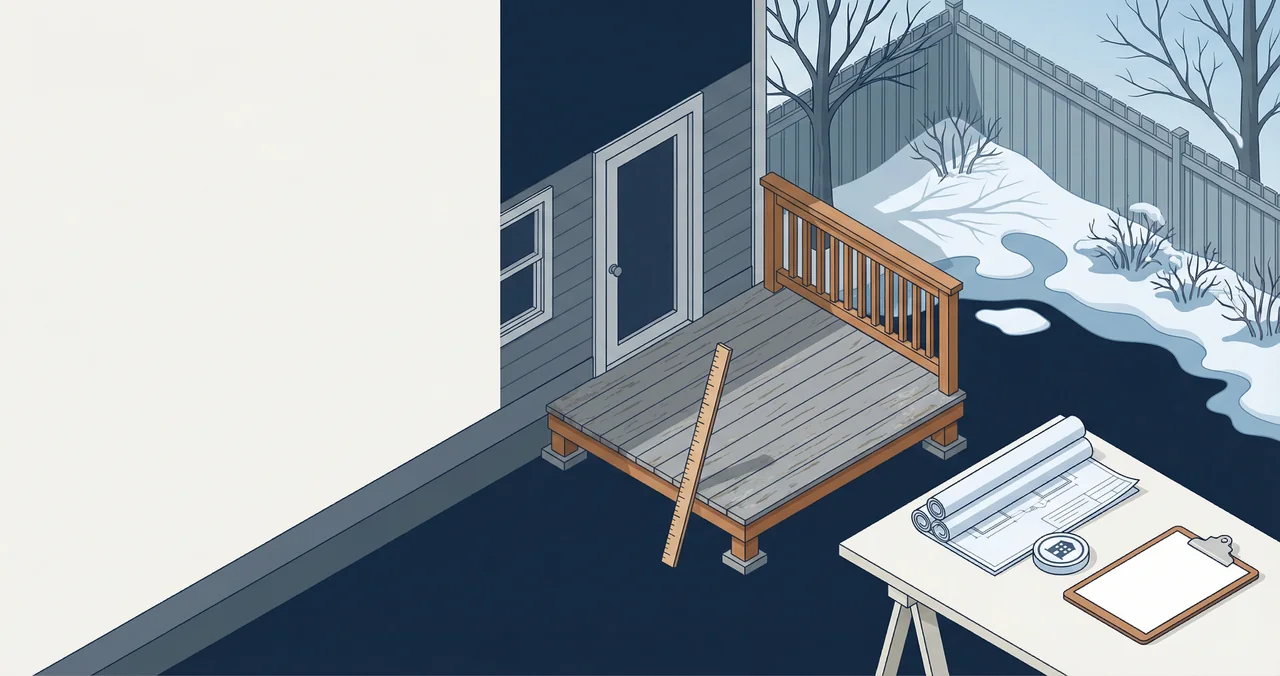
Planning a new deck in Guelph? Before you pick out materials or call a contractor, you need to figure out one thing first: do you actually need a building permit?
Looking for more regional information? Check out our Ontario Decking Hub.
The short answer for most Guelph homeowners — yes, you probably do. And skipping it can cost you far more than the permit itself. Here's everything you need to know about Guelph's deck permit requirements, fees, timelines, and how to get through the process without headaches.
📋 Tool Alert: Permit Checker
Do you really need a permit? Check the exact rules for your city or township.
Check Permits →Do You Need a Deck Permit in Guelph?
In Guelph, the City's Building Services division enforces the Ontario Building Code (OBC), which governs when a building permit is required for deck construction.
🏗️ Planning a deck project?
Get a free manual project review, or visualize your dream deck with AI before requesting quotes.
You need a permit if your deck is:
- More than 24 inches (0.6 m) above adjacent finished grade at any point
- Over 100 square feet (9.3 m²) in area
- Attached to your house (which affects the building envelope)
- Incorporating a roof, pergola, or enclosed structure
You may not need a permit if your deck is:
- At or below 24 inches above grade AND under 100 sq ft
- A ground-level floating platform with no permanent footings
- Not attached to the house structure
Even if your project falls under the exemption threshold, your deck still has to comply with the Ontario Building Code, local zoning bylaws, and setback requirements. "Permit-exempt" doesn't mean "code-exempt." That distinction trips up a lot of homeowners.
When in doubt, call Guelph's Building Services at 519-837-5615 or visit their office at 1 Carden Street. A five-minute phone call can save you thousands in fines or forced removal later.
When a Permit Is Required
Let's break this down with real scenarios Guelph homeowners commonly face:
You Definitely Need a Permit
- Standard backyard deck — A typical 12×16 or 16×20 deck attached to the back of your home. It's over 100 sq ft and almost certainly more than 24 inches off the ground. Permit required, no question.
- Second-storey or raised deck — Common on Guelph homes with walkout basements, especially in areas like the south end near the Hanlon Expressway or older homes in St. Patrick's Ward. Any deck significantly above grade needs engineering and a permit.
- Deck with a hot tub — The added live load of a hot tub (often 3,000–4,000 lbs filled) means your substructure needs specific engineering. The permit process ensures your footings and framing can handle it.
- Covered deck or screened-in porch — Adding a roof structure changes the scope entirely and triggers permit requirements regardless of deck size.
Grey Areas
- Replacing an existing deck — If you're tearing down and rebuilding on the same footprint with the same dimensions, you still typically need a permit in Guelph. The city treats it as new construction.
- Expanding a small existing deck — If the expansion pushes you over the 100 sq ft or 24-inch thresholds, you need a permit for the whole structure.
For a deeper look at how attached and detached decks are treated differently, see our guide on attached vs. freestanding deck permits in Ontario.
Permit Fees & Processing Time
How Much Does a Deck Permit Cost in Guelph?
Guelph's building permit fees are based on the estimated construction value of your project. As of 2026, expect the following:
| Project Value | Approximate Permit Fee |
|---|---|
| Under $10,000 | $150–$250 |
| $10,000–$25,000 | $250–$450 |
| $25,000–$50,000 | $450–$700 |
| Over $50,000 | $700+ (calculated per $1,000 of value) |
These figures are estimates based on Guelph's current fee schedule. The city calculates fees using a rate per $1,000 of construction value, with a minimum permit fee. Check the City of Guelph's Building Services fee schedule for the exact current rates, as they can adjust annually.
To give you a sense of where your project might land cost-wise, here's what typical deck installations run in the Guelph area:
| Decking Material | Installed Cost (CAD/sq ft) |
|---|---|
| Pressure-treated wood | $30–$55 |
| Cedar | $40–$65 |
| Composite | $50–$85 |
| Trex (premium composite) | $55–$90 |
| Ipe (tropical hardwood) | $70–$120 |
So a 16×20 composite deck at $50–$85/sq ft would run $16,000–$27,200 installed, putting your permit fee somewhere in the $250–$700 range. That's a small fraction of the total project cost — and well worth the protection it provides.
For detailed budgeting on popular deck sizes, check out our 16×20 deck cost breakdown for Ontario.
How Long Does It Take?
Guelph's Building Services aims to review residential deck permits within 10 to 15 business days of receiving a complete application. Key word: complete.
Incomplete submissions are the number one cause of delays. Missing site plans, incorrect measurements, or absent engineering documents will send your application back to square one.
Tips to speed things up:
- Submit all required documents on your first attempt
- Use a licensed designer or your contractor's drafting service for plans
- Apply in January or February — the review queue is lighter before spring building season
- Call Building Services to confirm your application package is complete before submitting
Guelph's building season is short. Contractors start booking up by March, and you want your permit in hand before the May–October prime construction window. Working backward from a June build start, you should be submitting your permit application by late March at the latest.
Building Codes & Setback Rules
Ontario Building Code Requirements
Every deck in Guelph must comply with the Ontario Building Code (OBC). Here are the critical structural requirements:
Footings and Foundations
- Footings must extend below the frost line, which in the Guelph area is at least 48 inches (4 feet) below grade. This is non-negotiable — Guelph's harsh freeze-thaw cycles will heave shallow footings right out of the ground.
- Sonotubes (concrete pier footings) are the standard approach. Typical minimum diameter is 10 inches for deck posts.
- Footing size depends on the load — larger decks, hot tubs, or snow load in exposed areas may require bigger footings.
Structural Framing
- Joists must be appropriately sized for the span — typically 2×8 or 2×10 for standard residential decks
- Beam sizing depends on the span between posts and the tributary load area
- Ledger boards (where the deck attaches to the house) must be properly flashed and bolted — not nailed — to the rim joist. Improper ledger connections are the leading cause of deck collapses in Ontario.
- All lumber in contact with the ground or concrete must be pressure-treated to UC4A standard or better
Railings and Guards
- Guards (railings) are required on any deck surface more than 24 inches above grade
- Minimum guard height: 36 inches for residential decks (42 inches if the deck is more than 1.8 m above grade)
- Baluster spacing: no more than 4 inches (100 mm) between balusters — the "4-inch sphere rule" ensures small children can't fit through
- Guards must withstand specific load requirements outlined in the OBC
For more on railing options that meet Ontario code, see our guide to deck railing systems in Canada.
Guelph Zoning Setback Rules
Setbacks are the minimum distances your deck must be from property lines, easements, and other structures. In Guelph, typical residential zoning setbacks include:
- Rear yard setback: Usually 7.5 metres from the rear property line (varies by zone)
- Interior side yard setback: Typically 1.2 metres minimum
- Exterior side yard setback (corner lots): Often 4.5 metres
- Decks can sometimes project into required rear yards — but usually no more than a specific distance (check your zone)
These numbers vary based on your specific zoning designation. Guelph has multiple residential zones (R.1A, R.1B, R.1C, R.2, R.3, etc.), and each has different setback requirements. You can look up your property's zoning on the City of Guelph's interactive zoning map or call Planning Services.
If your lot backs onto a conservation area, creek, or the Speed River, additional setbacks from the Grand River Conservation Authority (GRCA) may apply. Properties near the Eramosa River or in flood-prone areas of downtown Guelph face extra scrutiny.
If you're building near an easement, our guide on building near easements in Ontario covers what you need to know.
Climate-Specific Building Considerations for Guelph
Guelph sits in a climate zone with significant snow loads and extreme freeze-thaw cycling. This directly affects how your deck should be designed and built:
- Snow load design: Your deck must be engineered to handle Guelph's ground snow load, which informs the joist size, spacing, and beam specifications
- Frost heave protection: Those 48-inch-deep footings aren't optional. Shallow footings in Guelph shift every spring, causing uneven decking, loose railings, and structural failure over time
- Water management: Proper flashing at the ledger board is critical. Guelph's freeze-thaw cycles turn any trapped moisture into expanding ice, which pries apart connections
- Material selection matters: Composite and PVC decking hold up significantly better than wood against Guelph winters. Wood decks need annual sealing to resist moisture and road salt tracked from driveways. Our guide to the best decking materials for Ontario's freeze-thaw climate breaks down the options in detail.
Use PaperPlan to visualize different decking materials on your own home before committing — it's much easier to compare composite vs. cedar when you can see it on your actual house.
How to Apply for a Deck Permit in Guelph
Step 1: Gather Your Documents
Before approaching Guelph's Building Services, prepare:
- Site plan showing your property boundaries, the house footprint, the proposed deck location, and distances to all property lines. Include dimensions.
- Construction drawings — plan view (top down) and cross-section showing footings, posts, beams, joists, decking, and railings with all dimensions and material specifications
- Footing details — diameter, depth (below frost line), and reinforcement
- Railing/guard details — height, baluster spacing, connection method
- Ledger board connection details (for attached decks) — flashing, bolt pattern, and spacing
- Engineering documentation if required (for complex, elevated, or heavily loaded decks)
Step 2: Complete the Application
You can obtain the building permit application from:
- Online: The City of Guelph's Building Services webpage
- In person: City Hall, 1 Carden Street, Guelph
Fill out the application completely. Include the estimated construction value — this determines your permit fee.
Step 3: Submit and Pay
Submit your complete package along with the permit fee. Guelph accepts applications:
- In person at the Building Services counter
- By email or online (check the city's current submission options, as digital submissions have expanded)
Step 4: Wait for Review
Building Services reviews your application against the Ontario Building Code and local zoning bylaws. If everything checks out, you'll receive your permit. If there are deficiencies, they'll send a correction notice — address it promptly to avoid restarting the review timeline.
Step 5: Schedule Inspections
Once your permit is approved and construction begins, you'll need to book inspections at key stages:
- Footing inspection — before pouring concrete, the inspector verifies depth and diameter
- Framing inspection — after the structural frame is complete but before decking is installed
- Final inspection — the completed deck, including railings, stairs, and all connections
Do not cover up work before it's been inspected. Pouring concrete before the footing inspection or installing decking before the framing inspection means you may have to tear it out.
For a similar step-by-step walkthrough, see how the process works in nearby Cambridge's deck permit application guide.
What Happens If You Build Without a Permit
This is where things get expensive. Some Guelph homeowners skip the permit thinking they'll save money or avoid hassle. Here's what actually happens:
Immediate Consequences
- Stop work orders: If a building inspector discovers unpermitted construction, they can issue an order halting all work immediately
- Fines: Under the Ontario Building Code Act, fines for building without a permit can reach up to $50,000 for individuals and $100,000 for corporations per offence
- Forced removal: In serious cases, the city can order you to demolish the unpermitted structure at your own expense
Long-Term Problems
- Insurance issues: Your homeowner's insurance may deny claims related to an unpermitted deck. If someone is injured on it, you could face personal liability.
- Sale complications: When you sell your home, the buyer's lawyer or home inspector will likely flag the unpermitted deck. This can delay or kill a sale, or require a significant price reduction.
- Retroactive permits: You can apply for a permit after the fact, but it's more expensive and more difficult. The city may require you to expose hidden structural elements for inspection — meaning tearing up finished decking to check footings and framing.
Building without a permit is a gamble with terrible odds. The permit fee is typically 1-3% of your total project cost. It's not worth the risk.
For a full breakdown of what can go wrong, read our article on the risks of building a deck without a permit in Ontario.
🎨 Not sure which material to pick?
Upload a photo of your backyard and see exactly how Trex, TimberTech, or cedar would look — free and instant.
Frequently Asked Questions
How much does a deck permit cost in Guelph?
Most residential deck permits in Guelph cost between $150 and $700 CAD, depending on the estimated construction value of your project. A standard 200–300 sq ft deck typically falls in the $250–$450 range. The city calculates fees based on a rate per $1,000 of construction value, with a minimum fee. Contact Guelph Building Services at 519-837-5615 for the exact current rate.
Can I build a small deck without a permit in Guelph?
Potentially. If your deck is both under 24 inches above grade and under 100 square feet, it may be exempt from permit requirements. However, it still must comply with the Ontario Building Code and local zoning bylaws, including setback requirements. Always verify with the city before assuming you're exempt.
How long does it take to get a deck permit in Guelph?
Plan for 10 to 15 business days from the date you submit a complete application. Incomplete submissions take longer — sometimes much longer. If you're targeting a spring or early summer build, submit your application by late March. Guelph's short building season means timing your project right is critical.
What inspections are required for a deck in Guelph?
Typically three inspections: footing inspection (before pouring concrete), framing inspection (after structural frame is complete, before decking goes on), and final inspection (completed deck with railings, stairs, and all finishes). Your permit will specify the required inspections. Don't skip them — uninspected work may need to be torn apart.
Can my neighbour complain about my deck in Guelph?
Yes. If your deck violates zoning setbacks, exceeds height limits, or was built without a permit, a neighbour complaint can trigger a municipal investigation. Even with a permit, issues like privacy and sightline concerns sometimes lead to disputes. The best protection is a properly permitted deck that meets all code and zoning requirements.
📋 Planning a deck project?
Get a free manual project review from our team — no obligation, no spam.
Get Free Project Review →Upload a backyard photo and preview real decking materials with AI — free, instant, no sign-up.
Permits, costs, material comparisons, and questions to ask before requesting quotes — delivered to your inbox.