
Deck Permits in Vaughan (2026)
Need a deck permit in Vaughan? Learn requirements, fees, setback rules, and how to apply. Avoid fines and delays with this 2026 guide for Vaughan homeowners.
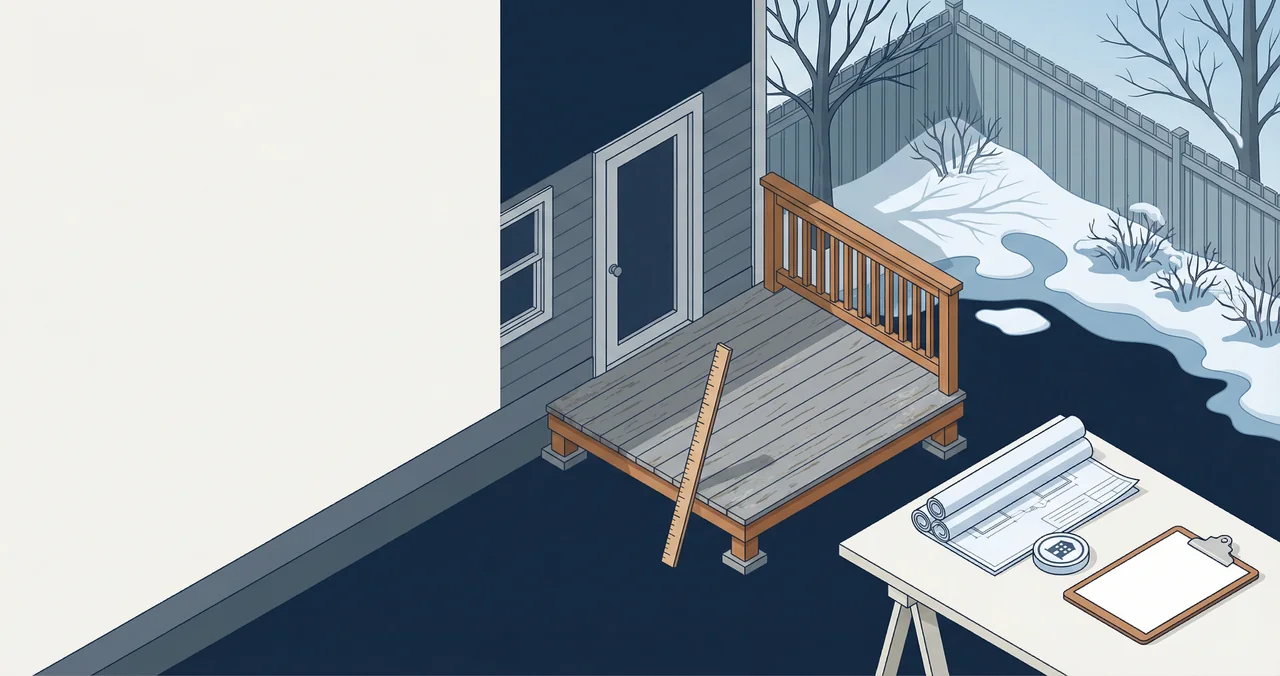
Building a deck in Vaughan without the right permit can cost you thousands in fines — or force you to tear it down entirely. Before you pick out materials or call a contractor, you need to know what the City of Vaughan's Building Standards Department requires.
Looking for more regional information? Check out our Ontario Decking Hub.
Here's exactly what triggers a permit, what it costs, and how to get through the process without delays.
📋 Tool Alert: Permit Checker
Do you really need a permit? Check the exact rules for your city or township.
Check Permits →Do You Need a Deck Permit in Vaughan?
Short answer: almost certainly yes.
🏗️ Planning a deck project?
Get a free manual project review, or visualize your dream deck with AI before requesting quotes.
In Vaughan, a building permit is required for any deck that is more than 24 inches (0.6 m) above finished grade or exceeds 100 square feet (9.3 m²) in area. Since most usable backyard decks clear both of those thresholds, the vast majority of deck projects need a permit.
Even a modest 12×12 deck is 144 square feet — already over the limit.
There are a few narrow exceptions. A ground-level platform deck that sits under 24 inches high and under 100 square feet may not require a building permit. But even then, you still need to comply with zoning bylaws, setback requirements, and lot coverage limits. A permit-exempt deck doesn't mean a regulation-exempt deck.
If your deck will be attached to the house, a permit is essentially guaranteed. Attached structures affect the building envelope, and inspectors need to verify the ledger board connection meets the Ontario Building Code (OBC).
Bottom line: Call Vaughan's Building Standards Department at 905-832-8510 or visit Vaughan City Hall before you assume you're exempt.
When a Permit Is Required
Here's a quick breakdown of what triggers a permit and what might not:
Permit Required
- Deck surface is more than 24 inches above grade at any point
- Deck area exceeds 100 square feet
- Deck is attached to the house via ledger board
- Deck includes a roof, pergola, or covered structure
- Deck includes stairs with more than 3 risers
- Any deck with electrical or gas hookups (hot tub, outdoor kitchen)
Permit Likely Not Required
- Freestanding platform deck under 24 inches high and under 100 square feet
- No roof or overhead cover
- No electrical or plumbing connections
Even for exempt builds, you must still respect zoning setbacks and lot coverage maximums. Vaughan enforces these separately from building permits, and violations can trigger orders to comply regardless of permit status.
Attached vs. Freestanding: Does It Matter?
Yes. An attached deck has different permit implications than a freestanding one. Attached decks must meet stricter structural requirements because they transfer loads to your home's foundation. Freestanding decks on independent footings sometimes face simpler approvals, but in Vaughan, size and height are the primary triggers — not attachment method alone.
Permit Fees & Processing Time
Vaughan's building permit fees are based on the estimated construction value of your project. As of 2026, expect the following:
| Project Value | Approximate Permit Fee |
|---|---|
| Under $10,000 CAD | $200–$350 |
| $10,000–$25,000 CAD | $350–$600 |
| $25,000–$50,000 CAD | $600–$900 |
| Over $50,000 CAD | $900+ (scaled) |
These are approximate ranges. The City of Vaughan calculates fees using a formula tied to project value and square footage, so your actual fee depends on the specifics of your submission. There may also be a zoning review fee if your project requires a zoning certificate or minor variance.
How Long Does Approval Take?
For a straightforward residential deck, plan on 10 to 20 business days for permit review. That's the typical turnaround when your application is complete and code-compliant on first submission.
If your plans need revisions — and many do on the first round — add another 5 to 10 business days per resubmission cycle. Complex projects involving variances or Committee of Adjustment hearings can take 8 to 12 weeks or longer.
Pro tip: Vaughan's building season is short. If you want your deck built between May and October, submit your permit application by late February or early March. Contractors in the GTA book up fast during the warmer months, and waiting on a permit through April means you might not break ground until June or July.
Building Codes & Setback Rules
Vaughan follows the Ontario Building Code (OBC), which sets the structural and safety standards for residential decks. On top of that, the city's own zoning bylaws dictate where you can build on your lot.
Key OBC Requirements for Decks
- Footings must extend below the frost line — in Vaughan, that's a minimum of 48 inches (4 feet) deep. Vaughan's freeze-thaw cycles are brutal, and shallow footings will heave. Some contractors go to 54 inches for extra margin.
- Guard rails are required on any deck surface more than 24 inches above grade. Minimum height: 36 inches for residential (42 inches if the deck is more than 1.8 m above grade).
- Railing balusters must be spaced so a 4-inch sphere cannot pass through.
- Stair requirements: minimum 36-inch width, maximum 7.87-inch rise, minimum 8.25-inch run.
- Load capacity: decks must support a minimum 40 psf live load plus 10 psf dead load.
- Ledger board connections for attached decks must use lag bolts or through-bolts into the rim joist — nails alone are never acceptable.
Vaughan Zoning Setbacks
Zoning setbacks determine how close your deck can be to property lines. Typical Vaughan residential setbacks include:
- Rear yard setback: 7.5 metres from the rear lot line (varies by zone)
- Interior side yard: 1.2 metres minimum
- Exterior side yard (corner lots): 4.5 metres
- Lot coverage maximum: Your deck counts toward total lot coverage, which is typically capped at 30–35% depending on the zone
These numbers vary by zoning designation. Vaughan has numerous residential zones (R1, R2, R3, RD1, etc.), each with slightly different setback requirements. Confirm your zone on the City of Vaughan's interactive zoning map or by calling the Planning Department.
If your planned deck encroaches on a setback, you'll need a minor variance from the Committee of Adjustment. That adds $1,500–$2,500+ in application fees and 2–3 months to your timeline.
What About Easements?
Many Vaughan lots — especially in newer subdivisions in Kleinburg, Vellore Village, and Maple — have drainage or utility easements along rear or side property lines. You generally cannot build permanent structures within an easement. Check your lot survey or contact the city's engineering department before finalizing your deck plan.
How to Apply for a Deck Permit in Vaughan
Vaughan accepts building permit applications online through their e-permitting portal or in person at the Vaughan Civic Centre (2141 Major Mackenzie Drive). Here's the step-by-step process:
Step 1: Confirm Zoning Compliance
Before you draft plans, verify your property's zoning. Check:
- Permitted setbacks for your zone
- Maximum lot coverage
- Any easements or restrictive covenants
- Whether your deck requires a minor variance
You can request a Zoning Certificate from the city, which provides written confirmation of what's allowed on your specific lot. This costs around $100–$200 and is well worth it if you're building close to setback limits.
Step 2: Prepare Your Drawings
Your permit application must include:
- Site plan showing the deck's location on your lot, with dimensions to all property lines
- Construction drawings — plan view, cross-sections, and elevation views
- Structural details including footing sizes, beam spans, joist spacing, and connection methods
- Footing details showing depth below grade (minimum 48 inches)
- Railing and guard details if applicable
- Lot survey (current, within the last few years)
Drawings must be to scale and clearly dimensioned. Many Vaughan homeowners hire a designer or drafting service for this — expect to pay $500–$1,500 for professional deck drawings.
Use PaperPlan to visualize different decking materials on your own home before committing — it can help you decide on material choices before investing in detailed construction drawings.
Step 3: Submit Your Application
Upload your documents through Vaughan's online portal or submit hard copies in person. You'll need to pay the permit fee at the time of submission.
Include:
- Completed building permit application form
- Two sets of construction drawings
- Site plan with lot survey
- Proof of lot survey
- Any applicable engineering reports (for complex structures)
Step 4: Wait for Review
The Building Standards Department reviews your plans for OBC compliance. If they find issues, you'll receive a deficiency letter outlining required corrections. Respond promptly — each revision cycle adds time.
Step 5: Receive Your Permit and Schedule Inspections
Once approved, you'll receive your building permit. Post it visibly at the construction site. Vaughan typically requires two inspections for a standard deck:
- Footing inspection — after holes are dug but before concrete is poured
- Final inspection — after the deck is fully built, including railings and stairs
Do not pour concrete or continue building until each inspection is passed. Building ahead of inspections can result in orders to expose or redo work.
What Happens If You Build Without a Permit
Skipping the permit might seem tempting — especially for a simple deck. But in Vaughan, the consequences are real.
Fines and Penalties
Under the Ontario Building Code Act, building without a required permit can result in fines of up to $50,000 for individuals and $100,000 for corporations upon conviction. Vaughan bylaw officers actively investigate complaints, and neighbours do report unpermitted construction.
Orders to Comply
The city can issue a stop work order immediately and an order to comply requiring you to either:
- Obtain a retroactive permit (which involves double the standard fees in many cases)
- Modify the deck to meet code
- Remove the deck entirely if it can't be brought into compliance
Insurance and Liability Issues
Your homeowner's insurance may deny claims related to an unpermitted structure. If someone is injured on a deck that was never inspected, your liability exposure is significant.
Problems When Selling
This is where most homeowners get burned. When you sell your home, a buyer's lawyer or home inspector will check for open permits and unpermitted structures. An illegal deck can delay or kill a sale, reduce your asking price, or force a last-minute removal.
Read more about the risks of building a deck without a permit in Ontario.
What About DIY? Can You Pull Your Own Permit?
Yes. Ontario allows homeowners to apply for their own building permits and do their own construction. You don't need to be a licensed contractor. But you are personally responsible for meeting all code requirements, passing inspections, and ensuring structural safety.
If you're considering a DIY deck build in Ontario, be realistic about your skills. Footing depths of 48+ inches in Vaughan's clay-heavy soil require proper equipment. And the OBC's structural requirements for beams, joists, and connections aren't suggestions — they're law.
Most Vaughan homeowners who pull their own permits still hire a contractor for the actual build. The permit is in your name either way.
Vaughan-Specific Climate Considerations
Vaughan's climate directly affects how your deck must be designed and built — and the building department knows it.
Frost and Footings
Vaughan sits in a zone where frost penetration regularly reaches 48 inches or deeper. The OBC requires footings below the frost line to prevent heaving. In Vaughan's clay soils, this is non-negotiable. Sonotube footings poured on undisturbed soil at 48–54 inches deep are standard practice.
Snow Load
Ontario's building code requires decks to handle snow loads specific to the region. In Vaughan, design snow loads are approximately 1.1 kPa (about 23 psf). Your structural plans must account for this — it affects joist sizing, beam spans, and post spacing.
Material Selection
Vaughan's freeze-thaw cycles, road salt tracked onto surfaces, and prolonged winter moisture make material selection critical. Here's how the main options compare:
| Material | Installed Cost (CAD/sqft) | Winter Performance | Maintenance |
|---|---|---|---|
| Pressure-treated wood | $30–$55 | Good with annual sealing | High — seal/stain yearly |
| Cedar | $40–$65 | Fair — prone to splitting | Medium-high — seal every 1–2 years |
| Composite (Trex, Fiberon) | $50–$85 | Excellent | Low — occasional cleaning |
| Trex (premium lines) | $55–$90 | Excellent | Very low |
| Ipe (hardwood) | $70–$120 | Excellent | Low — oil annually for colour |
Composite and PVC decking hold up best in Vaughan's conditions. Pressure-treated wood is the most affordable option, but the annual maintenance commitment is real. For a deeper comparison of what these costs look like on a full-sized deck, check out 12×16 deck pricing in Ontario or 16×20 deck costs.
The best time to build in Ontario is May through October. With Vaughan's compressed building season, submit your permit application early and book your contractor by March at the latest.
🎨 Not sure which material to pick?
Upload a photo of your backyard and see exactly how Trex, TimberTech, or cedar would look — free and instant.
Frequently Asked Questions
How much does a deck permit cost in Vaughan?
Permit fees in Vaughan are based on your project's estimated construction value. For a typical residential deck, expect to pay $200–$600 CAD. Larger or more complex projects with higher construction values will cost more. There may be additional fees if you need a zoning certificate or minor variance.
How long does it take to get a deck permit in Vaughan?
A complete, code-compliant application typically takes 10 to 20 business days to review. If revisions are needed, each resubmission cycle adds another 5–10 business days. Applications requiring minor variances can take 2–3 months. Submit by late February to avoid delays in the spring building rush.
Can I build a small deck without a permit in Vaughan?
Possibly, but only if the deck is both under 24 inches above grade and under 100 square feet in area. Even then, you must comply with all zoning setbacks and lot coverage limits. If you're attaching it to the house or adding any electrical, you need a permit regardless of size.
What happens if my neighbour reports my unpermitted deck?
Vaughan's Building Standards Department will investigate. If they confirm you built without a required permit, you'll likely face a stop work order, an order to obtain a retroactive permit (at increased fees), and potentially fines. In worst-case scenarios, you may be ordered to remove the structure. It's always cheaper to get the permit upfront.
Do I need an engineer for my deck permit in Vaughan?
Not always. Standard residential decks using conventional construction methods typically don't require an engineer's stamp. However, if your deck involves unusual spans, cantilevers, multi-level structures, or heavy loads (like a rooftop hot tub), the building department may require engineered drawings. When in doubt, ask during your initial consultation with the Building Standards Department.
📋 Planning a deck project?
Get a free manual project review from our team — no obligation, no spam.
Get Free Project Review →Upload a backyard photo and preview real decking materials with AI — free, instant, no sign-up.
Permits, costs, material comparisons, and questions to ask before requesting quotes — delivered to your inbox.