
Deck Cost in London: What Homeowners Are…
What does a deck cost in London, Ontario in 2026? Get real CAD pricing per square foot by material, plus local tips to save on your build.
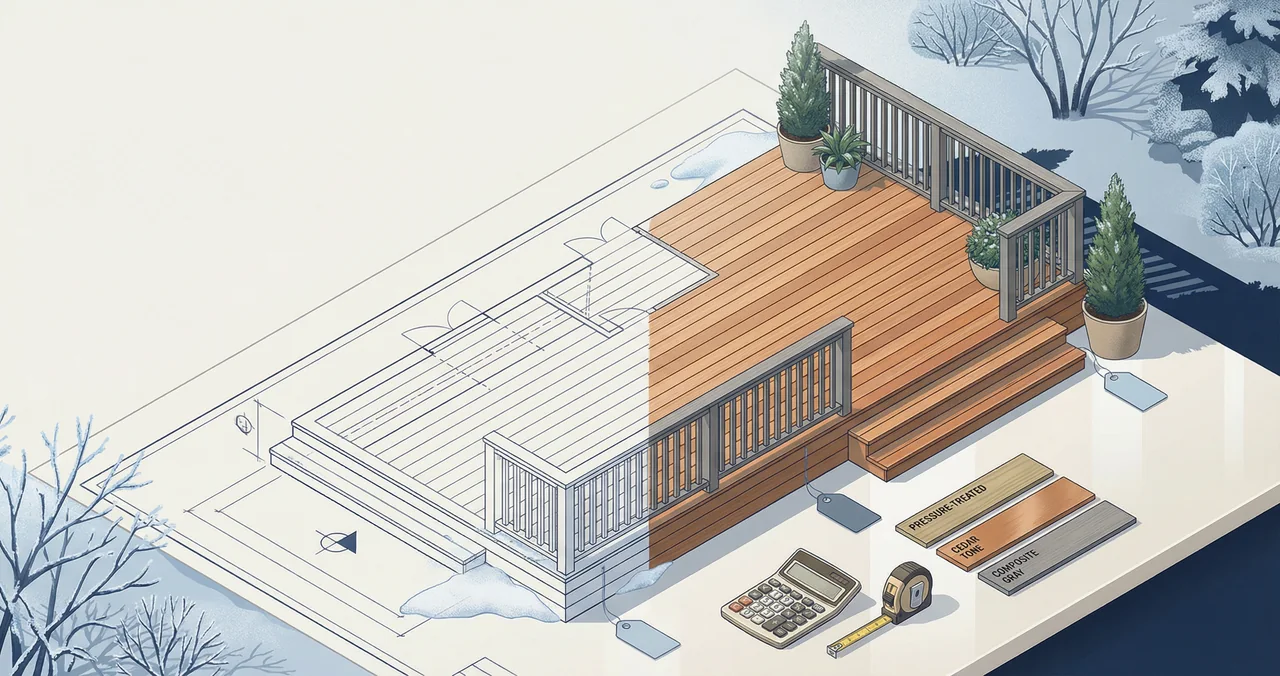
How Much Does a Deck Cost in London, Ontario?
You're getting quotes, and the numbers are all over the place. One contractor says $15,000 for a basic deck. Another quotes $45,000 for what sounds like the same thing. That's the reality of deck pricing in London right now — material choice, deck size, and who you hire can swing the total by tens of thousands of dollars.
🏗️ Planning a deck project?
Get a free manual project review, or visualize your dream deck with AI before requesting quotes.
Looking for more regional information? Check out our Ontario Decking Hub.
Here's what London homeowners are actually paying in 2026, broken down by material, size, and scope so you can budget with confidence.
The short answer: most London decks cost between $12,000 and $45,000 installed, depending on size and material. A standard 12x16 pressure-treated deck runs roughly $5,800–$10,500, while a large composite deck with railings and stairs can push well past $50,000.
🧮 Tool Alert: Deck Cost Calculator
Estimate your project costs in seconds based on local pricing bands for your area.
Calculate My Cost →For a broader look at deck pricing across different materials and regions, see our complete deck cost guide.
Average Deck Cost in London by Material
Material is the single biggest factor in your final price. Here's what you'll pay per square foot in London, fully installed, as of early 2026:
| Material | Installed Cost (CAD/sq ft) | Best For |
|---|---|---|
| Pressure-Treated Wood | $30–$55 | Budget-friendly builds |
| Cedar | $40–$65 | Natural look, moderate durability |
| Composite | $50–$85 | Low maintenance, long lifespan |
| Trex (brand-name composite) | $55–$90 | Premium composite with strong warranty |
| Ipe (tropical hardwood) | $70–$120 | Maximum durability, luxury aesthetic |
These ranges include materials, labor, standard railings, and basic stairs. They don't include permits, complex multi-level designs, or built-in features like benches or planters.
Pressure-treated wood is still the most popular choice in London for homeowners watching their budget. But here's the trade-off: London's freeze-thaw cycles — we can see 50+ freeze-thaw events per winter — punish wood decks hard. You'll need to seal or stain annually to prevent cracking, warping, and grey-out. That ongoing maintenance cost adds up over a decade.
Composite and PVC decking hold up significantly better against London winters. No annual sealing, no splinters, no rot. The upfront cost is higher, but the total cost of ownership over 15–20 years is often lower when you factor in staining supplies, your time, and eventual board replacement.
Cost Per Square Foot Breakdown
That per-square-foot number includes several components. Here's roughly how the money breaks down for a mid-range composite deck in London:
- Decking boards: $15–$35/sq ft (material only)
- Substructure (joists, beams, posts): $8–$15/sq ft
- Hardware and fasteners: $2–$5/sq ft
- Railings: $40–$100 per linear foot (installed)
- Stairs: $75–$200 per step (installed)
- Footings: $150–$400 per footing
For a standard 12x16 deck (192 sq ft) using composite decking, here's a realistic budget range:
| Component | Low Estimate | High Estimate |
|---|---|---|
| Decking + substructure | $9,600 | $16,320 |
| Railings (32 linear ft) | $1,280 | $3,200 |
| Stairs (4 steps) | $300 | $800 |
| Footings (6) | $900 | $2,400 |
| Permit | $150 | $400 |
| Total | $12,230 | $23,120 |
Want to see how this scales for larger builds? Check out our detailed guides for 12x16 deck costs in Ontario and 16x20 deck costs.
Labor Costs in London
Labor typically accounts for 40%–60% of your total deck cost. In London, you'll see:
- General labor rate: $40–$75 per hour per worker
- Crew of 2–3 for most residential decks
- Build time: 3–7 days for a standard single-level deck, 2–4 weeks for complex multi-level projects
London labor rates have climbed steadily since 2023. Demand is high, and the compressed building season — realistically May through October — means contractors pack an entire year's work into six months. That drives prices up, particularly during peak season (June through August).
How Timing Affects What You Pay
Book your contractor by March if you want a spring or early summer build. Waiting until May to start calling around means you're competing with every other homeowner who just survived another winter staring at their rotting deck.
Some contractors offer 10%–15% discounts for fall builds (September–October). The weather is still workable, and their schedules loosen up. It's one of the simplest ways to save real money.
Winter builds are technically possible but rarely recommended. Frozen ground makes footing excavation expensive, and concrete doesn't cure well below 5°C without special additives. Most London builders shut down or shift to indoor projects from November through March.
For a detailed look at seasonal timing, see our guide on the best time to build a deck in Ontario.
What Affects Your Total Price
Beyond material and labor, several London-specific factors can push your costs up — or keep them down.
Deck Size and Shape
Simple rectangles are cheapest. Every angle, curve, or multi-level transition adds labor hours and material waste. A 16x20 rectangular deck is straightforward. An L-shaped deck wrapping two sides of your house? That's a different budget conversation entirely. See what 20x20 deck projects run in Ontario for reference.
Height and Accessibility
A deck that sits 24 inches or more above grade in London requires a building permit. It also means taller posts, deeper footings, more complex railings, and stairs — all of which add cost. A ground-level deck (under 24 inches) is significantly cheaper and may not need a permit at all, though you should always confirm with London's Building Department before assuming.
Footings and Frost Line
This is where London's climate really hits your wallet. The frost line in our region sits between 36 and 60 inches deep. Every footing must extend below it to prevent frost heave — that slow, destructive upward push of frozen soil that can shift your entire deck out of level.
Helical piles (screw piles) have become popular in London because they're fast to install and go well past frost depth. They cost $200–$400 per pile installed, compared to $150–$300 for poured concrete footings. The price difference is modest, and screw piles avoid the mess and curing time of concrete.
Permit Costs
In London, Ontario, deck permits are typically required for structures over 24 inches above grade or exceeding 100 square feet. Requirements can vary, so contact London's Building Department directly. Permit fees generally run $150–$400 depending on project scope. Don't skip this — building without a permit carries real risks including fines, forced removal, and insurance complications.
Railings, Stairs, and Add-Ons
Railings are required by code on any deck surface 24 inches or more above grade (42 inches high in Ontario). The type you choose matters:
- Pressure-treated wood railings: $40–$60/linear ft installed
- Aluminum railings: $60–$90/linear ft installed
- Glass panel railings: $80–$150/linear ft installed
- Cable railings: $70–$120/linear ft installed
For a look at the best railing systems available in Canada, we've compared the top options.
Attached vs. Freestanding
Attaching a deck to your house requires a ledger board bolted to your home's rim joist, plus proper flashing to prevent water infiltration. Freestanding decks avoid the attachment entirely, which simplifies the build but requires additional footings. The cost difference is usually modest — $500–$1,500 — but the permit implications differ.
Composite vs. Wood: Cost Comparison
This is the decision most London homeowners wrestle with. Here's an honest side-by-side for a 14x20 deck (280 sq ft):
| Factor | Pressure-Treated Wood | Mid-Range Composite |
|---|---|---|
| Material + install | $8,400–$15,400 | $14,000–$23,800 |
| Annual maintenance | $200–$400 (stain/seal) | $0–$50 (occasional wash) |
| 10-year maintenance total | $2,000–$4,000 | $0–$500 |
| Expected lifespan | 15–20 years (with maintenance) | 25–30+ years |
| 10-year total cost | $10,400–$19,400 | $14,000–$24,300 |
| Warranty | None (typically) | 25–50 years (varies by brand) |
The gap narrows fast when you account for maintenance. And in London's climate — where salt, snow, moisture, and UV all batter your deck surfaces — composite's durability advantage is more pronounced than in milder regions.
Wood still makes sense if you genuinely enjoy the maintenance ritual or you're building on a tight budget and need the deck now. There's nothing wrong with a well-maintained pressure-treated deck. Just go in with realistic expectations about the annual work required. Our guide to the best decking materials for Ontario's freeze-thaw climate covers this in depth.
Use PaperPlan to visualize different decking materials on your own home before committing — it's a helpful way to compare wood tones against composite colours without ordering samples of everything.
How to Save Money on Your London Deck
Real ways to bring your deck cost down without sacrificing quality:
1. Build in the Shoulder Season
September and October builds can save 10%–15% on labor. Contractors want to keep crews busy before winter shutdown. You lose nothing in build quality — the weather is still cooperative.
2. Keep the Design Simple
A rectangular, single-level deck with standard railings is the most cost-efficient design per square foot. Every angle change, built-in bench, or level transition adds labor and waste. If your budget is tight, go simple now and add features later.
3. Use Pressure-Treated for the Substructure
Even if you want composite decking on top, the joists, beams, and posts underneath can be pressure-treated wood. This is standard practice and saves money compared to aluminum framing — though aluminum has its own longevity advantages worth considering.
4. Get Three Quotes Minimum
Pricing in London varies significantly between contractors. Get at least three detailed, written quotes that break down materials and labor separately. Beware the lowest bid — it often means corners will be cut on fasteners, footings, or flashing.
5. Do Your Own Demo
If you're replacing an old deck, tearing it out yourself saves $500–$2,000 in labor. It's hard work but straightforward. Rent a dumpster, recruit a friend, and set aside a weekend.
6. Skip the Premium Railings (For Now)
If you're stretching your budget, install basic pressure-treated railings and upgrade to glass or aluminum in a future season. Railings are one of the easiest components to swap out later.
7. DIY What You Can
Building your own deck in Ontario is legal and can save you thousands on labor. But be honest about your skills. A poorly built deck is a safety hazard and an insurance liability. At minimum, hire a professional for the footings and structural framing, then handle decking boards and railings yourself if you're handy.
🎨 Not sure which material to pick?
Upload a photo of your backyard and see exactly how Trex, TimberTech, or cedar would look — free and instant.
Frequently Asked Questions
How much does a 12x12 deck cost in London, Ontario?
A 12x12 deck (144 sq ft) in London typically costs $4,300–$7,900 for pressure-treated wood and $7,200–$12,200 for composite, fully installed with basic railings. Costs vary based on height, footing requirements, and railing style. Ground-level builds come in at the lower end.
Do I need a permit to build a deck in London?
In most cases, yes. London, Ontario generally requires a building permit for decks that are over 24 inches above grade or exceed 100 square feet. Requirements can vary, so contact London's Building Department directly before starting your project. The permit process typically takes 2–4 weeks and costs $150–$400.
What's the best decking material for London's climate?
Composite or PVC decking performs best in London's freeze-thaw climate. These materials resist moisture absorption, which is the primary driver of cracking and warping during our winter cycles. Pressure-treated wood works fine but requires annual sealing to prevent water penetration and salt damage. Cedar falls in the middle — beautiful but still needs regular maintenance. For a detailed comparison, read our guide on the best low-maintenance decking in Canada.
When is the cheapest time to build a deck in London?
September and October typically offer the best pricing. Contractor schedules loosen up as the peak summer rush ends, and some builders discount rates to keep crews working before winter. Avoid booking in June or July if price is your priority — that's peak demand. Start getting quotes in January or February and book by March regardless of when you want to build.
How long does it take to build a deck in London?
A standard single-level deck (200–300 sq ft) takes 3–7 working days once the crew is on site. Multi-level or large decks can take 2–4 weeks. The bigger variable is wait time — during peak season, you might wait 4–8 weeks after signing a contract before work begins. Factor permit processing time into your timeline as well: 2–4 weeks on average.
📋 Planning a deck project?
Get a free manual project review from our team — no obligation, no spam.
Get Free Project Review →Upload a backyard photo and preview real decking materials with AI — free, instant, no sign-up.
Permits, costs, material comparisons, and questions to ask before requesting quotes — delivered to your inbox.