
How High Can a Deck Be Without a Railing in Ontario?
Ontario Building Code allows decks under 24 inches high to skip railings. Learn exact height rules, measurement points, and permit requirements for KWC homeowners.
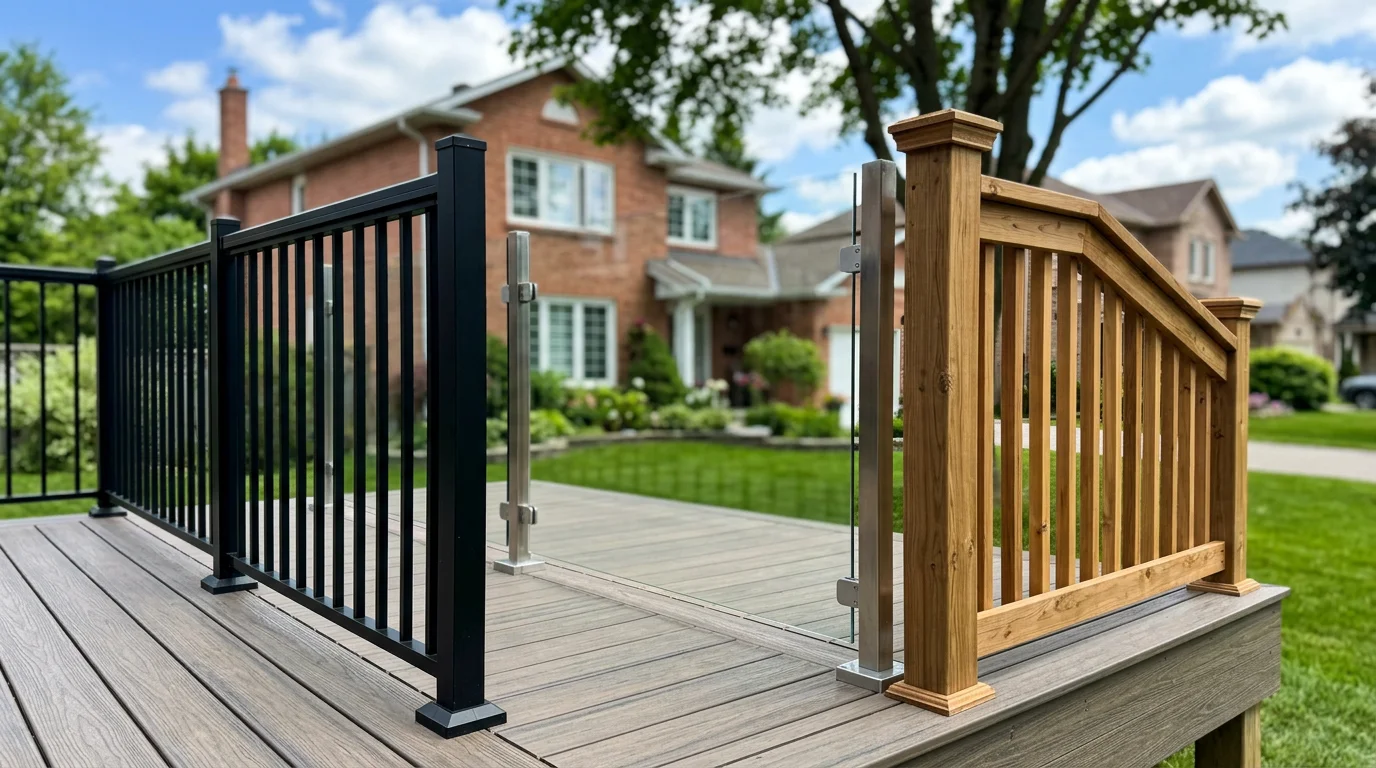
If you're planning a low-profile deck in Ontario, you might be wondering whether you can skip the railing installation and save some money. The answer depends entirely on how high your deck sits above the ground.
Under the Ontario Building Code (OBC), any deck or platform that's less than 24 inches (600 mm) high doesn't require a guard rail. Once your deck surface reaches or exceeds that 24-inch threshold, railings become mandatory.
That's the quick answer. But there's more to consider: how height is measured, what happens at grade transitions, when permits are still required, and whether skipping a railing actually makes sense for your project.
What the Ontario Building Code Says About Deck Height
The Ontario Building Code 2012 (Division B, Section 9.8.8.2) sets the railing requirement based on walking surface height. Here's the exact rule:
🏗️ Planning a deck project?
Get a free manual project review, or visualize your dream deck with AI before requesting quotes.
Guards (railings) are required where a walking surface is more than 600 mm (24 inches) above adjacent ground level or a floor below.
This means:
- Under 24 inches: No railing required by code
- 24 inches or higher: Guard rail mandatory, minimum 36 inches (900 mm) tall for decks serving single-family homes
- 42 inches or higher: Guard must be at least 42 inches (1,070 mm) tall
The height is measured from the finished grade directly below the deck to the top surface of the deck boards, not the joists or framing.
How to Measure Your Deck Height Correctly
Measuring seems simple, but it's where most homeowners trip up during permit inspections. Here's how to do it right:
Measure at the Lowest Adjacent Grade
Your deck height is determined by the lowest point of finished grade within 900 mm (3 feet) of the deck edge. If your yard slopes, measure at the low side.
Example: Your deck is 18 inches high on the uphill side but 30 inches high on the downhill side. Code uses the 30-inch measurement. You need a railing.
Account for Settled Soil
If you're building on freshly graded fill or disturbed soil (common after new home construction in KWC subdivisions), remember that soil will settle 2-4 inches over the first year. What measures 23 inches today might be 27 inches next summer.
Deck Stairs and Access Points
If your low deck has stairs with more than two risers, those stairs require their own handrail even if the deck itself doesn't need a guard. See deck stair railing code requirements for specifics.
Common Low-Deck Scenarios in KWC
Walkout Basement Decks
Many homes in Waterloo and Cambridge have walkout basements with small landings or patios at grade. If you're adding a deck that sits on footings just above existing concrete, you'll often land in the 12-18 inch range—well below the railing threshold.
Cost estimate: A 12x12 pressure-treated deck at this height runs $3,200-$4,800 installed in 2026, compared to $4,000-$6,200 with railing added.
Grade-Level Patio Decks
Some homeowners build composite or cedar decks as alternatives to poured concrete or interlock patios. These decks sit on sleepers or short posts, typically 8-16 inches off grade.
Benefit: No railing required, but you still get better drainage than a concrete slab and easier long-term repair. See above ground pool deck vs patio for a comparison of ground-level deck framing versus solid surfaces.
Front Porch Landing Decks
Small entry decks or porch landings in older KWC neighbourhoods are often built just high enough to clear snow accumulation (18-22 inches). As long as you stay under 24 inches, no railing is legally required.
Caveat: Many homeowners still add railings for safety, especially if elderly visitors or young children use the entry frequently.
When You Still Need a Permit (Even Without a Railing)
Skipping the railing doesn't mean skipping the permit. Ontario municipalities require building permits for most deck construction regardless of height.
Kitchener Deck Permit Rules
In Kitchener, any deck over 24 inches high or larger than 108 square feet (10 m²) requires a building permit. A low deck under 24 inches and under 108 sqft is typically exempt.
Permit fee: $150-$250 for standard residential deck permits in 2026.
Waterloo Deck Permit Rules
Waterloo requires permits for decks over 24 inches or attached to the home's structure. Freestanding decks under 24 inches and under 10 m² may be exempt, but you should confirm with the building department before starting work.
Processing time: 2-4 weeks for standard deck permit reviews.
Cambridge Deck Permit Rules
Cambridge applies similar thresholds: 24 inches height and 108 sqft area. However, if your deck is within 3 feet of a property line, you'll need zoning approval even if it's technically permit-exempt by size. See our Cambridge deck permit application guide for the full process.
Permit fee: $180-$300 depending on deck size and complexity.
When in Doubt, Call the Building Department
Even if you think your deck qualifies as exempt, it's worth a 10-minute phone call to confirm. Building officials would rather answer questions upfront than issue stop-work orders or force teardowns later. Learn more about the risks in building a deck without a permit in Ontario.
Frost Line and Footing Requirements for Low Decks
Just because your deck is low doesn't mean you can skip proper footings. Ontario's frost line sits at 48 inches (1.2 m) across most of KWC, and all deck footings must extend below that depth to prevent frost heave.
Sonotube Footings
Standard practice: dig 10-12 inch diameter holes to 48+ inches, pour concrete, and set post bases. Cost is minimal—$25-$40 per footing including materials and labour.
Helical Piles
For low decks on difficult soil (common clay in Cambridge and Kitchener), helical piles offer a faster alternative. Installed by machine in 15-30 minutes per pile, they eliminate digging and concrete curing time.
Cost: $150-$300 per pile installed, but you'll save time and avoid the risk of collapsed holes in wet clay.
Deck Blocks and Precast Piers
Not recommended for permanent structures in Ontario. Surface-mounted deck blocks don't penetrate below frost line and will shift during freeze-thaw cycles. Inspectors won't approve them for permitted decks.
Should You Add a Railing Anyway?
Code compliance is one thing. Safety and resale value are another.
When Adding a Railing Makes Sense
Even on a 20-inch-high deck, railings provide:
- Fall protection for children, elderly visitors, or anyone stepping backward while grilling or entertaining
- Visual boundary that prevents accidental step-offs at night
- Perceived value for future buyers who may view railing-free decks as incomplete
Railing cost: Expect to pay $40-$70 per linear foot for pressure-treated wood railings, or $80-$120 per linear foot for composite or aluminum systems. For a 12x16 deck (56 linear feet of perimeter), that's $2,240-$6,720 added cost.
When Skipping a Railing Makes Sense
For decks that are:
- Truly grade-level (under 12 inches)
- Used primarily as patio-style outdoor flooring
- Surrounded by landscaping, gardens, or natural barriers
- Built for accessibility with ramp access
...adding a railing can feel like unnecessary clutter and expense.
Alternatives to Full Railings for Low Decks
If you want some boundary definition without a full code-compliant railing system, consider:
Decorative Borders
Low planters, built-in benches, or landscape timbers positioned 18-24 inches from the deck edge can create a visual perimeter without obstructing views.
Removable Railing Systems
Some homeowners install removable railing sections that can be added for parties or events with children, then removed for everyday use. Not required by code, but offers flexibility.
Integrated Seating
Built-in benches around the deck perimeter serve as both seating and a physical barrier, reducing fall risk without vertical pickets. Just ensure bench heights meet ergonomic standards (16-18 inches seat height).
Multi-Level Decks and Railing Transitions
If you're building a multi-level deck where one section is under 24 inches and another is above, each level is assessed independently.
Example scenario: Your main deck is 36 inches high (requires railing). A lower deck section steps down to 20 inches high (no railing required for that level). However, any stairs connecting the two levels need handrails if they have more than two risers.
Design tip: Keep transitions gradual. A single 16-inch step-down from a high deck to a low deck creates a tripping hazard. Two 8-inch steps with a small landing between are safer and look more intentional.
Insurance and Liability Considerations
Your home insurance policy doesn't dictate building code compliance, but it does care about negligence and "reasonably foreseeable" risks.
If someone falls off your 22-inch deck (technically no railing required) and is injured, your insurer will investigate whether:
- The deck was built to code (good)
- The lack of railing was a contributing factor (potentially problematic)
- You took reasonable steps to mitigate fall risk (lighting, step markings, warnings)
Recommendation: Even if you're code-compliant without a railing, consider documenting your decision and taking photos showing grade transitions, sight lines, and use case. If you host frequent gatherings or have a pool nearby, add the railing.
Cost Comparison: Deck With vs. Without Railing
Let's compare a typical 12x16 pressure-treated deck in Kitchener-Waterloo:
| Component | With Railing | Without Railing |
|-----------|--------------|-----------------|
| Framing & decking materials | $2,800-$4,200 | $2,800-$4,200 |
| Footings (8 posts, 48" deep) | $320-$480 | $320-$480 |
| Labour (framing, decking, install) | $2,400-$3,600 | $2,000-$2,800 |
| Railing materials (56 linear ft) | $1,100-$2,500 | $0 |
| Railing labour | $800-$1,400 | $0 |
| Permit fees | $200-$300 | $200-$300 (if required) |
| Total installed cost | $7,620-$12,480 | $5,320-$7,780 |
Savings by skipping railing: $2,300-$4,700 on a mid-size deck. For a wider look at where railings sit within typical deck costs across Ontario, see our full pricing guide.
For composite decking, the gap widens because composite railing systems are significantly more expensive than wood. See composite deck cost in Waterloo for detailed breakdowns.
What Happens If You Build Too High Without Railings
If your deck measures 24 inches or higher and you skip the railing, expect:
1. Failed inspection: Building inspectors will red-tag the deck and require railing installation before issuing final approval.
2. Insurance issues: If someone is injured, your liability claim may be denied due to code violations.
3. Resale complications: Home inspectors flag code violations in pre-sale reports. You'll either install railings or negotiate price reductions with buyers.
4. Municipal fines: Some KWC municipalities fine homeowners for unpermitted work or code violations—typically $500-$2,000 per offense.
Bottom line: If you're close to the 24-inch threshold, measure carefully and build conservatively. Being 1 inch over can cost you thousands in retrofitted railings.
How Deck Material Choice Affects Height
The type of decking you choose doesn't change code requirements, but it does affect final height due to material thickness:
- Pressure-treated 2x6 boards: 1.5 inches actual thickness
- Composite decking boards: 0.9-1.25 inches thick depending on brand
- Cedar 5/4 decking: 1 inch actual thickness
If you're trying to stay under the 24-inch threshold, using thinner composite or cedar boards instead of thick pressure-treated lumber can buy you an extra half-inch of clearance.
Example: Framing that puts joists at 22.5 inches + 1.5-inch PT boards = 24 inches (railing required). Same framing + 1-inch composite boards = 23.5 inches (no railing required).
See best decking materials for Ontario freeze-thaw to compare options.
Regional Variations Within KWC
While the Ontario Building Code applies across the province, municipalities can add local amendments or interpretation standards.
Kitchener
Kitchener building inspectors are known for strict enforcement of guard rail height and spacing. If your deck measures 24.0 inches on inspection day, expect scrutiny. Some inspectors recommend building to 23 inches max if you're trying to avoid railings.
Waterloo
Waterloo's building department tends to focus more on structural issues (footings, ledger board attachment, joist sizing) than railing height on low decks. Still, measure accurately and document your height calculations.
Cambridge
Cambridge has stricter setback rules than Kitchener or Waterloo, especially in older neighbourhoods with smaller lots. Even a low deck without railings may require variance approval if it's within 3 feet of your property line.
🎨 Not sure which material to pick?
Upload a photo of your backyard and see exactly how Trex, TimberTech, or cedar would look — free and instant.
Common Questions
Can I remove railings from an existing deck to avoid maintenance?
No. If your deck required railings when it was built (i.e., 24+ inches high), those railings must remain in place. Removing code-required safety features creates liability and violates building code, even if the deck is decades old.
What if my deck height varies due to sloped ground?
Code requires measurement at the lowest adjacent grade point. If any section of your deck exceeds 24 inches, the entire deck perimeter requires railings. You can't install railings on just the high side.
Do floating decks under 24 inches still need permits?
In most KWC municipalities, freestanding decks under 24 inches and under 108 square feet are permit-exempt. Anything larger or attached to your home requires a permit regardless of height. Always confirm with your local building department before starting work.
Can I use landscaping to reduce effective deck height?
Technically yes—if you build up grade around the deck perimeter with soil, gravel, or retaining walls, you reduce the measured height. However, inspectors may scrutinize this if it looks like you're manipulating grade purely to avoid railing requirements. Natural grading is fine; obviously artificial berms raise questions.
Is there a maximum size for decks without railings?
The Ontario Building Code doesn't set a maximum area for railing-free decks, only a maximum height (under 24 inches). However, larger decks are more likely to trigger permit requirements, and inspectors may question the safety of a 400-square-foot deck with no railings even if height is compliant. Use common sense and prioritize safety over technicalities.
Upload a backyard photo and preview real decking materials with AI — free, instant, no sign-up.
Permits, costs, material comparisons, and questions to ask before requesting quotes — delivered to your inbox.