
Deck Joist Spacing in Ontario: 16\" vs 12\" On-Center
Should you use 16\" or 12\" joist spacing for your Ontario deck? Learn code requirements, material costs, and when tighter spacing saves you money long-term.
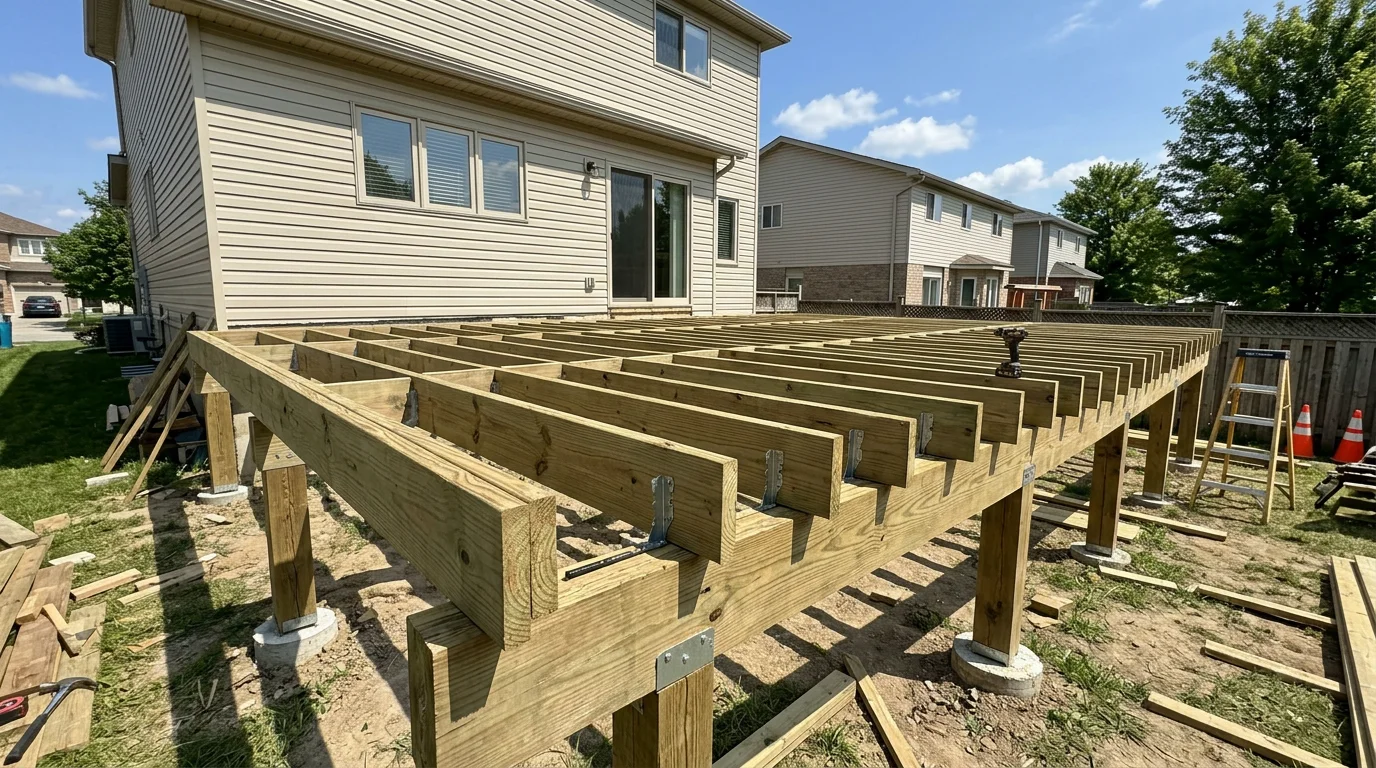
Your deck builder just sent you two quotes: one with joists spaced 16 inches apart, another at 12 inches. The second quote is $800 more. Are you paying for something you actually need, or is this upselling?
Joist spacing matters more than most homeowners realize. Get it wrong and you'll deal with bouncy decking, failed inspections, or worse—boards that crack under Ontario's freeze-thaw cycles. Get it right and your deck stays solid for decades.
What the Ontario Building Code Actually Requires
The Ontario Building Code (OBC) doesn't mandate a specific joist spacing. Instead, it requires your deck structure to safely support the loads it'll encounter—and those loads determine your spacing.
🏗️ Planning a deck project?
Get a free manual project review, or visualize your dream deck with AI before requesting quotes.
Here's what your deck needs to handle:
- Dead load: 10 psf (the weight of the deck itself)
- Live load: 40 psf in Ontario (that's people, furniture, snow)
- Total design load: 50 psf minimum
Your joist spacing depends on three things:
1. Joist size (2×6, 2×8, 2×10, 2×12)
2. Joist span (distance between supports)
3. Decking material (manufacturer requirements)
Most builders default to 16 inches on-center because it works for standard 2×8 or 2×10 joists spanning 8-12 feet with composite or pressure-treated decking. But that's not always the right answer.
When You Must Use 12-Inch Spacing
Some situations require tighter joist spacing regardless of what the span tables allow:
Composite Decking Manufacturers Require It
Almost every composite decking brand sold in Canada has specific joist spacing requirements printed right in their installation guides:
- Trex: 16" on-center for perpendicular installation, 12" on-center for 45-degree diagonal
- TimberTech: 16" standard, 12" required for diagonal or heavy-traffic commercial
- Fiberon: 16" maximum, recommends 12" for better performance
- Deckorators: 16" on-center, 12" mandatory for angles
Install Trex at 16-inch spacing when it requires 12 inches, and you void your warranty. Inspectors in Kitchener-Waterloo-Cambridge check this during framing inspections.
If you're installing your decking at any angle other than 90 degrees to the joists, plan for 12-inch spacing. Period.
Learn more about composite options in our guide to composite decking in Canada.
Cantilevers and Overhangs
The OBC limits cantilevers (joists extending past the beam) to the lesser of 16 inches or 1/4 of the joist span. Even if your span table says 16-inch joist spacing is fine, cantilevered areas benefit from 12-inch spacing—especially at the outer edge where bounce is most noticeable.
Stair Landings and High-Traffic Zones
Any section of deck that functions as a stair landing should use 12-inch spacing minimum. The concentrated load from people going up and down stairs puts extra stress on those boards.
Same goes for areas around hot tubs, BBQ islands, or dining zones where furniture legs concentrate weight on small areas.
When 16-Inch Spacing Works Fine
Standard 16-inch on-center joist spacing is code-compliant and structurally sound for most residential Ontario deck guides when:
- You're using 2×8 joists spanning 8-10 feet or less
- You're using 2×10 joists spanning 10-12 feet or less
- Your decking runs perpendicular to the joists (not diagonal)
- Your decking manufacturer approves 16" spacing
- You're using 5/4×6 pressure-treated or cedar boards
For pressure-treated wood decking, 16-inch spacing gives you a solid, non-bouncy surface. Wood boards are stiffer than composite, so they span farther between joists without flexing.
Most Kitchener-Waterloo-Cambridge builders use 16-inch spacing for standard pressure-treated decks and it performs perfectly through our winters.
See full joist span requirements in our deck joist span table guide.
The Cost Difference: 16" vs 12" Spacing
Tighter joist spacing means more lumber and more labor. Here's how it breaks down for a typical 12×16-foot deck (192 square feet):
Material Costs (Pressure-Treated Lumber, 2026 KWC Pricing)
16-inch on-center spacing (12-foot span):
- Number of joists: 10
- Lumber cost (2×8×12): $18 each = $180
- Joist hangers (20): $3 each = $60
- Total framing materials: $240
12-inch on-center spacing (same span):
- Number of joists: 13
- Lumber cost (2×8×12): $18 each = $234
- Joist hangers (26): $3 each = $78
- Total framing materials: $312
Material difference: $72 (30% more lumber)
Labor Cost Difference
Installing 30% more joists means 30% more cutting, fastening, and hanger installation. Most builders charge $25-45/sqft for deck framing and installation.
For tighter spacing, expect to add $2-4/sqft to the labor portion of your quote. On a 192 sqft deck, that's $384-768 additional labor.
Total cost difference for 12" vs 16" spacing: $450-850 on a typical 12×16 deck. When weighed against what Ontario homeowners pay for a deck overall, the upgrade is modest.
Is that worth it? Depends entirely on your decking material and how you're installing it.
How Spacing Affects Deck Performance
Beyond code compliance, joist spacing changes how your deck feels underfoot.
Bounce and Deflection
The OBC allows joists to deflect (bend) up to L/360 under live load. That's technical speak for "a 120-inch span can flex 0.33 inches and still pass code."
But code-compliant doesn't mean comfortable. A deck that flexes within code limits can still feel bouncy when you walk on it.
Tighter joist spacing reduces deflection:
- 16" spacing: More noticeable flex, especially with composite decking
- 12" spacing: Noticeably firmer feel, less bounce
If you're building a second-story deck or a large entertaining space, the extra $600 for 12-inch spacing delivers a premium feel that's worth every dollar.
Board Support and Sagging
Composite decking is heavier and less rigid than wood. Over time, composite boards can sag slightly between joists—especially in summer heat.
12-inch spacing cuts unsupported span by 25%, which means:
- Less visible sagging over the deck's lifespan
- Better performance in Ontario's summer heat (composite softens when hot)
- Reduced risk of cupping or warping at board edges
This is why Trex and TimberTech recommend 12-inch spacing even when 16 inches is technically allowed. They know their product performs better long-term with tighter support.
Read about composite deck maintenance in our Ontario cleaning and care guide.
What Inspectors Check in KWC
When your deck framing inspection happens in Kitchener, Waterloo, or Cambridge, the inspector will verify:
1. Joist spacing matches your approved plans
2. Spacing meets decking manufacturer specs (they'll ask for install guides)
3. Joists properly fastened to beams and ledger board
4. Joist hangers correctly installed (nails in every hole)
5. Blocking or bridging installed if required (depends on span)
If your plans show 12-inch spacing but you built at 16 inches to save money, you'll fail the inspection. If your plans show 16 inches but your composite decking requires 12 inches, you'll also fail.
Get the spacing right on your permit drawings before you pour footings.
See what inspectors look for during framing inspections.
Hybrid Spacing: A Smarter Approach
You don't need uniform spacing across your entire deck. Smart builders use different spacing for different zones:
- 12-inch spacing at stair landings, cantilevers, and high-traffic areas
- 16-inch spacing for the main deck field where loads are distributed
- 12-inch spacing under diagonal decking sections
This approach saves money where it doesn't matter and adds strength where it does.
Your permit drawings need to show these variations clearly. Most municipal plan reviewers in KWC are fine with hybrid spacing as long as it's documented and meets code.
Blocking and Bridging: When Spacing Isn't Enough
For joist spans over 8 feet, the OBC may require blocking or cross-bracing between joists—regardless of your spacing.
Blocking serves three purposes:
1. Prevents joists from twisting under load
2. Distributes weight across multiple joists
3. Stiffens the entire deck system
Solid blocking (cut pieces of joist lumber installed perpendicular between joists) is common on Ontario decks. Some builders prefer X-bracing with metal strapping.
If your deck feels bouncy even with proper joist sizing and spacing, adding mid-span blocking usually solves it.
Should You Use 2×10 Joists Instead of Tighter Spacing?
Sometimes upsizing your joists makes more sense than tightening the spacing.
Option A: 2×8 joists at 12" on-center
Option B: 2×10 joists at 16" on-center
For similar spans, Option B often costs less (fewer joists needed, faster installation) while delivering equal or better performance.
Run the numbers with your builder. On longer spans (10-14 feet), 2×10 joists at 16-inch spacing give you a rock-solid deck for less money than 2×8 joists at 12 inches.
See our complete joist span comparison table.
What to Specify in Your Deck Quote
When you're getting quotes for a new deck in Kitchener-Waterloo-Cambridge, make sure the contract clearly states:
- Joist size (2×8, 2×10, etc.)
- Joist spacing (12" or 16" on-center)
- Joist material (pressure-treated, cedar, engineered)
- Beam size and spacing
- Blocking/bridging details
Don't assume "standard framing" means the right spacing for your decking material. If you're installing composite at 45 degrees, "standard 16-inch spacing" will fail inspection.
Get it in writing before the contract is signed.
Use our deck quote checklist to know what to ask.
🎨 Not sure which material to pick?
Upload a photo of your backyard and see exactly how Trex, TimberTech, or cedar would look — free and instant.
Common Questions
Can I use 24-inch joist spacing to save money?
No. While the OBC doesn't explicitly prohibit 24-inch spacing, no decking manufacturer approves it. You won't find 24-inch spacing in span tables for residential deck joists. Stick with 12 or 16 inches maximum.
Does joist spacing affect my deck permit?
Yes. Your permit drawings must show joist size, span, and spacing. If you change spacing after permit approval, you need to submit revised drawings. Most KWC municipalities charge $50-100 for permit revisions.
Learn about deck permit costs in KWC.
Should I use joist tape with 12-inch spacing?
Joist tape protects the top edge of your joists from moisture—it has nothing to do with spacing. Whether you use 12-inch or 16-inch spacing, joist tape is a smart investment for deck longevity in Ontario's wet climate.
Read about joist tape benefits in our detailed guide.
Can I switch from 16-inch to 12-inch spacing mid-build?
Technically yes, but you'll need to submit revised permit drawings and wait for approval before the framing inspection. If the inspector shows up and your framing doesn't match the approved plans, you fail—even if your actual spacing is *better* than what was approved.
Does cedar decking need different joist spacing than pressure-treated?
Cedar and pressure-treated wood have similar strength properties, so spacing requirements are identical. Both work fine at 16 inches on-center when installed perpendicular to joists. Composite decking is where spacing rules change.
Compare pressure-treated vs composite costs in our Ontario guide.
Upload a backyard photo and preview real decking materials with AI — free, instant, no sign-up.
Permits, costs, material comparisons, and questions to ask before requesting quotes — delivered to your inbox.