
Deck Permits in Mississauga (2026)
Everything you need to know about getting a deck permit in Mississauga — requirements, fees, building codes, setback rules, and how to apply in 2026.
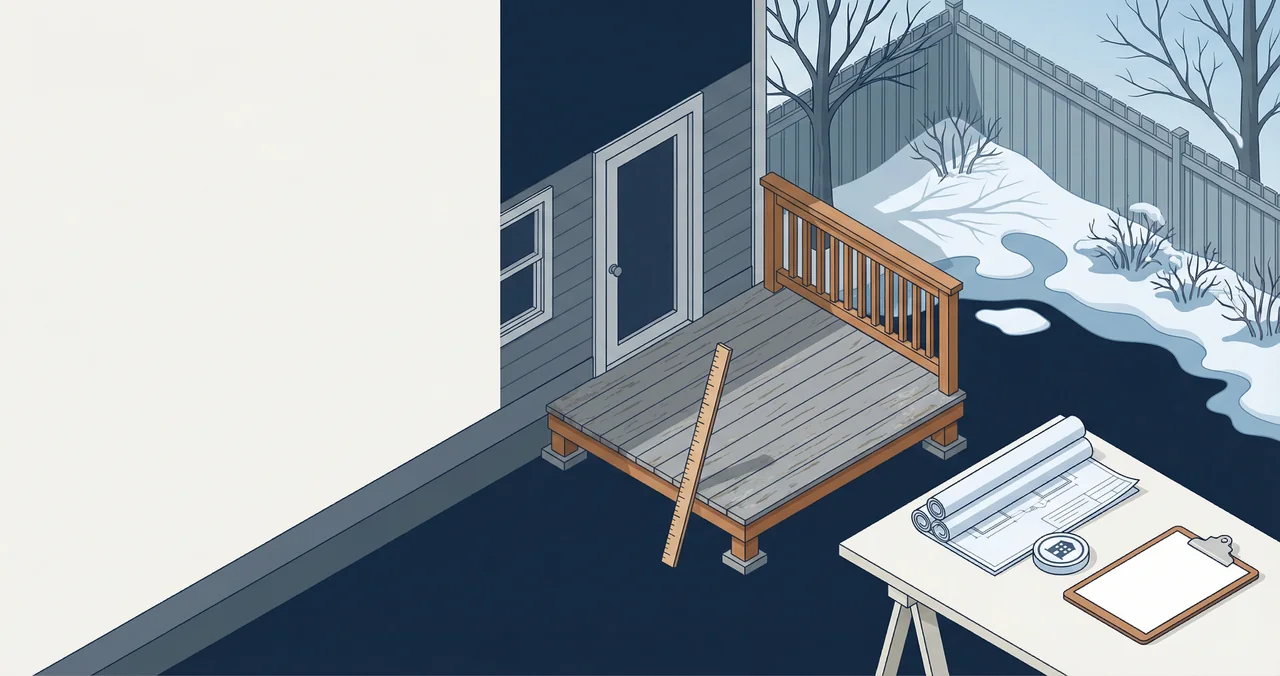
Planning a new deck in Mississauga? Before you pick out materials or call a contractor, there's one step you can't skip: figuring out whether you need a building permit. Get it wrong, and you could face fines, forced removal, or serious headaches when you try to sell your home.
Looking for more regional information? Check out our Ontario Decking Hub.
Here's exactly what Mississauga homeowners need to know about deck permits in 2026 — the rules, the costs, and the process from start to finish.
📋 Tool Alert: Permit Checker
Do you really need a permit? Check the exact rules for your city or township.
Check Permits →Do You Need a Deck Permit in Mississauga?
Yes, most decks in Mississauga require a building permit. The City of Mississauga's Building Division follows the Ontario Building Code (OBC), and the rules are stricter than many homeowners expect.
🏗️ Planning a deck project?
Get a free manual project review, or visualize your dream deck with AI before requesting quotes.
You'll need a permit if your deck meets any of these conditions:
- The deck surface is more than 24 inches (0.6 m) above finished grade at any point
- The deck is attached to your house
- The deck exceeds 100 square feet (approximately 10 sq m) in area
- The deck includes a roof, pergola cover, or enclosed structure
A small, ground-level platform under 100 sq ft that sits freestanding in your backyard? That's generally exempt. But the moment you attach it to your house, raise it above 24 inches, or go bigger than 100 sq ft, you're in permit territory.
Important: Even if you think your deck is exempt, it still has to comply with the Ontario Building Code, zoning bylaws, and setback requirements. "No permit required" doesn't mean "no rules apply."
For a deeper look at the distinction, see our guide on attached vs. freestanding deck permits in Ontario.
When a Permit Is Required
Let's break this down by common deck scenarios Mississauga homeowners actually encounter:
Raised Decks (Most Common)
If your home has a walkout basement or even a slightly elevated back door — common in Mississauga neighborhoods like Erin Mills, Meadowvale, Streetsville, and Lorne Park — your deck will almost certainly be more than 24 inches off the ground. You need a permit.
Most standard backyard decks in Mississauga fall into this category. A typical 12x16 or 16x20 deck off the back of a two-storey home sits 3 to 5 feet above grade, which absolutely requires a permit and inspections.
Ground-Level Decks
A low platform deck sitting directly on or very close to the ground may be exempt if it's:
- Under 24 inches above grade at every point
- Not attached to the house
- Under 100 sq ft
Go over any one of those thresholds, and you'll need to apply.
Replacing an Existing Deck
Replacing your deck boards on existing framing? You generally don't need a new permit for surface replacement alone. But if you're changing the footprint, raising the height, modifying the structure, or replacing the framing, a permit is required. When in doubt, call Mississauga's Building Division at 311 or (905) 896-5511 — they'll tell you straight.
Adding Features to an Existing Deck
Adding a pergola, roof structure, hot tub, or built-in seating with structural implications? These modifications often trigger permit requirements even if the original deck was built with a permit.
Permit Fees & Processing Time
What You'll Pay
Mississauga's deck permit fees are based on the estimated construction value of the project. As of 2026, here's the general fee structure:
| Project Value | Approximate Permit Fee |
|---|---|
| Under $10,000 CAD | $200–$350 CAD |
| $10,000–$25,000 CAD | $350–$600 CAD |
| $25,000–$50,000 CAD | $600–$900 CAD |
| Over $50,000 CAD | $900+ CAD |
A typical Mississauga deck project — say a 14x20 pressure-treated deck — runs about $8,400–$15,400 CAD for the build, putting your permit fee in the $200–$600 range. For a composite build, you're looking at higher construction value and fees closer to $600–$900.
To estimate your total project cost, check out our breakdowns for 12x16 decks or 16x20 decks in Ontario.
How Long Does It Take?
Mississauga's Building Division typically processes residential deck permits within 10 to 15 business days for straightforward applications. That's roughly 2 to 3 weeks from submission.
However:
- Incomplete applications get sent back, adding weeks to your timeline
- Complex projects (multi-level decks, structures near easements, variances needed) can take 4 to 8 weeks
- Peak season (March through May) sees higher volume, so submissions can take longer
Pro tip: Submit your permit application in January or February if you want to build in the spring. Mississauga's building season effectively runs May through October, and contractor schedules fill up fast. Book your contractor by March, and have your permit in hand before the ground thaws.
Building Codes & Setback Rules
Mississauga follows the Ontario Building Code (OBC) and the city's own zoning bylaws. Here are the key requirements that affect deck construction:
Structural Requirements
- Footings must extend below the frost line — in the Mississauga/GTA region, that means a minimum of 48 inches (4 feet) deep. This is non-negotiable. Mississauga's freeze-thaw cycles will heave shallow footings right out of the ground.
- Deck joists must be sized and spaced according to OBC span tables. Typical residential decks use 2x8 or 2x10 joists at 16 inches on center.
- Beam and post sizing depends on your span and load. Snow loads in Mississauga are significant — the OBC requires designing for local snow load conditions.
- Ledger boards (where the deck attaches to the house) must be properly flashed and fastened with lag screws or through-bolts into the rim joist. This is where most DIY deck failures happen.
Railings and Guards
- Any deck surface 24 inches or more above grade requires guards (railings)
- Minimum guard height: 36 inches for residential decks (42 inches if the deck is more than 5.9 feet above grade)
- Baluster spacing: no more than 4 inches apart (a 4-inch sphere cannot pass through)
- Guards must resist a specified horizontal load per OBC requirements
For railing options that meet code, take a look at the best deck railing systems available in Canada.
Setback Rules
Mississauga zoning bylaws specify minimum setbacks for decks:
- Rear yard setback: Typically 7.5 metres (about 25 feet) from the rear lot line for the main structure, but decks can usually encroach into this setback by a specified amount (often up to 1.5 m). Check your specific zone.
- Side yard setback: Usually 1.2 metres (4 feet) minimum from the side lot line, though this varies by zone designation (R1, R2, R3, etc.)
- Lot coverage: Your deck counts toward your property's total lot coverage, which is capped by zoning (typically 30–45% depending on your zone)
Your property's specific zoning determines your exact setback requirements. A home in Cooksville may have different rules than one in Churchill Meadows. Look up your zoning designation on the City of Mississauga's website or call 311.
If you're building near an easement, you'll want to read our guide on building near an easement in Ontario before submitting your application.
Climate-Specific Code Considerations
Mississauga's climate puts serious demands on deck construction:
- Snow load: Your deck must handle heavy snow accumulation. The OBC specifies minimum snow loads for the Mississauga region — your engineer or designer must account for this.
- Frost heave: Footings that don't reach below the frost line will shift. This isn't a maybe — it's a certainty with Mississauga winters.
- Drainage: Proper grading away from your home's foundation is critical. Water pooling under a deck accelerates rot and can undermine footings.
- Material selection: Composite and PVC decking hold up best against Ontario's freeze-thaw cycles. Pressure-treated wood is the most affordable option but requires annual sealing to resist moisture and road salt tracked onto the surface. For more on choosing materials built for this climate, see best decking materials for Ontario's freeze-thaw cycles.
Use PaperPlan to visualize different decking materials on your own home before committing — it's a practical way to see how composite, cedar, or pressure-treated options will actually look against your siding and yard.
How to Apply for a Deck Permit in Mississauga
Here's the step-by-step process:
Step 1: Gather Your Documents
You'll need:
- Site plan / survey showing your property boundaries, house location, and proposed deck position with setback dimensions
- Construction drawings including:
- Plan view (top-down layout with dimensions)
- Elevation drawings (side views showing height, railings, stairs)
- Cross-section details (footing depth, joist sizing, beam connections)
- Ledger board attachment detail (if attaching to the house)
- Specifications for materials, fasteners, and hardware
- Lot grading information if requested
Most Mississauga contractors who handle permit applications regularly will prepare these drawings for you — or they'll work with a draftsperson. If you're going the DIY route, you can hire a residential designer to produce permit-ready drawings for $500–$1,500 CAD depending on complexity.
If you're considering building the deck yourself, our guide on building your own deck in Ontario covers what's involved.
Step 2: Submit Your Application
You have two options:
- Online: Through the City of Mississauga's online portal (search "Mississauga building permit application" on the city website)
- In person: At the Mississauga Civic Centre, 300 City Centre Drive
Online submissions are faster and let you track status digitally.
Step 3: Plan Review
The Building Division reviews your submission for OBC compliance and zoning conformity. For a standard deck, this takes 10–15 business days. You may receive comments or requests for additional information — respond promptly to avoid delays.
Step 4: Permit Issuance
Once approved, you'll receive your permit. Post it visibly at your property during construction. This is a legal requirement.
Step 5: Inspections
Mississauga typically requires two inspections for deck construction:
- Footing inspection — before pouring concrete, the inspector verifies hole depth and dimensions
- Final inspection — after the deck is complete, the inspector checks the overall structure, railings, connections, and compliance with approved plans
Do not backfill footings or close up framing before the relevant inspection. If you cover up work that needs inspecting, you may be required to expose it again.
Step 6: Final Approval
Once you pass the final inspection, you'll receive your completion certificate. Keep this document — you'll need it when you sell your home.
What Happens If You Build Without a Permit
Skipping the permit process might seem tempting. Don't.
Here's what you're risking in Mississauga:
- Stop-work orders: A bylaw officer can shut down your project immediately
- Fines: Up to $25,000 for individuals and $50,000 for corporations under the Ontario Building Code Act
- Forced removal: The city can order you to tear down the deck entirely — at your expense
- Insurance problems: Your homeowner's insurance may deny claims related to an unpermitted structure
- Sale complications: When you sell, the buyer's lawyer will check permits. An unpermitted deck can kill a deal, reduce your sale price, or force a last-minute teardown
We've seen Mississauga homeowners forced to demolish $30,000+ decks because they skipped a $300 permit. It's one of the most expensive shortcuts in home renovation.
For a full breakdown of the risks, read building a deck without a permit in Ontario.
Can You Get a Permit After the Fact?
Sometimes. Mississauga may allow you to apply for a retroactive permit, but:
- You'll pay the standard permit fee plus potential surcharges
- The deck must meet all current code requirements
- You may need to open up framing for inspection, which means partial demolition
- If the deck doesn't meet code, you'll need to modify or remove it
It's always cheaper and easier to get the permit first.
🎨 Not sure which material to pick?
Upload a photo of your backyard and see exactly how Trex, TimberTech, or cedar would look — free and instant.
Frequently Asked Questions
How much does a deck permit cost in Mississauga?
Most residential deck permits in Mississauga cost between $200 and $600 CAD, depending on the estimated construction value of your project. A standard backyard deck typically falls in the $300–$500 range. Fees are set by the City of Mississauga's Building Division and are subject to annual updates — confirm current rates at mississauga.ca or by calling 311.
How long does it take to get a deck permit in Mississauga?
Plan for 10 to 15 business days for a straightforward residential deck. If your application is incomplete or requires zoning variances, it could take 4 to 8 weeks. Applications submitted during peak season (March–May) may experience additional delays. Submit early — ideally in January or February — if you want to start building in the spring.
Do I need a permit for a ground-level deck in Mississauga?
It depends. A freestanding deck that's under 24 inches above grade and under 100 sq ft is generally exempt from a building permit. However, it must still comply with the Ontario Building Code and Mississauga's zoning bylaws, including setback requirements. If you're attaching it to your house or exceeding either threshold, you need a permit.
Can my neighbour complain about my deck in Mississauga?
Yes. If your deck doesn't meet setback requirements, exceeds lot coverage limits, or was built without a permit, a neighbour's complaint can trigger a bylaw investigation. Even with a valid permit, disputes over privacy and overlook are common in Mississauga's tighter lot subdivisions. Our article on whether a neighbour can complain about your deck in Ontario covers what they can and can't do.
What is the frost line depth in Mississauga?
Mississauga's frost line depth is approximately 48 inches (4 feet). All deck footings must extend below this depth to prevent frost heave — a major concern given the city's harsh winters with repeated freeze-thaw cycles. Your building inspector will verify footing depth during the footing inspection. Footings that don't meet this requirement will fail inspection, full stop.
📋 Planning a deck project?
Get a free manual project review from our team — no obligation, no spam.
Get Free Project Review →Upload a backyard photo and preview real decking materials with AI — free, instant, no sign-up.
Permits, costs, material comparisons, and questions to ask before requesting quotes — delivered to your inbox.