
Deck Permits in Toronto (2026)
Need a deck permit in Toronto? Learn when permits are required, current fees, building code rules, setback requirements, and how to apply step by step in 2026.
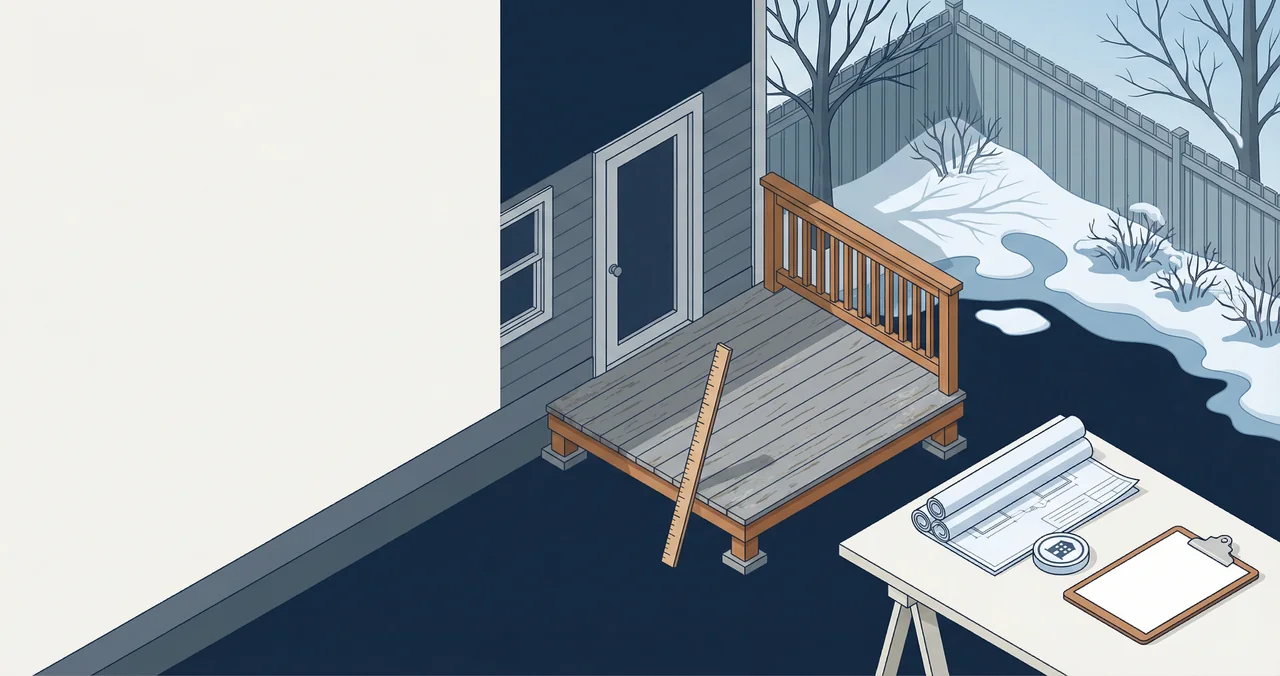
Do You Need a Deck Permit in Toronto?
If your deck will be higher than 24 inches (0.6 m) above finished grade or larger than 100 square feet (9.3 m²), you need a building permit from the City of Toronto. That covers the vast majority of backyard decks.
🏗️ Planning a deck project?
Get a free manual project review, or visualize your dream deck with AI before requesting quotes.
Looking for more regional information? Check out our Ontario Decking Hub.
Even a modest 12×12 deck hits 144 square feet — well past the threshold. And if your deck connects to your house at a back door that's more than two feet off the ground (most are), you're looking at a permit regardless of size.
Here's the quick breakdown:
- Permit required: Deck over 24" above grade or over 100 sq ft
- No permit needed: Ground-level deck under 24" above grade and under 100 sq ft, with no roof structure
- Always requires a permit: Any deck with a roof, pergola with a solid cover, or enclosed structure
Toronto's Building Division enforces the Ontario Building Code (OBC) along with local zoning bylaws. The rules aren't suggestions — inspectors actively check for compliance, and neighbours do report unpermitted work.
📋 Tool Alert: Permit Checker
Do you really need a permit? Check the exact rules for your city or township.
Check Permits →When a Permit Is Required
The 24-inch / 100-square-foot rule is the starting point, but several other situations trigger a permit:
Attached Decks vs. Freestanding Decks
Attached decks — those bolted to your home's ledger board — almost always need a permit. The connection to your house is a structural concern, and the city wants to verify it's done correctly to prevent water damage and structural failure.
Freestanding decks still need a permit if they exceed the size or height thresholds. The only advantage is a slightly simpler application since there's no ledger connection to evaluate. For a deeper comparison, see our guide on attached vs. freestanding deck permits in Ontario.
Other Triggers
- Adding a hot tub to an existing deck (concentrated load requirements)
- Building stairs from a raised deck to grade
- Installing a pergola or gazebo with footings
- Any electrical work for lighting or outlets (separate electrical permit required)
- Decks near property lines — setback requirements apply even to small builds
What About Replacing an Existing Deck?
If you're tearing down and rebuilding on the same footprint with no structural changes, you might not need a new permit — but don't assume. Call Toronto Building at 416-397-5330 or visit a Building Division counter to confirm. If you're changing the size, height, or structural design, you'll need a fresh permit.
Permit Fees & Processing Time
Toronto's building permit fees are calculated based on project value and type. For residential decks, expect the following in 2026:
| Fee Component | Estimated Cost (CAD) |
|---|---|
| Permit application fee | $200–$500 |
| Plan review fee | Included in most residential applications |
| Inspection fees | Included with permit |
| Zoning review (if required) | $150–$350 additional |
The total typically lands between $250 and $750 CAD for a standard residential deck, depending on the project scope. Larger or more complex builds — multi-level decks, rooftop decks, or structures near easements — cost more.
How Long Does It Take?
- Simple residential deck: 10–20 business days for permit approval
- Complex projects (variances, Committee of Adjustment): 3–6 months or more
- Incomplete applications: Sent back for revision, adding weeks to the timeline
Pro tip: Toronto's building season runs from roughly May through October. Permit applications spike in March and April. If you want to break ground in May, submit your application by mid-February at the latest. Contractor schedules fill up fast — booking your builder by March is standard practice.
Building Codes & Setback Rules
Toronto decks must comply with the Ontario Building Code (OBC 2024) and the city's Zoning By-law 569-2013. Here are the key requirements:
Structural Requirements
- Frost line depth: Footings must extend at least 48 inches below grade in Toronto (the OBC specifies 36–60 inches depending on the region, and Toronto falls in the deeper range due to its freeze-thaw cycles)
- Snow load: Decks must support a minimum ground snow load of 1.0 kPa (approximately 21 psf) plus applicable rain load
- Live load: 1.9 kPa (40 psf) minimum for residential decks
- Beam and joist sizing: Must follow OBC span tables or be engineered
- Ledger connections: Lag bolts or through-bolts with proper flashing — nails are never acceptable
Railing Requirements
- Guard rails required when the deck surface is more than 24 inches (600 mm) above grade
- Minimum height: 36 inches (900 mm) for residential, 42 inches (1,070 mm) if the drop exceeds 1.8 m
- Baluster spacing: No more than 4 inches (100 mm) between balusters — a 4" sphere cannot pass through
- Horizontal cables or rails: Must comply with the OBC's anti-climbing provisions
For railing options that meet code, check out our best deck railing systems guide.
Setback Rules
Toronto's zoning bylaws dictate how close your deck can be to property lines:
- Rear yard setback: Typically 0.6 m (2 feet) minimum from the rear property line for decks under 1.2 m above grade — but this varies by zone
- Side yard setback: Usually 0.9 m (3 feet) minimum; wider on corner lots
- Lot coverage: Your deck counts toward the maximum lot coverage percentage. In most residential zones (R, RD), total lot coverage caps at 30–35%
- Easements: Decks cannot encroach on utility easements. If you're building near an easement, verify the registered plan with the city
Important: Toronto's zoning is complex, with dozens of residential zone categories. Your specific setback requirements depend on your property's zoning designation. Look yours up on the city's Interactive Zoning By-law Map or request a zoning certificate.
Climate-Specific Code Considerations
Toronto's climate is hard on decks. Winters bring repeated freeze-thaw cycles, heavy snow loads, ice, and road salt tracked onto surfaces. This affects both code compliance and practical durability:
- Footings: Must reach below the frost line. Improperly set footings heave, cracking your deck structure. Helical piles or sono tubes filled to 48"+ are standard
- Drainage: The OBC requires adequate drainage below and around deck structures. Pooling water that freezes will damage both the deck and your foundation
- Material choice: Composite and PVC decking materials handle Toronto winters far better than untreated wood. Pressure-treated lumber works but needs annual sealing to resist moisture and salt damage
How to Apply for a Deck Permit in Toronto
Step 1: Check Your Zoning
Before drawing a single line, confirm your property's zoning. Visit toronto.ca/zoning or call 416-397-5330. You need to know your:
- Zoning designation
- Maximum lot coverage
- Required setbacks
- Any site-specific restrictions or overlays
Step 2: Prepare Your Drawings
Toronto Building requires:
- Site plan showing your lot, house, proposed deck location, distances to property lines, and lot dimensions
- Construction drawings with framing plan, footing details, beam/joist sizes, railing details, and cross-sections
- Foundation details showing footing depth (minimum 48" in Toronto)
Drawings don't need to come from an architect for a simple deck, but they must be to scale and dimensioned. Many Toronto deck builders prepare permit drawings as part of their quote — ask when getting estimates. Use PaperPlan to visualize different decking materials on your own home before committing to a design direction.
If you're tackling the project yourself, our guide on building your own deck in Ontario walks through what's involved.
Step 3: Submit Your Application
You have two options:
- Online: Through Toronto's ePermit portal at toronto.ca/epermit — upload drawings, fill out the application, and pay fees electronically
- In person: Visit a Toronto Building customer service counter (North York Civic Centre, Scarborough Civic Centre, Etobicoke Civic Centre, or City Hall)
Online submissions are faster and let you track status in real time.
Step 4: Plan Review
A plans examiner reviews your submission for OBC and zoning compliance. If there are issues, you'll receive a correction notice. Respond promptly — delays here push your whole timeline back.
Step 5: Receive Your Permit & Schedule Inspections
Once approved, you'll receive your building permit. Post it visibly on site during construction. You'll need inspections at key stages:
- Footing inspection: Before pouring concrete — inspector verifies depth and soil conditions
- Framing inspection: After framing is complete but before decking boards go on
- Final inspection: Completed deck, railings, stairs, and guards
Don't cover work before it's been inspected. Inspectors can require you to tear out and redo anything they can't see.
What Happens If You Build Without a Permit
Skip the permit and you're gambling with serious consequences:
- Stop work order: A bylaw officer can shut down your project mid-build
- Fines: Toronto can issue fines up to $25,000 for individuals and $50,000 for corporations under the Building Code Act
- Forced removal: The city can order you to demolish the deck entirely at your expense
- Insurance problems: Your homeowner's insurance may deny claims related to an unpermitted structure
- Sale complications: When you sell, the buyer's lawyer or home inspector will flag unpermitted work. It can kill a deal or force a price reduction
- Liability: If someone is injured on an unpermitted deck, you're exposed to personal liability
Neighbours report unpermitted construction more often than you'd think. Toronto bylaw enforcement follows up on complaints.
The math doesn't work out. A permit costs $250–$750. Tearing down a finished deck and rebuilding it with a permit costs thousands. Get the permit.
What If You Already Built Without One?
You can apply for a permit retroactively, but expect:
- Additional fees and potential penalties
- An inspection that may require opening up finished work (removing deck boards to inspect framing and footings)
- Possible requirements to bring non-compliant elements up to code
It's more expensive and stressful after the fact, but it's still better than leaving the problem unresolved.
🎨 Not sure which material to pick?
Upload a photo of your backyard and see exactly how Trex, TimberTech, or cedar would look — free and instant.
Frequently Asked Questions
How much does a deck permit cost in Toronto in 2026?
Most residential deck permits in Toronto cost between $250 and $750 CAD, depending on the project's scope and assessed value. This includes the application fee and standard inspections. If your project requires a zoning variance or Committee of Adjustment hearing, expect additional fees of $3,000–$6,000+ for the variance application alone.
How long does it take to get a deck permit approved in Toronto?
Standard residential deck permits take 10–20 business days from submission to approval, assuming your application is complete and no zoning issues arise. Incomplete applications get sent back, which can add weeks. During peak season (March–May), processing times may stretch longer. Submit early.
Can I build a small deck without a permit in Toronto?
Only if it meets all of these criteria: under 24 inches above finished grade, under 100 square feet, not attached to a roof structure, and compliant with setback requirements. Even then, you still must follow the Ontario Building Code for structural safety. Most practical decks exceed at least one of these thresholds. When in doubt, call Toronto Building — the phone consultation is free.
Do I need a permit to replace deck boards in Toronto?
Replacing deck boards on an existing permitted structure — same footprint, same framing, just new surface material — generally does not require a permit. But if you're replacing structural components (joists, beams, posts, footings) or changing the deck's size or height, that's a different story. A quick call to 416-397-5330 can save you a headache.
What is the frost line depth for deck footings in Toronto?
Deck footings in Toronto must extend a minimum of 48 inches (1.2 m) below grade to get below the frost line. This prevents frost heave from shifting your deck structure during winter freeze-thaw cycles. Some Toronto deck builders use helical piles as an alternative to traditional sono tube footings — they're driven below the frost line mechanically and work well in tight backyard spaces.
📋 Planning a deck project?
Get a free manual project review from our team — no obligation, no spam.
Get Free Project Review →Upload a backyard photo and preview real decking materials with AI — free, instant, no sign-up.
Permits, costs, material comparisons, and questions to ask before requesting quotes — delivered to your inbox.