
Multi-Level Deck Cost in Ontario: How Much for Two Tiers?
Multi-level deck cost in Ontario ranges $25,000-$80,000+ depending on size, materials, and height. Get 2026 pricing for two-tier decks in KWC.
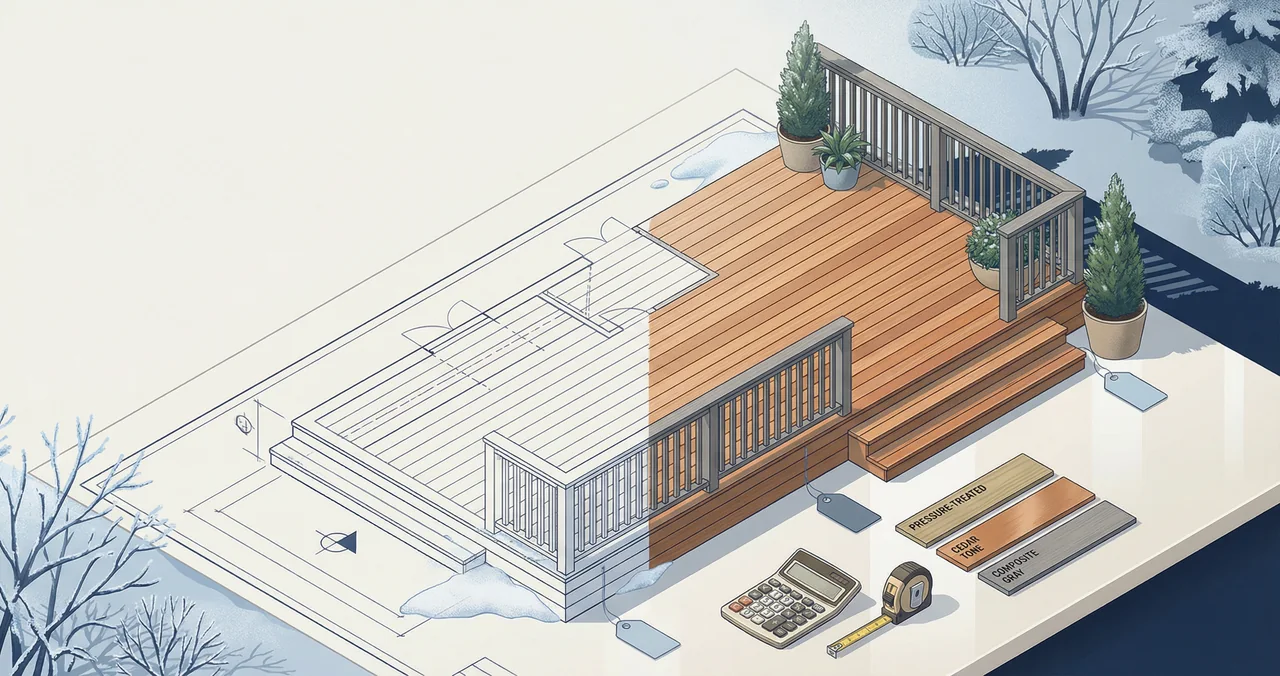
Multi-level decks cost $25,000 to $80,000+ in Ontario, with most two-tier projects in Kitchener-Waterloo-Cambridge landing between $35,000 and $55,000 for pressure-treated construction or $50,000 to $85,000 for composite materials.
The wide range comes down to size, material choice, height difference between tiers, and structural complexity. A simple two-level deck with a 12-inch step down costs far less than a dramatic split-level design with 6-foot elevation changes requiring extensive foundation work.
What Makes Multi-Level Decks More Expensive?
Multi-level decks aren't just "two decks stacked together." They require additional structural elements that single-level decks don't need.
🏗️ Planning a deck project?
Get a free manual project review, or visualize your dream deck with AI before requesting quotes.
Extra framing and support structures — Each tier needs its own beam system, joists, and post configuration. The transition between levels requires additional blocking, headers, and ledger connections. You're essentially building two deck frames that need to integrate structurally.
Increased footing requirements — More posts mean more footings. In Ontario, all footings must reach 48 inches (1.2 m) below grade to get below the frost line. A single-level 400 sqft deck might need 8-10 footings. A two-tier deck of the same total square footage could require 14-18 footings at $150-300 each for helical piles or $200-350 for concrete sonotubes including labour.
Additional stairs and transitions — Beyond the main stairs from ground to deck, you'll need stairs or steps connecting the two levels. These transition stairs require their own stringers, treads, and often handrails depending on the height difference and Ontario Building Code requirements.
More complex railing systems — Multi-level decks have more perimeter to enclose. You'll need railing along both upper and lower tier edges, plus potentially guards around the transition area. At $40-120 per linear foot installed, railing costs add up quickly on multi-tier designs.
Higher labour hours — Builders spend more time coordinating elevations, ensuring proper drainage between levels, and managing structural loads. Expect labour rates of $25-45 per square foot to increase by 15-25% for multi-level complexity.
Multi-Level Deck Cost Breakdown by Size
Here's what you'll typically pay for complete two-tier deck installations in the KWC market:
Small Multi-Level Deck (300-400 sqft total)
- Pressure-treated: $15,000 - $24,000
- Composite: $22,000 - $36,000
- Common configuration: 200 sqft upper tier + 150 sqft lower tier
- Usually 12-24 inch elevation change
- Includes stairs to ground and tier transition steps
Medium Multi-Level Deck (400-600 sqft total)
- Pressure-treated: $24,000 - $42,000
- Composite: $36,000 - $60,000
- Common configuration: 300 sqft upper + 250 sqft lower tier
- 24-48 inch elevation change typical
- May include multiple stair locations
Large Multi-Level Deck (600-900 sqft total)
- Pressure-treated: $42,000 - $65,000
- Composite: $60,000 - $90,000+
- Common configuration: 450 sqft upper + 400 sqft lower tier
- Can accommodate dramatic elevation changes (4-6+ feet)
- Often includes wraparound designs or L-shaped configurations
These prices include all structural framing, decking boards, railings, stairs, permit fees, and professional installation. They assume standard soil conditions and straightforward site access in the KWC region. For single-level pricing comparisons, see our comprehensive Ontario deck cost guide.
Material Cost Impact on Two-Tier Decks
Your material choice dramatically affects the total project cost:
| Material | Installed Cost per Sqft | 500 sqft Two-Tier Deck Total |
|----------|------------------------|------------------------------|
| Pressure-treated pine | $45-65 | $22,500 - $32,500 |
| Cedar | $55-80 | $27,500 - $40,000 |
| Basic composite (Trex Select, TimberTech Edge) | $65-80 | $32,500 - $40,000 |
| Premium composite (Trex Transcend, Azek) | $80-95 | $40,000 - $47,500 |
For multi-level decks specifically, many homeowners choose composite for the upper tier (high visibility, frequent use) and pressure-treated for the lower tier (less visible, potential drainage exposure). This hybrid approach can save $5,000-$12,000 while keeping the most-seen areas premium.
Learn more about material trade-offs in our guide to composite vs wood decking in Ontario.
Height Difference Between Tiers and Structural Costs
The vertical drop between your deck levels significantly impacts foundation and framing costs:
Small Drop (12-18 inches)
- Simplest transition — often just 2-3 steps
- Lower tier posts may share some footings with upper tier structure
- Minimal additional engineering required
- Cost premium: +$3,000 to $6,000 over single-level equivalent
Medium Drop (24-48 inches)
- Most common configuration for split-level homes
- Fully independent support systems for each tier
- Requires careful drainage planning between levels
- May need guardrails at transition depending on Ontario Building Code interpretation
- Cost premium: +$6,000 to $12,000 over single-level equivalent
Large Drop (4-6+ feet)
- Often results from walkout basement scenarios or sloped lots
- Lower tier essentially becomes ground-level patio area
- May require engineered plans for tall posts and beam spans
- Extensive stair systems needed
- Cost premium: +$12,000 to $20,000+ over single-level equivalent
Tall multi-level decks with posts exceeding 8 feet in height typically require engineer-stamped drawings in addition to standard permit applications. Budget $800-1,500 for structural engineering fees if your design needs professional calculations.
Permit Costs and Approval Timelines
Multi-level decks always require building permits in Kitchener, Waterloo, and Cambridge — no exceptions, regardless of the size or height thresholds that might exempt simple single-level platforms.
Permit fees in KWC:
- Kitchener: $250-400 depending on project value
- Waterloo: $200-350 depending on project value
- Cambridge: $150-325 depending on project value
Drawing requirements — Your permit application needs site plans showing property lines, setbacks, existing structures, and detailed deck plans with elevations. Multi-level designs require both tiers shown in plan view and side elevation to demonstrate code compliance for height, guardrails, and structural support.
Get the full application checklist in our deck permit drawings guide for KWC.
Timeline expectations:
- Application submission to approval: 2-4 weeks typical
- Framing inspection scheduling: 3-7 days after calling for inspection
- Final inspection: 1-2 weeks after completion
See municipality-specific processes:
- Kitchener deck permit application walkthrough
- Waterloo deck permit application walkthrough
- Cambridge deck permit application walkthrough
Design Features That Increase Multi-Level Deck Costs
Beyond basic two-tier construction, these popular upgrades add to your budget:
Built-in seating or planters — Custom benches integrated into railings or planter boxes between levels add $800-2,500 depending on linear footage and materials.
Under-deck drainage systems — If you want to use the space under your upper tier as dry patio area, expect $8-15 per square foot for ceiling systems like TimberTech DrySpace or similar products.
Multiple stair locations — Each additional staircase to grade or between tiers costs $1,200-3,500 depending on rise, material, and railing requirements.
Curved or angled transitions — Non-rectangular deck shapes require custom cutting and more complex framing. Add 20-35% to framing labour costs for curved or multi-angled designs.
Deck lighting systems — Low-voltage LED lighting in stairs, railings, and post caps runs $1,500-4,500 installed for a full multi-level setup. Check our deck lighting guide for Ontario requirements.
Pergola or roof structures — Adding a pergola over one tier adds $3,500-8,500 depending on size and finish materials. Fully covered roof structures may trigger additional permit requirements.
Foundation Options for Two-Tier Decks in KWC
Ontario's clay soil and deep frost line create specific foundation challenges for multi-level decks:
Concrete sonotubes — Traditional method using cardboard forms filled with concrete and embedded post brackets. Costs $200-350 per footing including excavation, concrete, and labour. Works well for stable, settled soil.
Helical piles — Screw-in steel posts that reach stable soil depth without excavation. Costs $150-300 per pile installed. Excellent for clay soil common in KWC and can be installed year-round without frost concerns.
For detailed comparison including permit expectations, see helical piles vs concrete footings in KWC.
Multi-level decks with significant elevation changes often work better with helical piles for the taller posts and concrete footings for shorter posts on the lower tier. Your builder can mix foundation types based on load requirements and soil conditions.
Getting Accurate Multi-Level Deck Quotes
Multi-level deck pricing varies significantly based on your specific lot conditions, design preferences, and material choices. Here's how to get reliable quotes:
Site visit is essential — Don't accept quotes based on phone descriptions alone. Builders need to see your lot slope, measure elevation changes, assess soil conditions, and verify setbacks from property lines.
Request itemized quotes — Your quote should break out materials, labour, permits, and optional upgrades separately. This transparency lets you make informed decisions about where to spend or save.
Ask about footing strategy — Clarify whether the quoted price includes helical piles or concrete footings, how many are required, and whether soil testing might reveal additional needs.
Verify what's included — Confirm whether stairs, railings, post caps, and fascia boards are included in the quoted square footage price or listed as separate line items.
See our complete deck quote checklist for Kitchener-Waterloo to ensure you're comparing quotes accurately.
Timing and Scheduling for Multi-Level Projects
Multi-level decks take longer to build than single-level equivalents:
Construction timeline:
- Small two-tier deck (300-400 sqft): 5-8 working days
- Medium two-tier deck (400-600 sqft): 8-12 working days
- Large two-tier deck (600-900 sqft): 12-18 working days
Weather delays, inspection scheduling, and material delivery can extend these timelines. Factor in framing inspection mid-project (mandatory before proceeding with decking installation) and final inspection after completion.
Best seasons for multi-level deck construction — Spring through fall offers the most predictable conditions in Ontario. Winter construction is possible but may face delays from frozen ground (affecting footing installation) and material handling challenges.
Read about seasonal considerations in our best time to build a deck in Ontario guide.
🎨 Not sure which material to pick?
Upload a photo of your backyard and see exactly how Trex, TimberTech, or cedar would look — free and instant.
Common Questions
How much more expensive is a two-level deck compared to single-level?
Expect to pay 20-40% more for a two-tier deck compared to a single-level deck of the same total square footage. A 500 sqft single-level pressure-treated deck might cost $23,000-28,000, while the equivalent two-tier design costs $28,000-38,000. The premium covers additional footings, more complex framing, extra stairs, and increased railing perimeter.
Do I need an engineer for a multi-level deck in Ontario?
Not always, but it depends on your design. Standard two-tier decks with conventional framing and post heights under 8 feet typically don't require engineer-stamped drawings — your builder submits standard construction plans for permit approval. You'll need engineering calculations if your deck has posts exceeding 8 feet tall, unusually long beam spans, or if you're adding heavy features like a hot tub on one tier. Engineer fees run $800-1,500 when required.
Can I use the space under my upper deck tier?
Yes, and many homeowners treat the lower tier or the area beneath the upper tier as usable outdoor space. If you want true dry storage or finished patio space underneath, install an under-deck drainage system during construction for $8-15 per square foot. Without drainage, you'll get a covered but potentially damp area depending on deck board spacing and drainage patterns. Learn more about deck drainage and water management in Ontario.
How do you handle drainage between deck tiers?
Proper drainage is critical for multi-level decks. The upper tier should slope away from the house at 1/8 inch per foot minimum to prevent water pooling. Ensure deck board gaps allow water to drain through to the lower level. The transition area where tiers meet needs careful flashing and spacing to prevent water from sitting against the upper tier's support posts or rim joists. Your builder should address drainage in the framing design to avoid long-term rot issues.
What railing height is required between two deck levels in Ontario?
If the elevation change between tiers is 24 inches (600 mm) or more, Ontario Building Code requires guardrails at least 42 inches (1,070 mm) high along the edge where the drop-off occurs. For drops less than 24 inches, railings may not be structurally required but are often installed anyway for safety and finished appearance. Consult our deck railing height guide for Ontario for complete code requirements.
Upload a backyard photo and preview real decking materials with AI — free, instant, no sign-up.
Permits, costs, material comparisons, and questions to ask before requesting quotes — delivered to your inbox.