
Cable Railing for Decks in Ontario: Is It Code-Compliant?
Cable railing looks sleek but does it meet Ontario Building Code? Height rules, spacing limits, and what KWC inspectors actually check.
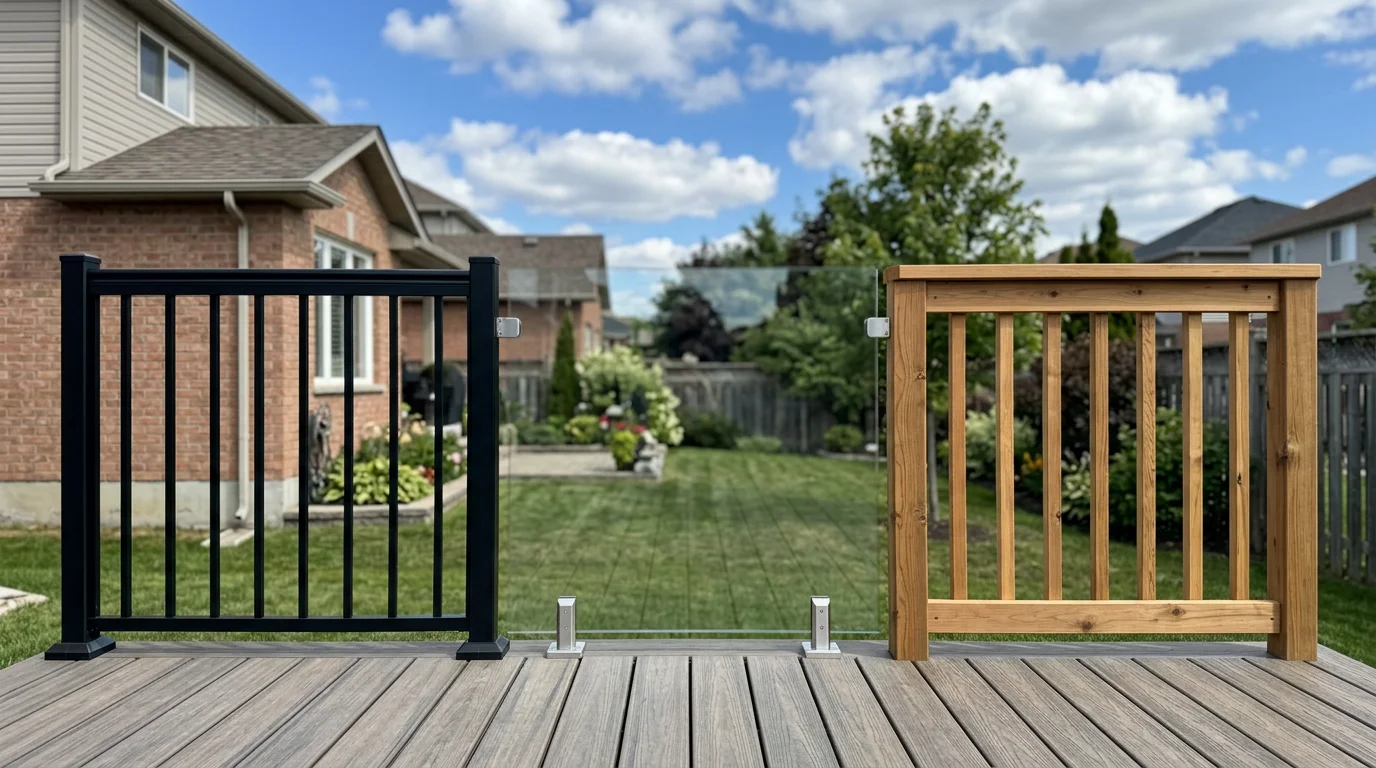
Cable railing looks modern and keeps your sightlines open, but it doesn't meet Ontario Building Code requirements in its most common form. The standard 4-inch sphere rule means nothing larger than a 4-inch ball can pass through any opening in your guardrail—and typical cable spacing violates this.
Most cable railing systems space horizontal cables 3 to 3.5 inches apart vertically, which technically passes the 4-inch test. The problem? Horizontal cables create a "ladder effect" that children can climb, and the diagonal measurement between cables often exceeds 4 inches when cables are tensioned and deflect under pressure.
That doesn't mean you can't have cable railing in Ontario. It means you need to understand what inspectors look for, which systems actually pass, and where you have flexibility.
What the Ontario Building Code Actually Says
The Ontario Building Code (OBC) Section 9.8.8 covers deck guardrails. The rules are specific:
🏗️ Planning a deck project?
Get a free manual project review, or visualize your dream deck with AI before requesting quotes.
- Minimum height: 36 inches (915 mm) for residential decks, measured vertically from the deck surface to the top of the guardrail
- Infill openings: No opening shall permit the passage of a sphere having a diameter of more than 100 mm (approximately 4 inches)
- Load requirements: Guards must withstand a concentrated load of 0.5 kN (roughly 112 pounds) applied horizontally or vertically at any point
Cable railing systems must meet all three requirements. The 4-inch sphere rule is where most horizontal cable systems fail, not because the vertical spacing is too wide, but because:
1. Diagonal measurement: When you measure diagonally between two cables under tension, the distance often exceeds 4 inches
2. Cable deflection: Horizontal cables deflect when pushed, creating larger gaps temporarily
3. Climbability: Horizontal cables create footholds, which inspectors view as a safety risk even if spacing technically passes
Different municipalities in KWC may interpret these rules slightly differently. Cambridge, Kitchener, and Waterloo all follow OBC, but individual inspectors may have varying standards for what constitutes "climbable" or how strictly they measure diagonal openings.
Why Horizontal Cable Spacing Fails Inspection
Let's do the math. If you install cables with 3-inch vertical spacing center-to-center, you'd think you're safely under the 4-inch limit. But that's measuring straight up and down.
When you measure diagonally between two cables—say, from the bottom of the top cable to the top of the cable below it, offset horizontally by 6 inches (a typical post spacing point)—you get:
√(3² + 6²) = √(9 + 36) = √45 ≈ 6.7 inches
That's a clear code violation.
Even with tighter spacing, horizontal cables present issues:
- Tension = deflection: Properly tensioned cables should have minimal sag, but they still deflect when pushed. A 4-foot span between posts can deflect 0.5 to 1 inch under the required 112-pound load, temporarily opening gaps.
- Climbing hazard: The OBC doesn't explicitly ban "climbable" railings, but Section 9.8.8 is written with child safety in mind. Horizontal cables clearly provide footholds. Some inspectors will flag this even if spacing technically passes.
This is why most code-compliant cable railing systems in Ontario use vertical cables, not horizontal.
Code-Compliant Cable Railing Options in Ontario
You have three realistic paths to cable railing that passes inspection in KWC:
Vertical Cable Infill
Vertical cables eliminate the climbing hazard and make the 4-inch rule much easier to satisfy. With vertical orientation:
- Cables run from top rail to bottom rail (or deck surface)
- Typical spacing: 3 to 3.5 inches between cables
- No diagonal measurement problem—cables don't create a grid
- Posts must be spaced closer together (typically 3 to 4 feet maximum) to prevent cable deflection
Cost: Vertical cable railing systems run $80–$140 per linear foot installed in the KWC area, depending on post material (aluminum vs. wood) and cable gauge.
Vertical systems use more hardware (tensioners at each cable, not just at posts) and require more labor to install, which pushes cost higher than horizontal systems in the U.S. market. But they pass Ontario inspection reliably.
Hybrid Cable + Glass Panels
Some homeowners combine cable with tempered glass panels in alternating sections. Glass panels have no infill openings, so they automatically pass the 4-inch rule. Cable sections (vertical only) provide ventilation and reduce cost.
Cost: Glass panel railing runs $150–$250 per linear foot installed. Hybrid systems split the difference, averaging $110–$180 per linear foot depending on the glass-to-cable ratio.
Glass works well for wind-exposed decks where you want a visual barrier without losing transparency. Tempered glass is required; it must be 5 mm minimum thickness and labeled as safety glass. Some municipalities require an engineer's stamp for glass railing on elevated decks (anything over 6 feet above grade).
Prefab Code-Compliant Cable Systems
Several manufacturers sell cable railing kits specifically designed for Canadian code compliance:
- Stainless Cable & Railing (Canadian supplier): Vertical cable kits with pre-drilled posts, tensioning hardware included. Spacing pre-calculated for OBC.
- Atlantis Rail: Vertical cable systems with aluminum or stainless posts. Popular in Ontario; most inspectors recognize the brand.
- Feeney CableRail: U.S.-based but offers vertical spacing templates. You'll need to confirm your configuration meets OBC before ordering.
Cost: DIY cable railing kits run $50–$90 per linear foot in materials for vertical systems. Add $30–$50 per linear foot for professional installation if you're not comfortable tensioning cables yourself. Under-tensioned cables deflect too much; over-tensioned cables can warp posts.
If you're ordering a prefab system, confirm with your building department before installation. Bring product specs to your permit application and ask if the inspector foresees any issues. This saves you from ripping out non-compliant railing after it's installed.
What Inspectors Actually Check During Cable Railing Inspection
When your KWC building inspector shows up for your deck framing inspection, they'll check your guardrail for:
1. Height Measurement
Inspector will measure 36 inches vertically from the deck surface to the top of the top rail. Not 36 inches to the top of a cable—the rail itself must hit 36 inches. If your top rail is only 34 inches and you've got cables above it, that's a fail.
Some homeowners try to use a cable as the top rail (no wood or metal cap). This rarely passes. The top rail must be graspable and provide a continuous handhold. Cables don't meet this requirement.
2. Sphere Test
Inspectors may bring a 4-inch ball or sphere gauge and attempt to pass it through your railing at multiple points:
- Between cables (vertically, horizontally, and diagonally)
- Between the bottom cable and the deck surface
- Between cable and post
If the sphere passes through anywhere, you fail. This includes corners, where cable spacing can be irregular.
3. Load Test
The inspector will push hard on the railing at various points to check for deflection and stability. They're simulating the 112-pound horizontal load requirement. If posts wobble, cables sag excessively, or the railing feels loose, they'll flag it.
This is where post spacing matters. Posts more than 4 feet apart on a cable system often deflect too much under load, especially with vertical cables. Keep posts at 3 to 4 feet maximum for reliable code compliance.
4. Climbability (Subjective)
Some inspectors will visually assess whether the railing is "climbable." There's no explicit OBC section banning climbable railings, but if a toddler could obviously use your horizontal cables as a ladder, the inspector may invoke OBC 9.8.1 (general safety requirements) and ask for changes.
This is rare with vertical cable systems. It's common with horizontal systems, even if spacing technically passes the 4-inch rule.
Cost Comparison: Cable Railing vs. Other Code-Compliant Options
How does cable railing compare to traditional railing materials that definitely pass Ontario code?
| Railing Type | Cost per Linear Foot (Installed) | Code Compliance | Maintenance |
|--------------|-----------------------------------|-----------------|-------------|
| Vertical Cable (Aluminum Posts) | $80–$140 | ✅ Passes with proper spacing | Low—annual cable tension check |
| Horizontal Cable (Aluminum Posts) | $70–$120 | ❌ Usually fails OBC 4-inch rule | Low—but may need retrofit |
| Pressure-Treated Picket | $40–$70 | ✅ Passes easily (1.5" picket spacing) | Medium—staining every 2-3 years |
| Composite Picket | $60–$100 | ✅ Passes easily | Very low—occasional cleaning |
| Tempered Glass Panels | $150–$250 | ✅ Passes (no openings) | Medium—cleaning for visibility |
| Aluminum Picket | $70–$110 | ✅ Passes easily | Low—annual inspection |
Verdict: Cable railing (vertical) sits in the mid-to-high cost range for Ontario decks. You're paying for aesthetics and unobstructed views, not for cost savings. If budget is tight, pressure-treated or composite picket railing is significantly cheaper and passes code without any debate. To see how railing costs fit into the total picture, check our guide to deck costs in Ontario.
Can You Install Horizontal Cable Railing Anyway?
Technically, yes—if you can convince your inspector it meets code. Here's how some homeowners and builders get horizontal cable systems approved in Ontario:
Tighter Spacing + Engineer's Letter
If you space horizontal cables 2.5 inches or less center-to-center and provide an engineer's letter confirming the system meets OBC load and infill requirements, some inspectors will approve it. The engineer must calculate diagonal measurements and deflection under load.
Cost: Engineering letter runs $500–$1,200 depending on complexity. Add this to your cable railing cost.
This approach works best in Waterloo and Cambridge, where building departments are slightly more flexible with engineered solutions. Kitchener inspectors tend to be stricter on horizontal cables regardless of engineering.
Hybrid Top Section
Install horizontal cables in the top 12 inches only, with vertical cables or pickets below. The top section provides the modern cable look, while the lower section (where children can reach) meets code with vertical infill.
Cost: Adds $15–$25 per linear foot compared to all-vertical cable, but passes inspection more reliably.
This is a design compromise. You lose some of the sleek, uninterrupted cable aesthetic, but you keep the horizontal lines where they're most visible (eye level when seated).
Low Decks (Under 24 Inches)
If your deck is less than 24 inches above grade, you may not need a guardrail at all under OBC Section 9.8.8.1. This is the "24-inch rule" in Kitchener, Waterloo, and Cambridge.
No guardrail required = no cable spacing debate. However, most homeowners still install railing on low decks for safety and aesthetics. If you choose to install railing on a sub-24-inch deck voluntarily, it still must meet code if it's present. Inspectors won't approve non-compliant railing just because it's optional.
Cable Railing and Deck Stairs in Ontario
Cable railing on deck stairs is even trickier. OBC Section 9.8.9 covers stair guards and introduces additional requirements:
- Handrail required: Stairs with more than 3 risers (about 21 inches of elevation) must have a graspable handrail between 32 and 38 inches above the stair nosing.
- Guard height on stairs: If a guard is required (deck more than 24 inches high), it must be 36 inches measured vertically from the stair nosing.
- Infill still 4 inches: The same sphere rule applies.
Cable railing works on stairs only if you add a separate graspable handrail. You can't use the top cable as a handrail. The handrail must be:
- Graspable (round or oval profile, 1.25 to 2 inches in diameter)
- Continuous (no interruptions along the stair run)
- Mounted 32–38 inches above stair nosings
This typically means installing a wood or metal handrail inside your cable railing, mounted to the posts. Budget an extra $25–$40 per linear foot for stair handrails compared to flat deck sections.
Some homeowners skip cable railing on stairs entirely and use traditional picket or composite balusters instead, reserving cable for the main deck perimeter where installation is simpler.
Cable Railing Maintenance in Ontario's Climate
Ontario's freeze-thaw cycles and winter conditions add maintenance requirements to cable railing:
Annual Tension Checks
Cables loosen over time, especially after winter. Check tension every spring by pressing the center of each cable span. If you can deflect the cable more than 0.5 inches with moderate hand pressure, it needs re-tensioning.
Most systems use threaded tensioners (turnbuckles or swage fittings) at one end of each cable. Turn clockwise to tighten. Don't over-tighten—excessive tension can warp posts or crack fittings.
Winter Salt and Corrosion
If your deck is near a driveway or walkway where you use road salt, stainless steel cables can still corrode over time. Ontario winters are hard on metal. Rinse cable railing with fresh water in early spring to remove salt residue.
Use 316-grade stainless steel for cables and hardware, not 304-grade. 316 has better corrosion resistance in chloride environments (salt). This is standard in marine applications and works well for Ontario decks.
Cleaning
Cable railing collects less debris than picket railing (no horizontal surfaces for leaves and snow to sit on), but you'll still need to clean it occasionally:
- Wipe cables with a microfiber cloth and mild detergent once or twice per season
- Check end fittings for rust or corrosion, especially where cables pass through posts
- Inspect posts for movement or loosening—cable tension can pull posts inward over time if they're not properly anchored
Compare this to composite deck maintenance, which is minimal, or pressure-treated railing maintenance, which requires re-staining every 2-3 years. Cable railing falls somewhere in the middle—not zero maintenance, but far less than wood.
How to Get a Permit for Cable Railing in KWC
If you're building a new deck or replacing existing railing, you'll need a building permit in Kitchener, Waterloo, or Cambridge for any deck over 24 inches high. Here's how to include cable railing in your permit application:
1. Include Railing Details in Your Drawings
Your permit drawings must show:
- Railing height (36 inches minimum)
- Post spacing (typically 3-4 feet for cable systems)
- Cable orientation (vertical or horizontal)
- Cable spacing (center-to-center measurement)
- Material specs (stainless steel grade, cable diameter, post material)
If you're using a prefab system, attach the manufacturer's spec sheet to your application. This shows the building department that the system is designed for code compliance.
2. Note Cable Railing in Your Application
In the "Railing Type" or "Guardrail Details" section of your permit application, write:
> "Vertical cable infill railing, 316 stainless steel, 3-inch spacing, 36-inch height, per OBC 9.8.8"
Be specific. "Cable railing" without details may trigger questions or delays. If you say "vertical cable" upfront, the inspector knows you've thought about code compliance.
3. Expect Follow-Up Questions
Building departments in Kitchener, Waterloo, and Cambridge may ask for clarification if cable railing is unusual in your neighborhood. Be ready to provide:
- Engineer's letter (if using horizontal cables or non-standard spacing)
- Load calculations (if posts are spaced wider than 4 feet)
- Product cut sheets (if using a prefab system)
This doesn't mean cable railing is "hard" to permit—just that it's less common than wood picket railing, so inspectors may want extra documentation to confirm it meets code.
Permit fees in KWC range from $150 to $400 depending on deck size and municipality. Cable railing doesn't add extra fees, but an engineer's letter (if required) is a separate cost.
Alternatives to Cable Railing That Pass Code Easily
If cable railing feels too complicated or expensive, here are code-compliant alternatives with similar modern aesthetics:
Aluminum Picket Railing
Powder-coated aluminum balusters in black or bronze give a sleek, contemporary look without the code headaches of cable. Pickets are typically spaced 3.5 to 4 inches apart, which easily passes the sphere test.
Cost: $70–$110 per linear foot installed. Maintenance is minimal—no rusting, no staining.
Aluminum railing is the most popular modern alternative to cable in KWC. It's clean-lined, durable, and inspectors never question it.
Horizontal Metal Slat Railing
Instead of cables, use flat metal slats (1.5 to 3 inches wide) spaced 3.5 inches apart. This gives a horizontal line aesthetic similar to cable railing but with solid infill that clearly passes the 4-inch rule.
Cost: $90–$150 per linear foot installed for custom metal slat systems. More expensive than cable due to fabrication costs, but zero code ambiguity.
Metal slat railing is common on modern builds in Waterloo's Beechwood and Uptown neighborhoods. It pairs well with composite decking and contemporary home designs.
Composite Picket Railing
If you want ultra-low maintenance, composite picket railing (Trex, TimberTech, Fiberon) is virtually maintenance-free and passes code with standard 3.5-inch picket spacing.
Cost: $60–$100 per linear foot installed. Slightly cheaper than cable, with no tensioning or corrosion concerns.
Composite railing doesn't have the "invisible" look of cable, but it's clean, modern, and available in dark colors (black, charcoal) that minimize visual bulk. See composite decking options in Canada for material comparisons.
Cable Railing and Property Lines in KWC
If your deck is close to a property line, cable railing won't help you reduce setbacks. Kitchener, Waterloo, and Cambridge all require decks to be set back a minimum distance from property lines (typically 2 to 4 feet, depending on zoning).
Railing type doesn't affect setback rules. Whether you use cable, picket, or glass railing, the deck structure itself must meet setback requirements. Check KWC zoning setbacks before designing your deck.
Some homeowners assume cable railing is "less intrusive" and might get an exception for tight setbacks. Building departments don't see it that way. Setbacks are based on structure, not aesthetics.
🎨 Not sure which material to pick?
Upload a photo of your backyard and see exactly how Trex, TimberTech, or cedar would look — free and instant.
Common Questions
Can I use horizontal cable railing if I space cables 2 inches apart?
Possibly, but you'll likely need an engineer's letter confirming the system meets OBC requirements. Even with 2-inch spacing, diagonal measurements and climbability may still be issues. Vertical cable is a safer bet for code compliance in Ontario.
Do I need a permit to replace existing railing with cable railing?
Yes, if your deck is over 24 inches high. Railing replacement is a structural alteration and requires a building permit in Kitchener, Waterloo, and Cambridge. Permit fees range from $150 to $400. Some homeowners skip this step, but if an inspector drives by or a neighbor complains, you'll be required to pull a permit retroactively—and you may be required to remove non-compliant railing.
How do I tension cables properly without warping posts?
Use a cable tension gauge (available at hardware stores for $15–$30) to measure tension. Most residential cable railing systems should be tensioned to 200–300 pounds of force per cable. Over-tensioning (above 350 pounds) can pull posts inward, especially if posts are spaced more than 4 feet apart or made from wood rather than aluminum. Tension cables evenly—don't crank one cable super tight and leave others loose.
Can I install cable railing myself or do I need a contractor?
You can DIY cable railing if you're comfortable with precise measurements and hardware installation. The trickiest parts are drilling perfectly aligned holes through posts (for cable pass-through) and achieving consistent tension across all cables. Most KWC contractors charge $30–$50 per linear foot for labor to install cable railing. If you're doing a small deck (under 40 linear feet), DIY can save $1,200+. For larger decks or complex layouts, professional installation ensures code compliance and saves time.
Will cable railing hold up to snow load in Ontario winters?
Yes, if properly installed. Cable railing has no horizontal surfaces for snow to accumulate on, so snow load is less of a concern than with solid panel railing or wide top rails. The main winter concern is ice buildup on cables if you have roof runoff hitting your railing. Clear ice promptly—frozen ice can add weight and stress cables. Use 316 stainless steel for cables and hardware to resist corrosion from road salt and freeze-thaw cycles.
Upload a backyard photo and preview real decking materials with AI — free, instant, no sign-up.
Permits, costs, material comparisons, and questions to ask before requesting quotes — delivered to your inbox.