
Cedar vs Composite Decking in Ontario: Honest Comparison
Cedar vs composite decking in Ontario: real costs, maintenance, lifespan, and freeze-thaw performance. What 200+ KWC homeowners chose and why.
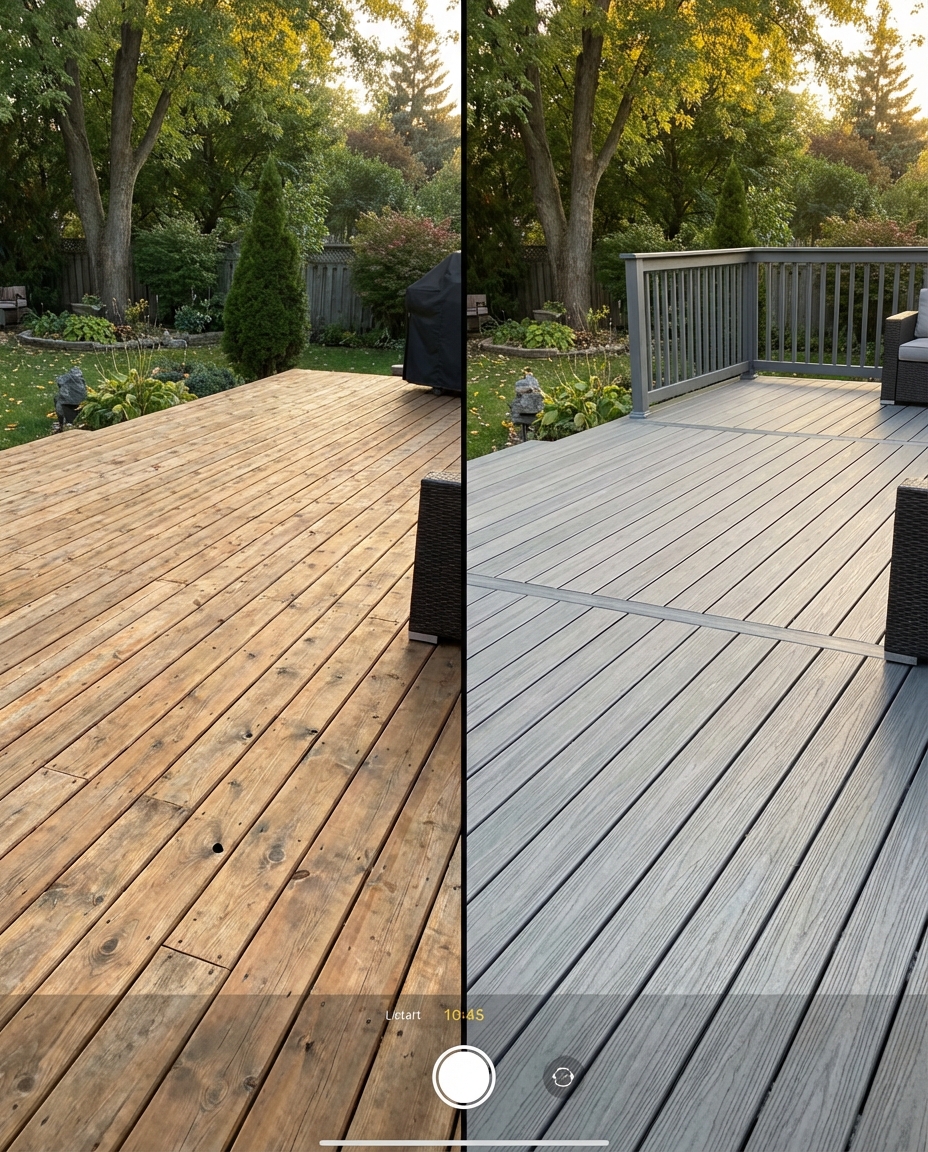
You're standing in the lumber yard, looking at cedar boards on one side and composite samples on the other. The cedar smells amazing. The composite rep promises you'll never stain again. Your neighbour swears by cedar, but your brother-in-law just installed Trex.
Here's what actually matters for Ontario decks: upfront cost, how much work you're signing up for, and what survives our freeze-thaw cycles. (Need a quick cost reference? See deck cost per square foot in Ontario or our complete Ontario deck cost guide.)
Upfront Cost Comparison
For a standard 200 square foot deck in Kitchener-Waterloo-Cambridge in 2026:
🏗️ Planning a deck project?
Get a free manual project review, or visualize your dream deck with AI before requesting quotes.
| Material | Materials Only | Installed Cost | Total Project |
|----------|---------------|----------------|---------------|
| Cedar decking | $2,200-3,400 | $11,000-16,000 | $55-80/sqft |
| Composite decking | $3,800-6,200 | $13,000-19,000 | $65-95/sqft |
| Difference | +$1,600-2,800 | +$2,000-3,000 | +$10-15/sqft |
Cedar costs 15-30% less upfront. That's real money—enough to upgrade your railing or add deck lighting.
But here's the catch: those numbers flip over time. Cedar needs staining every 2-3 years ($600-1,200 per treatment for a 200 sqft deck if you hire out, or a full weekend plus $150-300 in materials if you DIY). Composite needs soap and water.
Over 20 years, you're looking at 6-8 staining cycles on cedar. That's $3,600-9,600 in maintenance costs, or roughly 80-120 hours of your weekends. Composite? Maybe $400 total in cleaning supplies.
Maintenance Reality Check
Cedar Maintenance Schedule
Year 1: Let the wood weather for 3-6 months, then clean and apply penetrating oil stain. Budget a full weekend or $600-1,200 to hire it out.
Years 2-3: Re-clean and re-stain. Every time. The oil-based stains that hold up best in Ontario winters (Sikkens, Cabot) penetrate the wood but don't last as long as film-forming stains, which crack and peel in freeze-thaw cycles.
Years 5-10: You'll start replacing individual boards. Knots split. End grain soaks up moisture and rots faster. Boards near planters or in shaded areas go first.
Years 10-15: Expect to replace 10-20% of your deck boards. Factor $800-2,000 depending on how much you're replacing.
Years 15-20: Major refurbishment or full replacement. Most cedar decks need complete rebuilding at this point.
You also need to:
- Sweep debris weekly (leaves trap moisture and accelerate rot)
- Check for popped nails or screws after winter
- Trim vegetation back from deck edges
- Keep planters off the deck surface or use risers
Miss a staining cycle? The wood goes grey, grain raises, splinters appear, and moisture penetration accelerates. You can recover, but you'll need to sand or power wash first—adding another day and $50-150 in tool rental or abrasives.
Composite Maintenance Schedule
Yearly: Sweep debris, wash with soap and water. 30-60 minutes twice a year. That's it.
Every 2-3 years: Deep clean with a composite deck cleaner if you have mold or mildew in shaded areas. Budget $40 for cleaner, 1 hour of work.
Years 5-20: Same as above. No staining. No sealing. No sanding.
Composite doesn't rot, split, or splinter. Insects ignore it. You can put planters directly on the surface. Homeowners with composite decks in Ontario consistently report that the low maintenance is the single biggest quality-of-life improvement.
The downside? Composite scratches more easily than cedar (furniture legs, dog claws), and you can't sand it smooth. Quality brands include scratch-resistant caps, but budget composites show wear faster.
How They Handle Ontario Winters
Both materials survive freeze-thaw cycles, but differently.
Cedar in Freeze-Thaw
Cedar is naturally rot-resistant thanks to oils in the wood. Western Red Cedar (the good stuff from BC) handles moisture better than Eastern White Cedar.
But Ontario's freeze-thaw is brutal. Water gets into the wood grain, freezes, expands, and cracks the cells. This is why you must maintain a good stain or sealer—it's not cosmetic, it's structural. A well-maintained cedar deck lasts 15-20 years in KWC. A neglected one shows serious decay in 8-12 years.
Endgrain is the weak point. Deck boards cut to length expose fresh endgrain that soaks up water like a sponge. Always seal cut ends with extra coats of stain or a dedicated endgrain sealer.
Composite in Freeze-Thaw
Composite is engineered for this. Modern composite boards have a capped outer layer (PVC or polymer shell) protecting the wood-fiber core. Water can't penetrate the cap, so freeze-thaw cycles don't damage the board.
Early-generation composites (pre-2010) had problems with water absorption, warping, and mold. Modern capped composites from Trex, Fiberon, and TimberTech don't. Warranties reflect this: 25-30 years against fading, staining, and material defects.
Ice and snow don't damage composite. Salt doesn't either, though you should still rinse it off in spring to prevent surface buildup. See winter deck care in Ontario for seasonal maintenance tips.
One caveat: composite expands and contracts with temperature more than wood. Installers must leave proper gapping (3/16" to 1/4" per manufacturer specs) or boards will buckle in summer heat. In Ontario's temperature swings (-20°C to +35°C), this matters. A qualified deck builder knows this; a handyman might not.
Lifespan and Long-Term Value
Cedar Lifespan
With excellent maintenance: 15-20 years before major refurbishment.
With average maintenance: 12-15 years before you're replacing significant portions.
With poor maintenance: 8-12 years before structural concerns appear.
Composite Lifespan
25-30 years minimum, often longer. Most manufacturers warranty the product for 25-30 years, and the boards themselves can last 50+ years if the substructure is maintained.
The catch: your pressure-treated substructure (joists, beams, posts) still needs inspection and eventual replacement. Composite boards outlive the framing underneath them, which is typically good for 20-30 years depending on drainage and installation quality. See deck joist tape and membrane for ways to extend framing life.
Resale Value
Neither material definitively adds more resale value in KWC. What matters is:
- Condition: A well-maintained cedar deck beats a faded, scratched composite deck
- Size and design: A properly sized deck for your lot and home style matters more than material
- Safety: Current code compliance (railing height, stair rise/run) is non-negotiable
Real estate agents report that buyers appreciate composite for the low maintenance promise, especially older buyers or investors. Younger buyers sometimes prefer the natural look of wood.
If you're building for resale within 5 years, cedar makes sense—it looks great and you won't hit the first major maintenance cycle. If you're staying 10+ years, composite pays back the upfront premium.
Appearance and Design Flexibility
Cedar wins on natural beauty. The grain, color variation, and organic texture are unmatched. Fresh cedar has warm honey tones that age to silver-grey if left unstained, or maintain rich amber/brown tones with regular oiling.
Composite has improved dramatically. Modern boards mimic wood grain with embossed textures and multi-tonal coloring. From 10 feet away, quality composite looks like wood. Up close, it's clearly synthetic.
Color options:
- Cedar: Natural (honey to grey), or stained in any tone you want. Stain selection is unlimited.
- Composite: Fixed colors from the manufacturer. Expect 8-15 color options per brand, ranging from light greys to deep browns. Popular choices in Ontario: greystone, Havana gold, chestnut, beach dune.
Both materials work with any railing style. You can mix cedar decking with aluminum railing, or composite decking with wood railing. Your deck railing choice is independent of deck board material.
One design advantage for composite: consistent board dimensions. Cedar boards vary slightly in width and thickness (even within the same bundle). Composite boards are extruded to exact specs, making installation faster and creating tighter, more uniform sight lines.
Heat Retention and Comfort
Composite gets hotter in direct summer sun than cedar—often 15-20°F hotter. This matters if you walk barefoot or have kids and pets.
Cedar stays cooler because wood is a natural insulator. It absorbs less solar radiation and releases heat faster.
Solutions for composite heat:
- Choose lighter colors (greys and tans stay 10-15°F cooler than dark browns)
- Add shade structures (pergolas, umbrellas)
- Use outdoor rugs in high-traffic areas
- Install deck in partial shade if your yard allows
If your deck gets full southern exposure all day and you have young kids, cedar has a real comfort advantage June through August. If your deck is partially shaded or you're fine wearing sandals, composite heat is manageable.
Installation Considerations
Both materials install on the same pressure-treated substructure. Your builder needs to follow Ontario deck framing standards regardless of surface material.
Cedar Installation
Faster to install. Cuts easily with standard saws. Face-screwing or hidden fasteners both work. Boards are lighter and easier to handle.
Cost to install (labor only): $15-25/sqft for basic deck, $25-35/sqft for complex designs with angles or patterns.
Composite Installation
Slower to install. Composite boards are heavier, harder to cut (carbide blades required), and almost always use hidden fastener systems (clips that fit between boards). Hidden fasteners add $2-4/sqft in materials but create a cleaner look with no visible screws.
Composite also requires:
- Manufacturer-specific installation instructions (gapping, fastener spacing, etc.)
- More careful handling (boards can scratch during install)
- Proper ventilation underneath (composite doesn't "breathe" like wood)
Cost to install (labor only): $20-30/sqft for basic deck, $30-45/sqft for complex designs.
Some builders charge a premium for composite because of the stricter installation requirements. Others charge the same. Get multiple deck quotes and confirm what's included.
Environmental Considerations
Cedar
- Renewable resource (trees regrow), but old-growth Western Red Cedar is increasingly scarce
- Requires clear-cutting unless you buy FSC-certified lumber
- Stains and sealers contain VOCs and petrochemicals (low-VOC options available)
- Fully biodegradable at end of life
- Carbon-sequestering while in use
Composite
- Recycled content: Most composites use 60-95% recycled wood fiber and plastic (grocery bags, sawdust, plastic film)
- Non-biodegradable—sits in landfills forever
- Energy-intensive manufacturing process
- No ongoing chemical treatments needed
- Some brands (Trex, Fiberon) are made in North America with recycled content; budget brands often use virgin plastic from overseas
Neither option is clearly "greener." Cedar uses a renewable resource but requires ongoing chemical treatments. Composite uses recycled waste but never degrades. Your priorities dictate which matters more.
Permits and Code Compliance
Good news: material choice doesn't affect permits in Kitchener, Waterloo, or Cambridge. Whether you build with cedar or composite, you need a permit for any deck over 24 inches above grade or attached to your house.
Both materials must meet Ontario Building Code for:
- Joist spacing
- Beam spans
- Footing depth (48 inches minimum below grade in KWC)
- Railing height (42 inches for decks over 24" high)
- Baluster spacing (4 inches maximum between spindles)
See our permit guides for Kitchener, Waterloo, and Cambridge for municipality-specific requirements.
One installation note: some composite manufacturers require specific fastener types for warranty compliance. Keep receipts and installation photos—inspectors may ask to verify you followed manufacturer specs.
What KWC Homeowners Actually Choose
Based on 200+ deck projects across Kitchener-Waterloo-Cambridge over the past two years:
- Composite: 65-70% of new deck builds
- Cedar: 20-25% of new deck builds
- Pressure-treated: 10-15% (budget-focused projects)
Composite dominates because homeowners value the maintenance savings and long warranty. Cedar remains popular for:
- Covered decks or porches (less weather exposure = longer cedar life)
- DIY builders (easier to work with, lower material cost)
- Heritage homes or character properties (natural wood fits the aesthetic)
- Homeowners who enjoy yearly maintenance and restaining
The trend is clear: composite market share grows every year as prices drop and quality improves.
Decision Framework
Choose cedar if:
- You're budget-constrained and the $2,000-3,000 upfront savings matters right now
- You enjoy hands-on home maintenance and don't mind restaining
- You're building a covered deck or porch with limited weather exposure
- You want authentic wood grain and are willing to maintain it
- You're selling within 5 years and want lowest upfront cost
Choose composite if:
- You want minimal maintenance (biggest reason cited by homeowners)
- You're staying in the home 10+ years
- You have a busy schedule and would hire out maintenance anyway
- You want 25-30 year warranty and predictable costs
- You have young kids or pets (no splinters, easier to clean)
Neither choice is wrong. The "best" material depends on your budget, timeline, and how much ongoing work you want.
For most KWC homeowners staying 10+ years, composite pays back the premium through eliminated maintenance costs and longer lifespan. For homeowners who enjoy outdoor projects or are budget-constrained, cedar remains a solid choice with proven performance—if you commit to maintaining it.
Common Questions
Can you mix cedar railing with composite decking?
Yes, and it's common. Many homeowners choose composite deck boards for low maintenance but use cedar or aluminum railing for aesthetics or cost savings. Just ensure your railing meets Ontario code requirements regardless of material.
Does composite decking need special cleaning products?
No. Soap and water handle 95% of cleaning. For stubborn mold or mildew in shaded areas, use a composite-specific cleaner ($30-50 at Home Depot or Lowe's). Never use bleach or pressure washers above 1,500 PSI—you'll damage the cap layer.
How long does cedar last if you don't stain it?
The wood will last 12-18 years structurally, but appearance suffers. Unstained cedar turns silver-grey, grain raises, and splinters appear within 2-3 years. Moisture penetration accelerates rot in endgrain and anywhere debris accumulates. If you like the grey weathered look, you still need to clean the deck and seal endgrain to maximize lifespan.
Is composite slippery when wet or icy?
Modern composite has textured surfaces that provide decent traction when wet—comparable to wood. In icy conditions, both cedar and composite are equally slippery. Use salt-free ice melt (calcium chloride or magnesium chloride) on either material and rinse in spring. See winter deck care for seasonal tips.
Can you refinish composite decking like you can sand and restain cedar?
No. Composite can't be sanded or refinished. Surface scratches are permanent (though often minor and only visible up close). Quality brands like Trex and Fiberon have scratch-resistant cap layers that minimize this. Budget composites scratch more easily. Cedar's advantage: you can always sand and restain to refresh appearance.
Related guides (to pick the right material + scope)
If you’re getting quotes or deciding scope, these guides remove the biggest unknowns:
- Ontario deck cost calculator
- KWC deck cost calculator
- Deck quote line items (Ontario)
- Composite deck lifespan (Ontario)
- Pressure-treated deck lifespan (Ontario)
🎨 Not sure which material to pick?
Upload a photo of your backyard and see exactly how Trex, TimberTech, or cedar would look — free and instant.
Want a fast, comparable quote from 3 deck builders?
- Get quotes here: Get a deck quote
Upload a backyard photo and preview real decking materials with AI — free, instant, no sign-up.
Permits, costs, material comparisons, and questions to ask before requesting quotes — delivered to your inbox.