
Deck Beam Span Table (Ontario): How to Size Beams Correctly
Ontario deck beam span tables, load calculations, and sizing requirements. Learn how to spec beams correctly for code compliance and safety.
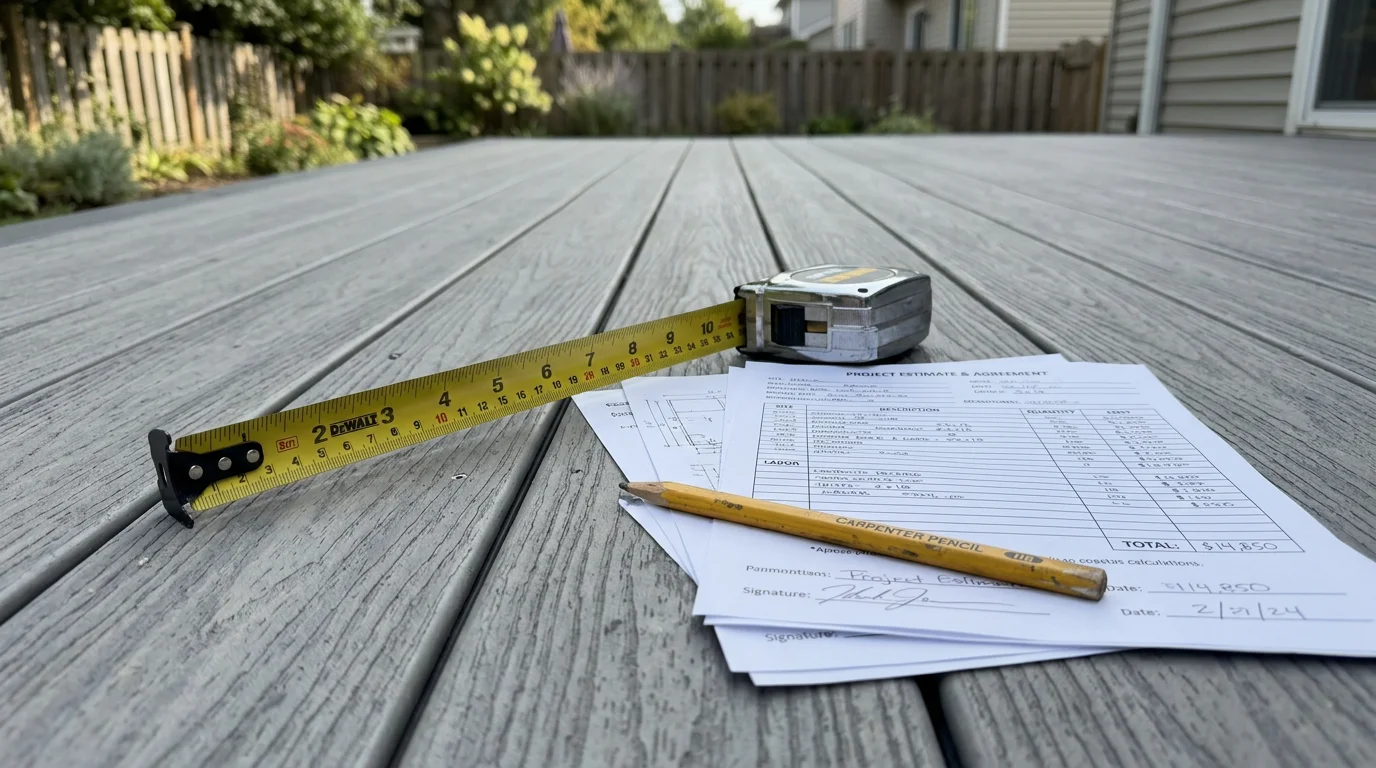
You're planning a deck and need to know if a single 2x10 beam will work or if you need a doubled-up 2-ply 2x12. Beam sizing isn't guesswork—Ontario Building Code specifies maximum spans based on wood species, beam size, joist span, and post spacing.
Get it wrong and your deck fails inspection. Oversize unnecessarily and you're wasting $400-800 on materials and labor. Here's how to size beams correctly for Ontario conditions.
What Deck Beams Actually Do
Beams carry the load from your joists and transfer it to posts and footings. They run perpendicular to joists and sit on top of posts (or sometimes between them in dropped-beam configurations).
🏗️ Planning a deck project?
Get a free manual project review, or visualize your dream deck with AI before requesting quotes.
The beam is the backbone of your deck's structural system. If your joists span 12 feet and rest on a beam at the 6-foot mark, that beam is carrying half the load of your entire deck—dead load (materials) plus live load (people, furniture, snow).
In Ontario, deck live loads are designed for 60 PSF (pounds per square foot) for residential decks, plus snow load and dead load. This is why beam sizing matters—undersized beams sag, crack, or fail catastrophically.
Ontario Deck Beam Span Tables
These tables are derived from Ontario Building Code Division B Part 9 and assume:
- Hem-Fir or SPF (Spruce-Pine-Fir) pressure-treated lumber—the most common species in Ontario
- 60 PSF live load + 10 PSF dead load
- Joists perpendicular to beam
- Posts supporting beam at each end and at intervals shown
Single 2x8 Beam Maximum Spans
| Joist Span (one side) | Post Spacing | Maximum Beam Span |
|-----------------------|--------------|-------------------|
| 6 feet | 4 feet | 6'5" |
| 6 feet | 5 feet | 5'9" |
| 6 feet | 6 feet | 5'3" |
| 8 feet | 4 feet | 5'7" |
| 8 feet | 5 feet | 5'0" |
| 8 feet | 6 feet | 4'7" |
Single 2x8 beams are marginal for most Ontario decks. You'll hit span limits quickly, especially with 8-foot joist spans.
Single 2x10 Beam Maximum Spans
| Joist Span (one side) | Post Spacing | Maximum Beam Span |
|-----------------------|--------------|-------------------|
| 6 feet | 5 feet | 7'4" |
| 6 feet | 6 feet | 6'8" |
| 6 feet | 7 feet | 6'2" |
| 8 feet | 5 feet | 6'5" |
| 8 feet | 6 feet | 5'10" |
| 8 feet | 7 feet | 5'5" |
| 10 feet | 5 feet | 5'9" |
| 10 feet | 6 feet | 5'3" |
A single 2x10 works for smaller decks, but you're still limited to 6-7 feet between posts for typical joist spans.
Double 2x8 Beam (2-Ply) Maximum Spans
| Joist Span (one side) | Post Spacing | Maximum Beam Span |
|-----------------------|--------------|-------------------|
| 6 feet | 6 feet | 7'5" |
| 6 feet | 7 feet | 6'10" |
| 6 feet | 8 feet | 6'5" |
| 8 feet | 6 feet | 6'5" |
| 8 feet | 7 feet | 5'11" |
| 8 feet | 8 feet | 5'7" |
| 10 feet | 6 feet | 5'9" |
| 10 feet | 7 feet | 5'4" |
Doubling up gives you more span, but 2x8s are still tight for joist spans over 8 feet.
Double 2x10 Beam (2-Ply) Maximum Spans
| Joist Span (one side) | Post Spacing | Maximum Beam Span |
|-----------------------|--------------|-------------------|
| 6 feet | 7 feet | 9'5" |
| 6 feet | 8 feet | 8'10" |
| 6 feet | 9 feet | 8'4" |
| 8 feet | 7 feet | 8'2" |
| 8 feet | 8 feet | 7'8" |
| 8 feet | 9 feet | 7'3" |
| 10 feet | 7 feet | 7'4" |
| 10 feet | 8 feet | 6'10" |
| 10 feet | 9 feet | 6'6" |
Double 2x10 is the workhorse beam size for Ontario decks. You can span 8-9 feet between posts with typical joist configurations, which minimizes footing count and cost.
Double 2x12 Beam (2-Ply) Maximum Spans
| Joist Span (one side) | Post Spacing | Maximum Beam Span |
|-----------------------|--------------|-------------------|
| 6 feet | 8 feet | 10'10" |
| 6 feet | 9 feet | 10'3" |
| 6 feet | 10 feet | 9'8" |
| 8 feet | 8 feet | 9'5" |
| 8 feet | 9 feet | 8'11" |
| 8 feet | 10 feet | 8'5" |
| 10 feet | 8 feet | 8'5" |
| 10 feet | 9 feet | 7'11" |
| 10 feet | 10 feet | 7'6" |
| 12 feet | 8 feet | 7'8" |
| 12 feet | 9 feet | 7'3" |
Double 2x12 gives you maximum span flexibility and is worth considering for larger decks, second-story applications, or when you want to minimize post count. Expect to pay $12-18/linear foot for doubled PT 2x12 material in KWC.
How to Read Beam Span Tables for Your Deck
Here's the process:
1. Determine your joist span—the distance joists will run between the ledger and the beam (or between two beams if freestanding). If your deck is 16 feet deep and you're using one beam in the middle, your joist span is 8 feet on each side.
2. Choose your post spacing—how far apart you want posts. Fewer posts mean fewer footings to dig (at $150-300 each with helical piles or sonotube concrete), but require beefier beams.
3. Find the intersection in the table. If you have 8-foot joist spans and want 8-foot post spacing, a double 2x10 beam gives you 7'8" maximum span—you're within limits.
4. Round down, not up. If your calculated beam span is 8'10" and the table shows 8'8", you need the next size up or closer post spacing.
Example: You're building a 16x16-foot freestanding deck. Joists run 16 feet, beams run perpendicular at 8-foot intervals, so joist span is 8 feet to each beam. You want posts every 8 feet to minimize footings. Looking at the double 2x10 table: 8-foot joist span + 8-foot post spacing = 7'8" max beam span. Your beam span is exactly 8 feet. You need double 2x12 or closer post spacing (7 feet works with double 2x10).
What If You're Between Sizes?
You have three options:
Add More Posts
Move from 8-foot to 7-foot post spacing. This drops your required beam size but adds one or two more footings. At $150-300 per footing (labor + materials + permit), this might cost $300-600 but saves $200-400 on beam lumber. Often a wash, but more posts mean more layout precision and more points of failure if footings settle unevenly in Ontario's clay soil conditions.
Upsize the Beam
Go from double 2x10 to double 2x12. Material cost difference is typically $3-6/linear foot, so a 16-foot beam costs $50-100 more. This is usually the cleanest solution.
Triple-Ply Beams
Instead of doubling, use three 2x10s. This works structurally but is labor-intensive (more fastening, harder to align), and you're approaching the cost of just using 2x12s. Most builders skip this unless they have leftover 2x10 stock.
Beam Attachment and Fastening Requirements
Beam-to-post connections must resist uplift and lateral loads, especially in Ontario's freeze-thaw cycles where frost heaving can shift posts.
Code-compliant connections:
- Through-bolted: Use ½-inch galvanized or stainless carriage bolts, two per post, with washers on both sides. This is the gold standard and what framing inspectors expect to see.
- Post cap hardware: Simpson or USP post-to-beam brackets (e.g., BC post cap). Use all nail holes with the specified fastener size (typically 10d or 16d nails). These resist uplift better than through-bolts alone.
- Notched posts: Cutting a notch in the post to seat the beam is allowed but weakens the post. If you notch, the remaining post width must meet minimum bearing requirements (usually 3.5 inches minimum for a 4x4 post).
Do not rely on toenailing or angle brackets alone for beam-to-post connections. Wind uplift and lateral loads will pull these apart over time.
For multi-ply beams, fasten plies together with 10d nails every 16 inches staggered top-to-bottom, or use ½-inch bolts every 24-32 inches. Inspectors want to see proper ply connection—just sandwiching boards together isn't enough.
Dropped Beams vs. Beams on Top of Posts
Beam on top of posts (standard configuration):
- Easier to build—posts are cut to exact height, beam sits on top, joists sit on top of beam with joist hangers or notched/rested on ledger strips
- Deck surface ends up higher (beam thickness + joist depth)
- Better for spanning obstructions like slopes
Dropped beam (beam hung between posts):
- Beam bolts to the side of posts using through-bolts or post-to-beam hardware
- Lowers the deck profile—useful when you want deck surface close to ground level
- More complex connections—requires properly sized bolts and alignment
- Joists sit on top of beam, giving you lower overall deck height
Most Ontario decks use beam-on-post configuration because it's simpler and inspectors are more familiar with it. Dropped beams are fine but expect scrutiny on bolting details during permit review.
Beam Material Costs (2026 KWC Pricing)
Prices for pressure-treated Hem-Fir or SPF beams at local lumberyards:
- Single 2x8 x 16': $35-50
- Single 2x10 x 16': $50-70
- Single 2x12 x 16': $70-95
- Double 2x10 (two 16' boards): $100-140
- Double 2x12 (two 16' boards): $140-190
Cedar beams cost 30-50% more but aren't typically used for structural beams—only for decorative exposed beams in covered decks or pergolas.
Engineered beams (LVL or glulam) cost $8-15/linear foot for equivalent spans and are worth considering for long clear spans (12+ feet) or heavy loads like hot tubs, but require engineer approval and are rarely seen in residential deck permits in KWC.
When You Need an Engineer for Beam Sizing
Ontario Building Code allows prescriptive (table-based) beam sizing for typical residential decks. You need a structural engineer's stamp when:
- Cantilevers over 24 inches on beams or joists
- Second-story decks attached to living space
- Spans exceeding code tables—if you want 10-foot beam spans with heavy loads, you're beyond prescriptive limits
- Hot tubs or heavy concentrated loads (over 100 PSF in a localized area)
- Unusual configurations—angled beams, multiple beam intersections, complex load paths
- Municipal requirement—some KWC inspectors flag second-story decks or large decks (over 200 sqft) for engineer review even if they're technically within code
Engineer fees run $800-1,500 for a typical residential deck stamp in Ontario. If your deck is borderline, it's often cheaper to adjust the design (add a post, move a beam, reduce a span) than to pay for engineering.
Beam Rot and Long-Term Durability
Beams are vulnerable to moisture because they sit on posts (end-grain contact point) and support joists (another end-grain connection). Ontario's freeze-thaw cycles accelerate rot at these joints.
Protective measures:
- Joist tape on top of beams: Apply butyl or peel-and-stick joist membrane on the beam top before installing joists. This costs $0.50-1/linear foot and extends beam life by years.
- Beam flashing: For dropped beams against posts, use metal flashing or membrane to shed water away from the bolt holes.
- Pressure-treated rated for ground contact: Use PT rated 0.60 PCF (ground contact) for beams, not just 0.40 (above-ground). The extra $5-10 per board matters when the beam is 6 inches from soil splash.
- Ventilation under deck: Ensure airflow under the deck—don't let deck skirting trap moisture around beams.
Inspect beams every 3-5 years for soft spots, checking, or insect damage. Beam rot is harder to spot than joist rot because beams are often partially hidden by posts or skirting.
Common Questions
Can I use a 4x8 or 4x10 beam instead of doubling 2x lumber?
Yes, structurally a 4x8 is slightly stronger than a doubled 2x8 due to fewer lamination gaps, but 4x lumber is expensive and hard to find in Ontario. A 4x10 x 16' costs $150-250 vs. $100-140 for doubled 2x10. It also weighs more and is harder to handle solo. Inspectors accept both, but doubled 2x is the norm and easier to source at local yards.
Do I need to double beams if I'm using a 6x6 post?
Beam sizing is independent of post size—it's driven by joist span and post spacing. A 6x6 post has more bearing capacity than a 4x4, which matters for tall decks or heavy loads, but doesn't change beam span limits. You still follow the same span tables. That said, if you're using 6x6 posts, you're likely building a large or tall deck where doubled 2x12 beams make sense anyway.
What if my beam span is exactly at the table limit?
Round down. If the table says 8'8" max and your beam is 8'8", you're technically fine, but consider this: lumber isn't perfectly straight, posts might be ¼-inch out of alignment, and inspectors measure to the nearest inch. Going to the next size up or tightening post spacing by 6-12 inches gives you margin. On a $15,000-25,000 deck project, an extra $100 in beam lumber is cheap insurance against callback or failure. See our Ontario deck cost guide for a full breakdown of where your budget goes.
Can I sister a new beam onto an existing undersized beam instead of replacing it?
Structurally possible but rarely done in practice. You'd need to remove joists, bolt the new beam to the old one, and ensure load transfer. Inspectors will question whether the old beam is sound enough to contribute to capacity—if it's rotted or checked, sistering doesn't help. For deck rebuilds, it's usually cleaner to replace the beam entirely. Sistering joists is common; sistering beams is not.
Do composite or PVC deck boards change beam sizing?
No, not for typical residential decks. Composite decking like Trex or other composite brands weighs about the same as PT wood decking (dead load around 10 PSF). The Ontario 60 PSF live load accounts for people, furniture, and snow—deck board material is a negligible change. If you're installing extremely heavy materials like tile or pavers over a deck frame, that's different and requires engineering.
Related guides (before you trust a span table)
If you’re getting quotes or deciding scope, these guides remove the biggest unknowns:
- Joist span table (Ontario)
- Ledger board safety checklist (KWC)
- Deck footing depth + permit checklist (KWC)
- Ontario deck permit guide
- Deck quote line items (Ontario)
🎨 Not sure which material to pick?
Upload a photo of your backyard and see exactly how Trex, TimberTech, or cedar would look — free and instant.
Want a fast, comparable quote from 3 deck builders?
- Get quotes here: Get a deck quote
Upload a backyard photo and preview real decking materials with AI — free, instant, no sign-up.
Permits, costs, material comparisons, and questions to ask before requesting quotes — delivered to your inbox.