
Deck Permit in Ontario: Complete Guide to Requirements and Process
Everything Ontario homeowners need to know about deck permits: when you need one, how to apply, costs, timelines, and what inspectors check.
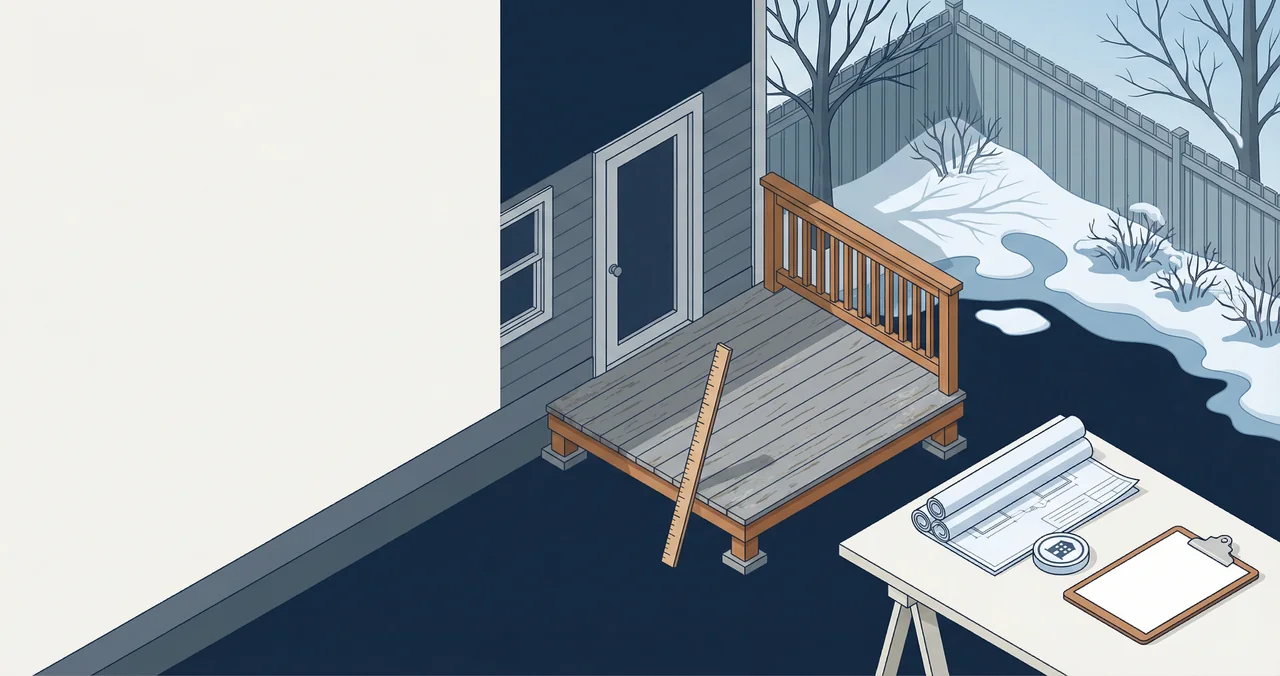
You're planning a deck for your Ontario home and wondering whether you need a permit. The short answer: probably yes. But the rules vary by municipality, deck size, height, and even what you're attaching it to.
Here's what you need to know about deck permits in Ontario — from provincial building code requirements to municipal variations, application steps, costs, and common inspection pitfalls.
When You Need a Deck Permit in Ontario
The Ontario Building Code (OBC) governs all residential construction, including decks. Any deck higher than 24 inches (60 cm) off the ground requires a building permit in most Ontario municipalities.
🏗️ Planning a deck project?
Get a free manual project review, or visualize your dream deck with AI before requesting quotes.
That 24-inch rule is a baseline. Many cities add their own requirements:
- Kitchener: Permit required if deck is over 24 inches high OR covers more than 108 square feet
- Waterloo: Permit required for decks over 24 inches high, regardless of size
- Cambridge: Permit required for decks over 24 inches high OR attached to a house
Even ground-level decks may need permits if they're attached to your house, affect drainage, or include stairs with more than two risers.
You also need a permit if you're:
- Rebuilding an existing deck (not just resurfacing boards)
- Adding a roof, pergola, or covered structure to an existing deck
- Building a deck that supports a hot tub or other heavy load
- Excavating within 3 feet of a property line
The safest move: call your municipal building department before you dig or order materials. Permit fees range from $150 to $400 — cheap insurance compared to the cost of tearing down non-compliant work.
For city-specific guidance, check out Kitchener deck permit requirements, Waterloo's permit process, or Cambridge's application steps.
What the Ontario Building Code Requires for Decks
The OBC sets minimum standards for structural safety. Your deck must meet these requirements whether you're pulling a permit or not:
Footings and Foundations
Footings must extend below the frost line — 48 inches (1.2 m) minimum in most of Ontario. In KWC's clay-heavy soil, frost heave is real. Shallow footings will shift, crack, and destroy your deck frame within a few winters.
Your options:
- Sonotube concrete footings: 10-12 inch diameter tubes filled with concrete and rebar, dug to 48+ inches
- Helical piles: Steel screw piles driven 6-8 feet deep, increasingly popular in KWC for their speed and frost resistance
Helical piles cost $150-300 per pile installed but don't require digging, concrete curing time, or inspections of wet concrete. Many KWC builders now prefer them. See helical piles vs. concrete footings for a detailed comparison.
Before you dig anything, call Ontario One Call at 1-800-400-2255 (or dial 811). It's free, required by law, and prevents you from hitting gas, electrical, or water lines. More on that process here: Ontario One Call before deck footings.
Joist Sizing and Span
Joist size depends on the span (distance between beams) and joist spacing (typically 16 inches on center):
| Joist Size | Max Span (16" O.C.) | Max Span (12" O.C.) |
|------------|---------------------|---------------------|
| 2x6 | 9'2" | 10'5" |
| 2x8 | 12'1" | 13'7" |
| 2x10 | 15'5" | 17'4" |
| 2x12 | 18'9" | 21'0" |
These are OBC maximums for southern yellow pine or spruce-pine-fir (SPF) lumber. Your municipality may require shorter spans for safety margins. If your deck design calls for longer spans, you'll need additional beams or engineered lumber.
Full joist span details here: deck joist span table for Ontario.
Ledger Board Attachment
If your deck attaches to your house, the ledger board must be lag-bolted or through-bolted to the house rim joist — not just nailed or screwed. The OBC requires:
- 1/2-inch lag bolts or through-bolts spaced no more than 16 inches apart
- Flashing installed above the ledger to prevent water infiltration and rot
- Proper joist hanger connections at every joist-to-ledger joint
Ledger failure is the most common cause of deck collapses in Ontario. Water gets behind the ledger, rots the rim joist, and the entire deck pulls away from the house.
If you're seeing soft spots, black streaks, or gaps between the ledger and house, read this: ledger board rot warning signs.
Guardrails and Height
Any deck more than 24 inches above grade requires a guardrail at least 42 inches (107 cm) high, measured from the deck surface.
Guardrail pickets or balusters must be spaced so that a 4-inch sphere cannot pass through. This prevents small children from slipping through or getting their heads stuck.
Cable railings, glass panels, and horizontal slat designs are all code-compliant if they meet the 4-inch sphere rule and the 42-inch height minimum. See deck railing height Ontario code for railing options and costs.
Stairs and Handrails
Stair construction is heavily regulated:
- Maximum riser height: 7.75 inches (19.7 cm)
- Minimum tread depth: 10 inches (25.4 cm)
- Maximum variation between risers: 3/8 inch (9.5 mm)
- Handrail required: For stairs with more than two risers
- Handrail height: 34-38 inches (86-97 cm) measured from the stair nosing
Inconsistent riser heights are a tripping hazard and will fail inspection every time. Most builders use a stair calculator or pre-cut stringers to ensure even rises.
Here's a detailed walkthrough: how many stairs do I need for my deck and deck stairs code Ontario.
How to Apply for a Deck Permit in Ontario
The permit application process varies slightly by city, but the steps are similar across KWC:
Step 1: Prepare Your Drawings
You'll need a site plan and construction drawings showing:
- Property boundaries and setbacks from lot lines (typically 3-5 feet minimum)
- Deck dimensions (length, width, height above grade)
- Footing locations and depth
- Joist layout with joist size, spacing, and span
- Beam and post locations
- Ledger attachment details if attached to the house
- Guardrail and stair design
Most municipalities accept hand-drawn plans if they're clear and dimensioned. You don't need an architect unless your deck is unusually large or complex.
For a full checklist of what to include, see deck permit drawings checklist KWC.
Step 2: Check Zoning and Setbacks
Your deck must comply with local zoning bylaws:
- Setbacks from property lines: Usually 3-5 feet, but varies by zone
- Lot coverage limits: Your deck counts toward total impermeable surface area
- Height restrictions: Especially if you're adding a pergola or roof
In KWC, you can check zoning online or call the planning department. Some properties have easements, drainage restrictions, or heritage designations that limit deck placement.
Read more: KWC deck zoning setbacks.
Step 3: Submit Your Application
Applications are submitted online or in person at your municipal building department:
- Kitchener: Online portal at kitchener.ca/buildingpermits
- Waterloo: Online or in-person at 100 Regina St S
- Cambridge: Online or in-person at 50 Dickson St
You'll need:
- Completed application form
- Site plan and construction drawings
- Permit fee payment ($150-400 depending on deck size and municipality)
- Proof of property ownership (recent tax bill or property deed)
Processing times vary. Expect 2-4 weeks for simple decks, longer if your plans need revisions or if you're in a busy spring construction season.
City-specific walkthroughs: Kitchener deck permit application, Waterloo deck permit application, Cambridge deck permit application.
Step 4: Schedule Inspections
Your permit will specify required inspections. Typically:
1. Footing inspection: Before you pour concrete or install helical piles
2. Framing inspection: After joists, beams, and ledger are installed, before decking goes on
3. Final inspection: After guardrails, stairs, and decking are complete
You must call for inspections before covering up work. Inspectors need to see footings, ledger bolts, and joist hangers. Covering them up means tearing off finished work later.
Inspectors in KWC are strict about ledger flashing, joist hanger nails, and guardrail spacing. Know what they're looking for: deck framing inspection KWC.
Step 5: Receive Final Approval
Once you pass final inspection, your permit is closed and your deck is legal. This matters for:
- Home insurance: Many insurers won't cover unpermitted structures
- Resale: Buyers and home inspectors will ask for permit records
- Liability: If someone is injured on an unpermitted deck, you're personally liable
Keep your permit documents with your home records. You may need them decades from now.
Deck Permit Costs in Ontario
Permit fees in KWC municipalities range from $150 to $400, based on:
- Deck size (square footage)
- Construction value (materials + labour estimate)
- Complexity (attached vs. freestanding, height, stairs, hot tub support)
| Municipality | Base Permit Fee | Typical Range |
|--------------|-----------------|---------------|
| Kitchener | $175 | $175-$350 |
| Waterloo | $150 | $150-$300 |
| Cambridge | $200 | $200-$400 |
Additional costs to budget for:
- Plan revisions: $50-$100 if your drawings need corrections
- Re-inspection fees: $75-$150 if you fail an inspection and need a follow-up visit
- Engineering review: $300-$800 if your deck requires engineered drawings (hot tub decks, cantilevered designs, etc.)
The permit cost is tiny compared to your total deck investment. A typical 12x16 composite deck costs $15,000-$22,000 installed in KWC — see the full Ontario deck cost breakdown for details. Paying $200 for a permit is 1% of that.
For a full cost breakdown including permits, see deck cost Kitchener 2026, deck cost Waterloo, or deck cost Cambridge.
How Long Do Deck Permits Take in Ontario?
From application to approval, expect 2-6 weeks depending on:
- Season: Spring and early summer (April-June) are peak times; plan submissions can take 4-6 weeks
- Plan complexity: Simple rectangular decks process faster than multi-level designs or hot tub decks
- Completeness: Missing dimensions or unclear drawings trigger delays
Timeline breakdown:
| Stage | Typical Time |
|---------------------------|--------------|
| Plan review | 1-3 weeks |
| Revision requests (if any)| 1-2 weeks |
| Permit issuance | 1-3 days |
| Footing inspection | 1-3 days |
| Framing inspection | 1-3 days |
| Final inspection | 1-3 days |
You can start buying materials once your permit is issued, but don't start digging until you have the physical permit card in hand. Building without a permit risks stop-work orders, fines, and forced teardowns.
More details: how long do deck permits take in KWC.
What Happens If You Build Without a Permit?
Skipping the permit might seem like a shortcut, but the consequences are real:
Immediate Risks
- Stop-work orders: Neighbors or inspectors spot unpermitted work, and your project halts
- Fines: $500-$5,000+ depending on municipality and violation severity
- Forced removal: In extreme cases, municipalities can order you to tear down the deck
Long-Term Consequences
- Insurance denial: If your deck collapses or causes damage, your insurer can deny claims for unpermitted structures
- Resale problems: Buyers' lawyers will ask for permit records; missing permits kill deals or force price reductions
- Liability exposure: If someone is injured on an unpermitted deck, you're personally liable without code compliance proof
Even if you're planning to sell soon, undisclosed unpermitted work is a legal headache. Home inspectors will spot it, and you'll be negotiating price cuts or retrofit costs.
Permit Exemptions: When You Don't Need One
A few scenarios genuinely don't require permits in most Ontario municipalities:
- Decks under 24 inches high with no stairs, guardrails, or roof (ground-level decks)
- Deck resurfacing: Replacing deck boards on an existing, permitted frame without altering structure
- Minor repairs: Replacing a few joists, fixing railing pickets, or patching ledger flashing
However, exemptions vary by city. Cambridge requires permits for some attached decks even under 24 inches. Waterloo may exempt freestanding decks under 108 square feet.
When in doubt, call your building department. A 5-minute phone call beats a $2,000 fine.
Hiring a Contractor vs. DIY Permitting
If You're Hiring a Deck Builder
Most licensed deck contractors in KWC handle permits as part of their service. They:
- Prepare and submit drawings
- Pay the permit fee (billed to you)
- Schedule and attend inspections
- Ensure code compliance throughout construction
Verify your contractor:
- Holds a valid Ontario builder's license
- Carries liability insurance ($2M minimum)
- Provides references from recent permitted deck projects
Your contract should specify who is responsible for permits and inspections. See deck builder contract KWC for what to include.
If You're DIYing Your Deck
You can absolutely pull your own permit as a homeowner. You'll need to:
- Draw your own plans (or hire a designer for $200-$500)
- Submit the application and pay fees
- Be available for inspections during business hours
- Fix any issues inspectors flag
DIY permitting saves contractor markup but requires time, precision, and willingness to redo work if inspectors reject it.
Most KWC homeowners building their own decks budget 40-60 hours for design, permitting, and construction of a simple 12x16 deck.
Common Deck Permit Mistakes to Avoid
Inspectors in Kitchener, Waterloo, and Cambridge flag these issues constantly:
Ledger Flashing Errors
Missing or improperly installed flashing is the #1 cause of ledger rot and deck failure. Flashing must sit on top of the ledger, not behind it, and extend up behind the house siding.
Details here: deck ledger flashing Ontario.
Incorrect Joist Hangers
Face-mount hangers require specific nails (10d x 1.5" for most Simpson hangers). Using screws or wrong-size nails will fail inspection. Inspectors check every single hanger.
Guardrail Spacing Violations
Balusters spaced too far apart (more than 4 inches) fail the sphere test. Inspectors carry a 4-inch gauge and will measure every bay.
Shallow Footings
Footings dug to 36 or 40 inches won't pass. Ontario frost line is 48 inches minimum. Inspectors will measure depth before you pour concrete.
See how deep should deck footings be in Ontario for proper footing depth and installation.
Undocumented Hot Tub Support
If you're planning to add a hot tub later, mention it now. Hot tubs weigh 3,000-5,000 lbs when filled. Your deck needs engineered support, closer joist spacing, and possibly larger beams.
More on that: hot tub on deck Ontario.
🎨 Not sure which material to pick?
Upload a photo of your backyard and see exactly how Trex, TimberTech, or cedar would look — free and instant.
Common Questions
Do I need a permit to replace deck boards?
No, if you're just replacing boards on an existing, structurally sound frame. But if you're replacing joists, beams, posts, or ledger boards, that's a rebuild and requires a permit.
Not sure whether to rebuild or resurface? See deck rebuild vs. resurface Kitchener-Waterloo.
Can I get a permit after I've already built the deck?
Yes, but it's messy. You'll need to submit an "as-built" application with photos and drawings of the completed work. Inspectors may require you to expose footings, ledger bolts, or framing to verify code compliance — meaning you'll tear off finished decking.
Municipalities can also levy fines for building without a permit. It's always cheaper and easier to permit first.
Do I need a permit for a pergola or covered deck?
Yes. Adding a roof or pergola to an existing deck is a structural change and requires a permit in Kitchener, Waterloo, and Cambridge. The roof adds wind and snow load, and your deck frame may need reinforcement.
See pergola and covered deck permits for requirements.
How long is a deck permit valid?
Most Ontario municipalities issue permits valid for 12 months. If you don't complete construction within that time, the permit expires and you'll need to reapply (often paying a renewal fee).
You can typically request one extension if you're delayed by weather, material shortages, or other legitimate reasons.
What if my neighbor complains about my deck?
If you have a valid permit and comply with setback rules, your neighbor's aesthetic objections don't matter legally. However, if your deck violates setbacks or zoning rules, your neighbor can file a complaint with the municipality, triggering an investigation.
Always check setbacks before building. Decks too close to property lines can be ordered removed. See deck setback rules KWC.
Upload a backyard photo and preview real decking materials with AI — free, instant, no sign-up.
Permits, costs, material comparisons, and questions to ask before requesting quotes — delivered to your inbox.