
Deck Builder Payment Schedule: What's Fair in Ontario?
Learn what payment schedules deck builders use in Ontario, how to protect yourself from unfair terms, and what milestones justify each payment.
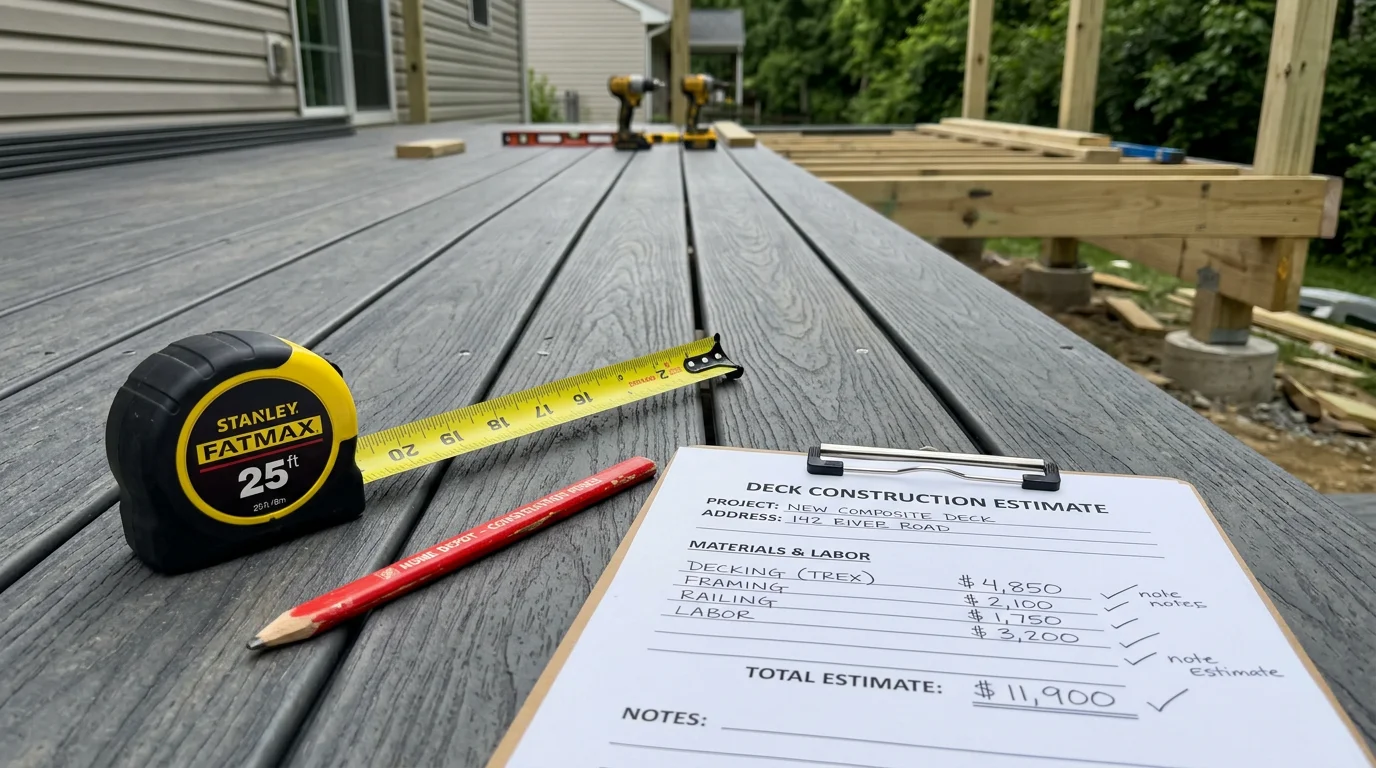
You've accepted a deck quote and you're ready to sign the contract. Then you see the payment terms: 50% upfront, 50% on completion. Is that normal? Or are you being asked to take on too much risk?
Payment schedules matter. They determine when your money leaves your account and what leverage you have if things go sideways. A fair schedule protects both you and your builder. A lopsided one can leave you holding the bag if the builder disappears, goes bankrupt, or delivers subpar work.
Here's what's actually fair in Ontario's deck building market, what red flags to watch for, and how to negotiate terms that protect your investment.
Standard Payment Schedules in Ontario
Most reputable deck builders in the KWC region use one of three payment structures:
🏗️ Planning a deck project?
Get a free manual project review, or visualize your dream deck with AI before requesting quotes.
Three-Payment Schedule (Most Common)
33% deposit – Signed contract, materials ordered
33% mid-build – Framing complete and inspected
34% final payment – Deck complete, you're satisfied
This is the most balanced approach. You're not fronting the entire material cost, the builder gets cash flow to cover labour, and you retain final payment as leverage until the job meets your standards.
Four-Payment Schedule (Larger Projects)
25% deposit – Contract signed
25% post-framing – Structure complete, framing inspection passed
25% decking/railing – Walking surface and railings installed
25% final – All deficiencies corrected, final walkthrough complete
This works well for complex builds (multi-level decks, hot tub installations, custom railings) where there are clear phases of work. It spreads financial risk more evenly.
Two-Payment Schedule (Small Decks Only)
50% deposit – Contract and material order
50% completion – Job done
Only accept this for very small projects (under 150 sqft). On a standard 12×16 deck in Kitchener costing $14,000–$18,000, you'd be putting down $7,000–$9,000 before a single board is cut. That's too much exposure.
What the Deposit Actually Covers
Builders justify the upfront payment by pointing to material costs. And yes, lumber, composite boards, fasteners, and concrete aren't free. But let's break down what that deposit *should* cover versus what you're actually being asked to pay.
For a typical 12×16 pressure-treated deck (materials only):
| Item | Cost |
|------|------|
| Lumber (joists, beams, ledger, decking) | $2,800–$3,500 |
| Concrete for footings (8 posts) | $200–$300 |
| Fasteners, joist hangers, hardware | $300–$500 |
| Railing materials | $800–$1,200 |
| Total materials | $4,100–$5,500 |
If you're being asked for $7,000 upfront on a $14,000 deck, that's not just covering materials. The builder is asking you to pre-pay a chunk of their labour. That's fine *if* there are subsequent progress payments. It's not fine if the schedule is 50/50 with nothing in between.
Red Flags in Payment Terms
50% or More Upfront (No Milestones)
If a builder wants half your project cost before starting work and there's no interim payment tied to measurable progress, walk away. This structure gives you zero leverage once the cheque clears.
Why builders ask for this: Cash flow problems, unpaid invoices from other jobs, or they're planning to use your deposit to finish someone else's deck.
"Materials Plus 10%" Deposit
Sounds reasonable until you realize "materials" includes their markup. A builder might claim materials are $8,000 when their actual supplier cost is $5,500. You're paying $8,800 upfront (with the 10% buffer) on inflated numbers.
Better approach: Ask for a copy of material invoices or an itemized material list with quantities. Compare it to retail pricing at local suppliers.
Final Payment Under 20%
Your final payment is your only leverage. If it's too small, the builder has little incentive to fix deficiencies, return for touch-ups, or address issues that surface after they've left the site.
Minimum final payment: At least 25–30% of the total contract. On a $16,000 deck, that's $4,000–$4,800. Enough to matter.
Cash-Only or E-Transfer-Only Terms
Legitimate businesses accept multiple payment methods. If a builder insists on cash or e-transfer *only* (no cheques, no credit cards), they're either avoiding the paper trail or dodging taxes.
Why it matters to you: No payment record means no proof you paid them if a lien surfaces or you need documentation for insurance, permits, or warranty claims.
How to Negotiate a Fair Schedule
You're not stuck with whatever terms the builder proposes. Most contractors expect some back-and-forth on payment structure. Here's how to adjust an unfair schedule:
Strategy 1: Add a Milestone
Builder wants 50% deposit, 50% final? Counter with:
- 30% deposit (contract signed, materials ordered)
- 35% framing complete (posts, beams, joists, ledger installed and inspected)
- 35% final (decking, railing, stairs complete, all deficiencies resolved)
You've turned a risky two-payment schedule into a safer three-stage plan. The builder still gets early cash flow, but you're not overexposed.
Strategy 2: Tie Payments to Permit Inspections
Ontario's building code requires inspections at specific stages (footing depth, framing, final). Align your payments with those inspections:
- 25% deposit
- 25% after footing inspection (confirms proper depth below frost line)
- 25% after framing inspection (structural integrity verified)
- 25% after final inspection and permit closure
This approach works especially well in Cambridge, Kitchener, and Waterloo where permit requirements are strictly enforced. You're paying only after an independent inspector confirms the work meets code.
Strategy 3: Holdback for Deficiencies
Even after final inspection, minor issues pop up: a loose railing spindle, a squeaky board, a gate that doesn't latch properly. Protect yourself by holding back 10% for 30 days after substantial completion.
Example clause:
*"Final payment of $1,600 (10% of contract) to be paid 30 days after substantial completion, provided all deficiencies have been corrected and client has approved final walkthrough."*
The builder gets 90% of their money when the job is done. You keep 10% as insurance.
What to Put in Writing
Payment terms aren't legally binding unless they're in the contract. Make sure your agreement specifies:
- Exact dollar amounts for each payment (not percentages—percentages can be disputed if scope changes)
- Trigger events for each payment (e.g., "Second payment of $5,200 due upon completion of framing and passing of municipal framing inspection")
- Payment method (cheque, e-transfer, credit card)
- Receipt requirement (builder must provide written receipt for every payment)
- Holdback terms (if applicable)
- What happens if you don't pay (reasonable late fees, not punitive ones)
- What happens if they don't perform (right to withhold payment if work doesn't meet code or contract specs)
Don't sign a contract that says "Progress payments as work is completed" with no specifics. That's unenforceable and leaves both parties guessing.
What If You're Asked to Pay for a Permit?
Some builders include the permit fee in the first payment. Others ask you to pay the municipality directly. Both are fine, but know what you're paying for.
Typical permit costs in KWC:
- Kitchener: $175–$350 depending on deck size and complexity
- Waterloo: $200–$400 for decks over 24 inches high
- Cambridge: $150–$300 for standard decks
If the builder includes the permit in your deposit, ask for a copy of the permit receipt. If they claim they paid $500 for a permit that actually cost $200, you're being overcharged.
For more on permit costs and timelines, see How Long Do Deck Permits Take in KWC?
When Builders Demand More Money Mid-Project
Scope creep happens. You decide mid-build that you want composite decking instead of pressure-treated. Or the builder discovers your ledger board is rotted and needs replacement. Extra costs are legitimate *if* they're documented.
Fair process for change orders:
1. Builder identifies additional work required
2. Builder provides written quote for the extra work (labour + materials)
3. You approve in writing before work proceeds
4. Payment terms for the change order are negotiated (usually due upon completion of that specific work)
Unfair process:
Builder says "We need another $2,000 or we're stopping work" with no breakdown, no documentation, and no clear explanation of what changed.
If a builder threatens to walk off the job unless you pay more money *without* a documented reason, that's either incompetence (they didn't price the job properly) or a shakedown. Either way, you have leverage: they don't get their final payment, and you can file a complaint with the Home Construction Regulatory Authority (HCRA) if they're a licensed builder.
Payment Schedule by Project Size
Here's what fair looks like for common deck sizes in the KWC market:
Small Deck (100–150 sqft, $7,000–$11,000)
- $2,500–$4,000 deposit (materials + initial labour)
- $4,500–$7,000 final (upon completion and your approval)
Standard Deck (150–250 sqft, $11,000–$18,000)
- $3,500–$6,000 deposit
- $4,000–$6,500 mid-build (framing complete)
- $3,500–$5,500 final
Large Deck (250–400 sqft, $18,000–$30,000)
- $5,000–$8,000 deposit
- $5,000–$8,000 post-framing
- $4,000–$7,000 decking/railing
- $4,000–$7,000 final
These ranges assume composite or pressure-treated builds with standard railings and align with the benchmarks in our Ontario deck cost guide. Multi-level decks, glass or cable railings, and custom features shift the numbers higher but shouldn't change the *structure* of the schedule.
What Happens If the Builder Doesn't Finish?
You've made your deposit. The builder starts work, then disappears. Maybe they went bankrupt. Maybe they took on too many jobs. Maybe they're just disorganized.
Your legal options:
1. Construction Lien (If They've Started Work)
If the builder completed *some* work but hasn't been fully paid, they can file a construction lien against your property. This prevents you from selling or refinancing until the lien is resolved. Ironically, even if *you* haven't paid them, their subcontractors or suppliers can lien your property if the builder didn't pay *them*.
How to protect yourself: Require lien waivers at each payment stage. The builder provides a signed document confirming that all subcontractors and suppliers have been paid. No waiver, no payment.
2. Small Claims Court (Under $35,000)
If the builder took your deposit and did little to no work, you can sue in Ontario Small Claims Court for the deposit amount plus damages. You'll need evidence: the contract, payment records, photos of the incomplete work, and documentation of your attempts to contact the builder.
Realistic timeline: 6–12 months to get a judgment. Another 3–6 months to collect if the builder doesn't pay voluntarily.
3. HCRA Complaint (If Builder Is Licensed)
Licensed builders in Ontario are regulated by HCRA. If your builder is registered, you can file a complaint for non-performance, shoddy work, or contract violations. HCRA can investigate, issue fines, or revoke licenses.
Check builder licensing: https://www.hcraontario.ca/public-register/
🎨 Not sure which material to pick?
Upload a photo of your backyard and see exactly how Trex, TimberTech, or cedar would look — free and instant.
Common Questions
How much deposit should I pay for a deck in Ontario?
A fair deposit ranges from 25–35% of the total contract price, enough to cover most material costs and initial labour. For a $15,000 deck, expect to pay $3,750–$5,250 upfront. Anything above 40% is excessive unless there are custom materials, long lead times, or unusual site conditions that justify higher upfront costs.
Should I pay a deck builder in cash?
No. Cash payments leave no paper trail, which creates problems if disputes arise, liens are filed, or you need proof of payment for insurance or warranty claims. Pay by cheque or e-transfer so you have a record. If a builder *requires* cash and refuses other payment methods, that's a red flag—they may be avoiding taxes or operating without proper licensing.
What if the builder asks for final payment before the job is done?
Don't pay it. Your final payment is your only leverage to ensure deficiencies are corrected, railings are tightened, and the site is cleaned up. A builder who demands final payment before the work meets your approval is either desperate for cash or planning to walk away from punch-list items. Withhold final payment until the deck passes final inspection (if required) and you've completed a thorough walkthrough.
Can I tie payments to permit inspections?
Yes, and it's one of the smartest ways to structure a payment schedule. Permits in Kitchener, Waterloo, and Cambridge require inspections at specific stages (footing depth, framing, final). Tying your payments to those inspections ensures you're paying only after an independent third party confirms the work meets Ontario Building Code. Builders may resist this because it introduces delays, but it significantly reduces your risk.
What's a reasonable holdback period after completion?
10% held for 30 days is standard in commercial construction and works well for residential decks too. This gives you time to use the deck, spot issues that weren't obvious during the final walkthrough (a board that squeaks under weight, a railing that loosens after a week, a gate latch that sticks), and confirm the builder returns to fix them. Most reputable builders accept this term without pushback because they know they'll get paid if they do quality work.
Upload a backyard photo and preview real decking materials with AI — free, instant, no sign-up.
Permits, costs, material comparisons, and questions to ask before requesting quotes — delivered to your inbox.