
Deck Footing Depth in Ontario: Frost Line Requirements
Ontario deck footings must go 48 inches deep to reach frost line. Learn code requirements, soil conditions, and helical pile alternatives for KWC builds.
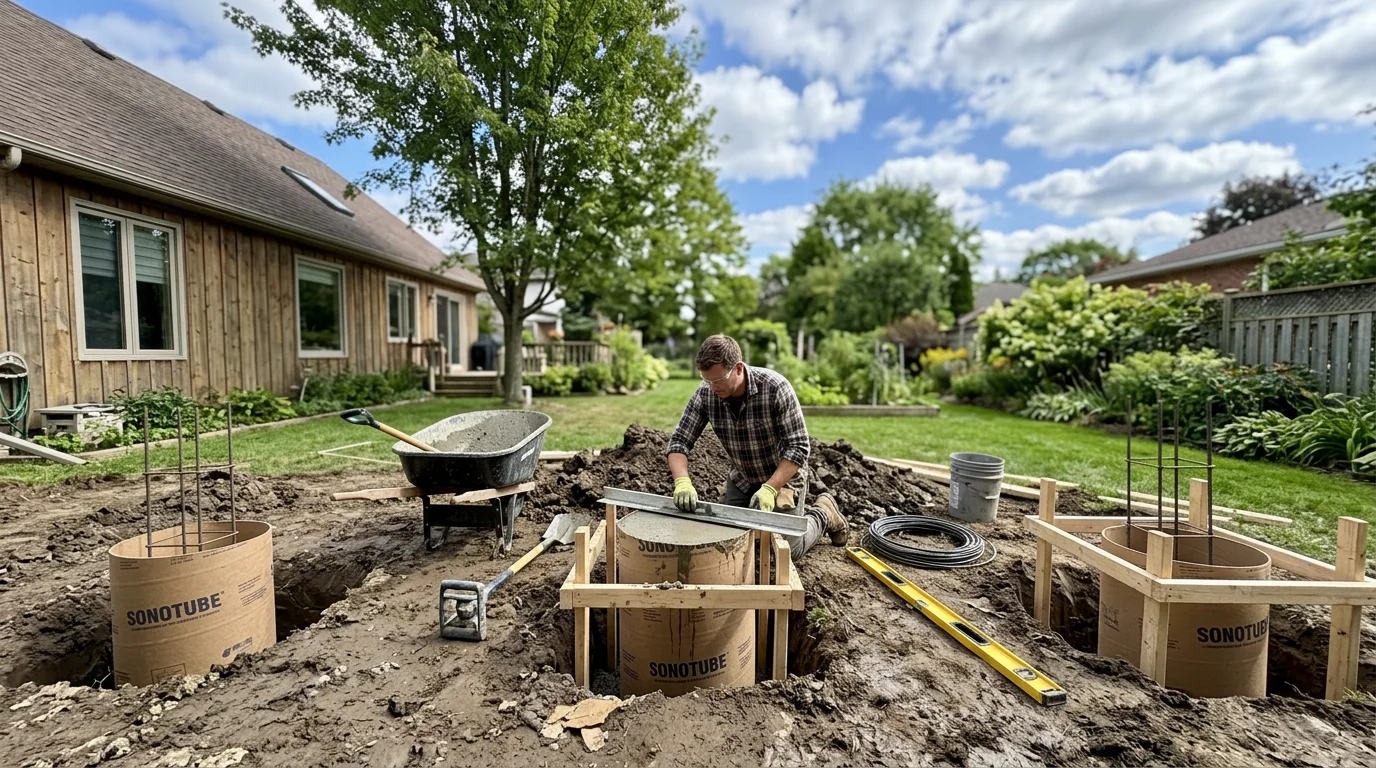
Your deck inspector just flagged your footings as too shallow. Now what?
In Ontario, the minimum footing depth is 48 inches (1.2 m) below grade. This isn't arbitrary — it's the depth our frost line reaches in winter, and it's specified in the Ontario Building Code (OBC) Division B 9.15.4.3.
Go shallower and frost heave will lift your footings every freeze-thaw cycle. Your deck posts shift, railings loosen, and structural damage compounds. Inspectors won't pass it, and your builder's warranty won't cover it.
Here's exactly how deep your footings need to go, how to handle problem soil, and when alternatives like helical piles make sense.
Why Ontario Requires 48-Inch Footings
Frost penetrates soil at different depths depending on climate. In southern Ontario, ground freezes reach 48 inches down in a typical winter. When water in soil freezes, it expands by roughly 9%, creating upward pressure strong enough to lift concrete.
🏗️ Planning a deck project?
Get a free manual project review, or visualize your dream deck with AI before requesting quotes.
This is frost heave, and it happens in cycles:
- Ground freezes, footings lift slightly
- Ground thaws, footings settle unevenly
- Posts shift, beams twist, connections fail
The OBC mandates 48-inch depth specifically to place footing bases below the frost zone where soil stays unfrozen year-round. Footings poured at 36 inches will move. Footings at 48+ inches stay stable.
Ontario Building Code Requirements
OBC Section 9.15.4.3 specifies:
- Minimum depth: 48 inches below finished grade
- Footing diameter: Typically 10-12 inches for residential decks
- Concrete strength: Minimum 20 MPa
- Pad thickness: 6-8 inches at base
Local municipalities enforce this province-wide. You'll find the same 48-inch rule whether you're applying for a Kitchener deck permit, Waterloo permit, or Cambridge permit.
What Happens If You Go Too Shallow
Footings at 36 inches might hold through summer. Then winter hits:
First winter: Minor heave — maybe 1/4 inch of lift. Posts feel slightly loose.
Second winter: Cumulative movement reaches 1/2 inch. Ledger board connections stress. Joist hangers show gaps.
Third winter: Visible deck movement. Railings wobble. Deck boards show uneven gaps.
Fixing frost-heaved footings means excavating around posts, cutting posts, pouring new deeper footings, and resetting framing. Budget $800-1,500 per footing for remediation. Much cheaper to dig correctly the first time.
How to Measure Footing Depth Correctly
"48 inches below grade" sounds simple until you're standing in your yard with uneven terrain.
Grade means the lowest adjacent finished ground level around each footing location. Not average grade. Not future grade. The lowest point where soil meets your footing.
Step-by-Step Measurement
1. Mark footing locations using your deck plan dimensions
2. Dig test holes at each corner (12 inches deep, 12 inches diameter)
3. Identify grade level — where existing finished soil sits
4. Measure 48 inches down from that grade point using a tape measure and level
5. Mark excavation depth on your auger or digger
If your yard slopes, each footing may require different excavation depths to reach 48 inches below its local grade.
Sloped Yards and Stepped Footings
On slopes, uphill footings need deeper holes than downhill footings. Example:
- Uphill footing: Grade at 100 inches above datum → dig to 52 inches above datum (48 inches deep)
- Downhill footing: Grade at 90 inches above datum → dig to 42 inches above datum (48 inches deep)
Total excavation from ground surface varies, but each footing base sits 48 inches below its own grade.
Inspectors check this carefully during framing inspections. Bring a tape measure and level to show your work.
Sonotube Concrete Footings: The Standard Method
Most Ontario deck guides builders use Sonotube forms with poured concrete. These are cardboard tubes that create cylindrical footings.
Materials and Sizing
Standard residential deck footing:
- Sonotube diameter: 10 inches (small decks under 100 sqft) or 12 inches (standard decks)
- Tube length: 48 inches minimum, buy 60-inch tubes for easier handling
- Concrete per footing: ~1.5 cubic feet for 10-inch tube, ~2 cubic feet for 12-inch tube
- Base pad: Some builders flare the bottom 6 inches to 16-18 inch diameter for added bearing
Cost per footing (materials only):
- Sonotube 10" x 48": $12-18
- Concrete (2 cubic feet): $8-12
- Rebar or post anchor: $6-10
- Total materials: $26-40 per footing
Add $100-200 per footing for professional installation including excavation, concrete delivery, and pour labor.
Installation Process
1. Call Ontario One Call (811) minimum 5 business days before digging to locate utilities — read more about 811 requirements
2. Excavate holes using auger (rental $80-120/day) or hand digger
3. Set Sonotubes plumb and level, backfill around outside for support
4. Pour concrete in single continuous pour per footing
5. Insert post anchors while concrete is wet, ensure vertical alignment
6. Cure minimum 7 days before loading (28 days for full strength)
Concrete poured in temperatures below 5°C won't cure properly. Plan footing work for April through October. Winter deck construction requires heated enclosures and admixtures.
Helical Piles: The Faster Alternative
Helical piles (screw piles) are galvanized steel shafts with helical blades that screw into soil like giant screws. They've become popular in KWC because they:
- Install in 15-30 minutes per pile (vs. 3-5 days for concrete cure)
- Work in winter when concrete won't cure
- Handle problem soil better than concrete
- Reach any depth without massive excavation
How Helical Piles Work
A hydraulic driver screws the pile into soil until it reaches torque resistance that correlates to bearing capacity. For residential decks, piles typically reach refusal at 6-10 feet depth depending on soil.
The pile stays there permanently. No concrete. No curing time. Attach your post bracket and start framing the same day.
Costs and Permit Considerations
Helical pile installed cost: $150-300 per pile in KWC (2026 pricing)
Compare to concrete footings:
- Materials: Helical piles cost 3-4x more
- Labor: Installation is faster but requires specialized equipment
- Timeline: Helical saves 7+ days of cure time
- Permitting: Many municipalities require engineer stamped plans for helical piles
For deep footings (6+ feet on slopes) or tight timelines, helical piles often make financial sense despite higher upfront cost. Read our helical pile comparison for detailed scenarios.
Problem Soils in KWC: Clay, Rocks, and Water
Kitchener-Waterloo-Cambridge sits on glacial till — a mix of clay, silt, sand, gravel, and rocks deposited during the last ice age. You'll encounter:
Heavy Clay Soil
Clay holds water and expands when frozen, creating maximum frost heave risk. If your test holes fill with sticky grey-brown clay:
- Increase footing diameter to 12-14 inches for more bearing area
- Compact base with 4-6 inches of clear stone before pouring concrete
- Consider helical piles which bypass expansive clay layers entirely
Clay excavation is harder — rent a gas-powered auger instead of hand digging.
Boulders and Bedrock
Hitting rocks at 36 inches deep is common in KWC. Options:
Small rocks (under 8 inches): Remove and continue digging
Large boulders: Rent a jackhammer ($90-140/day) or call an excavation contractor ($200-400 per footing)
Bedrock: Stop digging. Switch to helical piles or hire an engineer to approve shallower footings bearing directly on rock (rare, requires geotechnical testing)
Don't pour shallow footings because you hit a rock. Inspectors reject them.
High Water Table
If test holes fill with water within 48 inches, you're at or above the water table. Concrete will still cure underwater, but:
- Pump water during pour to prevent concrete dilution
- Use deeper Sonotubes (60-72 inches) to keep top dry while bottom sits in water
- Consider helical piles which work fine in saturated soil
Water in footing holes doesn't void the 48-inch requirement. Your footing base still needs to reach that depth.
Deck Footing Depth for Special Situations
Low Decks Close to Grade
A deck 18 inches above grade still needs 48-inch footings. Frost line doesn't change based on deck height.
Some builders ask: "Can I use deck blocks for low decks?"
Not legally. OBC applies to all decks regardless of height. Deck blocks sit at surface level, far above frost line. Inspectors fail them every time. More on low deck requirements here.
Hot Tubs on Decks
Hot tub loads concentrate thousands of pounds on small areas. If you're planning a tub:
- Increase footing size to 14-16 inch diameter
- Add more footings under tub area (16-24 inch spacing instead of standard 6-8 feet)
- Still 48 inches deep — load doesn't change frost line
Many KWC municipalities require engineer stamped plans for hot tub decks. Read our hot tub structural guide before planning.
Second-Story and Rooftop Decks
Elevated decks carry higher loads and face stricter engineering scrutiny, but footing depth remains 48 inches minimum. Engineers may specify deeper footings (60-72 inches) for taller structures to improve lateral stability.
Budget engineer fees of $800-2,000 for second-story deck plans.
Attached vs. Freestanding Footings
Attached decks connect to your house via a ledger board. The ledger shares some load with your house foundation, but all freestanding posts still need 48-inch footings.
Freestanding decks (no ledger) carry 100% of load on their own footings. You'll need more footings, but each still follows the same 48-inch rule.
Inspection Requirements and Documentation
KWC building inspectors check footing depth at two stages:
Pre-Pour Inspection
Before pouring concrete, inspectors verify:
- Hole depth: 48+ inches measured from grade
- Sonotube diameter: Matches approved plans
- Tube plumb: Within 1/4 inch over 48 inches
- Rebar placement: If specified in plans
- Bearing surface: Clean soil, no loose material
Have your tape measure, level, and approved permit drawings on site. Inspectors may measure every footing or spot-check a few.
Framing Inspection
After concrete cures and framing is up, inspectors verify:
- Post connections: Properly anchored to footings
- Footing alignment: Posts landed where planned
- No heave: Footings stayed stable during cure
Understanding the framing inspection process helps you prepare correctly.
What to Document
Take photos showing:
- Depth measurement with tape measure visible
- Tube installation before concrete pour
- Post anchor placement in wet concrete
- Final footing condition after cure
If an inspector questions depth months later during framing inspection, photos prove compliance.
Cost Impact: Footings in Your Deck Budget
Footings represent 8-12% of total deck cost for standard builds. On a 300 sqft deck:
Concrete footings (8 footings):
- Materials: $210-320
- Labor (dig + pour): $800-1,600
- Total: $1,010-1,920
Helical piles (8 piles):
- Installed: $1,200-2,400
- Engineer stamp (if required): $400-800
- Total: $1,600-3,200
For a $45-65/sqft pressure-treated deck (300 sqft = $13,500-19,500 total), footings add $1,000-2,000 using concrete or $1,600-3,200 using helical piles.
Compare this to overall deck costs in KWC or the Ontario deck cost breakdown to understand where footings fit in your budget.
DIY vs. Professional Footing Installation
DIY footing installation saves $100-200 per footing in labor. A deck needing 8 footings saves $800-1,600.
But consider:
Skills required:
- Auger operation (heavy, dangerous equipment)
- Measuring depth accurately on sloped sites
- Setting tubes plumb
- Timing concrete pour and anchor placement
- Understanding soil conditions
Time investment: Plan 2-3 full days for layout, 811 call wait time, excavation, pour, and cure monitoring.
Equipment rental:
- Gas auger: $80-120/day
- Concrete mixer (if mixing on-site): $50-80/day
- Level, tape measure, bracing lumber: $40-80
Permit considerations: Some municipalities require licensed contractors for structural work. Check your local permit requirements before committing to DIY.
When to DIY: You have construction experience, flat yard, good soil, simple deck design.
When to hire: Sloped site, problem soil, large deck (10+ footings), tight timeline, or inspector requires contractor involvement.
🎨 Not sure which material to pick?
Upload a photo of your backyard and see exactly how Trex, TimberTech, or cedar would look — free and instant.
Common Questions
Can I use 36-inch footings if I'm building a small deck?
No. Ontario Building Code requires 48 inches regardless of deck size. A 64 sqft deck needs the same footing depth as a 400 sqft deck. Frost line doesn't discriminate by project size.
What if I hit bedrock at 40 inches?
You have three options: (1) Move the footing location to avoid rock, (2) jackhammer through the rock to reach 48 inches, or (3) hire a geotechnical engineer to approve a footing bearing directly on rock at shallower depth. Option 3 costs $600-1,200 for engineer assessment but is often cheaper than jackhammering through thick bedrock. Inspectors won't pass 40-inch footings without engineer approval.
Do I really need to wait 7 days for concrete to cure?
Yes for loading. Concrete reaches 70% strength at 7 days and full strength at 28 days. You can remove Sonotube forms after 48 hours, but don't install posts and load the footings until day 7 minimum. Faster cure times require special concrete mixes ($30-50 extra per footing) — discuss with your concrete supplier.
Can I pour footings in winter?
Only if you maintain concrete temperature above 5°C for the first 72 hours using insulated blankets, heated enclosures, or accelerator admixtures. Most builders avoid winter footing work in KWC. Helical piles install year-round without temperature restrictions, making them the practical choice for winter deck projects.
How do I know if I need helical piles instead of concrete?
Consider helical piles if: (1) you're building in winter, (2) soil testing shows deep unstable clay or fill, (3) you hit bedrock or boulders preventing excavation, (4) your timeline doesn't allow 7-day concrete cure, or (5) you're on a steep slope requiring 6+ foot deep footings. For standard flat yards with good soil in summer, concrete footings cost less. Compare both options in detail here.
Upload a backyard photo and preview real decking materials with AI — free, instant, no sign-up.
Permits, costs, material comparisons, and questions to ask before requesting quotes — delivered to your inbox.