
Small Deck Cost in Ontario (Under 100 sq ft): Is It Worth It?
Small deck cost in Ontario ranges from $4,500-$9,500 for under 100 sq ft. Permits, materials, and labour costs for tiny decks in KWC explained.
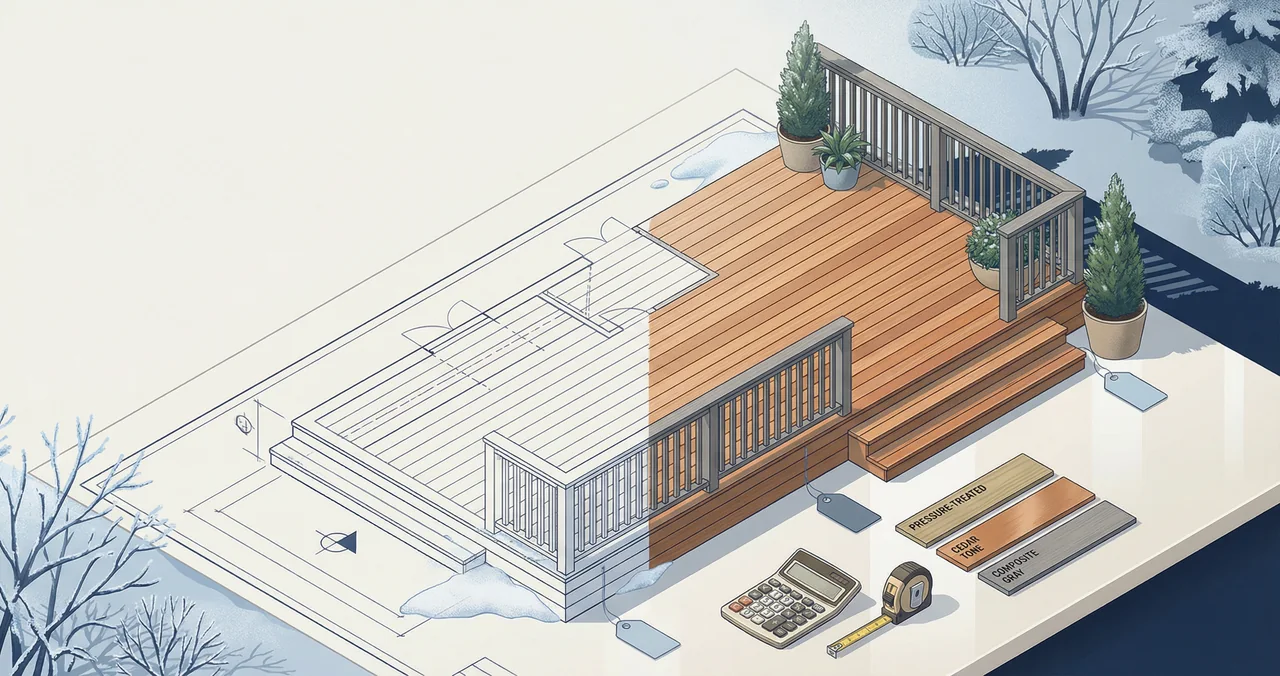
You're thinking about adding a small deck — maybe 8×10 or 6×12 — and wondering if the cost makes sense for such a tiny footprint. Here's the reality: small decks in Ontario typically cost $4,500 to $9,500 installed for under 100 square feet, which works out to $50-95 per square foot. That's often the same price per square foot as larger decks, sometimes higher.
The reason? Fixed costs don't scale down. You still need footings, a ledger board, railings (if required), stairs, permits, and a contractor's minimum charge. A 64 sq ft deck still needs four footings, structural lumber, and 2-3 days of labour. See our complete Ontario deck cost guide for standard-size pricing. Let's break down exactly what you'll pay and whether a small deck is worth it for your situation.
What Counts as a Small Deck in Ontario?
In Ontario, a "small deck" typically means under 100 square feet — roughly 8×12 feet (96 sq ft), 8×10 feet (80 sq ft), or 6×12 feet (72 sq ft). These are common sizes for:
🏗️ Planning a deck project?
Get a free manual project review, or visualize your dream deck with AI before requesting quotes.
- Back door landings elevated 2-4 feet off grade
- Side entrance platforms at basement walk-outs
- Small bistro decks off a kitchen or bedroom door
- Replacement stoops where concrete steps have failed
The Ontario Building Code (OBC) has a 24-inch exemption rule: if your deck is less than 24 inches (60 cm) above grade, it's often exempt from permits. But that's measured from the lowest grade within 5 feet, and most small decks at door height exceed this threshold. Check your municipality's rules — Kitchener, Waterloo, and Cambridge all enforce permits differently.
Under 100 sq ft doesn't mean permit-free. If your deck is attached to the house or elevated, you almost certainly need a permit.
Small Deck Cost Breakdown (Under 100 sq ft)
Here's what you'll actually pay for a small deck in the KWC area in 2026:
Pressure-Treated Small Deck (80-100 sq ft)
| Item | Cost | Notes |
|------|------|-------|
| Framing lumber (joists, beams, posts) | $600-900 | 2×8 or 2×10 joists, 4×4 posts |
| Decking boards (PT) | $400-600 | 5/4×6 or 2×6 pressure-treated |
| Footings (3-4 footings) | $300-600 | Sonotubes to 48" depth, concrete |
| Ledger board & flashing | $200-350 | Proper flashing prevents rot |
| Hardware (joist hangers, screws, brackets) | $150-250 | Code-compliant fasteners |
| Railing (10-16 linear feet) | $400-800 | PT or aluminum, if deck >24" high |
| Stairs (3-5 steps) | $300-600 | Stringers, treads, landing pad |
| Labour (framing, decking, install) | $2,000-3,500 | 2-3 days for one crew |
| Permit & inspections | $150-400 | Varies by city |
| Total (PT) | $4,500-7,600 | $56-76/sq ft |
Composite Small Deck (80-100 sq ft)
| Item | Cost | Notes |
|------|------|-------|
| Framing lumber (PT) | $600-900 | Structure is still PT |
| Composite decking | $800-1,400 | Trex, TimberTech, or similar |
| Footings | $300-600 | Same as PT deck |
| Ledger board & flashing | $200-350 | Critical for composite longevity |
| Hidden fasteners | $200-350 | Clips for grooved composite boards |
| Railing (composite or aluminum) | $600-1,200 | Composite matches deck aesthetic |
| Stairs | $400-700 | Composite treads add cost |
| Labour | $2,500-4,000 | Composite takes longer to install |
| Permit | $150-400 | Same permit requirements |
| Total (Composite) | $5,750-9,500 | $72-95/sq ft |
Why is the per-square-foot cost so high? Because you're spreading fixed costs (permit, footings, ledger, stairs) over fewer square feet. A 200 sq ft deck might cost $55/sq ft, while an 80 sq ft deck costs $70/sq ft.
What Drives Small Deck Costs Higher
1. Contractor Minimums
Most deck builders in KWC have a minimum job charge of $4,000-5,000 regardless of size. They still need to:
- Schedule a site visit and consultation
- Submit permit drawings and wait for approval
- Mobilize tools, equipment, and crew
- Coordinate inspections
For a one-day install, they'd rather take on larger, more profitable projects. You're often paying for their time and overhead, not just materials.
2. Structural Requirements Don't Shrink
A small deck still requires:
- Ledger board properly flashed and bolted to house rim joist
- Footings below the 48-inch frost line (Ontario minimum)
- 2×8 or 2×10 joists spaced 16" on center (can't downsize much)
- 4×4 posts and beam structure (even for 3 feet of span)
- Code-compliant railings if deck surface is >24" above grade
You can't cut corners structurally just because the deck is smaller. See our guide on deck footing options for cost comparisons.
3. Railing and Stairs Are Proportionally Expensive
On a 10×10 deck (100 sq ft), you might need:
- 30 linear feet of railing at $40-80/linear foot = $1,200-2,400
- 4-6 stairs with railings = $400-800
That's $1,600-3,200 in railing and stairs — up to 40% of your total budget for a feature that only exists because the deck is elevated. On a 16×16 deck, railing might be 20% of the budget. On a small deck, it's often 25-35%.
If your deck is less than 24 inches high and you can skip railings, you'll save significantly. Check Ontario railing code requirements.
4. Permit Costs Are the Same
Whether you're building 80 sq ft or 300 sq ft, the permit fee in KWC is typically:
Plus you'll need a site plan, framing drawings, and possibly an engineer's stamp if you're using helical piles or have tricky soil conditions. See deck permit costs in KWC for details.
Is a Small Deck Worth It?
Here's when it makes sense and when it doesn't:
When a Small Deck Is Worth It
You need a safe, code-compliant entry. If your current back door opens onto rotting steps or a 3-foot drop, a small deck is a safety upgrade and often required by insurance.
You're replacing a failing concrete stoop. Concrete stoops in Ontario crack and heave due to freeze-thaw cycles and clay soil movement. A properly-footed deck is more durable and easier to repair.
You want outdoor space but have limited yard. In urban KWC neighbourhoods (like Uptown Waterloo or Downtown Kitchener), a small deck might be your only viable outdoor living area.
You're prepping for resale. Homes without rear deck access in Ontario often feel incomplete to buyers. A small, tidy deck adds curb appeal and function.
You plan to expand later. Some homeowners build a small deck as phase one, then extend it in 2-5 years. Just make sure your initial footings and framing can support future expansion — discuss this with your builder upfront.
When a Small Deck Isn't Worth It
You're trying to save money with a tiny size. Going from 100 sq ft to 80 sq ft won't save you $1,500 — it'll save you $200-400. If you can afford 100 sq ft, build 100 sq ft.
Your door is less than 24 inches above grade. Consider a simple patio or paver landing instead. You'll spend $800-1,500 for pavers vs. $4,500-6,000 for a deck. No permit, no footings, no railings.
You want a meaningful outdoor living space. An 8×10 deck fits a bistro table and two chairs — barely. If you want to host or lounge, you'll regret not going bigger. Consider 12×12 (144 sq ft) or 12×16 (192 sq ft) as a minimum for furniture and movement.
You're DIYing on a tight budget. If you're handy, DIY can cut costs 40-50%, but you'll still spend $2,500-4,000 on materials and permits for a small deck. Weigh that against the time investment and risk of code violations.
How to Save Money on a Small Deck
1. Skip Composite for Very Small Decks
Composite decking adds $1,000-2,000 to an 80-100 sq ft deck. For a high-traffic entry deck that size, pressure-treated pine is durable and cost-effective. Save composite for larger decks where the maintenance savings matter more. Compare costs in our composite vs. wood guide.
2. Keep It Low to Avoid Railings
If you can design your deck to stay under 24 inches above grade (measured from the lowest point within 5 feet), you may avoid railings entirely. That saves $800-1,600 and simplifies permitting. Talk to your builder about grading options.
3. Use Helical Piles Instead of Concrete Footings
In areas with clay soil or tricky access (common in older KWC neighbourhoods), helical piles can be faster and eliminate the need for digging to 48 inches. Cost is similar ($150-300 per pile vs. $75-150 per sonotube footing), but install time drops and you avoid concrete truck access issues. See helical piles vs. concrete footings.
4. DIY the Footings and Framing Prep
If you're comfortable with excavation and concrete, you can DIY the footings and ledger board prep, then hire a contractor for framing and decking. This can save $500-1,000 and still ensures the structural work is done right.
5. Get Multiple Quotes
Small decks often get quoted inconsistently. Some builders see them as quick jobs; others as time-wasters. Get at least three quotes and compare line-by-line. Use our deck quote checklist to evaluate bids.
6. Build During Off-Peak Season
Deck builders in Ontario are swamped May-August. If you can build in April or September-October, you may get better pricing and faster timelines. Read our guide on the best time to build a deck in Ontario.
Design Tips for Maximizing Small Deck Value
Go wider, not deeper. A 6×14 deck (84 sq ft) feels more usable than an 8×10 (80 sq ft) because you can fit a longer bench or table along the house.
Use built-in seating. A built-in bench along one edge saves floor space and eliminates the need for furniture. Budget $400-800 for a simple PT bench.
Add stairs to grade, not a landing. If possible, run stairs directly from the deck to a paver pad at grade. This saves the cost of a landing platform and keeps the deck footprint compact.
Plan for drainage underneath. Small decks trap moisture if the ground underneath isn't graded properly. Add a layer of gravel and slope the grade away from the house. See deck drainage tips.
Choose simple railing. PT or aluminum picket railings cost $40-60/linear foot. Glass or cable railings run $80-120/linear foot — overkill for a small deck.
Permit and Code Considerations for Small Decks
Even if your deck is under 100 sq ft, you'll likely need a permit if:
- It's attached to your house (ledger board connection)
- It's more than 24 inches above grade at any point within 5 feet
- It includes stairs or railings
Permit timelines in KWC:
- Kitchener: 3-5 weeks (see our step-by-step Kitchener guide)
- Waterloo: 3-4 weeks (see our Waterloo permit guide)
- Cambridge: 2-4 weeks (see our Cambridge permit guide)
Your permit package must include:
- Site plan showing deck location, setbacks, and property lines
- Framing plan with joist spacing, beam sizes, footing locations
- Elevation drawings showing railing height and stair dimensions
Most contractors include permit drawings in their quote, but confirm this upfront. See our deck permit drawings checklist.
🎨 Not sure which material to pick?
Upload a photo of your backyard and see exactly how Trex, TimberTech, or cedar would look — free and instant.
Common Questions
Can I build a deck under 100 sq ft without a permit in Ontario?
Not automatically. The 100 sq ft threshold doesn't exist in Ontario building code. The key factor is height: if your deck is less than 24 inches above grade (measured from the lowest point within 5 feet) and isn't attached to the house, it may be permit-exempt in some municipalities. But most back door decks exceed 24 inches and require permits. Always check with your local building department before starting.
Why does a small deck cost almost as much as a larger one per square foot?
Fixed costs (permit, ledger board, footings, stairs, contractor mobilization) don't scale down. A 100 sq ft deck still needs 3-4 footings, structural lumber, railings, and 2-3 days of labour. You're paying for the complexity and code compliance, not just the square footage. Larger decks spread these fixed costs over more area, reducing the per-square-foot price.
Should I use pressure-treated or composite for a small deck?
For decks under 100 sq ft, pressure-treated is usually the better value. Composite adds $1,000-2,000 to the total cost, and the maintenance savings (no staining) take 10+ years to break even. PT decks require staining every 2-3 years, but material costs are 40-50% lower upfront. If budget is tight or the deck is purely functional (back door landing), stick with PT.
Can I DIY a small deck to save money?
Yes, if you're comfortable with carpentry and code requirements. DIY can cut costs to $2,500-4,000 for materials and permit, but you'll still need to pull a permit, pass inspections, and ensure footings reach 48 inches below grade. Common DIY mistakes include improper ledger flashing, inadequate joist sizing, and railing code violations. If you're unsure, hire a contractor for framing and DIY the finishing (decking, railing, stairs).
How long does it take to build a small deck in Ontario?
A professional crew can build an 80-100 sq ft deck in 2-3 days, assuming footings are poured and cured before framing starts. Total timeline including permit approval and inspections: 4-6 weeks in spring/summer, 3-4 weeks in fall. DIY projects typically take 4-6 weekends depending on your skill level and weather. Factor in Ontario's unpredictable spring rain, which can delay footing work.
Do I need railings on a deck under 100 sq ft?
It depends on height, not size. Ontario Building Code requires railings on any deck where the walking surface is more than 24 inches (60 cm) above grade. Most back door decks sit 30-48 inches high to match door sill height, so they need railings. If your deck is low to the ground (under 24 inches), you can skip railings and save $800-1,600. Measure from the lowest grade point within 5 feet of the deck.
Upload a backyard photo and preview real decking materials with AI — free, instant, no sign-up.
Permits, costs, material comparisons, and questions to ask before requesting quotes — delivered to your inbox.