
Do I Need a Permit to Replace Deck Boards in Ontario?
Replacing deck boards in Ontario usually doesn't require a permit if you're not changing the structure. Learn when you need one and when you don't.
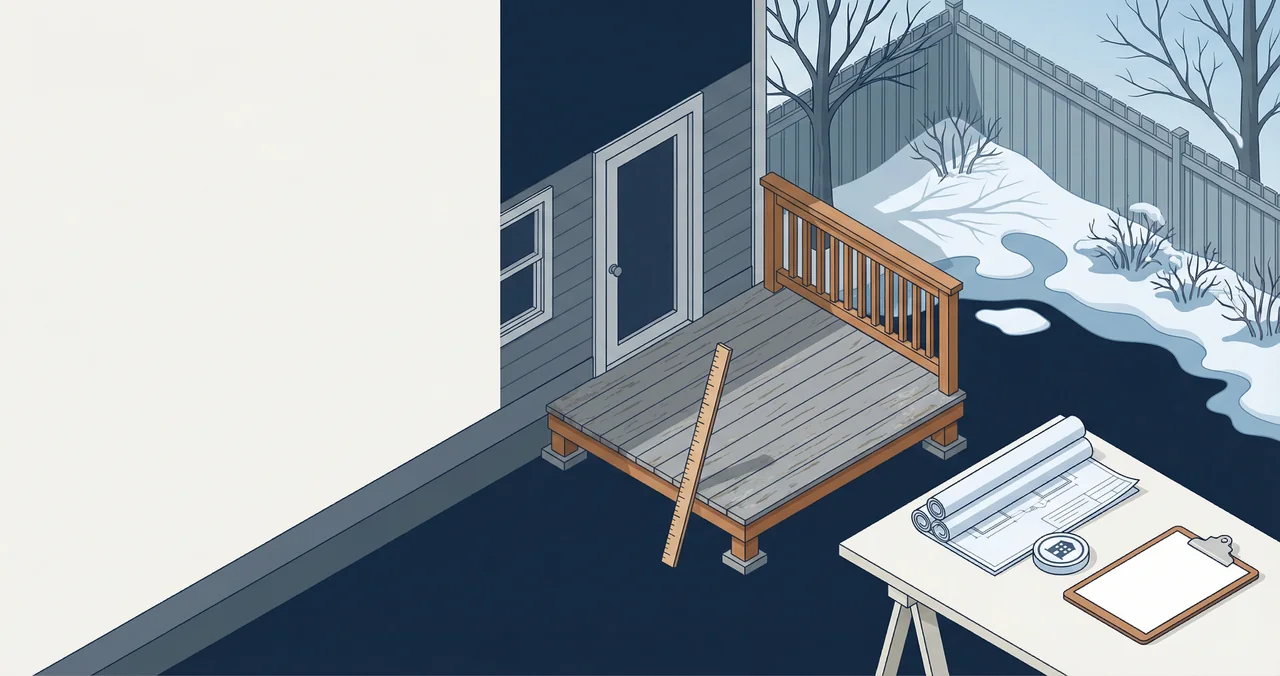
If your deck boards are rotting, warped, or showing their age, you're probably wondering whether you need to pull a permit just to replace them. In Ontario, replacing deck boards typically does not require a building permit — as long as you're only swapping boards and not altering the structure, framing, or footings.
But there are important exceptions. If you're changing the deck's size, altering the support structure, or upgrading from wood to composite (which can affect load calculations), you may need a permit. Here's what you need to know.
When Deck Board Replacement Doesn't Require a Permit
Most municipalities in Ontario follow the Ontario Building Code (OBC), which generally allows "like-for-like" repairs without a permit. Replacing deck boards falls into this category if:
🏗️ Planning a deck project?
Get a free manual project review, or visualize your dream deck with AI before requesting quotes.
- You're only replacing the walking surface (the boards people step on)
- The existing joists, beams, posts, and footings remain unchanged
- The deck's size, height, and configuration stay the same
- You're using similar materials (e.g., pressure-treated boards for pressure-treated boards)
For example, if your 12x16 deck has rotting pressure-treated boards and you're installing new pressure-treated boards of the same thickness, you don't need a permit. The structural elements — joists, beams, ledger board, footings — aren't being touched.
What Qualifies as "Like-for-Like"
- Replacing 5/4x6 pressure-treated boards with new 5/4x6 pressure-treated boards
- Swapping out damaged 2x6 cedar boards with new 2x6 cedar boards
- Removing warped boards and installing identical replacements
- Reusing the same fastening method (screws or nails)
This type of work is considered maintenance, not construction or alteration. You're restoring the deck to its original condition, not changing its design or capacity.
When You DO Need a Permit for Deck Board Replacement
There are situations where replacing deck boards crosses into permit territory. If any of these apply, you'll likely need approval from your local building department:
1. Changing Material Types (Wood to Composite)
Switching from wood to composite decking can trigger a permit requirement. Why? Composite decking is significantly heavier than wood, and your existing joist structure may not be rated for the additional load.
- Pressure-treated decking: ~2.5 lbs per square foot
- Composite decking: ~4-6 lbs per square foot
If your joists are spaced at 16 inches on center (common for wood decks), they may not meet span requirements for composite. The Ontario Building Code requires stricter joist spacing for heavier materials — often 12 inches on center for composite.
In Kitchener-Waterloo-Cambridge, building inspectors want to see calculations proving your deck can handle the extra weight. If you can't provide those, you'll need a permit (and possibly structural upgrades). Learn more about material choices in our guide to composite vs wood decking in Ontario.
2. Replacing Joists or Framing Components
If you're replacing deck boards and repairing or upgrading the joists, beams, or ledger board, you need a permit. Once you touch the structural framing, it's no longer simple maintenance — it's a structural repair.
Building inspectors will want to verify:
- Joist size and spacing meet current code
- Ledger board attachment is done correctly (critical for safety)
- Flashing and moisture protection are installed properly
- Joist hangers and hardware meet structural requirements
If your deck was built before 2012 (when Ontario updated its deck safety requirements), inspectors may require you to bring the entire deck up to current code. That can mean adding blocking, upgrading fasteners, or improving ledger flashing. Read more in our article on ledger board attachment in Ontario.
3. Changing Deck Size or Configuration
If you're replacing boards and extending the deck, adding a new section, or reconfiguring the layout, you need a permit. Any change to the deck's footprint is considered new construction.
Examples:
- Replacing boards on a 10x12 deck and adding 4 feet to make it 10x16
- Removing old boards and reconfiguring the deck from a rectangle to an L-shape
- Replacing boards and adding a new set of stairs
These changes affect the deck's load distribution, footing requirements, and setback compliance. Your municipality will require a site plan, framing drawings, and structural details.
4. Modifying Railings or Stairs
If you're replacing deck boards and altering the railing system or stairs, you'll likely need a permit. In Ontario, any deck more than 24 inches (600 mm) above grade requires a railing. If you're changing the railing height, material, or design, it must meet current code.
Key requirements:
- Railing height: minimum 36 inches (900 mm) for residential decks (42 inches for commercial)
- Baluster spacing: maximum 4 inches (100 mm) to prevent children from slipping through
- Top rail strength: must withstand 200 lbs of horizontal force
Stairs have their own code requirements for rise, run, and handrail placement. Learn more in our guide to deck stairs code in Ontario.
How to Verify Your Local Rules
While the Ontario Building Code provides the baseline, municipalities can set their own rules. Kitchener, Waterloo, and Cambridge each have slightly different interpretations of what requires a permit.
Kitchener
The City of Kitchener generally allows deck board replacement without a permit if the structure remains unchanged. However, if you're also repairing joists or replacing more than 50% of the deck's structural components, they may require a permit.
- Building department: 519-741-2345
- Online portal: kitchener.ca/building
- See our Kitchener deck permit guide for full details
Waterloo
Waterloo takes a similar approach. Board replacement is considered maintenance, but switching materials or touching framing components triggers a permit.
- Building department: 519-886-1550
- Online portal: waterloo.ca/building
- See our Waterloo deck permit guide
Cambridge
Cambridge follows Ontario Building Code standards. Cosmetic repairs don't need permits, but structural changes do.
- Building department: 519-740-4680
- Online portal: cambridge.ca/building
- See our Cambridge deck permit guide
Pro tip: Call or email your building department before starting work. A 5-minute conversation can save you from a stop-work order or fines.
What Happens if You Replace Boards Without a Required Permit?
If you do work that requires a permit and don't get one, you're risking:
- Stop-work orders: If a building inspector or neighbor reports unpermitted work, the city can order you to stop immediately
- Fines: Municipalities can fine you $500-$5,000 for unpermitted work
- Retroactive permit fees: You'll still need to pull a permit after the fact, and some cities charge double fees for unpermitted work
- Insurance issues: If your deck fails or causes injury, your homeowner's insurance may deny coverage if the work wasn't permitted
- Resale complications: When you sell your home, unpermitted work can delay or derail the sale
If you're unsure whether your project needs a permit, err on the side of caution. Permit fees in KWC range from $150-$400 — a small price compared to the risks of skipping the process.
How Much Does It Cost to Replace Deck Boards in Ontario?
If you're hiring a contractor to replace your deck boards, here's what to expect in the KWC market (2026 pricing):
Pressure-Treated Board Replacement
- Material cost: $4-$8 per square foot (boards + fasteners)
- Labour cost: $8-$15 per square foot
- Total installed: $12-$23 per square foot
For a 200-square-foot deck, budget $2,400-$4,600 for board replacement.
Composite Board Replacement
- Material cost: $10-$18 per square foot (boards + hidden fasteners)
- Labour cost: $10-$18 per square foot
- Total installed: $20-$36 per square foot
For a 200-square-foot deck, budget $4,000-$7,200 for composite board replacement.
Keep in mind that switching to composite may require joist reinforcement or additional framing work, which adds $8-$15 per square foot to the total cost.
For a full breakdown of deck costs in your area, see our guides for Kitchener, Waterloo, and Cambridge, or check our Ontario deck expense guide for the full picture.
DIY vs Hiring a Contractor for Deck Board Replacement
Replacing deck boards is one of the more accessible DIY projects — if you're comfortable with power tools and have a weekend to spare.
DIY Considerations
- Skill level: Intermediate. You'll need a circular saw or miter saw, drill, and measuring skills
- Time: 1-2 days for a 200-square-foot deck
- Cost savings: $1,600-$3,000 in labour (pressure-treated), $2,000-$3,600 (composite)
- Risk: If you don't maintain proper board spacing, use incorrect fasteners, or miss structural issues, you could create bigger problems
When to Hire a Pro
- You're switching from wood to composite and need joist evaluation
- You discover rot or damage in the joists while removing old boards
- The deck is elevated or has complex angles (harder to work safely)
- You want the job done quickly without sacrificing quality
A professional deck builder can spot structural issues you might miss, ensure proper fastening, and maintain consistent board spacing for drainage. Get quotes from at least three contractors and ask these essential questions.
What to Check While Replacing Deck Boards
If you're pulling up old deck boards, take the opportunity to inspect the structure underneath. Here's what to look for:
Joist Condition
- Rot or decay: Probe joists with a screwdriver. If it sinks in easily, the wood is compromised
- Sagging or warping: Joists should be straight. Significant sagging indicates overloading or undersized framing
- Insect damage: Look for tunnels, sawdust, or hollow-sounding wood (signs of carpenter ants or termites)
If you find joist damage, you'll need to repair or replace them — which means pulling a permit. Learn more about joist sizing and span requirements.
Ledger Board and Flashing
The ledger board (where the deck attaches to your house) is the most critical structural connection. Check for:
- Rot behind the ledger: Water infiltration can rot both the ledger and your home's rim joist
- Missing or damaged flashing: Flashing diverts water away from the ledger. Without it, rot is inevitable
- Loose or corroded fasteners: Lag screws or through-bolts should be tight and rust-free
If you see any issues here, address them immediately. Ledger failure is the leading cause of deck collapses. Read our guide on ledger board flashing in Ontario.
Joist Tape and Moisture Protection
If your deck was built in the last 10 years, joists may have protective tape on top to prevent moisture from the deck boards causing rot. If the tape is torn or missing, consider adding it during board replacement.
- Cost: $15-$30 per 50-foot roll
- Lifespan: 15-20 years
- ROI: Extends joist life significantly, especially in Ontario's freeze-thaw climate
Learn more about joist tape in Ontario.
🎨 Not sure which material to pick?
Upload a photo of your backyard and see exactly how Trex, TimberTech, or cedar would look — free and instant.
Common Questions
Can I replace my deck boards myself without a contractor?
Yes, if you're only replacing boards (not altering the structure), it's a manageable DIY project. You'll need a circular saw, drill, measuring tape, and basic carpentry skills. Budget 1-2 days for a typical 200-square-foot deck. If you're switching to composite or find structural issues, hiring a pro is safer.
Do I need to notify my municipality if I'm replacing deck boards?
Not if you're doing like-for-like board replacement. However, if you're changing materials (wood to composite) or touching any framing components, call your building department first. A quick phone call can clarify whether you need a permit and save you from compliance issues later.
How long do new deck boards last in Ontario?
Pressure-treated boards: 15-20 years with proper maintenance (staining every 2-3 years). Composite boards: 25-30 years with minimal maintenance. Ontario's freeze-thaw cycles are tough on decking, so choose materials rated for Canadian climates. See our composite decking guide for top options.
Can I put composite decking over my existing wood deck frame?
Sometimes, but not always. Composite decking is heavier than wood and requires tighter joist spacing (often 12 inches on center vs 16 inches for wood). If your joists are spaced too far apart or undersized, you'll need to add blocking or sister new joists — which requires a permit. Have a deck builder or structural engineer evaluate your framing before switching materials.
What's the best time of year to replace deck boards in Ontario?
Spring and fall are ideal. Spring (April-June) offers mild temperatures and lets you complete the project before summer entertaining. Fall (September-October) gives you dry weather and prepares your deck for winter. Avoid replacing boards in extreme heat (boards can expand and buckle) or during wet seasons (harder to work, moisture trapped under new boards). Learn more about timing your deck project.
Upload a backyard photo and preview real decking materials with AI — free, instant, no sign-up.
Permits, costs, material comparisons, and questions to ask before requesting quotes — delivered to your inbox.