
Can You Build a Deck in Winter in Ontario?
Yes, you can build a deck in winter in Ontario with the right conditions. Learn temperature limits, concrete curing, permit timelines, and builder availability.
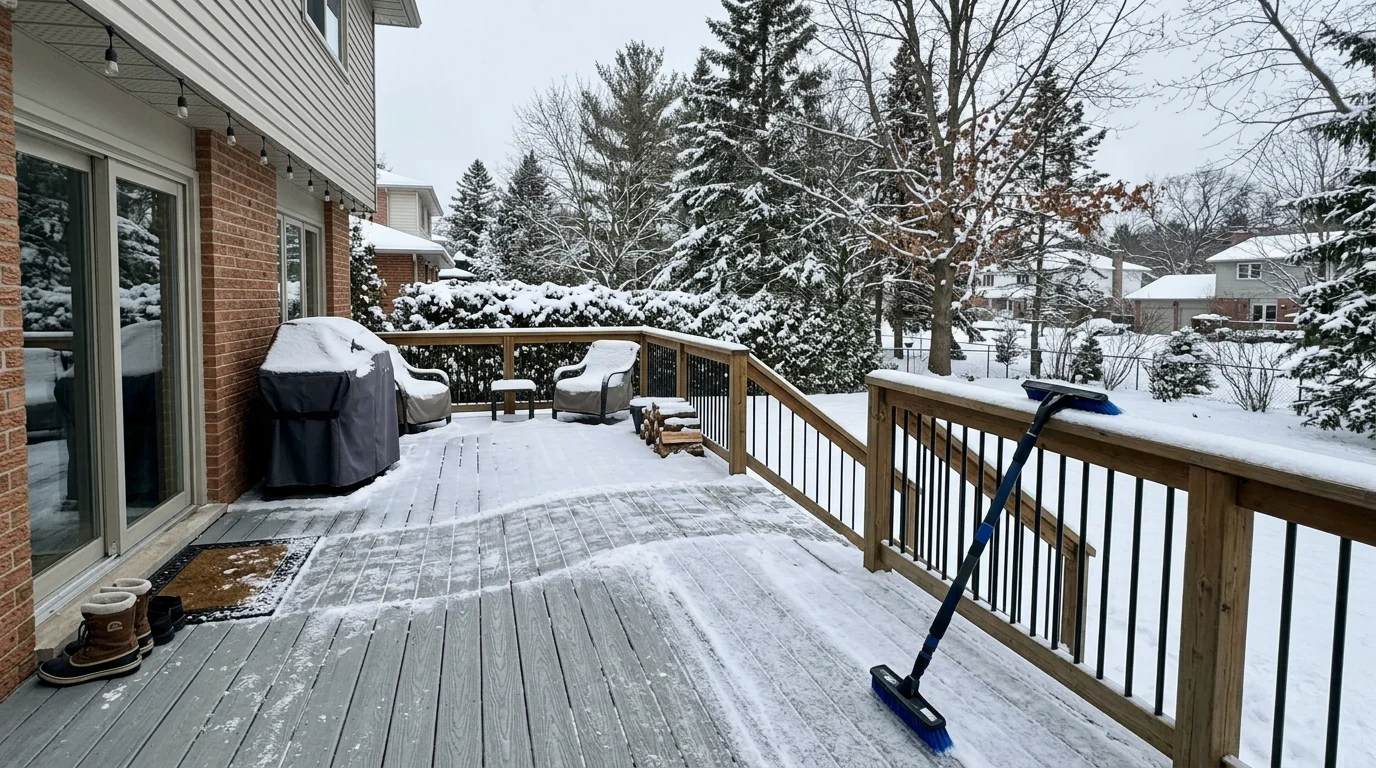
You can build a deck in winter in Ontario, but success depends on temperature, ground conditions, and the right construction methods. Most builders stop taking projects when temperatures consistently drop below -10°C, though experienced crews can work in cold weather with proper techniques.
Winter deck construction isn't impossible—it's just more complicated and expensive than spring or summer builds.
Temperature Limits for Winter Deck Construction
Concrete curing is the biggest limiting factor. Standard concrete needs temperatures above 5°C for at least 7 days to cure properly. Below that, you need expensive additives and insulated blankets to protect footings.
🏗️ Planning a deck project?
Get a free manual project review, or visualize your dream deck with AI before requesting quotes.
Your builder will likely refuse concrete work when:
- Daytime temperatures stay below 0°C
- Ground is frozen more than 6 inches deep
- Nighttime lows drop below -15°C consistently
Lumber and composite decking can be installed in cold weather, but materials behave differently:
- Pressure-treated lumber is more brittle below -10°C and prone to splitting
- Composite decking contracts in cold—expect wider gaps until spring expansion
- Fasteners and metal hardware become brittle; pre-drilling is essential
- Battery-powered tools drain faster in freezing temperatures
Most professional builders in Kitchener-Waterloo-Cambridge won't schedule new deck projects between mid-December and late February. The few who do winter work charge 10-20% premium for the added complexity.
Footing Installation Challenges in Frozen Ground
Ontario requires deck footings at 48 inches (1.2 m) minimum to get below the frost line. Digging through frozen clay soil is brutal.
Concrete Footings in Winter
If you're using sonotube footings, your builder needs to:
- Excavate before ground freezes solid (late November deadline in KWC)
- Pour concrete with accelerated admixtures that cure in cold temperatures
- Cover footings with insulated blankets for 7-10 days
- Heat the concrete if temperatures drop below -5°C
Concrete accelerators add $50-100 per footing. Insulated blankets and heating equipment add labour costs. You're looking at $200-350 per footing instead of the typical $100-150 in warm weather.
Helical Piles: The Winter Footing Advantage
Helical piles are the best option for winter deck builds. They screw into the ground mechanically—no concrete, no curing time, no waiting for warm weather.
Advantages in winter:
- Can be installed year-round regardless of temperature
- Frozen ground often makes installation easier (less shifting)
- No curing time—framing can start immediately
- Avoid spring thaw settling issues
Expect $150-300 per pile installed. They're more expensive than sonotube footings in summer, but comparable in winter once you factor in concrete cold-weather costs.
For a typical 12x16 deck, you'll need 8-12 helical piles. Learn more about helical piles vs. concrete footings in KWC.
Permit Processing in Winter
KWC municipalities process deck permits year-round, but expect slower turnaround between December and February.
| Municipality | Typical Permit Time (Summer) | Winter Permit Time |
|--------------|------------------------------|-------------------|
| Kitchener | 2-3 weeks | 3-5 weeks |
| Waterloo | 2-4 weeks | 4-6 weeks |
| Cambridge | 3-4 weeks | 4-7 weeks |
Building department staff take vacations during the holidays. Inspectors have fewer active construction sites, but they're also dealing with storm damage calls and heating system emergencies.
Inspection scheduling can be tricky. If your deck is partially completed and snow buries the framing, you'll need to clear it before the inspector arrives. Some municipalities won't schedule inspections if temperatures are below -15°C or if snow depth exceeds 15 cm.
You'll still need deck permit drawings and compliance with setback rules. Winter doesn't change code requirements.
Builder Availability and Pricing
Most deck builders in Kitchener-Waterloo-Cambridge shut down between mid-December and late March. The few who work through winter often focus on:
- Completing fall projects that ran over schedule
- Interior renovations and basement work
- Repair and warranty work
If you find a builder willing to take a winter deck project, expect:
- 10-20% premium over spring/summer pricing
- Longer project timeline (weather delays)
- Limited crew availability (smaller teams in winter)
- More flexible scheduling (fewer competing projects)
Winter pricing in 2026:
- Pressure-treated deck installed: $50-75/sqft (vs. $45-65/sqft in summer)
- Composite deck installed: $75-110/sqft (vs. $65-95/sqft in summer)
- Labour premium: $30-50/sqft (vs. $25-45/sqft in summer)
Some builders offer off-season discounts if you book in winter for spring construction. You might save 5-10% by locking in your project early—see our detailed breakdown of deck costs across Ontario for baseline pricing to compare against.
Best Winter Build Scenarios
Winter deck construction makes sense in specific situations:
1. Urgent structural repairs: If your old deck is dangerous and needs immediate replacement, winter build beats waiting 4-6 months for spring.
2. Helical pile foundation: If you're using helical piles instead of concrete, you eliminate the biggest cold-weather barrier.
3. Covered or heated workspace: If your deck is under an overhang or your builder has temporary enclosures, temperature issues are manageable.
4. Mild winter windows: If you hit a stretch of +5°C temperatures in January or February, experienced builders can move fast.
5. Material delivery advantages: Suppliers often have better stock in winter when demand drops. You'll get first choice on premium materials.
Winter is not ideal for:
- Large elevated decks requiring extensive concrete work
- Low decks close to grade (snow and ice access issues)
- Projects with complex stairs requiring precise measurements (wood movement in cold)
Material Performance in Cold Weather
Pressure-Treated Lumber
Pressure-treated lumber can be installed in winter, but watch for:
- Splitting: Pre-drill all screw holes when temperatures drop below -10°C
- Moisture content: Wet lumber freezes solid and becomes difficult to work with
- Expansion: Cold lumber will expand significantly in spring/summer heat
If you install pressure-treated decking in January, expect 1/8-inch gaps to tighten to 1/16 inch by July. Plan board spacing accordingly.
Composite Decking in Winter
Composite decking contracts in cold weather. If you install composite boards tight against each other at -5°C, they'll buckle when they expand to 30°C in summer.
Manufacturers specify temperature-specific gap spacing:
- Below 0°C: 6-8 mm gaps between boards
- 0-10°C: 5-6 mm gaps
- 10-20°C: 4-5 mm gaps
- Above 20°C: 3-4 mm gaps
Most builders avoid installing composite decking below -5°C because boards become brittle and prone to chipping during cutting.
Read more about composite deck maintenance in Ontario's freeze-thaw climate.
Metal Hardware and Fasteners
Galvanized joist hangers, structural screws, and lag bolts all become more brittle in extreme cold. Installers report increased snapping and stripping of fasteners below -15°C.
Your builder should:
- Store fasteners in heated areas before installation
- Pre-drill pilot holes for all lag screws
- Avoid over-torquing (metal is less forgiving when frozen)
- Use stainless steel hardware when possible (less temperature sensitivity)
Alternative: Book in Winter, Build in Spring
The smartest winter deck strategy might be planning ahead rather than building immediately.
Here's why booking in winter makes sense:
- Better pricing: Builders offer 5-10% discounts for off-season bookings
- First priority: Your project gets scheduled for early spring (April/May)
- More time for permits: Submit permits in January, get approved by March
- Material pre-ordering: Lock in pricing before spring demand spikes
If you contact a builder in February and schedule for late April, you'll avoid:
- Winter construction premiums
- Concrete curing issues
- Weather delays and inspector scheduling problems
- Material performance concerns
You'll also have time to properly plan deck design details, review builder contracts, and secure your permit approval.
What Professional Builders Say
Most experienced deck builders in KWC stop scheduling new projects after mid-November. They'll finish existing work into December, but won't break ground on new projects until March or April.
Why builders avoid winter deck construction:
- Concrete work requires expensive cold-weather additives
- Lumber and composite materials behave unpredictably in extreme cold
- Snow removal adds unpaid labour time
- Tool performance degrades (batteries, adhesives, caulking)
- Inspection delays when weather shuts down municipal services
- Higher insurance costs for cold-weather work
- Crew retention issues (workers prefer indoor winter projects)
The builders who do work in winter typically:
- Specialize in emergency repairs
- Use helical pile foundations exclusively
- Have heated material storage and workspace
- Charge significant premiums to make it worthwhile
If a builder offers you a winter deck build at normal spring prices, be suspicious. Either they're desperate for work (red flag) or they're underestimating costs (which will surface later).
🎨 Not sure which material to pick?
Upload a photo of your backyard and see exactly how Trex, TimberTech, or cedar would look — free and instant.
Common Questions
Can you pour concrete for deck footings in winter in Ontario?
Yes, but you need cold-weather concrete additives and insulated blankets to maintain curing temperatures above 5°C for 7-10 days. Standard concrete won't cure properly below this temperature. Expect to pay $50-100 extra per footing for accelerators and protective measures. Most builders recommend helical piles instead, which eliminate concrete entirely and work in any temperature.
What's the coldest temperature you can build a deck in Ontario?
Most professional builders stop working when temperatures consistently fall below -10°C. Lumber becomes brittle, composite decking contracts excessively, and fasteners are prone to snapping. Concrete work becomes impractical below 5°C without expensive cold-weather measures. The safest winter deck builds happen during mild stretches between 0-10°C with helical pile foundations.
Do I still need a deck permit if I build in winter?
Yes. Deck permits in Kitchener-Waterloo-Cambridge are required year-round regardless of season. Winter construction doesn't change code requirements for footing depth, railing height, or structural specifications. Expect 3-7 week permit processing in winter due to holiday slowdowns and reduced municipal staffing.
Is it cheaper to build a deck in winter?
Sometimes. If you book a project in winter for spring construction, you might save 5-10% through off-season discounts. But if you actually build in winter, expect to pay 10-20% more due to concrete cold-weather additives, slower work pace, material handling challenges, and limited builder availability. The cheapest approach is booking in February for April construction.
Can composite decking be installed in freezing temperatures?
Composite decking can technically be installed below freezing, but manufacturers don't recommend it below -5°C. Cold composite boards contract significantly and become brittle. If you install boards too tight together in winter, they'll expand and buckle in summer heat. You need to leave 6-8 mm gaps between boards when installing below 0°C. Most professional installers prefer to wait for warmer weather to avoid thermal expansion issues and material waste from cold-weather brittleness.
Upload a backyard photo and preview real decking materials with AI — free, instant, no sign-up.
Permits, costs, material comparisons, and questions to ask before requesting quotes — delivered to your inbox.