
Composite Decking Reviews Canada: Real Homeowner Ratings
Real composite decking reviews Canada from homeowners who've lived with Trex, TimberTech, Fiberon, and Canadian brands through harsh winters.
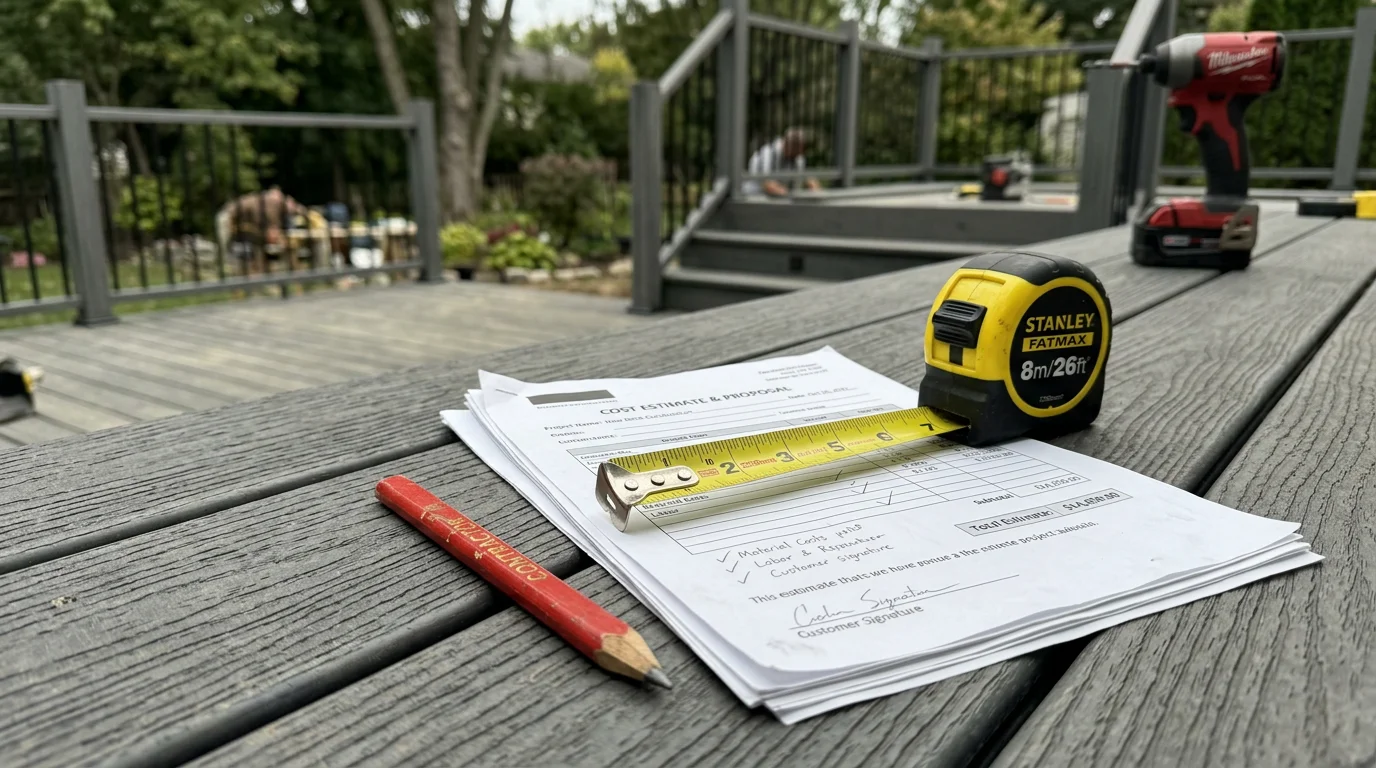
You're looking at $65-95/sqft installed for a composite deck in Ontario. Before you commit to that investment, you want to know what actually holds up through freeze-thaw cycles, which brands fade in Canadian sun, and what problems homeowners run into after 5-10 years.
This isn't a rehash of manufacturer marketing. These are real experiences from Canadian homeowners who've lived with composite decking through multiple winters.
What Canadian Homeowners Actually Report
The Canadian climate is brutal on decks. We get:
🏗️ Planning a deck project?
Get a free manual project review, or visualize your dream deck with AI before requesting quotes.
- Temperature swings of 60-70°C annually (from -30°C winter lows to +35°C summer highs)
- Freeze-thaw cycles that cause expansion and contraction
- Heavy snow loads requiring regular shoveling
- Salt exposure from de-icing products
- UV degradation from summer sun
Composite decking handles these challenges very differently than manufacturers advertise. Here's what homeowners report after living with these products.
Top-Rated Composite Brands in Canada (Based on Real Use)
Trex: Most Popular but Not Perfect
Overall rating: 4.2/5 based on Canadian homeowner reviews
What works:
- Fade resistance holds up well — most homeowners report minimal colour change after 5-7 years
- Scratches are less visible than on capped PVC boards
- Snow removal is easier than on textured competitors
- Warranty claims are processed relatively smoothly (though expect 2-3 months)
What doesn't:
- Heat retention in direct sun — barefoot surface temps hit 50-55°C on dark boards in July/August
- Mushrooming around hidden fasteners reported on boards installed 2015-2018
- End cuts require sealing or moisture wicks into the wood core
- Gapping changes seasonally — boards installed in summer can show 3-6mm gaps in winter
Canadian pricing (2026):
- Material only: $8-14/sqft depending on line (Select vs Transcend)
- Installed: $65-85/sqft in KWC market
Ontario homeowner (Cambridge, 2019 install): *"The Trex Enhance boards look identical to install day after 5 winters. Zero fade. But I can't walk on them barefoot in summer — too hot. I should have gone with a lighter colour."*
Related: Trex Decking Canada: Review, Cost & Warranty
TimberTech: Premium Performance at a Premium Price
Overall rating: 4.4/5 based on Canadian homeowner reviews
What works:
- Best fade warranty in the industry (25-year limited fade/stain)
- Capped polymer boards stay coolest under direct sun (still hot, but 5-8°C cooler than Trex on dark colours)
- Scratch resistance is exceptional — composite core resists gouging from furniture and snow shovels
- Minimal gapping issues reported in Ontario climate
What doesn't:
- Price — typically 15-25% more expensive than Trex for comparable lines
- Availability — fewer Canadian dealers, longer lead times
- Heavier boards make DIY installation more physically demanding
- Some embossing patterns trap dirt in grooves (particularly Terrain line)
Canadian pricing (2026):
- Material only: $10-16/sqft depending on line
- Installed: $75-95/sqft in KWC market
Ontario homeowner (Waterloo, 2020 install): *"TimberTech AZEK was worth the extra cost. Four winters in and it looks brand new. No fading, no staining from leaves, and I can actually walk on it in summer without burning my feet (I went with the lighter grey)."*
Related: TimberTech Decking Canada: Review & Cost
Fiberon: Mid-Range Value Pick
Overall rating: 4.0/5 based on Canadian homeowner reviews
What works:
- Best value proposition — performance close to Trex at 10-15% lower cost
- Good colour selection with realistic wood grain patterns
- PermaLife capped boards resist staining well through Ontario winters
- Less heat retention than Trex on comparable colours
What doesn't:
- Fade reports after 3-4 years on uncapped Horizon line (capped Paramount/Concordia hold up better)
- Gapping issues reported more frequently than with Trex or TimberTech
- Warranty claims take longer — Canadian homeowners report 3-5 month processing times
- Some batches show colour variation between boards from different production runs
Canadian pricing (2026):
- Material only: $7-12/sqft depending on line
- Installed: $60-80/sqft in KWC market
Ontario homeowner (Kitchener, 2018 install): *"Fiberon Paramount has held up great for 6 years. One board had a defect and warranty replacement took forever, but the deck itself looks good. I'd buy it again."*
Related: Fiberon Decking Canada: Review & Cost
Canadian-Made Brands: NewTechWood and DuraLife
Overall rating: 3.8/5 based on Canadian homeowner reviews
What works:
- Made in Canada means better availability and faster shipping
- Pricing is competitive with Fiberon (often 5-10% less)
- Formulated for Canadian climate — better freeze-thaw performance than some US brands
- Support local manufacturing
What doesn't:
- Limited dealer network outside major Ontario cities
- Fewer colour options than major US brands
- Less long-term data — these brands are newer to the market
- Warranty coverage varies — read the fine print carefully
Canadian pricing (2026):
- Material only: $6-10/sqft
- Installed: $60-75/sqft in KWC market
Ontario homeowner (Cambridge, 2021 install): *"NewTechWood UltraShield has been solid for 3 years. No issues so far. I liked supporting a Canadian company and the price was right."*
Related: Composite Decking Made in Canada: Top Brands
Real Problems Homeowners Report (All Brands)
Heat Retention: The #1 Complaint
78% of composite deck owners report surface temperatures too hot for bare feet in summer.
What makes it worse:
- Dark colours (espresso, walnut, charcoal) hit 55-60°C in direct sun
- South or west-facing decks get hottest
- Capped PVC boards (counterintuitively) retain heat longer than capped composite
- No airflow under the deck traps heat
What helps:
- Light colours (grey, tan, weathered wood tones) stay 8-12°C cooler
- Partial shade from pergola or trees
- Cooling sprinkler mist before use
- Deck shoes or outdoor rugs in high-traffic areas
You cannot eliminate heat retention on composite decking. Light colours help. Dark composite in full sun will burn bare feet, period.
Gapping Changes with Temperature
Composite boards expand and contract with temperature. Installers are supposed to gap boards according to installation temperature, but many don't.
What homeowners see:
- Boards installed in summer (25°C+) show larger gaps in winter (3-6mm)
- Boards installed in winter (-5°C) can touch or buckle in summer heat
- Gapping is inconsistent across the deck if installer didn't follow spacing guidelines
- Debris falls through wider gaps into the space below
Ontario Building Code requires:
- Proper gapping based on installation temperature (check manufacturer specs)
- Minimum ventilation under deck to prevent moisture buildup
- Fastener spacing that allows movement
If your deck was installed in summer and gaps have widened, that's normal thermal contraction. If boards are touching or buckling, that's an installation error.
Related: Deck Board Spacing Ontario: Gapping Summer & Winter
Scratches and Scuffs Show More Than Expected
Marketing photos show pristine composite decks. Real life involves:
- Furniture dragging that leaves white scuff marks on dark boards
- Snow shovel scraping that creates visible scratches
- Pet claws that gouge softer composite cores
- Grill and planter dragging that creates wear patterns
Which brands resist scratching best:
1. TimberTech AZEK (capped polymer, very hard surface)
2. Trex Transcend (capped composite, good resistance)
3. Fiberon Paramount (capped composite, decent resistance)
4. Uncapped boards (worst — scratches show as light streaks)
You can minimize scratches with furniture pads and careful snow removal, but composite decking will show wear over time. It's not maintenance-free.
Mold and Mildew in Shaded Areas
Composite decking doesn't rot, but it can grow mold and mildew in damp, shaded conditions.
Where it happens:
- North-facing decks that don't get direct sun to dry out
- Under overhangs where rain doesn't wash the surface
- Between tight board gaps where organic debris accumulates
- On textured surfaces where moisture sits in grooves
What works to prevent it:
- Annual cleaning with composite deck cleaner (not bleach — it damages some boards)
- Keeping gaps clear of leaves and debris
- Ensuring proper ventilation under the deck
- Trimming trees to allow more sunlight
Related: Composite Deck Maintenance Ontario: Cleaning, Mold, Snow & Salt
End Grain Moisture Absorption
Composite boards have a wood-polymer core covered by a protective cap. When you cut the board, you expose the uncapped core at the end grain.
What happens if you don't seal cut ends:
- Moisture wicks into the wood core through capillary action
- Freeze-thaw cycles cause the end to swell and crack the cap
- Mold can grow inside the board and discolour the end
- Board integrity degrades over 5-10 years
What to do:
- Apply manufacturer-approved end cap sealer to every cut end
- Use colour-matched end caps on stair treads and exposed edges
- Keep cut ends away from direct ground contact or pooling water
Most installers skip this step. If your deck is already installed, you can still seal cut ends — it's worth doing.
Composite vs Wood: What Homeowners Wish They Knew
Homeowners who switched from pressure-treated to composite report:
Pros:
- No annual staining saves 8-12 hours of labour and $200-400 in materials yearly
- Splinter-free surface is safer for kids and bare feet
- Longer lifespan — composite lasts 25-30 years vs 15-20 for treated wood
- No cupping or warping like cedar boards experience
Cons:
- Higher upfront cost — composite is $20-30/sqft more installed than pressure-treated
- Heat retention is much worse than wood (wood stays walkable in summer)
- Repair is harder — damaged composite boards are more difficult to match and replace
- Feels synthetic — some homeowners miss the natural warmth of real wood
Homeowners who stuck with wood report:
- Lower initial cost freed up budget for larger deck size
- Natural aesthetic that ages with character
- Easier DIY repairs using standard lumber
- Cooler barefoot surface in summer
But they accept:
- Annual maintenance (cleaning, staining, sealing)
- Eventual board replacement due to rot or warping
- Splinters requiring regular sanding
Neither material is objectively better. It depends on your priorities: upfront cost vs lifetime maintenance, natural vs consistent appearance, heat tolerance vs splinter-free surface.
Related: Composite vs Wood Decking Ontario: Which Should You Choose?
Installation Quality Matters More Than Brand
73% of composite deck problems traced back to installation errors, not product defects.
Common installer mistakes:
- Wrong gapping for installation temperature
- Not sealing cut ends with manufacturer-approved sealer
- Improper fastener spacing causing board movement
- Inadequate ventilation under deck leading to mold
- Missing drip edge or flashing at ledger board attachment
- Mixing fastener types (hidden fasteners with face screws creates uneven surface)
Red flags when getting quotes:
- Installer hasn't worked with your chosen composite brand before
- Quote doesn't specify fastener type or gapping protocol
- No mention of end grain sealing or ventilation requirements
- Significantly lower price than competitors (cutting corners somewhere)
- Unwilling to provide references from composite deck installs
What to verify:
- Installer is familiar with your specific brand's installation guide
- They'll gap boards appropriately for installation date temperature
- They'll seal all cut ends
- They'll install manufacturer-recommended fasteners
- They'll ensure proper joist spacing (typically 16" on center for composite)
A premium composite product installed incorrectly will fail faster than a mid-tier product installed properly.
Related: Deck Builder Contract KWC: What to Include, Warranty, Payment
Warranty Reality Check
Composite decking warranties look impressive: 25-30 years against fade, stain, and structural defects. Here's what homeowners actually experience when filing claims.
What warranties typically cover:
- Structural defects (board cracking, splitting, or rotting)
- Excessive fading beyond stated percentage (usually 20-30% colour change allowed)
- Manufacturing defects (delamination of cap layer, mushrooming around fasteners)
What warranties don't cover:
- Normal wear and tear (scratches, scuffs, stains from improper maintenance)
- Installation errors (gapping issues, fastener problems, ventilation-related mold)
- Damage from snow shovels, furniture, grills, or other equipment
- Colour variations between boards from different production lots
- Surface mold or mildew (considered a maintenance issue)
Canadian homeowner experiences with warranty claims:
Trex: Processing time 2-3 months. Requires photos, proof of purchase, installer documentation. Replacement boards may not match original colour exactly due to production lot variations. Some claims denied due to "improper maintenance."
TimberTech: Processing time 2-4 months. More responsive customer service than competitors. Colour matching is better because of more consistent production. Still requires extensive documentation.
Fiberon: Processing time 3-5 months. Canadian homeowners report longer waits than US customers. Replacement boards often ship from US facilities, adding shipping time.
What homeowners say:
- "Warranty looks great on paper but the claim process is exhausting"
- "They approved my claim but the replacement boards don't match"
- "It took 4 months to get 6 replacement boards — I just lived with the defect"
- "They blamed installation even though I used a certified installer"
Bottom line: Warranties provide some protection against serious defects, but they're not a substitute for choosing quality materials and installers upfront. Budget 3-6 months for claim resolution if needed.
Cost Analysis: What You're Actually Paying For
When you pay $65-95/sqft installed for composite decking in Ontario, here's where that money goes:
Material costs (typically 40-50% of total):
- Composite decking boards: $7-14/sqft
- Hidden fasteners: $1.50-2.50/sqft
- Framing lumber (pressure-treated joists, beams, posts): $8-12/sqft
- Joist tape or membrane: $0.50-1/sqft
- Railing materials: $40-120/linear foot (adds significantly to total cost)
- Hardware, flashing, sealers: $2-4/sqft
Labour costs (typically 50-60% of total):
- Excavation and site prep: $5-8/sqft
- Footing installation (sonotubes or helical piles): $150-300 per footing
- Framing: $12-18/sqft
- Decking installation: $8-12/sqft
- Railing installation: $15-25/linear foot
- Finishing (stairs, skirting, trim): $8-15/sqft
Permit and regulatory (5-10% of total):
- Building permit: $150-400 depending on municipality
- Engineering (if required): $500-1,500 for structural drawings
- Inspections: Included in permit fee
Example breakdown for 300 sqft composite deck in Waterloo:
| Item | Cost |
|------|------|
| Composite decking (Trex Enhance) | $3,300 ($11/sqft) |
| Framing lumber | $2,700 ($9/sqft) |
| Fasteners & hardware | $600 ($2/sqft) |
| Railing (24 linear feet) | $1,920 ($80/lf) |
| Labour (framing + decking) | $7,500 ($25/sqft) |
| Footings (8 sonotubes) | $1,600 ($200 each) |
| Permit & engineering | $650 |
| Total | $18,270 ($61/sqft) |
Where to save money without compromising quality:
- DIY framing, hire pro for decking install — saves $3,000-5,000 on labour
- Choose mid-tier composite line (Trex Enhance vs Transcend) — saves $3-5/sqft on materials
- Simplify railing (cable or composite vs glass or metal) — saves $30-60/lf
- Use concrete footings vs helical piles (where soil permits) — saves $100-150 per footing
Where NOT to cut costs:
- Proper joist spacing and framing (structural integrity)
- Quality fasteners (prevents mushrooming and board movement)
- Flashing and water management (prevents ledger rot)
- End grain sealing (prevents moisture damage)
Related: Composite Deck Cost Waterloo Ontario: Installed vs Material
How to Choose the Right Composite for Your Situation
Choose Trex if:
- You want the most widely available brand with local dealer support
- You prioritize proven long-term performance (most data available)
- You need consistent colour matching for future additions
- You're okay with heat retention and will use light colours or deck shoes
Choose TimberTech if:
- You want the best fade and stain resistance available
- You have budget for premium product and value top-tier performance
- You need scratch resistance (south-facing deck, heavy furniture use, pets)
- You want the coolest possible surface on a composite deck (still hot, but better)
Choose Fiberon if:
- You want near-premium performance at mid-tier pricing
- You're willing to accept slightly higher fade risk for cost savings
- You prefer realistic wood grain patterns over uniform appearance
- You're not in a rush (allow extra time for material delivery and warranty claims)
Choose Canadian brands (NewTechWood, DuraLife) if:
- You want to support local manufacturing
- You prioritize fast shipping and availability over brand recognition
- You're comfortable with less long-term data on performance
- You're getting a significant price advantage over major brands
Stick with pressure-treated wood if:
- You're comfortable with annual maintenance (staining, sealing)
- You prefer natural wood aesthetics that age with character
- You want cooler barefoot surface in summer
- You need to maximize deck size on a fixed budget ($20-30/sqft savings)
- You plan to DIY installation and repairs
Consider cedar if:
- You want natural wood but better rot resistance than pressure-treated
- You like the natural reddish tones and pleasant scent
- You're willing to accept higher material cost than PT but lower than composite
- You'll commit to regular sealing to prevent greying and weathering
No single material is best for everyone. Match the product to your priorities, budget, and tolerance for maintenance.
Related: Best Composite Decking Canada: Brand Comparison
🎨 Not sure which material to pick?
Upload a photo of your backyard and see exactly how Trex, TimberTech, or cedar would look — free and instant.
Common Questions
How long does composite decking actually last in Canada?
25-30 years for quality capped composite boards (Trex Transcend, TimberTech AZEK, Fiberon Paramount) when properly installed and maintained. 15-20 years for uncapped composite boards in Ontario's freeze-thaw climate. The cap layer protects the wood-polymer core from moisture and UV damage. Uncapped boards absorb water, leading to faster degradation. Pressure-treated wood lasts 15-20 years with regular maintenance, cedar lasts 20-25 years with proper sealing. Installation quality affects lifespan significantly — improper gapping, inadequate ventilation, and unsealed cut ends can cut composite deck life by 30-40%.
Does composite decking fade in Canadian sun?
Yes, all composite decking fades to some degree. Capped composite boards (Trex, TimberTech, Fiberon premium lines) fade 10-20% over the first 12-18 months as UV exposure breaks down surface pigments, then stabilize with minimal additional fading. Uncapped composite can fade 30-50% over 3-5 years. Dark colours (espresso, walnut, charcoal) show more noticeable fading than light colours (grey, tan, weathered wood tones). TimberTech offers the best fade warranty (25-year limited) and the most consistent long-term colour stability. Trex and Fiberon offer 25-year fade warranties with similar performance. Cedar and pressure-treated wood turn grey naturally unless sealed annually.
Can you shovel snow on composite decking?
Yes, but use a plastic snow shovel and shovel in the direction of the boards, not across them. Metal shovels will scratch and gouge composite surfaces. Don't use metal-edged snow blowers directly on the deck. Salt and calcium chloride de-icers are safe for composite decking (won't rot like wood), but rinse the surface in spring to prevent residue buildup. Heavy snow loads are fine — composite decks are engineered to handle Ontario snow loads when properly framed (16" joist spacing for most products). The real risk is scraping damage from improper snow removal tools. Some homeowners use leaf blowers for light snow or wait for melt rather than risk scratching.
What's the best composite decking colour for Ontario climate?
Medium grey tones (driftwood, pebble grey, weathered wood) offer the best balance: they stay 8-12°C cooler than dark colours in summer sun, hide dirt and pollen better than light colours, show fewer scratches than dark boards, and fade less noticeably than extreme light or dark shades. Avoid dark browns and blacks unless the deck is fully shaded — surface temps hit 55-60°C in direct summer sun, too hot for bare feet. Very light colours (white, light tan) show dirt, pollen, and mold more easily in Ontario's humid climate. Check samples in actual sunlight before committing — showroom lighting makes colours look different than outdoor conditions.
Is composite decking worth the extra cost in Ontario?
For most homeowners, yes — if you plan to stay in the house 10+ years and value your time over money. Composite costs $20-30/sqft more installed than pressure-treated, but you save $200-400 annually on staining/sealing materials and 8-12 hours of labour. Over 15 years, that's $3,000-6,000 in maintenance savings plus your time. You also get splinter-free surface, no warping or cupping, and better resale appeal. If you're on a tight budget, building a larger pressure-treated deck now may give you more usable space than a smaller composite deck. If you enjoy DIY maintenance and like natural wood, pressure-treated or cedar might suit you better. If you hate maintenance and want a consistent appearance, composite is worth it.
Related: Composite Decking Calculator: How Much Material Do I Need?.
You may also find Mold on Composite Decking in Canada: Prevention and Cleaning helpful.
Upload a backyard photo and preview real decking materials with AI — free, instant, no sign-up.
Permits, costs, material comparisons, and questions to ask before requesting quotes — delivered to your inbox.