
Does a Floating Deck Need Footings in Ontario?
Floating decks in Ontario need frost-protected foundations. Learn code requirements, footing options, and when permits apply for ground-level decks.
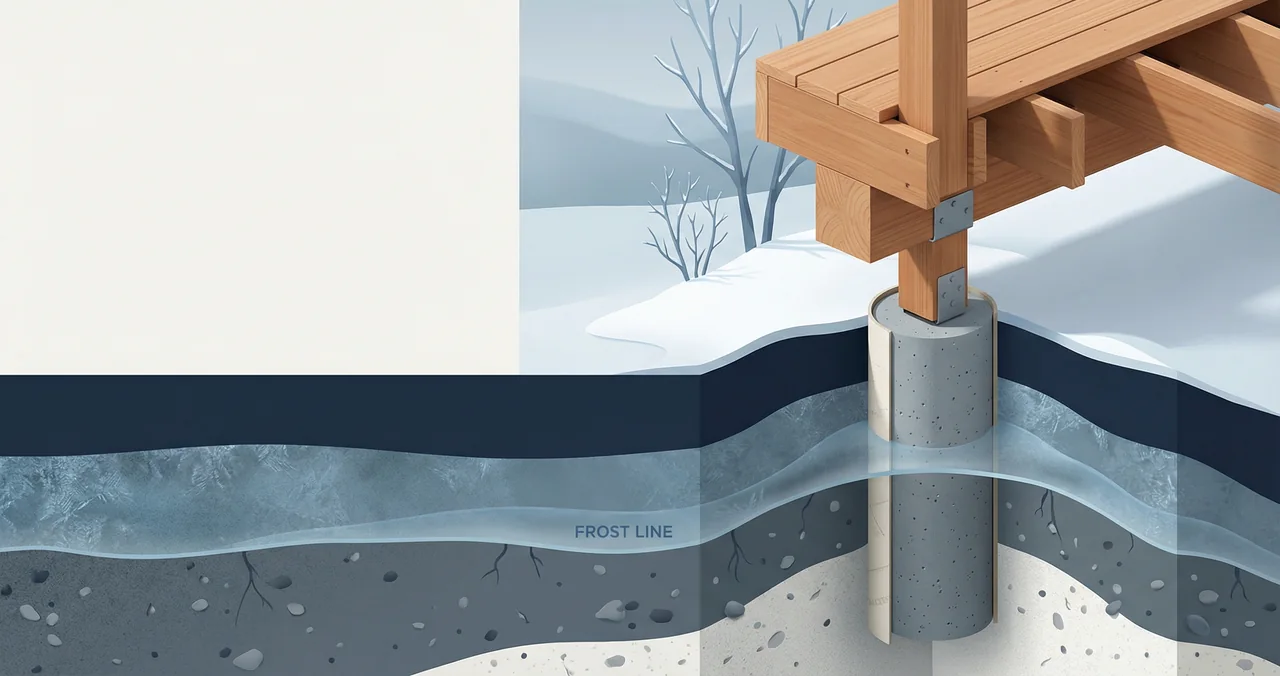
You're planning a floating deck and wondering if you can skip the footings. The short answer: yes, floating decks need footings in Ontario — but they work differently than traditional attached deck footings.
A floating deck (also called a freestanding or grade-level deck) isn't attached to your house. It "floats" on the ground. But that doesn't mean it sits directly on grass or gravel. Ontario's freeze-thaw cycle will heave an improperly supported deck, cracking boards and throwing the structure out of level.
Here's what you actually need to know about footings for floating decks in KWC.
What Makes a Deck "Floating"?
A floating deck has three defining features:
🏗️ Planning a deck project?
Get a free manual project review, or visualize your dream deck with AI before requesting quotes.
- Not attached to your house — no ledger board bolted to the foundation
- Low to the ground — typically less than 24 inches (60 cm) above grade
- Self-supporting — the entire frame rests on its own foundation system
Most floating decks are small: 8x10 feet to 12x16 feet. They're popular for patios, garden spaces, and hot tub pads.
The term "floating" is misleading. The deck doesn't actually float. It's called that because it's structurally independent from your house.
Do Floating Decks Need Footings Under the Ontario Building Code?
Yes. Any deck structure in Ontario requires a foundation that resists frost heave, according to the Ontario Building Code (OBC) Section 9.15.
The OBC doesn't exempt floating decks from foundation requirements. It exempts decks less than 24 inches high and less than 108 square feet from the permit requirement — but that's not the same as exempting them from proper construction.
Here's the distinction:
- Permit-exempt = you don't need to apply for a building permit
- Code-compliant = your deck still needs to meet structural standards
Even if your floating deck doesn't require a permit, it still needs frost-protected footings to prevent settling, heaving, and structural failure.
Why Ontario Soil Conditions Require Footings
Ontario's freeze-thaw cycle is brutal on outdoor structures. When groundwater freezes, it expands. Frost heave can lift a deck several inches in winter, then drop it unevenly when the ground thaws in spring.
In Kitchener-Waterloo-Cambridge, you're dealing with:
- Heavy clay soil that retains moisture and expands when frozen
- Frost line at 48 inches (1.2 m) — the depth where ground stops freezing
- Wet spring conditions that cause settling in poorly supported structures
A floating deck placed directly on gravel or patio stones will shift, crack, and become unsafe within 1-2 freeze-thaw cycles.
Footing Options for Floating Decks in Ontario
You have three code-compliant foundation options for a floating deck. Each resists frost heave differently.
1. Concrete Footings (Sonotube)
The traditional approach: dig holes below the frost line, pour concrete footings, and attach post bases.
How deep?
- 48 inches minimum in KWC (below the frost line)
- 12-inch diameter footings for most residential decks
Cost:
- $40-80 per footing (materials + labour)
- 6-8 footings for a typical 10x12 floating deck
- Total: $240-640
Pros:
- Most affordable option
- Familiar to builders and inspectors
- Permanent solution
Cons:
- Labour-intensive digging (especially in clay)
- Requires concrete mixing or truck delivery
- 3-7 day cure time before building
You'll need to call Ontario One Call (811) before digging to locate buried utilities. See our guide on Ontario One Call requirements.
2. Helical Piles (Screw Piles)
Galvanized steel screws driven into the ground with hydraulic equipment. Popular for floating decks on difficult sites.
How deep?
- Driven to refusal (when torque reading confirms load capacity)
- Typically 4-8 feet deep in KWC soil
Cost:
- $150-300 per pile installed
- 6-8 piles for a 10x12 deck
- Total: $900-2,400
Pros:
- Installed in 1-2 hours (no digging, no curing)
- Works on sloped sites and poor soil
- Adjustable height for leveling
- Can be removed and relocated
Cons:
- Higher upfront cost
- Requires specialized equipment
- May require engineer approval in some municipalities
Learn more in our comparison: Helical Piles vs. Concrete Footings.
3. Precast Deck Blocks (Limited Use)
Concrete blocks with built-in post brackets. Only code-compliant if frost-protected.
Standard deck blocks sitting on gravel are NOT code-compliant in Ontario. Frost will heave them.
To use deck blocks properly:
- Dig holes to frost line depth (48 inches)
- Fill with compacted gravel
- Place blocks on top of gravel base
At that point, you've done the same work as pouring concrete footings — but with a less stable result.
Verdict: Deck blocks are convenient but rarely frost-protected in practice. Most KWC builders don't recommend them for permanent structures.
When Do You Need a Permit for a Floating Deck in KWC?
Permit rules vary by municipality. Here's the breakdown:
Kitchener
- Permit required if deck is 24 inches or higher above grade
- Permit exempt if less than 24 inches AND less than 108 sq ft (10 m²)
- Setback: 2 feet from property lines (4 feet if facing a street)
See step-by-step instructions: Kitchener Deck Permit Application.
Waterloo
- Permit required if deck is 24 inches or higher above grade
- Permit exempt if less than 24 inches AND less than 108 sq ft (10 m²)
- Setback: 1.2 m (4 feet) from rear and side property lines
Full guide: Waterloo Deck Permit Application.
Cambridge
- Permit required if deck is 24 inches or higher above grade
- Permit exempt if less than 24 inches AND less than 108 sq ft (10 m²)
- Setback: 0.6 m (2 feet) from property lines
Details: Cambridge Deck Permit Application.
Important: Even if your floating deck is permit-exempt, you still need to meet setback requirements and use frost-protected footings.
Check your specific property for zoning overlays: How to Check KWC Deck Zoning and Setbacks.
How to Build a Floating Deck with Proper Footings
Here's the standard construction sequence for a code-compliant floating deck:
Step 1: Layout and Excavation
- Mark deck perimeter with stakes and string
- Call Ontario One Call (811) at least 5 business days before digging
- Dig footing holes to 48 inches depth (6-8 holes for a 10x12 deck)
- Space footings 6-8 feet apart along the perimeter
Step 2: Pour Footings
- Insert Sonotube forms into holes
- Level tops using a laser or water level
- Pour concrete and insert post base hardware (Simpson Strong-Tie or equivalent)
- Let cure 3-7 days
Step 3: Frame the Deck
- Install 6x6 posts on footings (or adjustable post bases)
- Build perimeter frame with doubled 2x8 or 2x10 joists
- Install interior joists at 16-inch spacing for composite, 12-inch for wood
- Use joist hangers and structural screws (no nails for structural connections)
For joist sizing, see: Deck Joist Span Table for Ontario.
Step 4: Decking and Finishing
- Install deck boards perpendicular to joists
- Leave proper gaps for drainage (1/8 inch for composite, 1/16 inch for pressure-treated)
- Add fascia boards to hide framing
- Optional: skirting for aesthetics (ensure ventilation to prevent moisture buildup)
Read more: Deck Board Spacing in Ontario.
Floating Deck Footing Costs in KWC (2026)
Here's what you'll pay for footings on a typical 10x12 floating deck (120 sq ft):
| Foundation Type | Material Cost | Labour Cost | Total Cost |
|----------------|---------------|-------------|------------|
| Concrete Footings (6-8 holes) | $120-200 | $120-440 | $240-640 |
| Helical Piles (6-8 piles) | $600-1,200 | $300-1,200 | $900-2,400 |
| Deck Blocks (improper) | $80-150 | $50-150 | $130-300 (not recommended) |
Total floating deck cost (materials + labour, pressure-treated):
- DIY: $800-1,500
- Professionally built: $2,500-4,800 ($45-65/sq ft installed)
For full pricing breakdowns: How Much Does a Deck Cost in Kitchener? You can also explore understanding what decks cost in Ontario for a province-wide perspective.
Can You Put a Floating Deck on a Concrete Patio?
Yes, but you still need to ensure proper drainage and ventilation under the deck frame.
If you're building on an existing concrete patio:
- Use adjustable deck pedestals (not direct contact with concrete)
- Ensure 1-2% slope for water runoff
- Leave ventilation gaps under the frame to prevent moisture buildup
- Check existing patio condition — cracks and heaving mean the slab isn't frost-protected
A floating deck on a concrete patio doesn't need deep footings — the slab provides the frost-protected base — but the slab itself must be properly constructed.
Hot Tub on a Floating Deck: Special Footing Requirements
Planning to put a hot tub on your floating deck? You need engineered footings.
A standard 6-person hot tub weighs:
- Empty: 800-1,000 lbs
- Filled with water: 3,500-4,500 lbs
- With 6 people: 4,500-5,500 lbs
That's 300-400 lbs per square foot concentrated in one area.
Special requirements:
- Engineered footing design (stamped by a professional engineer)
- Reinforced framing (doubled joists, blocking)
- Building permit required (even if under 24 inches high)
See our full guide: Hot Tub on a Deck: Ontario Structural Checklist.
🎨 Not sure which material to pick?
Upload a photo of your backyard and see exactly how Trex, TimberTech, or cedar would look — free and instant.
Common Questions
Can I build a floating deck without concrete footings?
Not in Ontario. You need frost-protected footings to prevent heave and settling. Helical piles are an alternative to concrete, but deck blocks on gravel are not code-compliant.
How many footings does a floating deck need?
Typically 6-8 footings for a 10x12 deck. Space footings 6-8 feet apart along the perimeter and support points. Larger decks or decks with heavy loads (hot tubs) need more footings and may require engineering.
Do I need a permit for a floating deck in Ontario?
It depends on size and height. In KWC municipalities, decks under 24 inches high and under 108 sq ft are permit-exempt — but still must meet building code requirements for footings and setbacks. Check with your local building department for confirmation.
What's the cheapest way to build a floating deck foundation?
DIY concrete footings (Sonotube) are the most affordable option at $240-640 total for a small deck. Rent an auger ($80-120/day) to speed up digging in clay soil. Helical piles cost more upfront but save labour time.
Can a floating deck be built in winter in Ontario?
Yes, but with limitations. Concrete can't be poured below 5°C without insulated blankets and additives. Helical piles can be installed year-round regardless of temperature, making them the better choice for winter projects. See: Best Time to Build a Deck in Ontario.
Upload a backyard photo and preview real decking materials with AI — free, instant, no sign-up.
Permits, costs, material comparisons, and questions to ask before requesting quotes — delivered to your inbox.