
Hot Tub Deck Designs for Ontario (2026)
Build a safe, beautiful hot tub deck in Ontario. Structural requirements, design ideas, permit rules, and cost breakdowns for KWC homeowners.
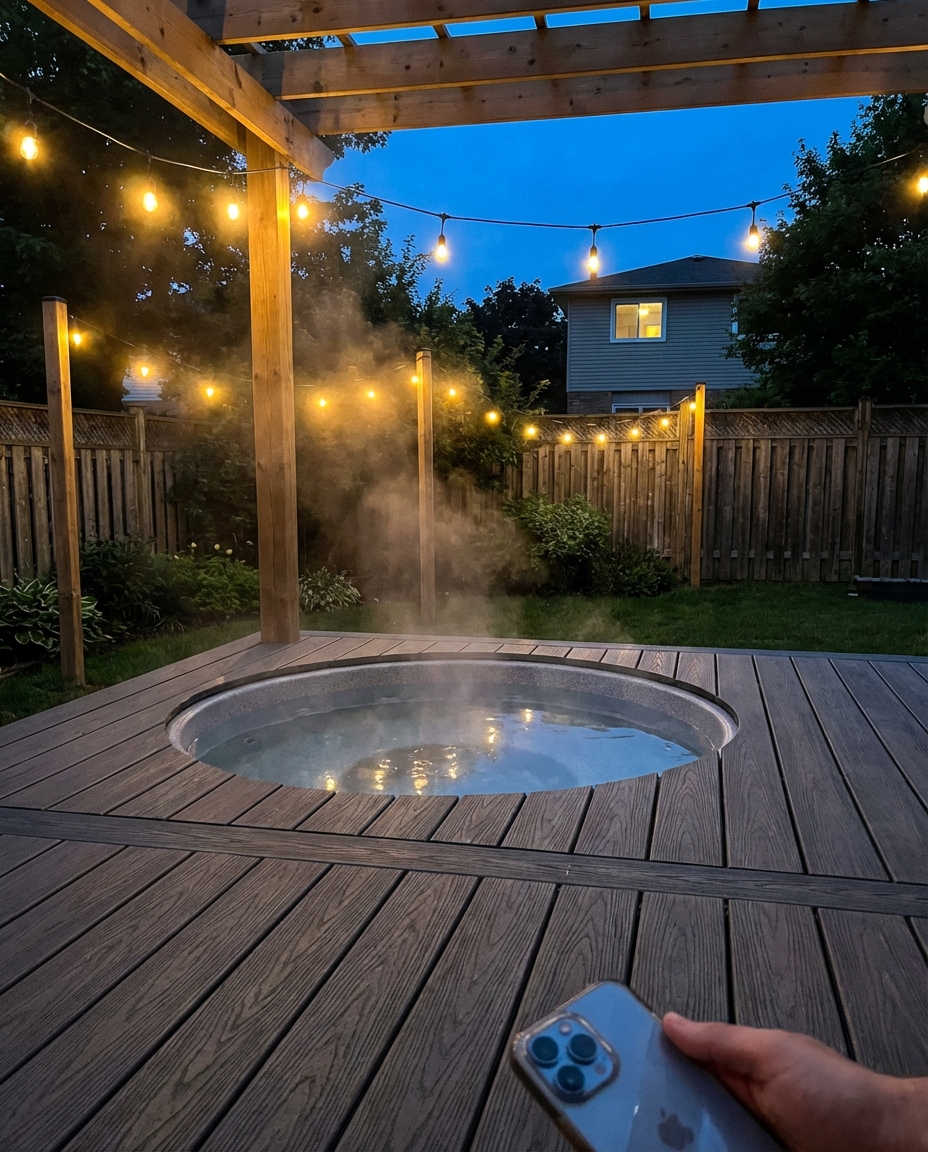
Planning a hot tub deck means solving two problems at once: building a platform strong enough to hold 4,000-6,000 lbs of water, tub, and people, and making it look like something you'd actually want to spend time on. Most decks aren't built for that kind of load. Here's how to do it right in Ontario.
Structural Requirements for Hot Tub Decks
Your standard deck can't handle a hot tub. A typical 8-person hot tub weighs 800-1,000 lbs empty, holds 400-500 gallons of water (adding 3,300-4,200 lbs), and supports 6-8 people (another 1,200-1,600 lbs). That's 100-120 lbs per square foot concentrated in one spot.
🏗️ Planning a deck project?
Get a free manual project review, or visualize your dream deck with AI before requesting quotes.
Wondering what your design will cost? Our complete deck cost guide covers pricing for every material and style. Most covered and elevated decks require permits — see our guide on deck permit requirements.
What you need structurally:
- Dedicated footing cluster: 4-6 footings directly under the tub area, independent of the main deck footings
- Doubled or tripled joists: 2x10 or 2x12 joists at 12" on center (not the standard 16")
- Reinforced beams: Double or triple 2x10 beams directly under the hot tub footprint
- Frost-protected footings: Minimum 48 inches deep (Ontario frost line) with 12" diameter sonotubes or helical piles
- Joist hangers rated for the load: Use heavy-duty galvanized hangers, not standard ones
Most builders design hot tub decks to handle 150 lbs per square foot in the tub zone to include a safety margin. The rest of the deck can follow standard framing specs.
Ontario Building Code requirements for deck footings apply to the entire structure, but your hot tub zone needs engineered reinforcement beyond code minimums.
Hot Tub Placement: On-Deck vs. Beside-Deck
You have two structural approaches, and each affects cost and complexity differently.
Hot Tub ON the Deck Surface
The tub sits on top of the finished decking. Pros: easier access, cleaner look, simpler electrical routing. Cons: you need serious reinforcement below, and the tub sits higher (more steps to climb in).
Framing requirements:
- Joists: 2x10 at 12" on center minimum (2x12 at 10" is better)
- Beams: Triple 2x10 or double 2x12
- Footings: 6-8 footings clustered under the tub area
- Blocking: Solid blocking between every joist under the tub
Cost impact: Add $15-25/sqft to the reinforced zone (typically 100-150 sqft) for extra framing, footings, and labour.
Hot Tub BESIDE the Deck (Sunken or Grade-Level)
The tub sits on a separate pad at grade level or partially sunken, with the deck wrapping around it. Pros: less structural demand on the deck, easier tub service access, lower entry height. Cons: requires separate concrete pad, more complex design, potential drainage issues.
Requirements:
- Concrete pad: 6" thick, 12" larger than tub footprint on all sides
- Gravel base: 6-8" compacted gravel under the pad
- Deck framing: Can use standard specs since the tub isn't on it
- Steps/access: Built-in steps from deck down to tub level
Cost impact: Concrete pad runs $800-1,500 depending on size and site access. Deck framing costs are standard, but you'll pay for additional steps and transitions.
Design Styles That Work in Ontario
Hot tub decks need to balance aesthetics with year-round functionality. Here's what works in freeze-thaw climates.
Multi-Level Deck with Dedicated Tub Platform
Build the hot tub on its own raised platform (12-18" higher than the main deck). This creates visual separation, improves drainage around the tub, and makes the reinforced framing obvious during inspections.
Materials: Composite decking for the tub platform (no wood rot from splashing), pressure-treated or composite for the main deck.
Typical layout:
- Main deck: 250-350 sqft at grade or one step up
- Tub platform: 100-120 sqft, elevated with built-in steps
- Privacy wall or pergola on the tub platform side
Cost: $20,000-32,000 installed for a full multi-level design with composite on the tub zone. See composite deck costs in the KWC area for material vs. labour breakdowns.
Wraparound Deck with Sunken Tub Nook
The deck wraps around a grade-level or partially sunken hot tub. Works well on sloped lots where you can nestle the tub into the hillside.
Site requirements: Need 2-3 feet of grade drop to make the sunken look work without excessive excavation.
Materials: Composite or cedar railings to frame the tub nook, composite decking to handle splash zones.
Typical layout:
- Tub nook: 8x10' area at grade, surrounded by deck on 2-3 sides
- Deck height: 18-30" above grade to step down into tub
- Privacy screens or pergola on the exposed side
Cost: $18,000-28,000 for a wraparound design with composite materials and a separate tub pad.
Corner Tub Deck with Privacy Pergola
Place the hot tub in one corner of a rectangular deck, with a pergola or privacy wall creating an enclosed zone. This works on smaller lots where you need to maximize usable deck space.
Layout:
- Deck size: 300-400 sqft total
- Tub zone: 10x10' corner with reinforced framing
- Pergola or privacy wall on two sides (corner position)
Materials: Match decking material across the whole surface for a cohesive look. Add composite or aluminum railing with privacy inserts (horizontal slats, lattice, or frosted panels).
Cost: $16,000-26,000 including pergola structure. Add $3,000-6,000 if you want a covered pergola with a roof, which requires a separate permit in most KWC municipalities.
Material Choices for Hot Tub Zones
Hot tubs splash. A lot. Your material choice in the tub zone matters more than anywhere else on the deck.
Composite Decking (Best for Tub Zones)
Why it works: No rot, no splinters, minimal maintenance, handles constant moisture without breaking down.
Considerations:
- Choose a capped composite (plastic shell over wood-composite core) for maximum water resistance
- Darker colors absorb heat in summer — grey, tan, or lighter browns stay cooler underfoot
- Grooved boards provide better traction when wet than smooth boards
Cost: $65-95/sqft installed for quality composite. Brands like Trex, TimberTech, and Fiberon are widely available in Ontario.
Maintenance: Rinse monthly, scrub with soap and water twice a year. Composite maintenance is minimal compared to wood.
Pressure-Treated Wood
Why builders use it: Half the cost of composite, structurally sound, easy to replace boards if needed.
Drawbacks: Requires annual sealing in splash zones, prone to algae growth around the tub, splinters when wet.
Cost: $45-65/sqft installed.
Maintenance: Seal the tub zone every spring, power wash annually, replace boards every 8-12 years in high-splash areas.
If budget is tight, consider a hybrid approach: composite boards in a 10x10' zone around the tub, pressure-treated everywhere else. Saves $2,000-4,000 compared to all-composite while protecting the highest-wear area.
Cedar (Premium Wood Option)
Why people love it: Natural look, naturally rot-resistant, smells great when wet.
Reality check: Still requires annual treatment, can gray or darken unevenly in splash zones, costs nearly as much as composite without the durability.
Cost: $55-80/sqft installed.
Best used for railings and trim rather than the primary decking surface around a hot tub.
Permits and Code Requirements in KWC
Any deck with a hot tub requires a permit in Kitchener, Waterloo, and Cambridge. No exceptions.
What Triggers a Permit
- Deck height over 24 inches from grade (all KWC municipalities)
- Any deck supporting a hot tub, regardless of height (structural load concern)
- Covered structures over the deck (pergola with roof, gazebo)
See the specific rules for Kitchener, Waterloo, and Cambridge.
What Inspectors Look For
Building inspectors will check your hot tub deck at two stages: footing/framing inspection and final inspection.
Footing/framing stage:
- Footing depth (must see 48" before concrete pour)
- Joist spacing and size in the tub zone
- Beam doubling/tripling under the tub
- Ledger board attachment (if attached to the house)
- Joist hanger installation
Final stage:
- Railing height (42" minimum if deck is over 24" high)
- Guardrail spacing (no gaps wider than 4")
- Stair rise/run consistency
- Electrical rough-in for tub (GFCI-protected 240V circuit)
What inspectors look for during framing inspection covers the full checklist.
Permit Costs and Timeline
- Permit fees: $200-400 depending on municipality and deck size
- Timeline: 2-4 weeks from submission to approval in KWC
- Drawings required: Site plan, framing plan, cross-section showing tub reinforcement
Most builders include permit costs and drawings in their quote. If you're DIYing, budget $500-800 for an engineer to stamp your drawings if the municipality requires it (common for hot tub decks due to structural loads).
Electrical and Plumbing Considerations
Hot tubs need dedicated 240V electrical service with GFCI protection. This is separate from your deck permit but gets inspected at the same time.
Electrical requirements:
- 50-60 amp dedicated circuit (depends on tub specs)
- GFCI breaker at the main panel
- Conduit run from panel to tub (can run under the deck)
- Weatherproof disconnect within sight of the tub
Cost: $800-1,500 for electrical rough-in if your panel is within 50 feet of the tub. Add $300-600 if the electrician needs to upgrade your main panel.
Plumbing: Most hot tubs are self-contained (no plumbing hookup required). You'll need a garden hose connection nearby for filling. If you want an auto-fill system, add $400-800 for plumbing rough-in.
Privacy and Wind Protection
Hot tubs in Ontario need wind protection. January soaks in -15°C wind are miserable without a windbreak.
Privacy screen options:
- Horizontal slat walls: 6-8 feet tall, attached to deck posts or independent footings. Cost: $60-100/linear foot installed.
- Lattice panels: Cheaper but less wind protection. Cost: $40-70/linear foot.
- Pergola with side panels: Creates a room-like enclosure. Cost: $3,000-7,000 depending on size and materials.
- Glass or acrylic panels: Modern look, full wind protection, expensive. Cost: $150-250/linear foot.
Privacy screens may require wind load calculations if they're over 6 feet tall or in exposed locations.
Plant-based privacy: Evergreen hedges (cedar, yew) provide year-round screening but take 3-5 years to fill in. Works as a supplement to built structures, not a replacement.
Drainage Around Hot Tubs
Water doesn't just splash out — it also condenses on the underside of the tub and drips through deck board gaps. Poor drainage leads to standing water, ice dams, and rotted framing.
Drainage solutions:
- Slope the deck: Minimum 1/8" per foot slope away from the house
- Under-deck drainage system: Corrugated panels that channel water to gutters. Cost: $8-15/sqft.
- Gravel bed under the tub zone: 6-8" of crushed stone improves drainage at grade level
- Deck board spacing: Leave 1/4" gaps between boards (use spacers during install) to let water through
Deck drainage and water management explains why this matters in freeze-thaw climates.
If your deck is attached to the house, make sure your ledger board has proper flashing. Hot tub splash accelerates wood rot where the ledger meets the house.
Cost Breakdown for Hot Tub Decks in KWC
Here's what you'll actually pay for a complete hot tub deck in the Kitchener-Waterloo-Cambridge area in 2026.
Small Hot Tub Deck (200-250 sqft)
- Framing and footings: $4,000-6,000 (including reinforced tub zone)
- Decking material: $3,500-5,500 (composite) or $2,000-3,500 (pressure-treated)
- Railing: $1,200-2,400 (30-40 linear feet)
- Labour: $3,000-5,000
- Permit and drawings: $400-800
- Electrical rough-in: $800-1,200
Total: $13,000-21,000 for a basic hot tub deck with composite in the tub zone.
Medium Hot Tub Deck (300-400 sqft)
- Framing and footings: $6,500-9,500
- Decking material: $5,500-9,000 (composite) or $3,500-5,500 (pressure-treated)
- Railing: $1,800-3,500 (50-60 linear feet)
- Labour: $5,000-8,000
- Permit and drawings: $500-1,000
- Electrical rough-in: $1,000-1,500
- Privacy screen or pergola: $2,000-5,000
Total: $22,000-37,000 for a mid-size deck with privacy features.
Large Multi-Level Deck (450-600 sqft)
- Framing and footings: $10,000-15,000
- Decking material: $8,500-14,000 (composite) or $5,000-8,000 (pressure-treated)
- Railing: $2,500-5,000 (70-90 linear feet)
- Labour: $8,000-13,000
- Permit and drawings: $600-1,200
- Electrical rough-in: $1,200-2,000
- Privacy screens, pergola, or covered structure: $4,000-10,000
Total: $35,000-60,000 for a premium multi-level design.
See typical deck costs in Kitchener and Waterloo for more pricing context.
🎨 Not sure which material to pick?
Upload a photo of your backyard and see exactly how Trex, TimberTech, or cedar would look — free and instant.
Common Questions
Can I put a hot tub on my existing deck?
Only if the deck was built to handle the load. Most existing decks weren't. You need an engineer or experienced builder to inspect the framing, joist spacing, beam size, and footing locations. If the deck is over 10 years old or built with 2x8 joists at 16" centers, it's not safe without reinforcement. Adding footings and beams under an existing deck is possible but costs $3,000-6,000 depending on access and site conditions.
Do I need an engineer to design a hot tub deck?
Not legally required in most cases, but many builders won't touch a hot tub deck without stamped drawings. The building department may require an engineer's stamp if your deck is over 6 feet high, attached to a second-storey, or on a sloped lot. Cost for engineered drawings: $800-1,500. Some builders include this in their quote, others charge separately.
What's the best decking material to avoid slipping around a hot tub?
Capped composite with a wood-grain texture (not smooth). Brands like Trex Transcend, TimberTech AZEK, and Fiberon Paramount have textured surfaces that grip well when wet. Avoid glossy or smooth composite — it's slippery in winter. If you're using pressure-treated wood, leave it unsealed (sealed wood is slicker when wet) or use a non-slip stain designed for wet areas.
How close can a hot tub deck be to my property line?
Depends on your municipality. In Kitchener and Waterloo, decks must be 3 feet from side property lines and 6 feet from rear lines unless you apply for a minor variance. Cambridge has similar rules but varies by zoning district. Hot tubs themselves don't change setback rules, but privacy screens or pergolas may trigger additional setbacks if they're over 6 feet tall. Check KWC setback rules before you design.
Should I use helical piles or concrete footings for a hot tub deck?
Both work. Concrete sonotubes (48" deep, 12" diameter) are standard and cost $80-120 per footing including labour. Helical piles install faster, work better in poor soil (common clay in KWC), and don't require frost-depth excavation. Cost: $150-300 per pile installed. For hot tub decks, helical piles make sense if you have clay soil, high water table, or limited excavation access. See helical piles vs. concrete footings for a detailed comparison.
Upload a backyard photo and preview real decking materials with AI — free, instant, no sign-up.
Permits, costs, material comparisons, and questions to ask before requesting quotes — delivered to your inbox.