
Composite vs PVC Decking in Canada: What's the Difference?
Composite vs PVC decking in Canada: material differences, performance in freeze-thaw, pricing, warranties, and which works best for your Ontario deck project.
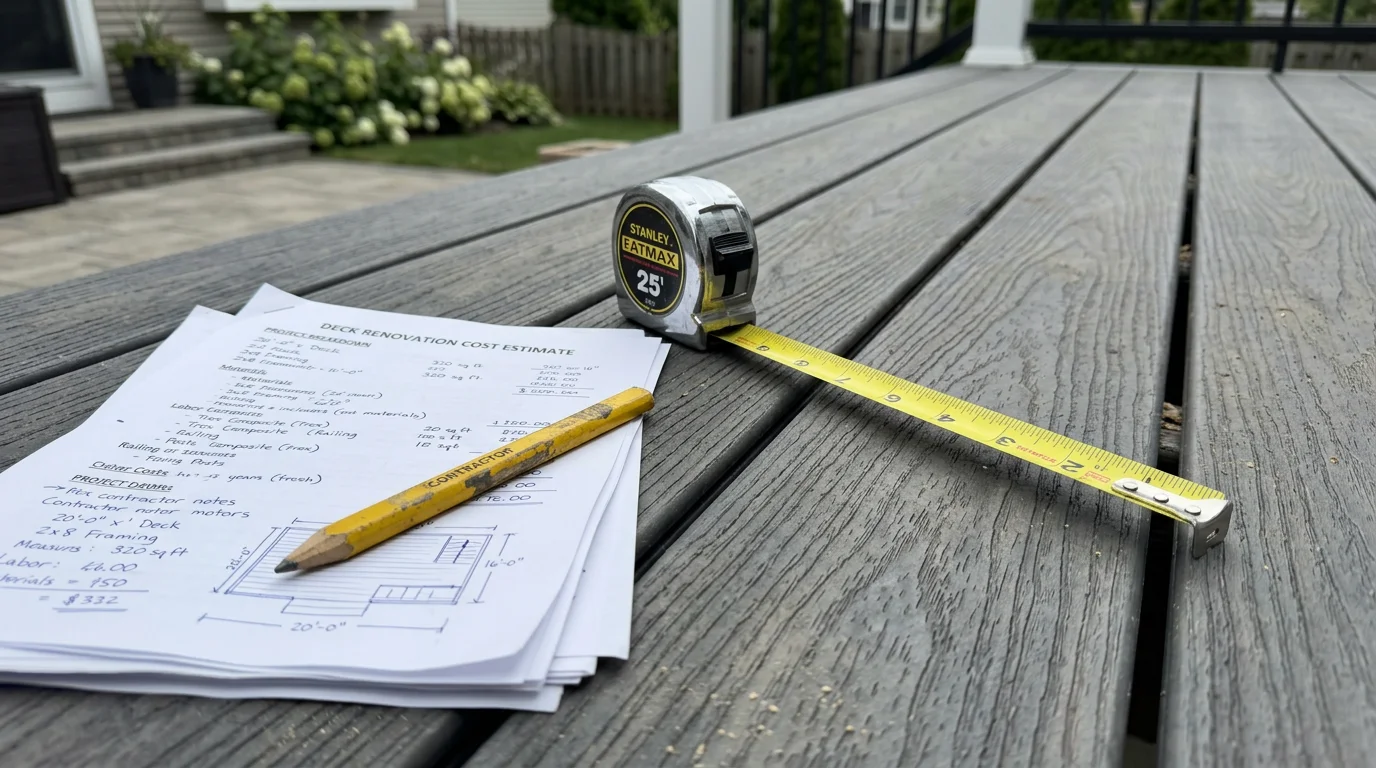
You're shopping for low-maintenance decking and keep seeing "composite" and "PVC" used interchangeably—or worse, as completely different categories. Here's what actually matters: PVC decking is 100% plastic, while composite decking blends wood fibers with plastic. Both handle Ontario winters better than wood, but they perform differently in heat, cold, and under foot traffic.
This guide breaks down the material science, real-world durability in Canadian climates, installed pricing for KWC projects in 2026, and which option makes sense for your budget and backyard.
What Composite Decking Actually Is
Composite decking combines 60-80% wood fiber (usually recycled sawdust or wood chips) with 20-40% plastic polymer (polyethylene or polypropylene). The mix is heated, extruded into boards, and capped with a protective plastic shell.
🏗️ Planning a deck project?
Get a free manual project review, or visualize your dream deck with AI before requesting quotes.
Key characteristics:
- Wood fiber core gives it a natural feel underfoot
- Plastic cap layer resists moisture, stains, and fading
- Heavier and denser than PVC (about 2.5-3 lbs/linear foot for a 5.5" board)
- Slightly cooler surface temperature in direct sun compared to PVC
- Can expand/contract with temperature swings (typical: 1/8" per 16-foot board in Ontario's -25°C to +35°C range)
Popular composite brands available in Canada include Trex, TimberTech, Fiberon, and made-in-Canada options like DeckoRail and DuraLife.
What PVC Decking Actually Is
PVC (polyvinyl chloride) decking is 100% synthetic plastic with no wood fibers. It's extruded as a solid or cellular (foam-core) board, then capped with a dense outer layer for scratch resistance.
Key characteristics:
- All-plastic construction means zero moisture absorption
- Lighter weight than composite (about 1.5-2 lbs/linear foot for a 5.5" board)
- More flexible and "springy" feel underfoot
- Can get significantly hotter in direct sun (10-15°F warmer than composite)
- Minimal expansion/contraction (about 1/16" per 16-foot board)
- Premium pricing tier—typically 15-25% more than composite
Azek, TimberTech AZEK (same company), and Zuri are the main PVC players in the Canadian market.
How They Perform in Ontario's Climate
Freeze-Thaw Cycling
Ontario sees 40-60 freeze-thaw cycles per year in KWC. Both materials handle this better than wood, but there are differences:
Composite decking has wood fiber inside the core. If moisture infiltrates through cut ends, scratches, or manufacturing defects, that water can freeze and expand. This is why proper maintenance matters—sealing cut ends during installation prevents moisture intrusion.
PVC decking absorbs virtually no water (less than 0.5% by weight). Freeze-thaw cycling doesn't affect it structurally. The trade-off: it expands and contracts more dramatically with temperature changes, requiring specific fastening techniques to avoid buckling or cupping.
Surface Temperature in Summer
Both materials get hot in direct sun, but PVC runs hotter:
- Composite: 60-75°F above ambient air temp (so 95°F becomes 155-170°F on the deck surface)
- PVC: 70-85°F above ambient (95°F ambient = 165-180°F surface temp)
This matters in KWC's July/August heat. If your deck faces south or west with full sun exposure, PVC can be uncomfortably hot barefoot. Lighter colors help (grey or tan runs 10-15°F cooler than dark brown), but composite still wins for surface temp.
Snow Load and Winter Use
Both materials easily handle Ontario's snow loads. The Ontario Building Code requires decks to support a minimum 100 psf live load. Composite and PVC boards meet this when framed at standard 16" joist spacing.
Winter maintenance differences:
- Composite can be shoveled with plastic or rubber-edged shovels without damage
- PVC is more scratch-prone—metal shovels or aggressive ice chipping can gouge the surface
- Both materials get slippery when wet or icy; neither has meaningful traction advantage
- Salt won't damage either material structurally, but can leave white residue (rinse in spring)
For detailed winter care, see our winter deck maintenance guide.
Durability and Lifespan
Scratch and Dent Resistance
Composite has a wood-fiber core that's denser than PVC's cellular interior. Heavy furniture, dropped tools, and pet claws leave fewer visible marks. The trade-off: deep scratches can expose the wood core, creating a moisture entry point.
PVC scratches more easily on the surface. The good news: scratches don't compromise structural integrity since there's no wood to absorb moisture. The bad news: they're more visible, especially on darker colors.
Staining and Mold
Both materials resist mold and mildew far better than wood, but neither is immune:
- Composite: The wood fiber inside can support mold growth if moisture gets in through damaged areas. Surface mold (the green stuff you see) wipes off with soap and water. Internal mold is rare unless the board is severely damaged.
- PVC: No organic material means nothing for mold to feed on. Surface algae or mildew can appear in shaded, damp areas but cleans off easily.
Tannin staining (brown spots from leaves, acorns, or deck furniture) affects composite more than PVC. PVC's non-porous surface wipes clean; composite may need a deck cleaner for stubborn stains.
Warranty Comparison
| Warranty Type | Composite (Trex, TimberTech) | PVC (Azek, TimberTech AZEK) |
|--------------|------------------------------|------------------------------|
| Fade/Stain | 25 years | 30-50 years |
| Structural | 25 years | 30-50 years |
| Labor Coverage | Rare (material only) | Rare (material only) |
| Transferable | Yes, with limits | Yes, with limits |
Both warranties exclude damage from improper installation, lack of ventilation, or homeowner neglect. Read the fine print—most cover board replacement but not labor, which can cost $15-25/sqft for tear-out and reinstallation.
Installation Differences
Weight and Handling
Composite is heavier, making solo installation tougher. A 16-foot composite board weighs 35-45 lbs; the same PVC board weighs 22-28 lbs. If you're DIYing, PVC is easier on your back.
For professional installs in KWC, labor costs are similar—most builders charge $25-45/sqft for framing and decking regardless of material. The weight difference doesn't significantly affect pricing.
Fastening Systems
Both use hidden fasteners (clips or tracks) to avoid visible screws. Key difference:
Composite uses standard hidden fastener clips that allow 1/8" expansion gap. Rigid fastening works because expansion/contraction is moderate.
PVC requires floating fasteners or specialized clips that let boards move more freely. PVC expands and contracts up to twice as much as composite over temperature swings. If you lock it down too tightly, boards can buckle or cup in summer heat.
Cutting and Trimming
Both cut with standard carbide-tipped saw blades. PVC dulls blades slightly faster due to its abrasive nature.
Critical step for composite: Seal all cut ends with wax-based end cap sealer or paraffin wax. This prevents moisture from wicking into the wood core through exposed edges. PVC doesn't need this—no wood inside means no moisture intrusion risk.
Cost Comparison (2026 KWC Pricing)
Material Only (Per Square Foot)
- Mid-grade composite (Trex Select, TimberTech Edge): $6-9/sqft
- Premium composite (Trex Transcend, TimberTech PRO): $9-13/sqft
- PVC (Azek, TimberTech AZEK): $11-16/sqft
These are material costs only—no framing, labor, or railing included.
Installed Costs (Complete Deck)
For a typical 12' × 16' (192 sqft) deck in KWC:
| Component | Composite Installed | PVC Installed |
|-----------|---------------------|----------------|
| Decking Material | $1,150-2,500 | $2,100-3,100 |
| Framing (Pressure-Treated) | $1,900-3,200 | $1,900-3,200 |
| Labor (Framing + Decking) | $4,800-8,600 | $4,800-8,600 |
| Railing (Composite/PVC Match) | $1,600-3,800 | $1,800-4,200 |
| Permit + Extras | $500-1,200 | $500-1,200 |
| Total Installed | $10,000-19,300 | $11,100-20,300 |
PVC adds $1,000-2,000 to total project cost for a 200-sqft deck compared to mid-grade composite. For detailed KWC pricing breakdowns, see our composite deck cost guide.
Long-Term Cost Factors
Neither material requires staining, sealing, or sanding like wood. Annual maintenance is minimal—soap and water cleaning, maybe a deck wash product for stubborn stains.
20-year cost of ownership (192 sqft deck):
- Composite: Initial install + $100-200 in cleaning supplies = $10,100-19,500 total
- PVC: Initial install + $100-200 in cleaning supplies = $11,200-20,500 total
Compare this to pressure-treated wood, which needs staining/sealing every 2-3 years at $400-800 per application (DIY) or $1,200-2,400 (professional). Over 20 years, that's an extra $3,000-12,000 in maintenance alone.
Which Should You Choose?
Choose Composite If:
- You want the closest feel to real wood. Composite's wood-fiber core has a denser, more solid feel underfoot.
- Your deck gets full sun. Composite runs 10-15°F cooler than PVC in direct sunlight—better for bare feet.
- You have heavy furniture or active pets. Composite resists scratches and gouges better than PVC.
- Budget is tight. Composite costs 15-25% less than PVC for similar quality tiers.
- You prefer made-in-Canada options. Several Canadian composite brands offer competitive pricing and local support.
Choose PVC If:
- You want absolute zero moisture issues. PVC doesn't absorb water, period. No risk of freeze-thaw damage or internal mold.
- Your deck is low or ground-level. Less ventilation = higher moisture exposure. PVC's non-porous construction handles this better.
- You want the longest warranty. PVC manufacturers offer 30-50 year fade/stain coverage vs. 25 years for composite.
- You live in a high-shade area. Less sun exposure = lower surface temps, negating PVC's heat disadvantage. Plus, PVC resists algae growth in damp shade.
- You want minimal expansion/contraction. PVC moves less over seasonal temperature changes, reducing cupping or buckling risk (when installed correctly).
What About Hybrid Options?
Some manufacturers offer "capped composite" or "multi-layer" boards that blur the lines:
- TimberTech PRO: Composite core with thicker PVC cap layer (best of both worlds)
- Trex Transcend: Composite core with advanced polymer shell
- Fiberon Concordia: Three-layer construction with extra-thick cap
These premium composites perform close to PVC in moisture resistance while maintaining composite's cooler surface temps and wood-like feel. Pricing sits between mid-grade composite and full PVC—typically $10-14/sqft material-only.
For more on selecting the right composite brand, check out our best composite decking in Canada guide.
Installation Considerations for KWC Projects
Permit Requirements
Both composite and PVC decks follow the same permit rules in Kitchener, Waterloo, and Cambridge. If your deck is:
- Over 24 inches above grade, you need a building permit
- Attached to your house, you need a permit (regardless of height)
- Freestanding and under 24 inches, no permit required (but check setbacks)
Permit fees run $150-400 depending on municipality and deck size. See our step-by-step guides for Kitchener, Waterloo, and Cambridge.
Framing Requirements
Both materials use pressure-treated lumber framing—joists, beams, and posts. The decking material doesn't affect structural requirements under the Ontario Building Code.
Standard joist spacing:
- 16" on-center for most composite and PVC boards
- 12" on-center for lighter-duty boards or diagonal installations
- Check manufacturer specs—some PVC boards require 12" spacing
For joist span tables and framing details, see our deck joist span guide.
Ventilation Matters
Both composite and PVC need airflow underneath to prevent moisture buildup. This is critical in Ontario's humid summers.
Minimum clearances:
- 6 inches from bottom of joists to ground
- Open skirting with vents (if using solid skirting)
- 1/4" gaps between deck boards for drainage
Poor ventilation can cause composite to mold internally or PVC to trap heat and warp. For ventilation best practices, see our deck skirting guide.
🎨 Not sure which material to pick?
Upload a photo of your backyard and see exactly how Trex, TimberTech, or cedar would look — free and instant.
Common Questions
Can you mix composite and PVC on the same deck?
Yes, but it's unusual. Some homeowners use composite for the main deck surface (cooler underfoot) and PVC for stair treads or high-traffic entries (better scratch resistance). Make sure your builder accounts for different expansion rates when mixing materials.
Do composite and PVC decks need special tools to install?
No. Both cut with standard miter saws, circular saws, or table saws using carbide-tipped blades. You'll need a drill for hidden fasteners and a chalk line for layout. PVC dulls blades slightly faster—keep a spare blade handy for larger projects.
Will composite or PVC fade over time in Ontario sun?
Both fade, but modern capped boards resist it well. Expect 5-10% color shift in the first 12-18 months as UV exposure stabilizes the surface. After that, fading slows dramatically. Darker colors (browns, reds) show more fade than greys or tans. Both materials carry 25-50 year fade warranties depending on brand and product line.
Can you install composite or PVC decking yourself?
Yes, if you're comfortable with basic carpentry. The decking itself is DIY-friendly—hidden fastener systems snap together without visible screws. The harder part is framing: cutting and installing joists, beams, ledger boards, and footings to code. Most KWC homeowners DIY the decking but hire pros for framing, especially if a deck permit is required (inspectors check framing, not decking).
Does composite or PVC work for pool decks in Ontario?
Both work well. PVC has a slight edge because it doesn't absorb pool water, sunscreen, or chlorine. Composite can stain from spilled drinks or sunscreen oils—clean spills quickly. Either way, choose lighter colors to reduce surface heat (bare feet around pools). For more on pool deck materials, see our pool deck comparison guide.
Related: Composite Decking Calculator: How Much Material Do I Need?.
You may also find How Does Composite Decking Perform in Canadian Winters? helpful.
Upload a backyard photo and preview real decking materials with AI — free, instant, no sign-up.
Permits, costs, material comparisons, and questions to ask before requesting quotes — delivered to your inbox.