
What Size Deck Can You Build Without a Permit in Ontario?
Learn what size deck needs a permit in Ontario. Height, area, and attachment rules explained for KWC homeowners planning a backyard deck project.
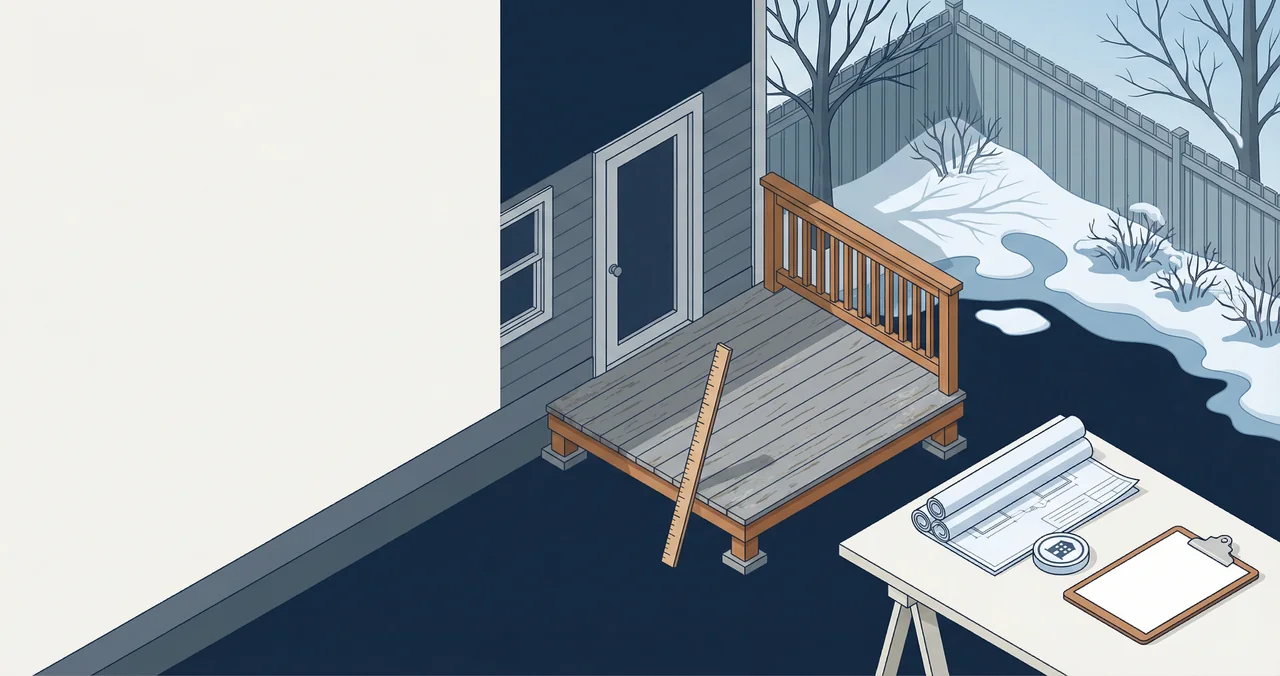
Most Ontario homeowners planning a deck want to know one thing first: can I skip the permit? The answer depends on your deck's height, size, and how it attaches to your house—not just square footage.
Here's the baseline rule across Ontario: you can typically build a low, detached deck without a permit if it meets specific criteria. But once your deck connects to your house, exceeds certain height thresholds, or covers significant area, you're in permit territory.
Ontario Building Code Permit Requirements
The Ontario Building Code (OBC) sets province-wide standards, but your local municipality enforces them—and sometimes adds restrictions. Under OBC, a deck generally requires a permit if:
🏗️ Planning a deck project?
Get a free manual project review, or visualize your dream deck with AI before requesting quotes.
- It's attached to your house (ledger board connection)
- The walking surface is more than 24 inches (60 cm) above adjacent ground at any point
- It exceeds 108 square feet (10 m²) in total area
- It's intended to support a hot tub, pergola, or roof structure
Detached decks (freestanding, not bolted to your home) have more flexibility. You can often build up to 108 square feet without a permit, provided the deck surface stays within 24 inches of grade.
But here's the catch: Kitchener, Waterloo, and Cambridge each interpret and enforce these rules slightly differently. What flies in Waterloo might trigger a permit requirement in Cambridge.
Kitchener Deck Permit Thresholds
Kitchener follows the OBC closely with some local clarifications:
- Detached decks under 108 square feet and within 24 inches of grade: typically no permit required
- Any deck attached to your house: requires a permit, regardless of size
- Decks supporting accessory structures (pergolas, gazebos, covered sections): require a permit
- Elevated decks exceeding 24 inches height at any point: require a permit
Kitchener building inspectors measure the 24-inch threshold from the lowest adjacent grade point, not average grade. If one corner of your deck sits 26 inches above ground because of a slope, you need a permit—even if the rest of the deck is lower.
For a detailed walkthrough of Kitchener's application process, see our Kitchener deck permit application guide.
Waterloo Deck Permit Rules
Waterloo's bylaws align with OBC standards but emphasize setback compliance even for permit-exempt decks:
- Detached decks under 108 square feet and 24 inches or lower: generally no permit needed
- Attached decks: always require a permit
- Setback rules apply to all decks, permit-exempt or not—typically 5 feet from side/rear property lines, 20 feet from front
- Decks in floodplains or near environmentally sensitive areas: may require permits regardless of size
Even if your deck qualifies as permit-exempt, you still need to respect setback rules. Building a small deck right against your neighbour's fence can trigger bylaw complaints, even without a permit violation.
Check out our Waterloo deck permit application guide if your project exceeds the thresholds.
Cambridge Deck Permit Requirements
Cambridge applies OBC rules with additional scrutiny on structural safety:
- Detached decks under 108 square feet and within 24 inches of grade: typically permit-exempt
- Attached decks: require a permit, including proper ledger board flashing and engineering details
- Any deck requiring guardrails (height triggers the need): requires a permit
- Decks in older neighbourhoods with mature trees or heritage designations: may need additional approvals
Cambridge has been increasingly strict about ledger board attachments following structural failures in other jurisdictions. If your deck bolts to your house, expect detailed ledger board flashing requirements and potentially engineered drawings.
Our Cambridge deck permit application guide walks through the full process.
What "24 Inches Above Grade" Really Means
The 24-inch rule trips up more homeowners than any other permit threshold. Here's how inspectors actually measure it:
From the lowest adjacent grade. If your yard slopes, the measurement starts from the lowest ground level touching your deck perimeter—not the highest point, not the average.
At any point along the deck. Even if 90% of your deck sits 18 inches high, one corner at 25 inches triggers the permit requirement.
Measured to the walking surface. The deck board surface counts, not the framing underneath. A 22-inch-tall frame with 2-inch-thick decking puts you at 24 inches—right at the threshold.
Grade means finished grade. If you plan to add topsoil, mulch, or landscaping after building, inspectors measure from the proposed finished grade, not current dirt level.
For sloped yards, many homeowners build a stepped or tiered deck to keep each section under 24 inches. This works, but the moment you connect sections with stairs or a shared frame, you're building a single structure—and the highest section determines permit requirements.
Detached vs. Attached Decks: Why It Matters
Attached decks bolt to your house with a ledger board, transferring structural loads to your home's foundation. This connection introduces water infiltration risks, structural stress on your siding and rim joist, and potential issues if your house settles differently than your deck footings.
Ontario Building Code treats attached decks as an extension of your home's structure, which is why they always require permits—even a 6×8-foot deck 12 inches off the ground needs approval if it's bolted to your house.
Detached decks stand independently on their own footings. They're structurally simpler, pose less risk to your home, and qualify for permit exemptions more often. The trade-off: detached decks require footings on all sides (no relying on your house for support), which can add $800-1,500 to foundation costs depending on soil conditions and footing depth.
If you're planning a deck right against your house but want to avoid permits, a detached design with a small gap (1-2 inches) might work—but you'll still need stairs or a bridge to cross that gap, and inspectors will scrutinize whether it's truly independent or functionally attached.
Does Size Include Stairs and Landings?
Yes. Stairs, landings, and attached platforms count toward your deck's total square footage for permit threshold calculations.
A 10×10-foot deck (100 square feet) stays under the 108-square-foot limit. Add a 3×4-foot landing at the bottom of your stairs, and you're at 112 square feet—over the threshold, permit required.
Stairs themselves introduce additional complications:
- Ontario Building Code requires guardrails on any deck more than 24 inches high (which triggers a permit)
- Stairs must meet specific rise and run dimensions: max 7.75-inch rise, min 10-inch run (see our deck stairs code guide)
- Handrails are required if you have more than three risers
Even if your deck is permit-exempt, once you add stairs that create a total structure over 108 square feet or exceed 24 inches in height, you're back in permit territory.
Building Without a Permit: Real Risks
Skipping a required permit isn't just a paperwork issue. Here's what happens if you build without approval:
Home sale complications. When you sell, your lawyer will ask if you pulled permits for renovations. An unpermitted deck shows up in buyer home inspections, can kill deals, or force you to apply for a retroactive permit—which costs more and might require tearing off decking for framing inspections.
Insurance claim denials. If someone gets injured on your unpermitted deck, or if deck failure causes property damage (say, pulling siding off your house), your home insurance may deny the claim. Policies typically exclude coverage for unpermitted structures.
Municipal fines. Kitchener, Waterloo, and Cambridge can fine you $500-5,000 per violation. If a neighbour complains or an inspector spots your deck during another property visit, you'll get a compliance order: pull a permit, pay fines, and potentially remove non-compliant work.
Safety risks. Permit-exempt decks don't get inspected, which means no professional verification of your footing depth, joist spans, or ledger board attachment. Ontario's freeze-thaw cycle, expansive clay soils in parts of KWC, and heavy snow loads make proper construction critical. A deck that looks fine in summer can fail catastrophically after a winter of frost heaving.
Footing depth matters most. Ontario requires footings below the 48-inch frost line (1.2 m). Shallow footings heave in winter, causing structural failure. Without an inspection, you're on your own to get this right. Our frost line guide explains why this matters.
What About Deck Replacement or Repairs?
Replacing decking boards on an existing frame usually doesn't require a permit, as long as you're not altering the structure, adding area, or changing load capacity.
But structural repairs or partial rebuilds often do:
- Replacing rim joists, beams, or posts: typically requires a permit
- Adding or relocating footings: requires a permit
- Extending an existing deck or adding a new section: requires a permit
- Replacing a ledger board or re-attaching to your house: requires a permit
If your existing deck was built before 2012 (when OBC deck standards were updated), bringing it up to current code during repairs might trigger a full permit requirement—even for work that would otherwise be minor.
Planning a deck refresh? Our deck rebuild vs. resurface guide helps you figure out what qualifies as repair vs. reconstruction.
How to Confirm Your Local Rules
Ontario's Building Code sets the baseline, but municipalities add their own layers. Here's how to confirm your specific requirements:
Call your city's building department:
- Kitchener Building Division: 519-741-2345
- Waterloo Building Division: 519-747-8785
- Cambridge Building Division: 519-740-4680 ext. 4365
Describe your project: size, height, attached or detached, location on your property. Ask explicitly: "Do I need a permit for this deck?"
Check zoning and setbacks. Even permit-exempt decks must comply with setback rules. Request your property's zoning map and setback requirements—these vary by neighbourhood and lot type. Our KWC zoning setback guide walks through the lookup process.
Visit in person. Bring a sketch: property boundaries, house location, proposed deck dimensions, and height. Building officials can give you immediate feedback and flag issues (like easements, utility corridors, or floodplains) that might complicate your project.
Don't rely on neighbour advice. "My neighbour built without a permit" doesn't mean it was legal—or that your project qualifies. Rules change, enforcement varies, and you assume the risk if you build based on someone else's experience.
Permit Costs vs. Skipping the Permit
Permit fees in KWC range from $150-400 depending on deck size and municipality. Here's the typical breakdown:
- Kitchener: $175-325 for residential deck permits
- Waterloo: $150-300 depending on project value
- Cambridge: $200-400 for decks over 108 square feet
You'll also need to factor in:
- Engineered drawings (if required): $400-1,200 for complex designs, hot tub decks, or large elevated structures
- Inspection fees: usually included in permit cost, but re-inspections after failed inspections can add $100-200 each
- Design time: assembling permit drawings takes a few hours if you're doing it yourself
Compare that to the cost of a retroactive permit (often double the original fee), potential fines, and the risk of tearing apart finished work for inspections—and the upfront permit cost looks pretty reasonable. For a complete picture of what you'll spend, check our deck spending guide for Ontario.
Our deck permit cost breakdown details what you actually pay.
Working with Contractors: Who Handles the Permit?
Most reputable deck builders in KWC include permit costs in their quotes and handle the application process for you. The contractor pulls the permit under their business license, schedules inspections, and ensures the build meets code.
Red flags:
- Contractor says "you don't need a permit" for an obviously permit-required deck (anything attached to your house, over 24 inches high, or exceeding 108 square feet)
- Offers a discount if you skip the permit
- Asks you to pull the permit yourself to avoid their liability
Licensed contractors know that unpermitted work voids their liability insurance. If a builder pressures you to skip permits, walk away.
If you're hiring a contractor, confirm:
- They'll pull the permit in their name or yours (depending on your agreement)
- Permit fees are itemized in the quote
- They'll coordinate inspection schedules and address any deficiencies
See our deck builder contract guide for what to include in your agreement.
Ground-Level Decks: The Real Permit-Exempt Option
Want to avoid permits entirely? Build a true ground-level deck: walking surface within 24 inches of grade at all points, detached from your house, and under 108 square feet.
Practical considerations:
Drainage and rot. Ground-level decks need excellent drainage underneath. Without airflow, moisture and organic debris accumulate, accelerating rot even in pressure-treated lumber. Install landscape fabric, add gravel for drainage, and slope the ground away from the deck. Our deck drainage guide covers best practices.
Frost heaving. Even ground-level decks need footings below the 48-inch frost line to prevent winter heaving. Skipping this because "it's not required without a permit" is a mistake—you'll be rebuilding in three years. Concrete footings or helical piles both work; helical piles cost more upfront ($150-300 each) but install faster and work better in KWC's clay soils. Compare options in our footing guide.
No guardrails. Decks under 24 inches high don't require guardrails by code, which is fine for adults but risky for kids or elderly family members. Consider adding removable railing or keeping the deck away from slopes where the effective height increases.
Limited size. 108 square feet is roughly 10×11 feet—enough for a small seating area and bistro table, but tight for hosting or full dining sets. If you need more space, you'll need to permit a larger deck.
Hot Tubs, Pergolas, and Other Deck Add-Ons
Planning to add a hot tub or pergola later? That changes everything—even if your deck initially qualified as permit-exempt.
Hot tubs require structural analysis. A filled 6-person hot tub weighs 3,000-4,500 pounds, concentrated in a small area. Standard deck framing (16-inch joist spacing, 2×8 or 2×10 joists) isn't rated for this load. You'll need:
- Reinforced framing: closer joist spacing, larger beams, additional footings
- Engineered drawings showing load calculations
- A building permit, regardless of deck size or height
See our hot tub deck checklist for structural requirements.
Pergolas, gazebos, and covered sections add wind and snow loads. Even a simple pergola with open slats qualifies as a roof structure, triggering permit requirements. If you're thinking "I'll add a pergola next summer after the deck is done," factor that into your initial planning—it's easier and cheaper to permit and build both at once.
🎨 Not sure which material to pick?
Upload a photo of your backyard and see exactly how Trex, TimberTech, or cedar would look — free and instant.
Common Questions
Can I build a 10×10 deck without a permit in Ontario?
A 10×10 deck (100 square feet) qualifies as permit-exempt if it's detached from your house and the walking surface stays within 24 inches of grade at all points. The moment you attach it to your house or elevate it beyond 24 inches anywhere along its perimeter, you need a permit.
Do floating decks need permits in KWC?
"Floating deck" typically means a ground-level, detached deck resting on surface blocks rather than buried footings. If it's under 108 square feet and within 24 inches of grade, it's permit-exempt. But building without proper frost-protected footings is risky—surface blocks shift and heave during Ontario winters. Inspectors don't review permit-exempt decks, so the quality and safety is entirely on you.
What happens if I build a deck without a permit and get caught?
Your municipality will issue a compliance order requiring you to apply for a retroactive permit. You'll pay double the normal permit fee, potentially expose framing for inspection (meaning removing decking), and face fines of $500-5,000 depending on the violation severity. If the deck doesn't meet code, you may be required to tear it down or make expensive structural corrections. It also creates a permanent record on your property file, complicating future sales.
Can I get a permit after building a deck?
Yes, but it's more expensive and disruptive. Retroactive permits (also called "after-the-fact" permits) cost double the standard fee. Inspectors will require you to expose structural framing for inspection—meaning removing deck boards to verify joist spans, ledger board attachment, footing depth, and flashing details. If anything fails inspection, you'll make corrections and pay for re-inspection. It's always cheaper and easier to permit before building.
Do I need a permit to replace old deck boards?
Replacing deck boards on an existing frame typically doesn't require a permit as long as you're not altering the structure, adding area, or changing the deck's load capacity. But if you're replacing structural components (joists, beams, ledger boards, posts, footings), you likely need a permit. When in doubt, call your city's building department and describe the work—they'll confirm whether it qualifies as maintenance or structural alteration. Our deck replacement cost guide helps determine what counts as repair vs. reconstruction.
Check local requirements in Do You Need a Patio Permit in Ontario?.
You may also find Deck Railing Height in BC: Building Code Requirements helpful.
Upload a backyard photo and preview real decking materials with AI — free, instant, no sign-up.
Permits, costs, material comparisons, and questions to ask before requesting quotes — delivered to your inbox.