
Composite vs Pressure-Treated Deck in Ontario: Full Comparison
Composite vs pressure-treated deck in Ontario: compare upfront cost, lifespan, maintenance, winter performance, and ROI to choose the right material.
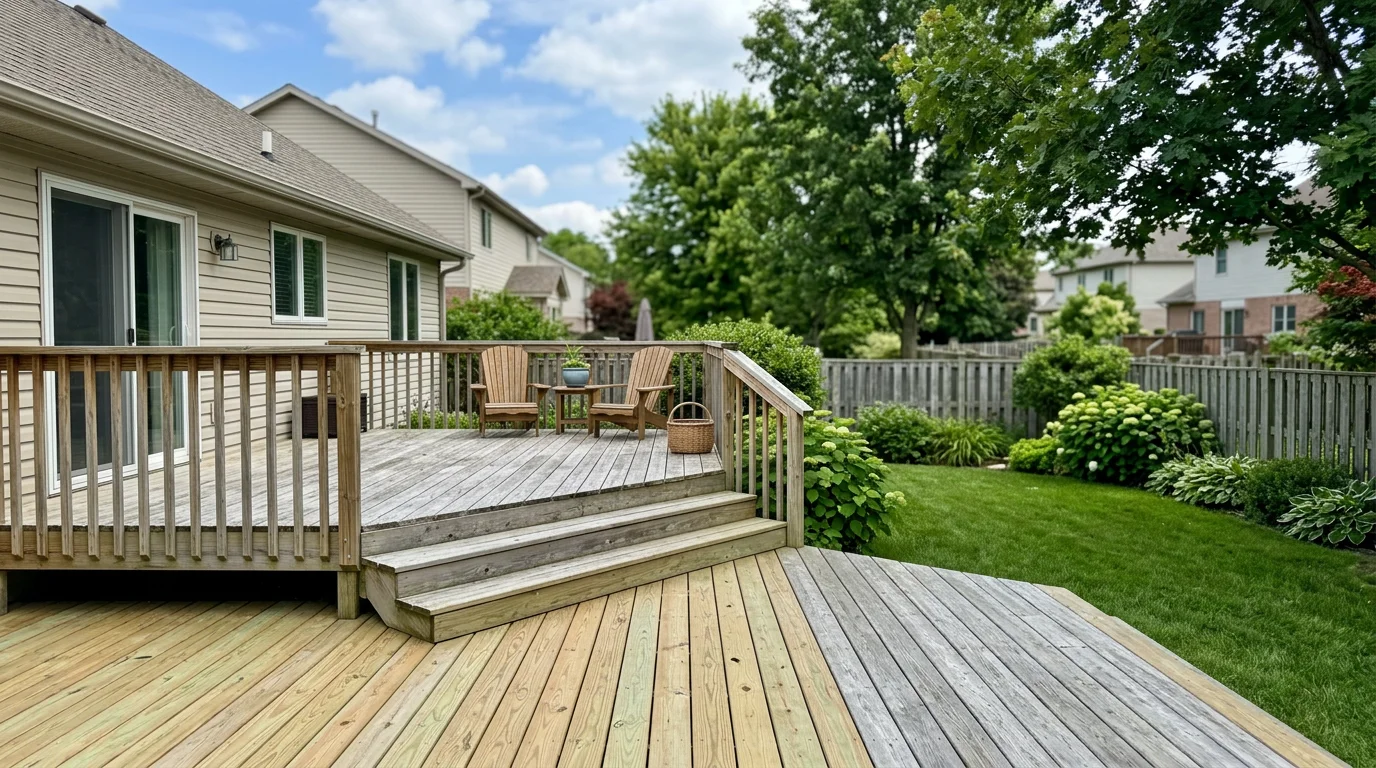
You're planning a new deck and facing the biggest material decision: composite or pressure-treated lumber. The upfront cost difference is significant—$20-30 more per square foot for composite—but so is the maintenance gap. Here's what you need to know to make the right choice for your Ontario home.
Cost Comparison: Upfront vs Long-Term
Initial Installation Costs
Pressure-treated deck installed: $45-65/sqft for a complete project including framing, decking, railings, and labour.
🏗️ Planning a deck project?
Get a free manual project review, or visualize your dream deck with AI before requesting quotes.
Composite deck installed: $65-95/sqft for the same scope.
For a typical 12x16 deck (192 sqft), you're looking at:
- Pressure-treated: $8,640-12,480
- Composite: $12,480-18,240
That's a $3,840-5,760 premium for composite upfront. Our Ontario deck pricing overview puts these numbers in context with full project costs.
Maintenance Costs Over Time
Pressure-treated requires annual or biannual maintenance to survive Ontario's climate:
- Power washing: $150-300/year (DIY) or $300-500 (professional)
- Stain/sealer: $200-400 in materials every 2-3 years
- Labour (if hiring out): $3-5/sqft for staining
For that 192 sqft deck, you're spending $300-900/year on maintenance. Over 20 years, that's $6,000-18,000 in upkeep alone.
Composite decking needs occasional washing (soap and water) and costs $50-150/year in cleaning supplies. No staining, no sealing, no rot repair.
Break-Even Timeline
Most homeowners break even on composite between years 8-15, depending on whether they DIY or hire out pressure-treated maintenance. If you're paying for professional staining every 2-3 years, composite pays for itself faster.
Lifespan and Durability
Pressure-treated lifespan in Ontario: 15-25 years with consistent maintenance. Skip the staining schedule and you're looking at rot, splintering, and board replacement by year 10-12.
Composite lifespan: 25-50 years depending on brand. Premium lines like Trex come with 25-50 year warranties covering staining, fading, and structural integrity.
Ontario's Climate Impact
Our freeze-thaw cycles are brutal on wood. Moisture seeps into cracks, freezes, expands, and accelerates rot. Pressure-treated lumber rated for ground contact (.40 CCA retention) handles it better than standard .25 retention, but you're still fighting a losing battle without proper sealing.
Composite boards don't absorb water the same way. Most premium composites have plastic shells that shed moisture, preventing the freeze-thaw damage that destroys wood decks. You'll still see some surface fading over time, but no structural degradation.
Maintenance Requirements
Pressure-Treated Maintenance Schedule
Year 1: Wait 6-12 months for the wood to dry before applying your first stain. Power wash, let dry 2-3 days, then apply semi-transparent or solid stain.
Years 2-3: Power wash annually to remove mildew. Spot-treat high-traffic areas.
Years 3-5: Full restain. This means stripping old stain (if it's peeling), power washing, sanding rough spots, and reapplying 2 coats.
Years 5+: Inspect for rot, especially around posts, ledger boards, and stairs. Replace damaged boards as needed. Restain every 2-3 years.
Composite Maintenance Schedule
Spring: Sweep off winter debris. Hose down or use soap and water for tougher spots.
Summer: Spot-clean spills (grease, wine, pollen) with warm soapy water.
Fall: Clear leaves before they stain the boards.
Winter: Shovel with a plastic shovel to avoid scratches. Avoid metal blades and ice melt with chlorides.
That's it. No staining, no sealing, no annual power washing required. Learn more in our composite deck maintenance guide.
Ontario Winter Performance
Freeze-Thaw Resistance
Pressure-treated lumber expands and contracts dramatically with temperature swings. Gaps you set at 1/8" in July can close completely in winter or open to 1/4" in summer. This constant movement loosens fasteners, warps boards, and creates uneven surfaces.
Composite decking moves less because it's engineered for dimensional stability. You'll still need proper deck board spacing, but the movement is predictable and consistent.
Snow Removal
Both materials handle snow fine, but composite boards are more scratch-resistant. Use a plastic shovel on either surface, but composite bounces back from minor scuffs better than wood.
Ice and Salt Damage
Avoid calcium chloride or rock salt on both materials. Use sand, kitty litter, or calcium magnesium acetate (CMA) instead. Salt accelerates rot in pressure-treated wood and can discolor some composite brands. Check our winter deck care guide for safe de-icing methods.
Appearance and Aesthetics
Initial Look
Pressure-treated starts out with a greenish tint from the chemical treatment. After a few months of UV exposure, it fades to silver-grey unless you stain it. Most homeowners stain within the first year to lock in a wood tone.
Composite comes in dozens of colors and grain patterns that mimic cedar, ipe, mahogany, and other hardwoods. The color is consistent from day one and doesn't require staining.
Long-Term Appearance
Pressure-treated: Shows wear quickly in high-traffic areas. Splintering, cupping, and color fade are inevitable without consistent maintenance. Even with staining, expect a weathered look after 10-15 years.
Composite: Premium brands fade 5-15% in the first 12-18 months, then stabilize. Early-generation composites (pre-2010) faded heavily and retained mold, but modern capped composites resist both. Budget lines still show more fade and spotting than premium options.
Installation Differences
Both materials use the same framing (pressure-treated joists, beams, and posts). The difference is in the decking installation.
Fastening Methods
Pressure-treated: Face screws (2 per board end, 1 per joist) are standard. Use coated or stainless screws rated for ACQ treatment to avoid corrosion. Pre-drill holes near board ends to prevent splitting.
Composite: Hidden fasteners (clips or tracks) give a cleaner look with no visible screws. Some budget composites still use face screws. Installation is slower—add 10-15% to labour time vs. pressure-treated.
Joist Spacing
Pressure-treated decking works on 16" on-center joists for 5/4x6 boards.
Composite requires 12" on-center joists for most brands to prevent sagging and maintain warranty coverage. This adds cost to the framing stage—more joists, more hangers, more labour.
Cutting and Handling
Pressure-treated cuts like any softwood. Use a circular saw or miter saw.
Composite requires a fine-tooth blade and produces more dust (wear a mask). Boards are heavier—a 20-foot composite board weighs 15-20% more than the same length in wood.
Structural and Safety Considerations
Splinters and Barefoot Safety
Pressure-treated splinters as it ages, especially in dry summer heat. Expect rough patches by year 5-7 even with staining.
Composite doesn't splinter, making it safer for kids and pets. Capped composites stay smooth for decades.
Slip Resistance
Wet pressure-treated wood is slippery when coated with algae or moss (common in shaded areas). Regular cleaning helps.
Most composite boards have embossed or grooved surfaces for traction. Premium lines perform better than smooth budget composites. Test slip resistance if you're installing near a pool—see our pool deck material comparison.
Heat Retention
Dark composite boards absorb heat and can reach 60-80°F above ambient temperature on sunny days. A grey or dark brown deck in 85°F weather hits 145-165°F—too hot for bare feet.
Lighter colors (tans, greys) stay 10-20°F cooler. Pressure-treated wood stays closer to ambient temp but still heats up.
Environmental Impact
Chemical Treatment
Pressure-treated lumber is treated with copper azole (CA) or alkaline copper quaternary (ACQ). Both prevent rot and insect damage but require careful handling during cutting (wear a mask, wash hands). The wood itself is safe once installed.
Older pressure-treated lumber (pre-2003) used chromated copper arsenate (CCA), which contained arsenic. If you're replacing an old deck, dispose of CCA lumber properly—don't burn it.
Composite Materials
Most composite decking is 50-95% recycled content (reclaimed wood fiber and recycled plastic). Brands made in Canada often highlight their recycled content and local manufacturing.
Composite is harder to recycle at end-of-life compared to wood, which can be chipped or composted (if untreated). Check with your municipality—some accept composite for recycling, most don't.
Resale Value and ROI
According to Remodeling Magazine's 2025 Cost vs. Value report (U.S. data, adjusted for Canadian markets), a wood deck recoups 65-75% of cost at resale, while a composite deck recoups 60-70%.
The difference? Composite costs more upfront, so the percentage return is slightly lower even though the absolute dollar recovery is similar.
From a buyer's perspective: A well-maintained composite deck is a selling feature (no immediate maintenance needed). A pressure-treated deck that needs restaining is a liability.
If you're staying in your home 10+ years, composite delivers better value through lower maintenance and longer lifespan. If you're flipping or selling within 5 years, pressure-treated keeps upfront costs down.
Best Use Cases for Each Material
Choose Pressure-Treated If:
- You're on a tight budget and can handle DIY maintenance
- You're building a temporary or starter deck
- You plan to sell within 5-7 years
- You enjoy hands-on projects and don't mind annual upkeep
- You prefer the natural wood look and texture
Choose Composite If:
- You want a low-maintenance, long-term solution
- You're building a large deck (300+ sqft) where maintenance costs add up
- You're installing in a high-traffic area (pool deck, main entertaining space)
- You plan to stay in your home 10+ years
- You want consistent color and no splinters
Common Questions
Can you mix composite decking with pressure-treated framing?
Yes, and you should. All composite manufacturers require pressure-treated or steel framing for structural support. The composite boards are decking only—never use composite for joists, beams, or posts.
Do composite decks need permits in Ontario?
Yes, if your deck is over 24 inches off grade or attached to your house. Permit requirements are the same for both materials. See our Kitchener, Waterloo, and Cambridge permit guides.
How long does pressure-treated lumber last in Ontario without staining?
10-15 years for the decking surface, but expect warping, splitting, and heavy weathering. Posts and framing (which aren't walked on) can last 20-25 years untreated, but exposed deck boards deteriorate faster.
Which composite brands perform best in Canadian winters?
Trex, TimberTech, Fiberon, and other premium composites with capped shells perform best. Budget composites without protective caps fade faster and retain moisture. Check our complete composite decking guide for brand comparisons.
Can you install composite decking yourself?
Yes, but it's slower than pressure-treated due to hidden fastener systems and stricter installation requirements. Budget 20-30% more time vs. face-screwing wood boards. If you're comfortable building a wood deck, you can handle composite—just follow the manufacturer's installation guide exactly to maintain warranty coverage.
---
🎨 Not sure which material to pick?
Upload a photo of your backyard and see exactly how Trex, TimberTech, or cedar would look — free and instant.
See These Materials on Your Actual Deck
Still comparing materials? Upload a photo of your backyard and see exactly how each option looks on your space — in seconds, for free.
Try PaperPlan → — our AI deck visualizer lets you swap between Trex, TimberTech, cedar, and pressure-treated so you can pick with confidence before spending a dime.
Upload a backyard photo and preview real decking materials with AI — free, instant, no sign-up.
Permits, costs, material comparisons, and questions to ask before requesting quotes — delivered to your inbox.