
Deck Board Replacement in Ontario: When and How Much
How much does deck board replacement cost in Ontario? Get pricing, signs your boards need replacing, and what to expect for partial vs. full replacement.
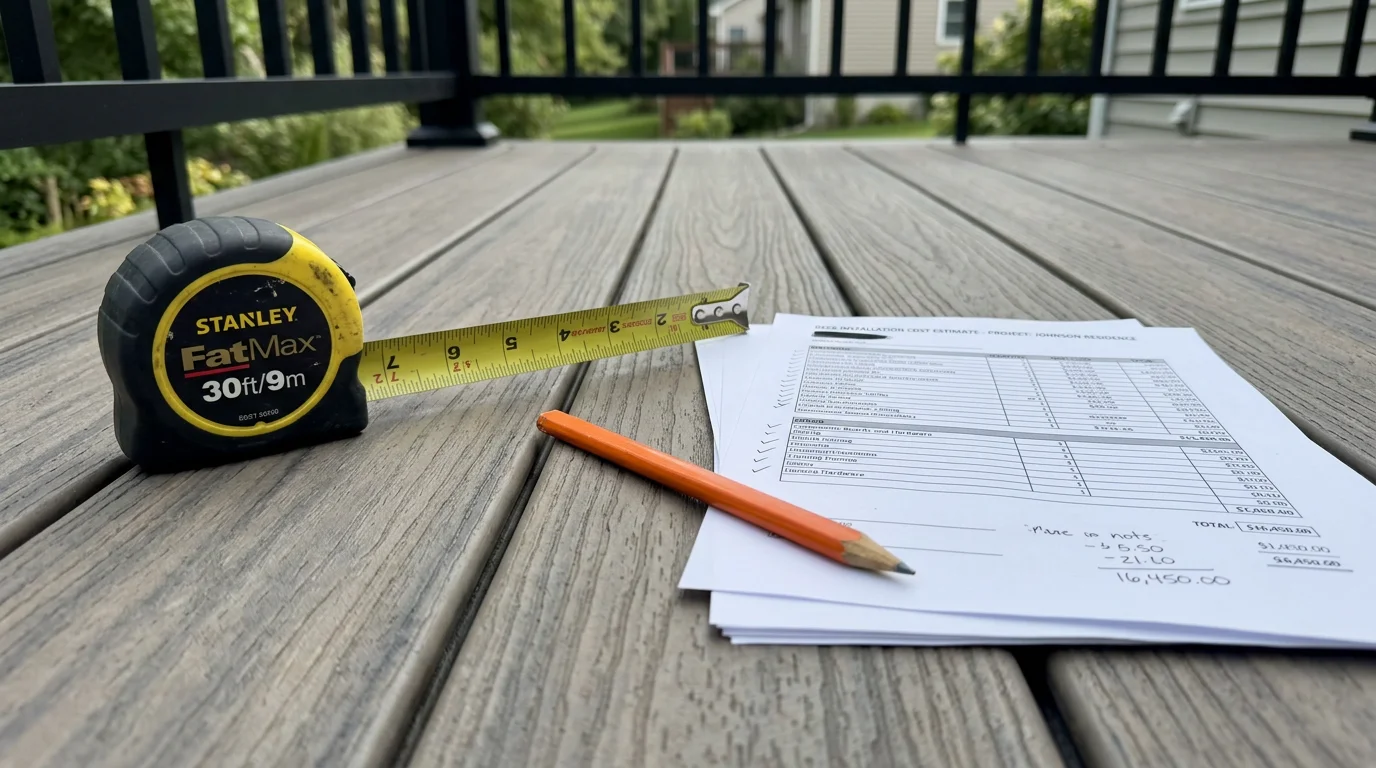
Your deck boards are cracked, splintered, or sagging. You know they need replacing, but you're not sure if you need to replace a few damaged boards or the entire surface—or what either option will cost.
Here's what deck board replacement actually costs in Ontario, when you need it, and how to decide between repairing individual boards versus resurfacing the entire deck.
Signs Your Deck Boards Need Replacement
Splintering and cracking are the most obvious signs. If you can't walk barefoot on your deck without risking splinters, or if boards are cracking along the grain, replacement is overdue.
🏗️ Planning a deck project?
Get a free manual project review, or visualize your dream deck with AI before requesting quotes.
Rot and soft spots mean structural failure. Press down on questionable boards—if they feel spongy or you can push a screwdriver into the wood easily, that's rot. Replace immediately before someone gets hurt.
Warping and cupping create trip hazards. Boards that have cupped (edges higher than center) or crowned (center higher than edges) won't flatten out. If the warp is severe enough to catch your foot, replace those boards.
Loose or missing fasteners indicate board movement. If screws or nails are pulling out, popping up, or missing entirely, the boards are moving with foot traffic. This accelerates wear and creates dangerous protrusions.
Excessive fading or weathering on pressure-treated or cedar decks suggests the protective coating has failed. Once the wood is exposed, it absorbs moisture and deteriorates rapidly. If staining no longer penetrates or color is severely uneven, the surface layer is compromised.
Mold and mildew buildup that returns quickly after cleaning indicates moisture retention. Ontario's freeze-thaw cycles worsen this—trapped moisture expands when frozen, splitting wood fibers from the inside.
Sagging between joists means boards have lost structural integrity. If boards deflect noticeably when you step on them (beyond normal flex), they're no longer stiff enough to be safe.
Deck Board Replacement Cost in Ontario (2026)
Materials Only
Pressure-treated boards run $3-6 per linear foot for 5/4x6 decking. A 12x16 deck (192 sqft, roughly 140 linear feet at 16" spacing) needs about $420-840 in materials.
Cedar boards cost $8-14 per linear foot. Same deck: $1,120-1,960 in materials.
Composite boards range $6-12 per linear foot depending on brand. Budget $840-1,680 for that 192 sqft deck. Premium brands like Trex can push $10-15 per linear foot.
Hidden fasteners add $0.50-1.50 per linear foot for composite or grooved wood boards. For 140 linear feet, that's another $70-210.
Joist tape or membrane costs $0.30-0.60 per linear foot of joist. If you're replacing all boards, protecting joists while they're exposed is smart—budget $50-120 for tape. See our guide on whether joist tape is worth it.
Labour Costs
Removal and disposal runs $2-4 per sqft. Removing old boards, pulling fasteners, and hauling debris costs $384-768 for a 192 sqft deck. Disposal fees vary—see deck demolition costs in KWC.
Installation labour is $8-15 per sqft for straightforward replacements. Same deck: $1,536-2,880. Complex patterns, hidden fasteners, or difficult access increase this.
Frame repairs often surface during board replacement. If joists are damaged, budget $15-25 per linear foot for sistering or replacing joists. Ledger board issues can add $500-1,500—check for ledger board rot warning signs.
Total Installed Costs
| Material | 192 sqft Deck (Materials + Labour) | Per Sqft Installed |
|----------|-------------------------------------|-------------------|
| Pressure-treated | $2,340-4,488 | $12-23 |
| Cedar | $3,656-6,600 | $19-34 |
| Composite (mid-range) | $3,456-6,408 | $18-33 |
These assume frame is sound. Add 20-40% if joists or substructure need work. For context on understanding deck costs in Ontario, our complete guide covers new builds, resurfacing, and everything in between.
Partial Replacement vs. Full Resurfacing
Replace individual boards when damage is isolated. If you have 5-10 damaged boards on a 40-board deck, spot replacement makes sense. Cost: $150-500 for materials and a few hours of labour.
Challenges with partial replacement:
- Matching old boards is difficult. New pressure-treated lumber is greener and wetter than aged wood. Cedar and composite fade, so new boards stand out.
- Hidden damage often exists. Once you start pulling boards, you'll likely find more rot or frame issues underneath.
- Fastener patterns matter. If original boards used nails and you're using screws, attachment points won't line up with joist centers.
Full resurfacing makes sense when:
- More than 30% of boards are damaged or questionable
- You're changing materials (wood to composite, or vice versa)
- The deck is 15+ years old and boards are generally weathered
- You want consistent appearance and warranties
Resurfacing lets you:
- Inspect and repair the entire frame
- Apply joist tape before new boards go down
- Switch to hidden fasteners for a cleaner look
- Adjust board spacing for proper drainage (see deck board spacing guide)
When to Replace vs. Rebuild the Entire Deck
If your frame is compromised, replacing just the boards is throwing money away.
Inspect the frame before committing to board replacement:
- Joists: Look for cracks, rot, or excessive sag. Joists should be straight and firm. Refer to joist span tables to confirm yours aren't undersized.
- Ledger board: Check where it attaches to your house. Water damage here is common and dangerous. Proper ledger flashing prevents this.
- Posts and footings: Rot at ground level or cracked concrete means structural issues. In Ontario, footings must go 48 inches deep minimum to avoid frost heave.
- Beams: Support beams shouldn't have cracks, twists, or soft spots.
Consider a full rebuild if:
- Frame damage is widespread (more than 25% of joists or beams)
- The deck is 20+ years old and was built before current code standards
- You want to change the deck size, shape, or height
- Foundation issues exist (settling, heaving, or inadequate frost protection)
Rebuild vs. resurface cost comparison for a 192 sqft deck:
- Resurface (boards only, sound frame): $2,340-6,600 installed
- Full rebuild (tear down, new structure and surface): $8,640-18,240 installed (using $45-95/sqft total deck costs)
Our article on deck rebuild vs. resurface walks through this decision in detail.
Material Choices for Replacement Boards
Pressure-Treated Lumber
Pros: Cheapest option, widely available, can be stained or painted.
Cons: Requires annual maintenance (sealing/staining), prone to warping and splintering, shorter lifespan (10-15 years with good maintenance).
Best for: Budget-conscious homeowners willing to maintain the deck, or if you plan to sell within 5-10 years.
Ontario considerations: Freeze-thaw cycles are tough on PT lumber. Standing water accelerates rot. Seal within 6 months of installation and reseal every 2-3 years. See pressure-treated maintenance schedules.
Cedar
Pros: Naturally rot-resistant, beautiful grain, doesn't get as hot as composite in sun.
Cons: Expensive, fades to grey without maintenance, still requires sealing every 2-3 years.
Best for: Homeowners who want a natural wood look and are committed to maintenance.
Ontario considerations: Cedar handles freeze-thaw better than PT lumber but still needs sealing to prevent moisture absorption. Expect 15-20 year lifespan with proper care.
Composite Decking
Pros: Minimal maintenance, 25-50 year lifespan, won't rot or splinter, wide color range, often backed by strong warranties.
Cons: Higher upfront cost, can get hot in direct sun, scratches show more on darker colors, not all brands handle freeze-thaw equally well.
Best for: Long-term homeowners who want low-maintenance, high-durability decking.
Ontario considerations: Choose composite rated for freeze-thaw. Most major brands (Trex, TimberTech, Fiberon) perform well in Canadian climates, but verify warranties cover winter performance. See our complete composite decking guide for brand comparisons.
Hidden fasteners: If you're replacing with composite or tongue-and-groove cedar, budget for hidden fastener clips. They cost more but eliminate exposed screw heads and create cleaner sight lines.
Do You Need a Permit to Replace Deck Boards?
Generally no, if you're only replacing boards on an existing deck. Ontario building codes treat this as maintenance, not new construction.
You DO need a permit if:
- You're replacing or modifying the frame, joists, or support structure
- You're changing the deck footprint or height
- You're adding a roof, pergola, or enclosed structure
- Original deck was unpermitted (this surfaces when inspectors see work in progress)
Municipal differences:
- Kitchener: Board replacement is maintenance. Frame work requires permits. See our Kitchener permit guide.
- Waterloo: Same approach. Deck resurfacing is exempt; structural changes aren't. Waterloo permit rules.
- Cambridge: Consistent with KWC—surface work is exempt, structure isn't. Cambridge permit process.
When in doubt, call your municipal building department. A 5-minute phone call prevents costly surprises.
How Long Does Deck Board Replacement Take?
Partial replacement (5-15 boards): Half day to full day for a DIYer. Pro crew: 2-4 hours.
Full resurfacing (all boards, sound frame): 2-4 days for a 192 sqft deck, depending on crew size and complexity. Removal takes 1 day, installation 1-3 days.
Full resurfacing with frame repairs: Add 1-3 days for joist sistering, ledger work, or post replacements.
Weather impacts timelines. Ontario's spring rain and winter freeze mean limited work windows. Best time to replace boards is late spring through early fall. See our guide on best time to build a deck in Ontario.
DIY vs. Hiring a Pro
DIY Deck Board Replacement
Doable if:
- You're replacing fewer than 20 boards
- Frame is sound and doesn't need repairs
- You have basic carpentry skills and tools (circular saw, drill, level, pry bar)
- Deck is accessible (not 10 feet off ground)
Tools needed: Circular saw, drill/driver, tape measure, speed square, pry bar, hammer, chalk line, safety glasses.
Time investment: Plan a full weekend for a 192 sqft deck resurface. Removal is faster than installation.
Risks: Improper fastener placement, incorrect board spacing (Ontario's temperature swings require specific gaps), missed frame damage, uneven surface.
Hiring a Contractor
Worth it when:
- Replacing most or all boards
- Frame repairs are likely
- You want warranties on labour and materials
- Deck is elevated or complex (multiple levels, angles, stairs)
What to ask contractors:
- Are you insured and WSIB-registered?
- Will you inspect the frame before quoting?
- What's included (removal, disposal, frame repairs, joist tape)?
- What warranty do you offer on labour?
- Can you provide references from recent resurfacing projects?
Use our deck quote checklist and contract guide to vet contractors properly.
Get 3 quotes. Prices vary widely in KWC. Our quote request template speeds up the process.
Extending the Life of Replacement Boards
Seal or stain pressure-treated and cedar boards within 6 months of installation. Ontario's UV exposure and moisture cycles break down wood fast. Reseal every 2-3 years.
Use joist tape when replacing boards. It costs $50-120 for most residential decks and extends joist life by preventing water rot where boards meet joists.
Space boards correctly. Pressure-treated needs 1/8"-1/4" gaps, composite needs 1/4"-3/8" depending on temperature during installation. Tight boards trap water; excessive gaps collect debris. See board spacing guide.
Install boards bark-side up (growth rings curving down) if using PT lumber. This minimizes cupping as boards dry.
Clean annually. Sweep debris, clear gaps between boards, wash with deck cleaner. Mold and mildew hold moisture against wood. Winter deck care is especially important in Ontario.
Inspect joists while boards are off. If you're doing a full resurface, check every joist for damage. Replacing a $40 joist now is cheaper than another full resurface in 5 years because rot spread.
Common Questions
How much does it cost to replace 10 deck boards in Ontario?
$150-500 depending on material and labour. Pressure-treated runs $30-60 in materials + $120-300 labour. Cedar or composite doubles material costs. DIY saves the labour if you're handy.
Can I replace deck boards without removing railings?
Usually yes, if boards run perpendicular to railings and posts. You'll cut boards to fit around posts. If boards run parallel or railings are attached to rim joists, you may need to temporarily remove railing sections. This adds 1-2 hours of labour per section.
Should I replace my deck boards with the same material?
Not necessarily. If your frame is sound, you can switch from wood to composite or vice versa. Switching to composite increases upfront cost by 40-60% but eliminates future maintenance and extends deck life. Switching from composite to wood is rare but doable if you want a natural look and are willing to maintain it.
How do I match old pressure-treated boards?
You can't perfectly. New PT lumber is greener and wetter. It will grey and shrink as it ages. If you're replacing a few boards, stain the entire deck once new boards have dried (6-12 months). This evens out color differences. Alternatively, accelerate weathering on new boards by leaving them unstained in the sun for a season before installation.
Do composite deck boards fade in Ontario's sun?
Yes, but minimally. Quality brands like Trex, TimberTech, and Fiberon fade 10-15% in the first 12-18 months, then stabilize. Early-generation composites faded more. Current cap-stock composites (plastic shell over composite core) resist fading better. Warranties typically cover excessive fading. Darker colors show more fading than lighter ones. See our best composite decking for Canada roundup.
Can I install new deck boards over old ones?
Technically yes, but it's almost never a good idea. You're hiding frame damage, trapping moisture between layers (accelerating rot), raising the deck surface (creating trip hazards at doorways and stairs), and adding weight to potentially compromised joists. Only viable if old boards are completely sound and you're adding a thin overlay system specifically designed for this—rare in residential applications.
Related guides (to decide repair vs rebuild)
If you’re getting quotes or deciding scope, these guides remove the biggest unknowns:
- Resurface vs rebuild (KWC)
- Ontario deck cost calculator
- Deck quote line items (Ontario)
- Cedar vs composite decking (Ontario)
- Pressure-treated deck lifespan (Ontario)
🎨 Not sure which material to pick?
Upload a photo of your backyard and see exactly how Trex, TimberTech, or cedar would look — free and instant.
Want a fast, comparable quote from 3 deck builders?
- Get quotes here: Get a deck quote
Upload a backyard photo and preview real decking materials with AI — free, instant, no sign-up.
Permits, costs, material comparisons, and questions to ask before requesting quotes — delivered to your inbox.